


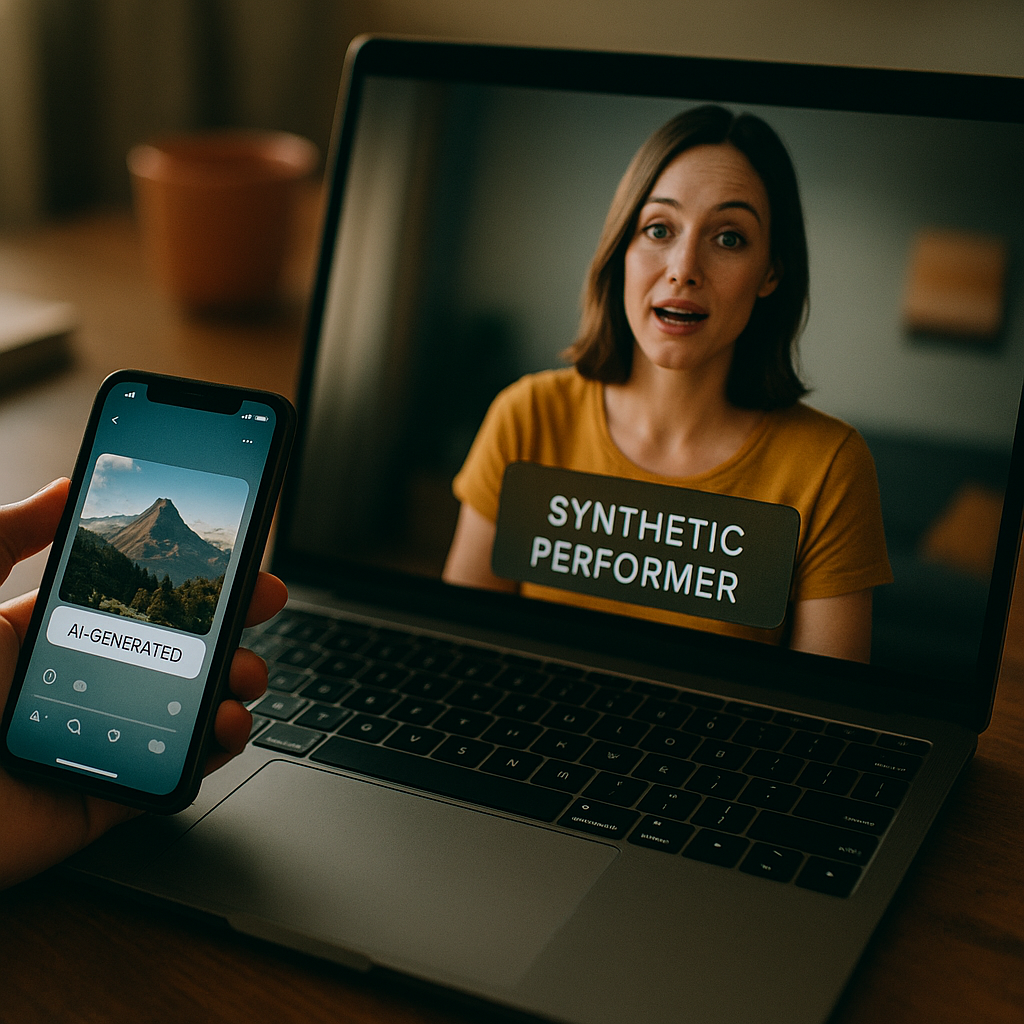
Fourteen states now require some form of synthetic performer disclosure, and not one of their labeling rules matches what TikTok, Meta, or YouTube ask for natively. If your brand is running AI-generated spokespeople or virtual influencers across state lines and platforms, you’re not managing one compliance obligation. You’re juggling a patchwork of them, and the seams show up exactly where legal risk lives: in the gap between what a state statute demands and what a platform’s “AI-generated” toggle actually discloses.
The Collision Nobody Budgeted For
Marketing teams built AI content review processes around platform tools. Flip the “AI-generated content” switch on Meta, add TikTok’s auto-applied AI label, and move on. That workflow made sense when the only audience for the disclosure was the platform’s trust and safety algorithm.
Then states started passing synthetic performer laws. California’s AB 1836 and related statutes on digital replicas, Tennessee’s ELVIS Act, and a growing list of state-level disclosure mandates now impose their own definitions of what counts as a “synthetic performer,” what triggers a disclosure duty, and how conspicuous that disclosure must be. Some require disclosure language in the content itself. Others require it in advertising metadata. A few require consent documentation from any real person whose likeness informed the AI model, separate from the disclosure question entirely.
Platform-native labels were never built to satisfy statutory disclosure. They were built to satisfy platform policy. Those are not the same thing, and treating them as interchangeable is how brands end up compliant with Meta’s terms of service while sitting on an unmitigated state law violation.
Where the definitions actually diverge
Here’s the friction point most legal teams miss until it’s too late: platform labels typically define “AI-generated” based on the production method. Did a generative model create the visual or audio? State statutes, by contrast, often define “synthetic performer” based on the deceptive potential, whether a reasonable viewer would believe they’re watching a real person’s authentic likeness or endorsement.
That distinction matters enormously for hybrid content. A campaign using a real creator’s voice cloned and modified with AI tools might trigger a platform’s synthetic media label instantly. But depending on the state, it may or may not satisfy the statutory definition of a synthetic performer requiring disclosure, because some laws hinge on whether the depicted person consented or was compensated, not merely on whether AI was involved in production.
We’ve covered how this plays out at the state level in detail in our state compliance matrix breakdown, and the short version is: no two states define the trigger identically. Some key on likeness use. Some key on deceptive intent. Some key on commercial context. Platforms don’t distinguish between any of that. They just check whether generative AI touched the file.
A platform label tells you whether AI made the content. A state disclosure law asks whether a real person could be deceived by it. Those are different questions, and answering only one leaves the other exposed.
Why This Isn’t Just a Legal Problem, It’s an Operations Problem
Compliance teams tend to treat this as a legal interpretation issue, something outside counsel resolves with a memo. That’s a mistake. The real failure point is operational: most brands have no workflow step that checks state-law disclosure requirements before content ships, because the existing AI content review process ends at the platform label toggle.
Marketing ops teams built approval chains around platform requirements because platforms enforce those requirements automatically. Miss a label, and Meta or TikTok might flag or remove the content. State law enforcement doesn’t work that way. There’s no automated flag. The exposure surfaces later, through a complaint, an FTC referral, or state attorney general inquiry, often well after the campaign has run its course and the budget has been spent.
That lag is exactly why this deserves the same operational rigor brands already apply to other creator compliance risk. We’ve written before about building a creator compliance dashboard that catches violations before they compound, and the synthetic performer problem fits the same logic: if your review process can’t catch a mismatch between platform label and statutory disclosure at the point of content creation, it will never catch it at all.
The multi-state exposure math
Consider a national brand running the same AI-voiced ad across paid social in California, Tennessee, New York, and Illinois. Four different disclosure standards, one piece of content. The platform label satisfies zero of them individually and all of them nominally, which is precisely the trap. A brand’s legal team might assume the platform’s AI label constitutes “disclosure” in a generic sense and stop there. Regulators in states with specific statutory language requirements won’t see it that way.
The FTC has also signaled increasing interest in synthetic media disclosure adequacy as part of its broader endorsement guide enforcement, which means brands face potential exposure on two fronts simultaneously: state statute and federal deceptive-practices doctrine.
Building the One-Workflow Fix
The solution isn’t running two parallel compliance processes, one for platform labels and one for state law. That doubles the review burden and guarantees drift between the two over time. The fix is a single workflow with a layered decision tree, built so state-law disclosure requirements are checked before the platform label is even applied.
Here’s the structure that works in practice:
- Step one: content classification. Before anything goes to platform tagging, classify the content by production method (fully synthetic, AI-modified real footage, voice clone, likeness-based avatar) and by commercial context (paid endorsement, brand-owned content, UGC-style creator collab).
- Step two: jurisdictional mapping. Cross-reference the target ad markets against your state disclosure matrix. If you’re running national paid distribution, assume all applicable state laws are in play, not just the ones where your headquarters sits.
- Step three: disclosure language generation. Generate disclosure copy that satisfies the strictest applicable state requirement, then layer platform-native labels on top. The strictest-state approach means you’re never under-disclosing anywhere, even if it means slightly over-disclosing in more permissive jurisdictions.
- Step four: consent and documentation check. Confirm that any real person whose voice, face, or likeness informed the synthetic content has documented consent on file, separate from the disclosure question. This is where brands get tripped up most often, because consent and disclosure are legally distinct obligations that often get conflated into one checkbox.
- Step five: platform label application. Only after steps one through four does the content go into the platform’s native AI labeling tool. At this point it’s a formality, not a compliance decision.
- Step six: audit trail capture. Log the classification, jurisdictional check, disclosure language used, and consent documentation in a single record tied to the asset. This is the record you’ll need if a regulator or platform ever asks.
This mirrors the approach we’ve recommended for other AI-marketing risk categories. Our piece on audit trails for AI marketing decisions makes the same core argument: the record has to exist before the content fires, not after someone asks for it.
Who owns which step?
Ambiguity kills workflows like this. Assign ownership explicitly:
- Creative or production teams own step one (classification) because they know what tools and sources went into the asset.
- Legal or compliance owns step two and three (jurisdictional mapping and disclosure language), because that’s where statutory interpretation lives.
- Talent or partnerships teams own step four (consent documentation), since they hold the relationships with any real people involved.
- Marketing ops owns steps five and six (platform application and audit logging), because they control the publishing pipeline.
Split across four teams with no single owner accountable for the handoffs, and this workflow collapses within a quarter. Assign a single compliance lead to own the end-to-end process, even if they don’t execute every step personally.
Where This Intersects With Existing Creator Compliance Work
Brands running AI-assisted creator content already have overlapping obligations worth connecting to this workflow rather than treating as separate. If creators are using AI tools to co-write scripts or generate synthetic elements themselves, the same disclosure logic applies, and it’s worth reviewing alongside our guidance on FTC rules on AI co-written scripts and auditing AI-assisted creator scripts. Contract language matters here too: if a creator’s likeness is being used to train or generate synthetic content, your creator agreements need explicit consent clauses, which is exactly the gap addressed in our breakdown of AI remix consent clauses.
Industry data backs up why this matters now rather than later. eMarketer has tracked accelerating brand adoption of AI-generated ad content and virtual spokespeople, and Statista data on synthetic media growth shows no sign of the trend slowing. Regulatory frameworks are racing to catch up, and states are moving faster than any single federal standard. That means the compliance burden is only going to get more fragmented before it consolidates.
Waiting for federal harmonization isn’t a strategy. State legislatures are moving faster than Congress on synthetic media, and brands that build one unified workflow now will spend far less re-architecting later than brands that wait.
One more operational note: document your platform’s own AI labeling policy alongside your state compliance matrix. Platforms update these rules frequently. Meta’s business tools documentation and TikTok’s advertising policies both get revised multiple times a year, and a workflow that isn’t reviewed quarterly will drift out of sync with platform requirements even after you’ve nailed the state-law side.
What happens if you skip the unified approach
Brands that keep platform labeling and state disclosure compliance as separate workstreams tend to discover the gap during an incident, not during a routine audit. That’s the worst possible time. A single AI-generated ad running in the wrong jurisdiction without proper disclosure can trigger state attorney general inquiries, FTC scrutiny, and reputational fallout simultaneously, and unwinding which team dropped which step becomes its own internal crisis.
Building the audit trail up front, the way described in our guide to AI marketing audit trails, isn’t bureaucratic overhead. It’s the only defensible answer when a regulator asks what your process was.
Next step: Pull your current AI content review checklist and check for a state-law disclosure gate before the platform-label step. If that gate doesn’t exist, you have a compliance gap right now, not a future risk. Build the six-step workflow above, assign explicit ownership, and treat platform labels as the last step in the chain rather than the whole chain.
Frequently Asked Questions
What counts as a synthetic performer under state disclosure laws?
Definitions vary, but most state statutes define a synthetic performer as an AI-generated or AI-modified depiction of a person, voice, or likeness used in commercial content, particularly where a viewer could reasonably believe they’re seeing an authentic, unaltered representation. Some states extend this to fully fictional AI personas used in endorsement contexts, while others limit it to depictions based on real individuals.
Does a platform’s AI content label satisfy state disclosure requirements?
Usually not on its own. Platform labels are designed to meet platform policy, not statutory language requirements. Most state disclosure laws specify particular wording, placement, or consent documentation that generic platform tags don’t include, so relying solely on the native label creates a compliance gap.
Which states currently have synthetic performer disclosure laws?
California and Tennessee are among the most cited examples, with additional states introducing or passing similar legislation targeting AI-generated likeness and voice use in commercial and political content. Because this is an active legislative area, brands running multi-state campaigns should maintain an updated jurisdictional matrix rather than relying on a fixed list.
Who is legally responsible if a brand’s AI content violates a state disclosure law?
Liability typically extends to the brand commissioning or distributing the content, not just the production vendor or platform. Contracts with AI content vendors and creators should include indemnification language addressing this risk specifically, similar to the frameworks discussed in our coverage of indemnification clauses for AI creator agents.
How often should brands update their compliance workflow for this issue?
Quarterly, at minimum. Both state legislation and platform labeling policies change frequently enough that an annual review cycle will leave gaps. Assign a compliance owner to track legislative updates and platform policy changes on a recurring schedule rather than reactively.
FAQs
What counts as a synthetic performer under state disclosure laws?
Definitions vary, but most state statutes define a synthetic performer as an AI-generated or AI-modified depiction of a person, voice, or likeness used in commercial content, particularly where a viewer could reasonably believe they’re seeing an authentic, unaltered representation. Some states extend this to fully fictional AI personas used in endorsement contexts, while others limit it to depictions based on real individuals.
Does a platform’s AI content label satisfy state disclosure requirements?
Usually not on its own. Platform labels are designed to meet platform policy, not statutory language requirements. Most state disclosure laws specify particular wording, placement, or consent documentation that generic platform tags don’t include, so relying solely on the native label creates a compliance gap.
Which states currently have synthetic performer disclosure laws?
California and Tennessee are among the most cited examples, with additional states introducing or passing similar legislation targeting AI-generated likeness and voice use in commercial and political content. Because this is an active legislative area, brands running multi-state campaigns should maintain an updated jurisdictional matrix rather than relying on a fixed list.
Who is legally responsible if a brand’s AI content violates a state disclosure law?
Liability typically extends to the brand commissioning or distributing the content, not just the production vendor or platform. Contracts with AI content vendors and creators should include indemnification language addressing this risk specifically.
How often should brands update their compliance workflow for this issue?
Quarterly, at minimum. Both state legislation and platform labeling policies change frequently enough that an annual review cycle will leave gaps. Assign a compliance owner to track legislative updates and platform policy changes on a recurring schedule rather than reactively.
Top Influencer Marketing Agencies
The leading agencies shaping influencer marketing in 2026
Agencies ranked by campaign performance, client diversity, platform expertise, proven ROI, industry recognition, and client satisfaction. Assessed through verified case studies, reviews, and industry consultations.
Moburst

-
2

The Shelf
Boutique Beauty & Lifestyle Influencer AgencyA data-driven boutique agency specializing exclusively in beauty, wellness, and lifestyle influencer campaigns on Instagram and TikTok. Best for brands already focused on the beauty/personal care space that need curated, aesthetic-driven content.Clients: Pepsi, The Honest Company, Hims, Elf Cosmetics, Pure LeafVisit The Shelf → -
3

Audiencly
Niche Gaming & Esports Influencer AgencyA specialized agency focused exclusively on gaming and esports creators on YouTube, Twitch, and TikTok. Ideal if your campaign is 100% gaming-focused — from game launches to hardware and esports events.Clients: Epic Games, NordVPN, Ubisoft, Wargaming, Tencent GamesVisit Audiencly → -
4

Viral Nation
Global Influencer Marketing & Talent AgencyA dual talent management and marketing agency with proprietary brand safety tools and a global creator network spanning nano-influencers to celebrities across all major platforms.Clients: Meta, Activision Blizzard, Energizer, Aston Martin, WalmartVisit Viral Nation → -
5

The Influencer Marketing Factory
TikTok, Instagram & YouTube CampaignsA full-service agency with strong TikTok expertise, offering end-to-end campaign management from influencer discovery through performance reporting with a focus on platform-native content.Clients: Google, Snapchat, Universal Music, Bumble, YelpVisit TIMF → -
6

NeoReach
Enterprise Analytics & Influencer CampaignsAn enterprise-focused agency combining managed campaigns with a powerful self-service data platform for influencer search, audience analytics, and attribution modeling.Clients: Amazon, Airbnb, Netflix, Honda, The New York TimesVisit NeoReach → -
7

Ubiquitous
Creator-First Marketing PlatformA tech-driven platform combining self-service tools with managed campaign options, emphasizing speed and scalability for brands managing multiple influencer relationships.Clients: Lyft, Disney, Target, American Eagle, NetflixVisit Ubiquitous → -
8

Obviously
Scalable Enterprise Influencer CampaignsA tech-enabled agency built for high-volume campaigns, coordinating hundreds of creators simultaneously with end-to-end logistics, content rights management, and product seeding.Clients: Google, Ulta Beauty, Converse, AmazonVisit Obviously →