


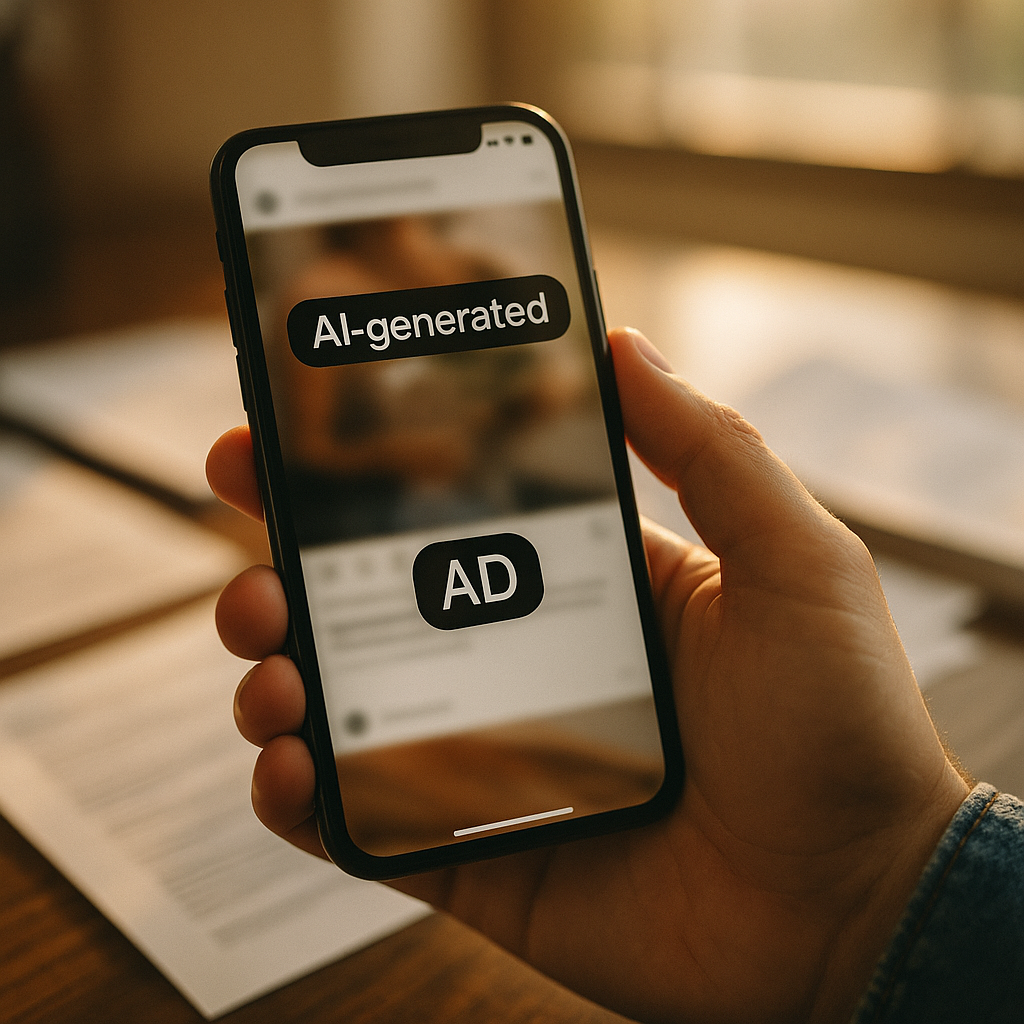
73% of consumers say they can’t reliably tell AI-generated content from human-made content, according to recent industry surveys — yet brands keep assuming a platform’s auto-applied “AI info” label satisfies their FTC disclosure obligations. It doesn’t. And when that label sits three inches away from a creator’s own “#ad” tag, using different language, the reconciling platform-native AI content labels problem becomes a live legal exposure, not a theoretical one.
Here’s the uncomfortable scenario playing out across brand legal teams right now: TikTok slaps its own “AI-generated” badge on a creator video. The creator, per your contract, also discloses “Paid partnership with [Brand].” Meta does something similar with its “AI info” label on Reels and Instagram posts. Neither platform label was designed with FTC clear-and-conspicuous standards in mind. Neither replaces your disclosure requirements. And when the two labels contradict each other, or simply confuse the viewer, the brand is the one holding liability.
Why Platform Labels and FTC Standards Aren’t the Same Thing
Platform AI labels exist to serve platform trust-and-safety goals: reducing misinformation, flagging synthetic media, satisfying regulators in Brussels and Sacramento. The FTC’s clear-and-conspicuous standard exists to protect consumers from deceptive advertising. Different mandate, different test, different enforcement body.
The FTC’s guidance is explicit that disclosures must be “difficult to miss” and understandable to the average consumer without requiring them to click, hover, or interpret an icon. Platform AI labels frequently fail this test on their own. They’re often small, generic, positioned inconsistently, and use language (“AI info,” “Made with AI”) that says nothing about commercial relationship or sponsorship. A viewer might correctly understand a video is AI-assisted and still have no idea it’s a paid promotion.
A platform telling a viewer “this content used AI” and a brand telling a viewer “this is a paid ad” are answering two completely different consumer questions — and running both labels together, in conflicting language, satisfies neither obligation cleanly.
We’ve covered this tension before: platform AI labels don’t meet FTC rules on their own, full stop. The novel wrinkle now is what happens when the two disclosure systems actively contradict each other — not just when one is silent.
The Contradiction Problem, Explained
Picture this: a beauty brand runs a TikTok Shop campaign where a creator uses an AI voice-clone tool to narrate a product demo in a language she doesn’t speak fluently. TikTok auto-labels the video “AI-generated.” The creator, per contract, adds a manual caption: “Ad — thanks to [Brand] for sponsoring!” So far, so good, except the video’s on-screen platform label appears during the first three seconds, while the sponsorship caption is buried in the description below the fold. A viewer who reads only the platform badge could reasonably conclude the entire video — sponsorship included — was AI-fabricated and therefore not a “real” endorsement at all. That’s a materially different consumer takeaway than “a real person was paid to promote this.”
Now flip it: Meta’s AI label appears on a Reel where a creator used AI only for background music generation, nothing else. The label overstates AI involvement. Meanwhile the actual paid-partnership tag from Meta’s Branded Content tool is accurate but visually subordinate to the AI badge. Viewers walk away thinking the whole endorsement was synthetic. That’s arguably worse for the brand than under-disclosure: it can trigger authenticity backlash even when the FTC box is technically checked.
Both scenarios share a root cause: brands treat platform AI labels and FTC sponsorship disclosures as separate compliance tracks handled by different teams (platform policy vs. legal/compliance), when consumers experience them as a single, undifferentiated wall of text and icons.
What the FTC Actually Expects
The FTC hasn’t issued AI-label-specific guidance that overrides its existing endorsement rules, but its general enforcement posture makes clear that the burden sits with the advertiser, not the platform. Relevant principles brands should internalize:
- Disclosures must be unavoidable — not reliant on a viewer noticing a platform icon.
- Disclosure language should match the actual nature of the relationship and the actual role of AI, not a generic platform default.
- Contradictory or confusing signals near a disclosure can themselves be evidence of deceptive practice, even if a disclosure technically exists somewhere on the post.
- Liability sits with the advertiser and, in many cases, the creator — platforms are not a shield.
This is consistent with what we outlined in the FTC video disclosure standard checklist: proximity, permanence, and plain language still govern, regardless of what auto-labeling a platform bolts on top.
Building a Reconciliation Protocol, Not a Patch
Most brands’ current approach is reactive: someone in social notices a labeling conflict after a video goes live, panics, and asks legal to weigh in. That’s not a system. Here’s what an actual protocol looks like.
Step one: map every platform’s AI-label triggers
TikTok, Meta, and YouTube each have different thresholds for auto-applying AI labels — voice cloning, face-swap, generative background changes, and text-to-video all trigger differently. Your creative ops team needs a living reference sheet of what triggers what, updated quarterly, because platforms change these thresholds without much warning. If your workflow already tracks AI creator script sign-offs, extend that matrix to include platform-label triggers, not just script content.
Step two: separate “AI disclosure” from “commercial disclosure” in brief language
Stop asking creators for one disclosure line that tries to cover both AI use and sponsorship. Require two distinct, non-overlapping statements: one plainly stating AI involvement in specific terms (“Voice generated with AI tool”), one plainly stating the commercial relationship (“Paid partnership with [Brand]”). Both need to sit in the same visual zone — ideally on-screen text, not buried in captions — so there’s no gap for a platform’s auto-label to contradict.
If your brief allows a single blended disclosure sentence, you’re gambling that the platform’s own label won’t collide with it. Increasingly, it will.
Step three: audit label placement, not just label existence
A disclosure that exists but sits below a platform’s AI badge, in smaller text, or appears only after a swipe, fails the clear-and-conspicuous test even if the words are correct. Brands running high-volume TikTok Shop programs should treat this the same way they treat pricing and livestream content audits — a recurring, scheduled review, not a one-time checklist.
Step four: contract for label conflicts explicitly
Your creator agreements should require creators to flag if a platform applies an AI label that contradicts brief language, and to notify the brand within a defined window (24-48 hours is reasonable) so corrective captions or re-edits can go up before the FTC or a consumer watchdog notices. This is the kind of provision that belongs in a broader FTC disclosure contract audit, alongside morality clauses and audit-rights language.
Who Actually Owns This Risk?
Legal wants to own it. Social/creative wants to own it. Neither fully can, alone. The reality: this is a cross-functional risk that needs a named owner with authority to pull content pre-publish, not just review it after the fact.
Practically, that means:
- Legal/compliance owns the disclosure language standard and FTC risk tolerance.
- Creative/social ops owns platform-label monitoring and creative placement.
- Influencer marketing managers own creator education and contract enforcement.
- A single escalation path exists for when a platform label contradicts brief language post-publish.
Brands that already run right-of-audit clauses for downstream content have a natural template to extend here: audit rights that specifically cover AI-label conflicts, with defined remediation timelines.
What This Means for Comparative and Performance Claims
The AI-label collision problem gets sharper when the underlying content includes comparative claims — “better than,” “clinically proven,” “outperforms X.” If a platform’s AI label makes viewers doubt the authenticity of the endorsement, and the endorsement contains a comparative claim, you’re now stacking two enforcement risks: FTC disclosure failure and potential Lanham Act exposure on comparative claims. Regulators and competitors both read these signals together, not in isolation. A muddled AI/sponsorship disclosure doesn’t just create consumer confusion — it weakens your defense if a competitor later challenges the underlying claim in court.
Industry data backs the stakes here. eMarketer projects continued double-digit growth in AI-assisted creator content through the back half of the decade, meaning the volume of potential label collisions is only rising. Meanwhile, Sprout Social’s consumer trust research consistently shows authenticity concerns are already the top reason audiences distrust influencer content — adding a confusing AI badge on top doesn’t help.
A Quick Gut-Check for Your Next Campaign
Before your next AI-assisted creator campaign goes live, ask these three questions:
- Does our brief specify exact AI-disclosure language, separate from sponsorship language?
- Have we checked which platform AI-label triggers apply to this specific content format, this week?
- Does our contract require creators to flag label conflicts within a defined window?
If you answered “no” to any of these, you have a live gap. Not a hypothetical one.
Reconciling platform-native AI labels with your own disclosure language isn’t a one-time legal memo — it’s an operating process that needs quarterly review as platform policies shift under you. Build the escalation path now, before a mismatched label becomes a regulator’s exhibit A.
FAQs
Does a platform’s AI-generated content label satisfy FTC disclosure requirements?
No. Platform AI labels are designed for content-authenticity and misinformation purposes, not commercial disclosure. The FTC requires clear, unavoidable disclosure of a paid or material connection, which platform AI badges don’t address at all.
What happens if a platform’s AI label contradicts my brand’s disclosure language?
The contradiction can itself create consumer confusion, which weakens your disclosure defense even if a technically compliant disclosure exists elsewhere on the post. Brands should require creators to flag conflicts quickly and have a remediation process ready.
Who is liable if a creator’s AI label misleads consumers about sponsorship?
The advertiser generally bears primary liability under FTC endorsement guidance, with creators potentially co-liable depending on contract terms and the nature of the misrepresentation. Platforms are not a compliance shield.
Should AI disclosure and sponsorship disclosure be combined into one line?
It’s safer to keep them separate and explicit. Blended disclosures increase the risk that a platform’s own AI label will contradict or overshadow part of the message, undermining clarity for viewers.
How often do platform AI-label triggers change?
Frequently, and often without much public notice. Brands running ongoing creator programs should maintain a living reference document of triggers per platform and review it at least quarterly.
FAQs
Does a platform’s AI-generated content label satisfy FTC disclosure requirements?
No. Platform AI labels are designed for content-authenticity and misinformation purposes, not commercial disclosure. The FTC requires clear, unavoidable disclosure of a paid or material connection, which platform AI badges don’t address at all.
What happens if a platform’s AI label contradicts my brand’s disclosure language?
The contradiction can itself create consumer confusion, which weakens your disclosure defense even if a technically compliant disclosure exists elsewhere on the post. Brands should require creators to flag conflicts quickly and have a remediation process ready.
Who is liable if a creator’s AI label misleads consumers about sponsorship?
The advertiser generally bears primary liability under FTC endorsement guidance, with creators potentially co-liable depending on contract terms and the nature of the misrepresentation. Platforms are not a compliance shield.
Should AI disclosure and sponsorship disclosure be combined into one line?
It’s safer to keep them separate and explicit. Blended disclosures increase the risk that a platform’s own AI label will contradict or overshadow part of the message, undermining clarity for viewers.
How often do platform AI-label triggers change?
Frequently, and often without much public notice. Brands running ongoing creator programs should maintain a living reference document of triggers per platform and review it at least quarterly.
Top Influencer Marketing Agencies
The leading agencies shaping influencer marketing in 2026
Agencies ranked by campaign performance, client diversity, platform expertise, proven ROI, industry recognition, and client satisfaction. Assessed through verified case studies, reviews, and industry consultations.
Moburst

-
2

The Shelf
Boutique Beauty & Lifestyle Influencer AgencyA data-driven boutique agency specializing exclusively in beauty, wellness, and lifestyle influencer campaigns on Instagram and TikTok. Best for brands already focused on the beauty/personal care space that need curated, aesthetic-driven content.Clients: Pepsi, The Honest Company, Hims, Elf Cosmetics, Pure LeafVisit The Shelf → -
3

Audiencly
Niche Gaming & Esports Influencer AgencyA specialized agency focused exclusively on gaming and esports creators on YouTube, Twitch, and TikTok. Ideal if your campaign is 100% gaming-focused — from game launches to hardware and esports events.Clients: Epic Games, NordVPN, Ubisoft, Wargaming, Tencent GamesVisit Audiencly → -
4

Viral Nation
Global Influencer Marketing & Talent AgencyA dual talent management and marketing agency with proprietary brand safety tools and a global creator network spanning nano-influencers to celebrities across all major platforms.Clients: Meta, Activision Blizzard, Energizer, Aston Martin, WalmartVisit Viral Nation → -
5

The Influencer Marketing Factory
TikTok, Instagram & YouTube CampaignsA full-service agency with strong TikTok expertise, offering end-to-end campaign management from influencer discovery through performance reporting with a focus on platform-native content.Clients: Google, Snapchat, Universal Music, Bumble, YelpVisit TIMF → -
6

NeoReach
Enterprise Analytics & Influencer CampaignsAn enterprise-focused agency combining managed campaigns with a powerful self-service data platform for influencer search, audience analytics, and attribution modeling.Clients: Amazon, Airbnb, Netflix, Honda, The New York TimesVisit NeoReach → -
7

Ubiquitous
Creator-First Marketing PlatformA tech-driven platform combining self-service tools with managed campaign options, emphasizing speed and scalability for brands managing multiple influencer relationships.Clients: Lyft, Disney, Target, American Eagle, NetflixVisit Ubiquitous → -
8

Obviously
Scalable Enterprise Influencer CampaignsA tech-enabled agency built for high-volume campaigns, coordinating hundreds of creators simultaneously with end-to-end logistics, content rights management, and product seeding.Clients: Google, Ulta Beauty, Converse, AmazonVisit Obviously →