


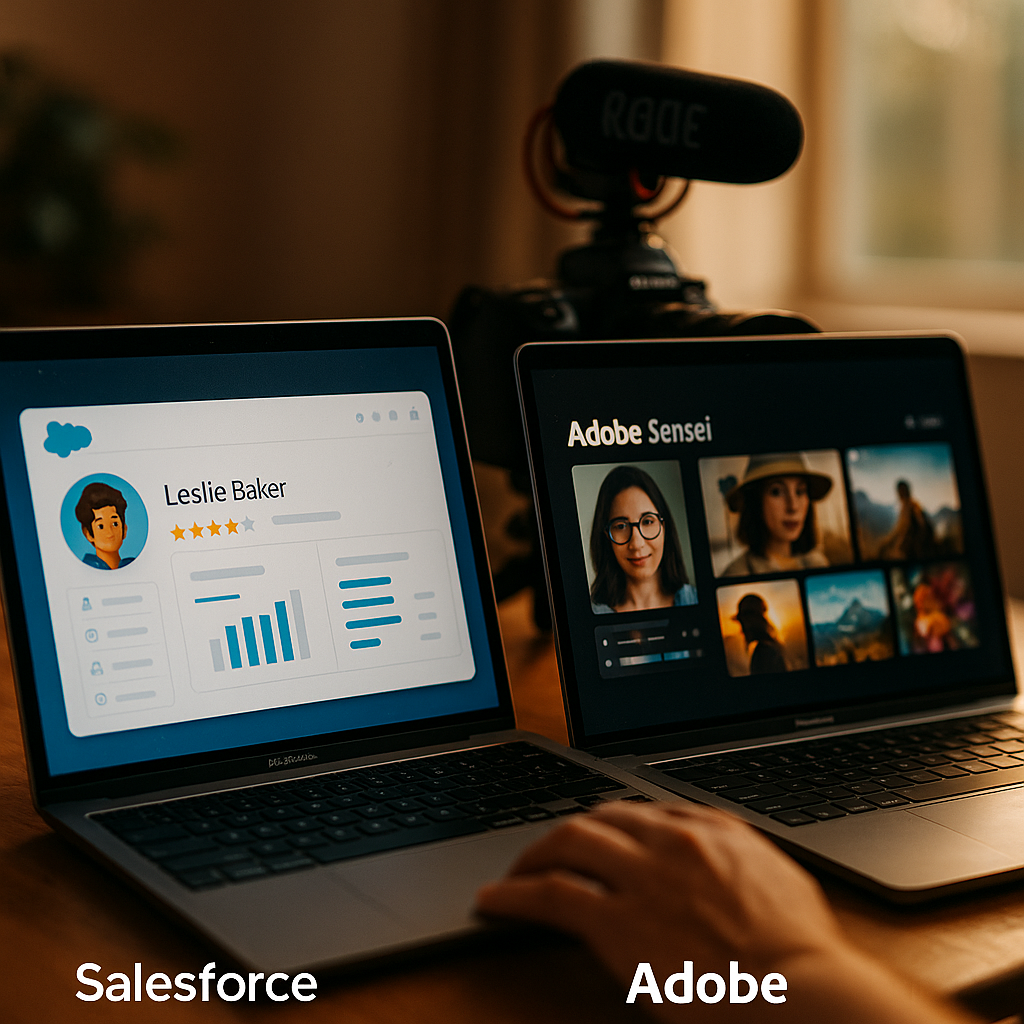
Only 34% of marketers say they can confidently tie creator content to revenue, according to recent eMarketer survey data. So when two of the biggest names in enterprise martech both claim their agentic AI just solved creator campaign attribution, you should ask hard questions before you sign anything. Salesforce Agentforce 360 and Adobe Sensei are pitching very different visions of what “agentic” even means. Here’s what actually matters for brand and agency buyers.
Two Different Bets on What Agentic Attribution Should Do
Salesforce built Agentforce 360 as a CRM-native reasoning layer. It sits on top of your existing Salesforce data model, pulls in creator-touch data from Marketing Cloud, and lets autonomous agents make judgment calls about which touchpoints deserve credit. Adobe’s answer, built around Sensei GenAI and the Experience Platform, comes from the opposite direction: it’s a content-and-journey engine first, attribution second. Sensei’s agents are optimized for creative performance signals, then layered with attribution modeling.
That distinction sounds academic. It isn’t. If your creator program lives mostly in spreadsheets and a patchwork of platform dashboards, Salesforce’s CRM gravity pulls everything into one record of truth. If your program is creative-heavy, with constant asset variation across TikTok, Instagram, and YouTube, Adobe’s content-lineage tracking might catch attribution signals Salesforce simply doesn’t see.
Neither platform was built specifically for influencer marketing. Both are retrofitting general-purpose customer data agents onto a creator economy problem they didn’t originate to solve — and that gap shows up in the edge cases.
How the Agents Actually Reason About Credit
Agentforce 360 uses what Salesforce calls “trust-scored reasoning chains.” In plain terms, the agent examines a sequence of events (a TikTok view, a landing page visit, a CRM lead creation, a closed deal) and assigns confidence-weighted credit based on historical patterns in your own Salesforce instance. It’s a closed loop. The more of your funnel that already lives in Salesforce, the smarter this gets. But if your creator payments, contracts, and performance data sit in tools like creator payment platforms that never sync back, the agent is reasoning with half a picture.
Adobe Sensei takes a different route: probabilistic modeling trained across Adobe’s broader customer base, then fine-tuned to your Experience Cloud data. It’s less “reasoning chain,” more “pattern match against millions of similar customer journeys.” That can be a strength — Sensei has seen more creative-format variation than most single-brand datasets could ever produce. It can also be a liability if your audience or vertical doesn’t resemble Adobe’s training distribution.
Ask each vendor this directly in a demo: “Show me how the agent explains a specific attribution decision, not just the output.” If they can’t produce a legible reasoning trace, you’re buying a black box with a nice dashboard on top. This matters even more given how aggressive attribution accuracy claims have proven in third-party testing to be inflated once you strip out self-reported wins.
The Multi-Touch Problem Neither Vendor Fully Solves
Creator campaigns rarely follow a linear path. A viewer sees a creator’s Reel, forgets about it, sees a retargeted ad two weeks later, then converts after a Google search for the brand name. Attributing that journey requires stitching identity across platforms that increasingly refuse to share data. This is the identity resolution problem, and it’s bigger than either vendor’s AI layer.
Salesforce leans on its own Customer 360 identity graph, which works well if your customer touchpoints funnel through owned properties (email, site, app). Adobe leans on Experience Platform’s Real-Time CDP, which has stronger native support for anonymous-to-known stitching across web and app but weaker creator-specific taxonomy out of the box.
Neither handles TikTok’s and Instagram’s walled-garden data restrictions particularly well. You’ll still need clean UTM discipline, creator-specific promo codes, and a server-side tagging strategy regardless of which agent you buy. Don’t let a sales deck convince you the AI erases the need for basic tracking hygiene — it doesn’t. For a deeper look at why identity gaps have become a governance issue and not just a marketing inconvenience, see why identity resolution is now a board-level risk.
Where Incrementality Testing Still Beats Both Platforms
Here’s the uncomfortable truth vendors won’t lead with: agentic attribution, however sophisticated, is still attribution. It infers causation from correlated data. It doesn’t prove a creator post caused a sale the way a controlled holdout test does. Smart marketing teams pair either Agentforce 360 or Sensei with periodic incrementality tests — geo-holdouts, ghost ads, matched-market comparisons — to validate what the AI is telling them.
This isn’t a knock on either platform. It’s a reminder that attribution vs. incrementality isn’t an either/or decision your AI vendor gets to make for you. Teams that treat the agent’s output as a hypothesis, not gospel, get better results than teams that trust the dashboard blindly. We’ve written before about why smart stacks run both models in parallel rather than picking a single source of truth.
Cost, Contracts, and the Lock-In Question
Pricing for both platforms is opaque by design. Agentforce 360 licensing typically bundles into existing Salesforce Marketing Cloud or Data Cloud contracts, with agent-specific “conversation credits” priced per interaction. For a mid-size brand running 40-60 active creator partnerships, expect agent costs layered on top of your existing Salesforce spend, not replacing it. Adobe’s Sensei pricing similarly rides on top of Experience Cloud licensing, with GenAI credits metered separately from your core platform fee.
Translation: neither is a standalone purchase. You’re buying into an ecosystem, and the attribution agent is the hook, not the whole fish.
That’s worth sitting with. Vendors increasingly bundle “free” or steeply discounted agentic add-ons into core platform renewals specifically to raise switching costs later. This is the same consolidation-versus-lock-in tension we flagged in our look at AI marketing operating systems and vendor lock-in. Before you sign a multi-year renewal that includes either agent, model out what it would cost to migrate off the platform entirely. If that number makes your CFO wince, you already have your answer about how much leverage you’re giving up.
The real cost of agentic attribution isn’t the license fee. It’s the years of switching-cost debt you accrue once your creator data model is fully dependent on one vendor’s reasoning engine.
A Practical Evaluation Framework
Skip the vendor scorecards. Run this instead, internally, before any demo call:
- Data residency audit: Map exactly where your creator performance data currently lives — platform-native dashboards, spreadsheets, a CDP, payment tools. Whichever agent requires the least data migration wins on time-to-value, even if it’s not the “smarter” model on paper.
- Explainability test: Demand the vendor show a full reasoning trace for one attribution decision, not just a summary score. If sales reps can’t produce this live, procurement should push back hard.
- Governance and kill-switch controls: Autonomous agents making budget or credit-allocation decisions need a human override path. Ask specifically how you pause or roll back an agent decision mid-campaign — standards outlined in our kill-switch requirements guide are a useful checklist here.
- Incrementality compatibility: Confirm the platform can export raw touchpoint data for third-party incrementality testing. If it can’t, you’re locked into trusting its own math forever.
- Fraud signal integration: Creator attribution is only as good as the underlying engagement data. Verify the agent flags or excludes bot-driven engagement before crediting it, a gap covered in our fraud-detection platform comparison.
Run a 90-day pilot with real budget on both platforms if you can afford the parallel spend. Most enterprise teams can’t, so at minimum, insist on a sandbox environment with your actual creator data before committing to a full rollout. Vendors love clean demo data. Your data is messier, and that’s where these agents actually get tested.
Who Should Pick Which
Brands already deep in Salesforce, with CRM as the operational backbone and sales cycles that touch creator-driven leads, will get faster time-to-value from Agentforce 360. The reasoning chains map naturally onto pipeline stages your sales team already understands.
Brands running creative-heavy, high-velocity campaigns across many creators and formats, especially those already on Adobe Experience Cloud for asset management, will likely find Sensei’s content-lineage tracking more useful for understanding which specific creative variants within a creator partnership actually drove results. That’s a level of granularity CRM-first tools tend to miss.
If you’re not deeply committed to either ecosystem yet, that’s actually the better negotiating position. Use it. Vendors discount harder for prospects who credibly threaten to walk to the competitor, a dynamic well documented in HubSpot’s martech buying research and echoed across enterprise procurement circles.
Frequently Asked Questions
FAQs
Is Salesforce Agentforce 360 or Adobe Sensei better for creator campaign attribution?
Neither is universally better. Agentforce 360 performs better for brands with CRM-centric funnels where creator-driven leads flow into Salesforce pipelines. Adobe Sensei performs better for creative-heavy programs where tracking asset-level performance across many creator variants matters more than pipeline mapping. The right choice depends on where your data already lives, not which vendor has the flashier demo.
Can either platform replace incrementality testing?
No. Both are correlation-based attribution models, however sophisticated their reasoning layers. Incrementality testing (geo-holdouts, matched-market tests) remains the only way to establish causal proof that a creator campaign drove results. Treat agentic attribution output as a strong hypothesis, then validate periodically with controlled tests.
How much does agentic attribution add to existing Salesforce or Adobe contracts?
Pricing is metered separately from core platform licensing in both cases, typically billed per agent interaction or “conversation credit.” Exact costs vary by data volume and usage, and neither vendor publishes standard rate cards publicly, so get quotes in writing before assuming an add-on is cheap.
Do these platforms handle TikTok and Instagram data restrictions?
Not fully. Both rely on your own tagging, promo codes, and identity resolution setup to bridge walled-garden platforms. Neither agent eliminates the need for disciplined UTM and server-side tracking practices across creator content.
What’s the biggest risk in adopting either platform for attribution?
Vendor lock-in. Both tools are add-ons to broader CRM or experience platform ecosystems, and switching costs rise significantly the longer your creator data model depends on one vendor’s proprietary reasoning engine. Model your exit cost before signing a multi-year renewal.
Bottom line: pilot both agents against your messiest real creator data, not a vendor’s polished demo set, and keep a parallel incrementality test running for at least one full quarter before you trust either one’s attribution numbers with next year’s budget.
Top Influencer Marketing Agencies
The leading agencies shaping influencer marketing in 2026
Agencies ranked by campaign performance, client diversity, platform expertise, proven ROI, industry recognition, and client satisfaction. Assessed through verified case studies, reviews, and industry consultations.
Moburst

-
2

The Shelf
Boutique Beauty & Lifestyle Influencer AgencyA data-driven boutique agency specializing exclusively in beauty, wellness, and lifestyle influencer campaigns on Instagram and TikTok. Best for brands already focused on the beauty/personal care space that need curated, aesthetic-driven content.Clients: Pepsi, The Honest Company, Hims, Elf Cosmetics, Pure LeafVisit The Shelf → -
3

Audiencly
Niche Gaming & Esports Influencer AgencyA specialized agency focused exclusively on gaming and esports creators on YouTube, Twitch, and TikTok. Ideal if your campaign is 100% gaming-focused — from game launches to hardware and esports events.Clients: Epic Games, NordVPN, Ubisoft, Wargaming, Tencent GamesVisit Audiencly → -
4

Viral Nation
Global Influencer Marketing & Talent AgencyA dual talent management and marketing agency with proprietary brand safety tools and a global creator network spanning nano-influencers to celebrities across all major platforms.Clients: Meta, Activision Blizzard, Energizer, Aston Martin, WalmartVisit Viral Nation → -
5

The Influencer Marketing Factory
TikTok, Instagram & YouTube CampaignsA full-service agency with strong TikTok expertise, offering end-to-end campaign management from influencer discovery through performance reporting with a focus on platform-native content.Clients: Google, Snapchat, Universal Music, Bumble, YelpVisit TIMF → -
6

NeoReach
Enterprise Analytics & Influencer CampaignsAn enterprise-focused agency combining managed campaigns with a powerful self-service data platform for influencer search, audience analytics, and attribution modeling.Clients: Amazon, Airbnb, Netflix, Honda, The New York TimesVisit NeoReach → -
7

Ubiquitous
Creator-First Marketing PlatformA tech-driven platform combining self-service tools with managed campaign options, emphasizing speed and scalability for brands managing multiple influencer relationships.Clients: Lyft, Disney, Target, American Eagle, NetflixVisit Ubiquitous → -
8

Obviously
Scalable Enterprise Influencer CampaignsA tech-enabled agency built for high-volume campaigns, coordinating hundreds of creators simultaneously with end-to-end logistics, content rights management, and product seeding.Clients: Google, Ulta Beauty, Converse, AmazonVisit Obviously →