


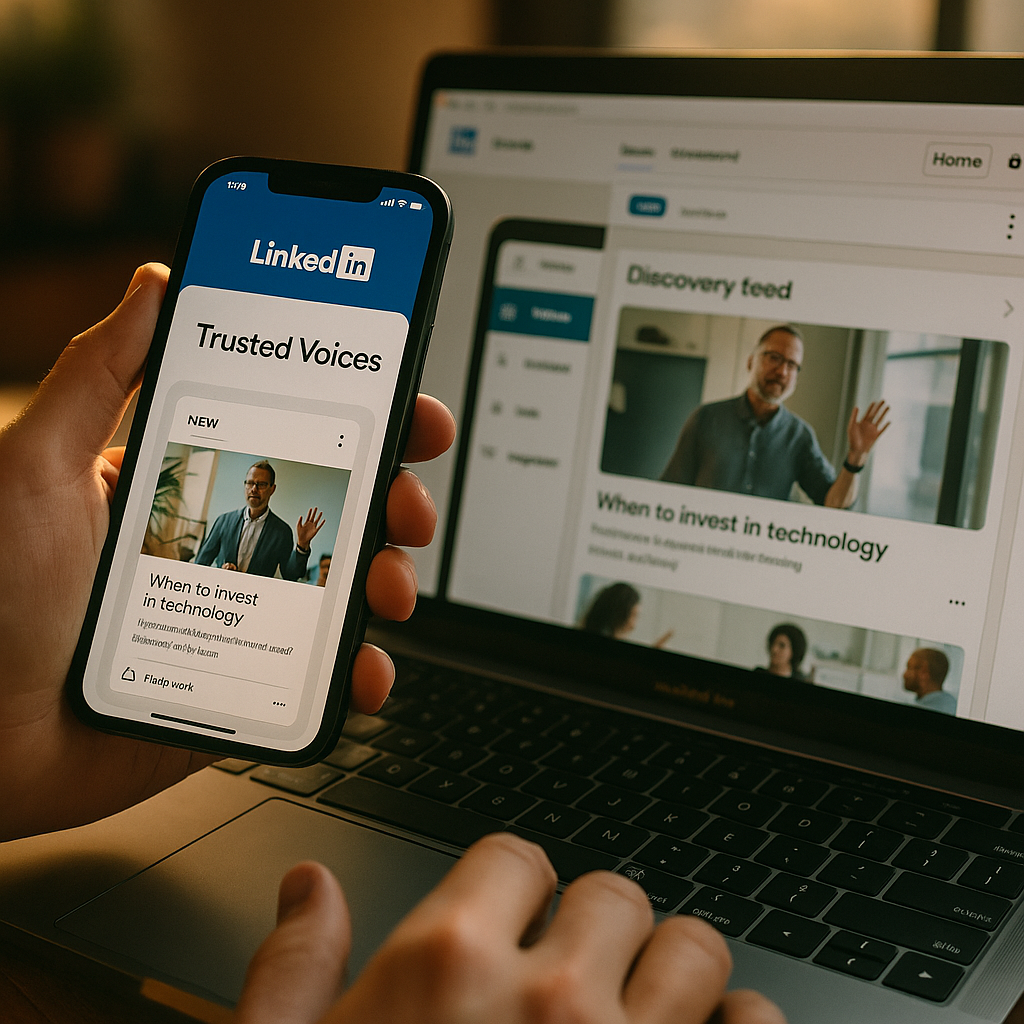
LinkedIn just told 1.1 billion users that reach is no longer the reward for showing up. Under the platform’s Trusted-Voice update, discovery feed optimization has become the difference between content that compounds and content that vanishes after forty impressions. If your B2B content strategy still treats LinkedIn like a broadcast channel, you’re already losing distribution to competitors who figured out the new rules first.
What Actually Changed
LinkedIn’s Trusted-Voice update shifts ranking weight away from raw engagement velocity and toward credibility signals: verified expertise, consistent topical authority, and audience trust behaviors like saves, thoughtful comments, and profile visits after a post. It’s a cousin of what we’ve seen play out across the industry — discovery-over-reach ranking logic is now the dominant pattern, not the exception.
For years, LinkedIn’s feed rewarded whoever posted most, tagged the right people, and triggered comment-pods-style engagement in the first hour. That playbook is dead. The new system reportedly weighs whether a creator or brand page has a track record of accurate, non-promotional content in a specific professional domain before it decides how far to push a given post.
LinkedIn’s own product team has signaled that “who you are” now matters more to distribution than “how fast people react” — a fundamental reordering of the incentive structure for B2B content.
This matters enormously for brand pages and executive ghostwriting programs. A CFO’s post on interest rate policy will now outperform a marketing intern’s post on the same topic, even with identical engagement numbers, because the algorithm is scoring topical authority, not just interaction counts.
Why B2B Brands Should Care More Than B2C Ever Did
B2B buying cycles are long, high-consideration, and multi-stakeholder. LinkedIn has always been the default channel for reaching procurement teams, IT buyers, and finance decision-makers who don’t live on TikTok. When the discovery feed changes how it distributes content, the entire top-of-funnel motion for enterprise marketing gets disrupted.
Consider the numbers: LinkedIn reports that B2B marketers see roughly two-thirds of their social traffic originate from the platform, and content marketing teams have leaned hard on employee advocacy and executive thought leadership to fill pipeline. If Trusted-Voice deprioritizes accounts without demonstrated authority, brands that spent years building generic “corporate voice” pages are staring at a distribution cliff.
This isn’t hypothetical. We covered a related shift in our LinkedIn Trusted-Voice creator vetting playbook, where the vetting criteria for sponsored creators tightened considerably. Discovery feed optimization is the natural next chapter: it’s not just about who you hire to post, it’s about how your own brand and executive accounts are scored.
The ROI Math Brands Can’t Ignore
Here’s the blunt version. If your organic reach drops 30-40% overnight because your brand page lacks trust signals, and you don’t adjust budget or strategy, your cost-per-lead on paid LinkedIn campaigns climbs to compensate. Marketing leaders who model this now, rather than reacting in a quarterly review, protect budget efficiency before the damage shows up in a board deck.
Building Topical Authority Signals Before You Post
Trusted-Voice scoring appears to look backward, not just at the post in front of it. That means brands need a documented history of consistent, credible content in a lane before the algorithm will reward net-new posts with wider distribution.
- Pick two or three content pillars, max. A brand page that posts about supply chain resilience, then pivots to office culture memes, then pivots to product launches, reads as inconsistent to a trust model. Narrow the lane.
- Route executive voices through verified profiles. LinkedIn’s verification (ID and workplace) appears to be a baseline trust signal now, not a nice-to-have. Get your spokespeople verified before you brief a single post.
- Prioritize dwell-time content over quick-scroll content. Carousels, native documents, and longer-form text posts that hold attention seem to score better than link-outs or single-image posts with a caption.
- Encourage comments that demonstrate expertise, not just enthusiasm. A wall of “Great post!” doesn’t move the trust needle. A thread of practitioners debating a point does.
This mirrors a pattern we’ve tracked across platforms. YouTube’s comment signal update forced brands to rebrief creators for substantive engagement over vanity metrics. LinkedIn is applying the same logic to a professional audience that’s arguably more sensitive to credibility than any other platform demographic.
Rebuilding the Brief: What Changes on the Ground
Marketing teams need to rewrite creator and internal content briefs with Trusted-Voice scoring in mind. This isn’t a copywriting tweak. It’s a structural change to how content gets planned, approved, and measured.
Start with attribution. If your brand page has historically posted under a generic “Company Name” voice with no named author, consider shifting toward bylined posts from verified employees with topical track records. LinkedIn’s own guidance on business content best practices has quietly leaned toward employee-generated content for years; Trusted-Voice just made it structurally necessary rather than optional.
Next, audit your posting cadence. Sporadic bursts of five posts in a week followed by three weeks of silence read as low-trust behavior to consistency-weighted algorithms. A steady cadence, even at lower volume, likely outperforms feast-or-famine publishing.
Brands that post twice a week with topical consistency for six months will likely out-distribute brands that post daily with no discernible lane — because Trusted-Voice rewards pattern recognition, not volume.
Finally, revisit your creator partnerships. If you’re running a B2B influencer or thought-leader program, the vetting bar just moved. Partners need demonstrable subject-matter history on LinkedIn specifically, not just a large following imported from another platform. Our AI search and salary rules playbook covers how LinkedIn’s broader AI-driven changes are reshaping discovery beyond just the feed, including search visibility for creator profiles.
Newsletter and Collaborative Article Formats Get a Boost
Two underused formats seem to be benefiting disproportionately from the update: LinkedIn Newsletters and Collaborative Articles. Both formats carry inherent trust signals — newsletters require sustained subscriber relationships, and Collaborative Articles are tied to LinkedIn’s own AI-assisted credibility scoring for contributors.
If your brand hasn’t launched a newsletter, this is the moment. We break down the mechanics in our newsletter sponsorship playbook for finance brands, which is directly applicable to any regulated or high-trust B2B vertical. Similarly, our collaborative articles playbook for executives outlines how to position senior leaders as top contributors, which appears to carry meaningful weight in the new trust model.
Measurement: What to Track Instead of Vanity Metrics
Impressions and likes are lagging indicators in a discovery-over-reach world. Marketing leaders should shift dashboards toward:
- Comment-to-impression ratio weighted toward substantive comments (length, reply threads) rather than raw comment count.
- Profile visit lift following a post — a strong proxy for whether the algorithm is treating the poster as a credible source.
- Follower quality, measured by job title and seniority match against your ICP, not just follower growth rate.
- Save rate, which LinkedIn has increasingly surfaced as a private-but-influential signal in its ranking documentation.
Data platforms like Sprout Social and HubSpot have started surfacing these deeper engagement quality metrics in their LinkedIn reporting modules, which makes this shift measurable without building custom dashboards from scratch. If your analytics stack still centers on reach and impressions as the north star, it’s time for an upgrade.
Industry researchers at eMarketer and Statista have both flagged the broader industry trend toward trust-weighted algorithmic distribution across platforms, which suggests LinkedIn’s move isn’t an isolated experiment. It’s a strategic bet that professional audiences will reward and stay longer on a platform that filters for credibility over volume.
Risk and Compliance: The Overlooked Angle
There’s a compliance dimension here that brand and legal teams shouldn’t skip. As LinkedIn weights verified identity and disclosed employment more heavily, ghostwritten executive content and undisclosed sponsored posts carry higher discovery risk, not just reputational risk. A post that reads as authentic but is later exposed as fully ghostwritten with no executive input could trigger both a trust penalty in the algorithm and a credibility hit in the market.
This is where FTC-style disclosure norms, long a feature of consumer influencer marketing, start bleeding into B2B. Brands running sponsored executive content or paid creator posts on LinkedIn should apply the same disclosure discipline covered in our FTC compliance playbook, even though that piece was written for a different vertical. The regulatory logic transfers directly: the FTC’s endorsement guidance doesn’t distinguish between B2C and B2B when it comes to material connection disclosures.
Next step: Audit your last twenty LinkedIn brand posts against topical consistency, verified authorship, and comment quality this week — then rebuild your Q1 content calendar around two focused pillars instead of five scattered ones. Distribution rewards depth now, not breadth.
FAQs
What is LinkedIn’s Trusted-Voice update?
It’s an algorithmic shift in LinkedIn’s discovery feed that weighs verified expertise, topical consistency, and audience trust signals more heavily than raw engagement metrics like likes and shares when deciding how widely to distribute a post.
How is discovery feed optimization different from traditional LinkedIn SEO?
Traditional LinkedIn optimization focused on keywords, hashtags, and posting times. Discovery feed optimization under Trusted-Voice focuses on long-term credibility signals: verified identity, consistent subject-matter posting, and engagement quality rather than volume.
Do brand pages need individual employee advocates to benefit from this update?
Largely, yes. Verified individual profiles with demonstrated topical authority appear to carry more trust weight than anonymous corporate brand pages, making employee advocacy programs more important for organic distribution.
Will paid LinkedIn ads be affected by the Trusted-Voice update?
Paid distribution operates on a separate auction system, but organic trust signals can influence ad relevance scoring and quality metrics, which in turn affects cost-per-click and overall campaign efficiency.
How long does it take to build topical authority under the new system?
There’s no official timeline from LinkedIn, but based on observed patterns, consistent posting within a narrow content lane for three to six months appears necessary before brands see meaningful distribution improvements.
Should B2B brands stop working with external creators on LinkedIn?
No, but the vetting bar has risen. Brands should prioritize creators with demonstrated, verifiable expertise on LinkedIn specifically rather than importing follower counts or credibility from other platforms.
Top Influencer Marketing Agencies
The leading agencies shaping influencer marketing in 2026
Agencies ranked by campaign performance, client diversity, platform expertise, proven ROI, industry recognition, and client satisfaction. Assessed through verified case studies, reviews, and industry consultations.
Moburst

-
2

The Shelf
Boutique Beauty & Lifestyle Influencer AgencyA data-driven boutique agency specializing exclusively in beauty, wellness, and lifestyle influencer campaigns on Instagram and TikTok. Best for brands already focused on the beauty/personal care space that need curated, aesthetic-driven content.Clients: Pepsi, The Honest Company, Hims, Elf Cosmetics, Pure LeafVisit The Shelf → -
3

Audiencly
Niche Gaming & Esports Influencer AgencyA specialized agency focused exclusively on gaming and esports creators on YouTube, Twitch, and TikTok. Ideal if your campaign is 100% gaming-focused — from game launches to hardware and esports events.Clients: Epic Games, NordVPN, Ubisoft, Wargaming, Tencent GamesVisit Audiencly → -
4

Viral Nation
Global Influencer Marketing & Talent AgencyA dual talent management and marketing agency with proprietary brand safety tools and a global creator network spanning nano-influencers to celebrities across all major platforms.Clients: Meta, Activision Blizzard, Energizer, Aston Martin, WalmartVisit Viral Nation → -
5

The Influencer Marketing Factory
TikTok, Instagram & YouTube CampaignsA full-service agency with strong TikTok expertise, offering end-to-end campaign management from influencer discovery through performance reporting with a focus on platform-native content.Clients: Google, Snapchat, Universal Music, Bumble, YelpVisit TIMF → -
6

NeoReach
Enterprise Analytics & Influencer CampaignsAn enterprise-focused agency combining managed campaigns with a powerful self-service data platform for influencer search, audience analytics, and attribution modeling.Clients: Amazon, Airbnb, Netflix, Honda, The New York TimesVisit NeoReach → -
7

Ubiquitous
Creator-First Marketing PlatformA tech-driven platform combining self-service tools with managed campaign options, emphasizing speed and scalability for brands managing multiple influencer relationships.Clients: Lyft, Disney, Target, American Eagle, NetflixVisit Ubiquitous → -
8

Obviously
Scalable Enterprise Influencer CampaignsA tech-enabled agency built for high-volume campaigns, coordinating hundreds of creators simultaneously with end-to-end logistics, content rights management, and product seeding.Clients: Google, Ulta Beauty, Converse, AmazonVisit Obviously →