


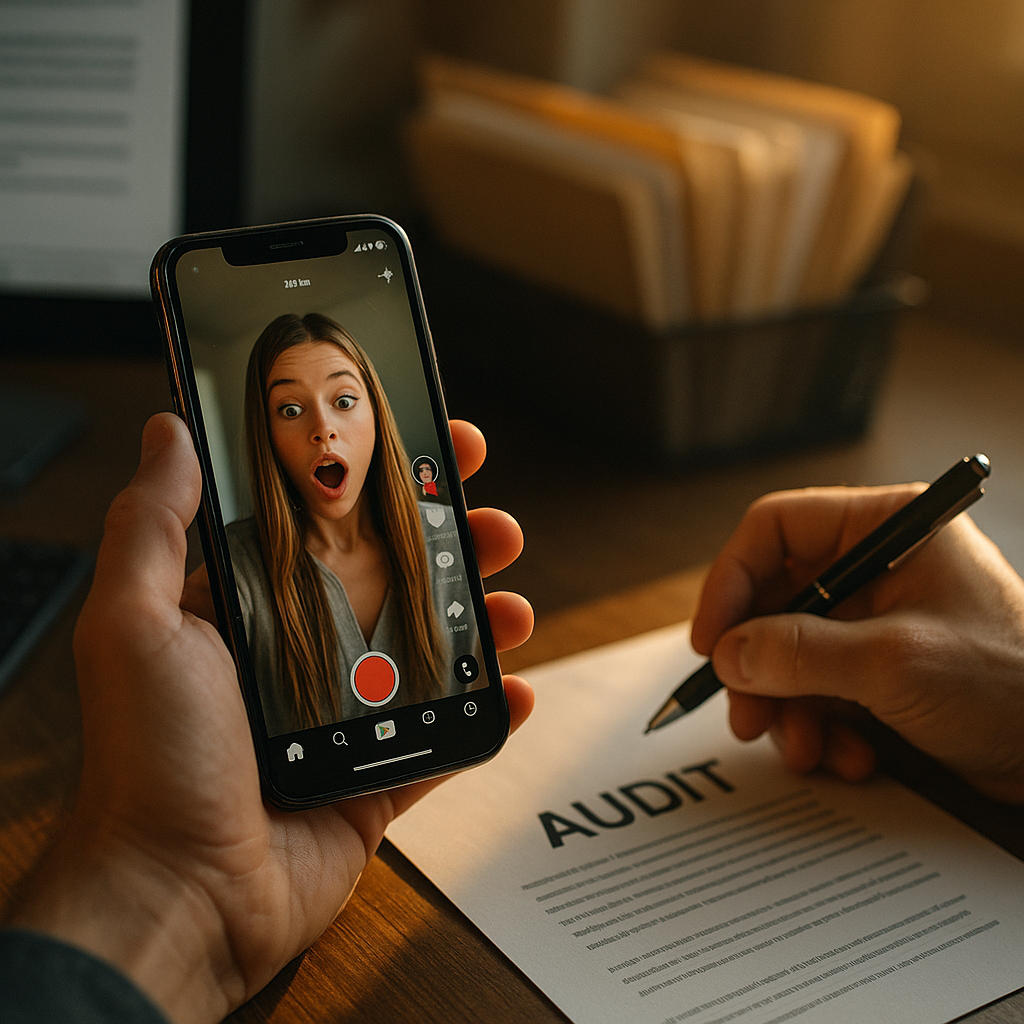
Ninety percent of TikTok viewers decide whether to keep watching within the first three seconds. That’s also the exact window where most brands bury their “#ad” tag, if they show it at all. The FTC’s clear and conspicuous standard was never designed for content that disappears before a thumb finishes scrolling, and now the agency is closing that gap.
If your creator program still treats disclosure as an afterthought caption, this is the audit that saves you from a warning letter, or worse.
Why the Three-Second Window Suddenly Matters
TikTok’s algorithm rewards hooks that grab attention instantly. Creators know this. Agencies coach for it. Entire courses exist teaching “pattern interrupts” for the first frame. But that same design principle, the thing that makes content perform, is exactly what regulators now flag as a disclosure risk.
The FTC’s Endorsement Guides have always required that material connections be disclosed clearly and conspicuously, meaning an average consumer notices it without having to hunt. The enforcement update sharpens this for short-form video specifically: disclosures placed after the hook, buried in a swipe-up caption, or flashed for a single frame no longer count as conspicuous. The standard now explicitly considers when a disclosure appears relative to when audience attention is highest, not just whether it exists somewhere in the post.
A disclosure that appears after 87% of viewers have already scrolled past isn’t a disclosure. It’s a compliance checkbox that failed at its actual job.
That distinction, between technically present and actually seen, is the whole ballgame for brands running TikTok Shop and affiliate campaigns at scale.
What “Clear and Conspicuous” Actually Requires Now
The FTC has never published a rigid pixel-and-second formula. Instead, it evaluates disclosures against a reasonable-consumer standard: placement, size, contrast, duration, and language all factor in. But recent guidance and enforcement actions give brands a working checklist for sub-3-second hooks:
- Timing: Disclosure must appear at or before the hook, not after it resolves.
- Duration: It needs to stay on screen long enough to be read, not flash for a single frame.
- Placement: Text overlays in the “safe zone” that TikTok’s UI doesn’t obscure with captions or engagement buttons.
- Redundancy: Verbal disclosure plus on-screen text plus the platform’s paid partnership label, layered, not either-or.
- Language: “#ad” or “#sponsored,” not vaguer terms like “#sp” or “thanks to” that consumer testing shows people misread or ignore.
This layered approach echoes what we’ve already seen with other placement rules. Our breakdown of paid partnership labels covers why the platform’s built-in tag was never sufficient on its own, and the same logic now applies with even less room to maneuver inside a three-second hook.
The Audit: Five Checkpoints Before You Approve Content
Most brands don’t have a formal review step for disclosure timing. They have a legal team that skims scripts and a brand safety tool that flags profanity. Neither catches a hook that hides the disclosure behind a jump cut. Here’s a practical audit sequence to run before any sponsored TikTok goes live.
1. Frame-by-frame timestamp review. Watch the first three seconds at quarter speed. Is the disclosure visible, legible, and unobstructed by TikTok’s UI elements? If you have to pause and squint, an average viewer definitely missed it.
2. Audio disclosure cross-check. Does the creator say “this is a paid ad” or similar before or during the hook, not buried in a 20-second monologue afterward? Verbal disclosure matters more on a platform where captions are often auto-generated and skimmed, not read.
3. Safe-zone placement test. Upload a draft to TikTok’s own preview tool and check whether captions, stickers, or the sound label cover your disclosure text. This sounds basic. It’s the single most common failure point agencies report.
4. Creator platform-label confirmation. Confirm the creator actually toggled TikTok’s “Branded Content” or “Paid Partnership” label. Shockingly common miss: the label exists as a feature, but creators forget to switch it on, especially on organic-style UGC content.
5. Consistency across cuts and remixes. If the video gets clipped, remixed, or reposted by the brand’s own channel, does the disclosure travel with it? A disclosure that only lives in the original post doesn’t protect you when your paid media team repurposes the clip into a six-second bumper ad.
Run this five-point check on 100 posts and you’ll likely find disclosure failures in 20 to 30 of them, based on informal agency audits circulating in performance marketing circles this year. That’s not a rounding error. That’s a program-wide liability.
Where TikTok Diverges From YouTube and Instagram
Brands running cross-platform campaigns often assume one disclosure standard fits all. It doesn’t. YouTube’s built-in disclosure timing rules operate on a completely different runway than TikTok’s hook-driven format. We’ve covered the mechanics in our comparison of platform disclosure timing rules, but the short version: a 10-minute YouTube video gives you room to disclose within the first minute and still satisfy regulators. TikTok gives you three seconds, sometimes less if the hook itself is the entire value proposition.
That compressed timeline is why brands can’t just copy-paste their Instagram Reels disclosure workflow onto TikTok Shop campaigns. Instagram’s Stories format, with its slower swipe pacing, tolerates a beat of delay that TikTok’s feed simply doesn’t. Treat each platform’s attention curve as a separate compliance variable, not a shared template.
The AI Content Wrinkle Nobody’s Talking About
Here’s where it gets messier. A growing share of sub-3-second hooks are now AI-generated or AI-assisted, whether that’s a synthetic voiceover, an AI-written script, or a fully avatar-based creator. The FTC’s audience-perception standard, which we detailed in our piece on testing AI UGC before it ships, adds a second disclosure obligation layered on top of the paid-partnership one: viewers also need to know when they’re watching AI-generated content, not just when they’re watching an ad.
Stack those two disclosure requirements into a three-second hook and you can see the problem. Brands are now being asked to communicate two distinct facts, paid relationship and synthetic origin, inside a window shorter than most people’s patience for a red light. Platforms are responding with layered labeling systems rather than relying on creator captions alone, a shift we mapped out in our coverage of AI-verified disclosure standards. If your creative team is producing AI-assisted hooks, both disclosures need a home in that opening frame, not a sequential reveal that only the second half of your audience ever sees.
Building This Into Your Workflow, Not Bolting It On
The brands getting this right aren’t running manual audits post-hoc. They’re building disclosure timing checks into the same pipeline used for brand safety and content approval. That means:
- A pre-publish checklist embedded in your creator brief, specifying exact disclosure timing, not just “include #ad somewhere.”
- A frame-review step assigned to a real person, not assumed to be covered by an AI moderation tool that flags keywords but not visual placement.
- Contractual language with creators that ties payment to disclosure compliance, similar to the script-control clauses discussed in our piece on script control and FTC liability.
- A rolling audit sample, reviewing 5 to 10% of live posts monthly, to catch drift as creators tweak their hook style over time.
None of this needs to be a six-figure compliance platform. A shared spreadsheet, a Slack channel for flagged content, and one person with veto authority over publish approval covers most mid-size programs. The failure mode isn’t lack of resources, it’s lack of ownership. Somebody on your team needs disclosure timing as an explicit job responsibility, not a hope that the creator handles it.
Industry benchmarking from eMarketer shows influencer marketing spend continuing to climb even as regulatory scrutiny intensifies, which tells you the FTC isn’t slowing the category down, it’s just raising the floor on how carefully brands need to operate inside it. Guidance from the FTC’s own endorsement resources remains the authoritative source, and it’s worth having your legal team review the current Endorsement Guides directly rather than relying on secondhand summaries, including this one.
What This Means for Budget and Vendor Selection
If you’re evaluating creator marketplaces or influencer platforms, disclosure timing enforcement should be a vendor selection criterion, not an afterthought. Ask any platform you’re considering whether they offer frame-level disclosure review, or whether their “compliance check” is really just a keyword scan of the caption. Tools like Sprout Social and similar social management platforms are building more granular content review features, but most weren’t originally designed with FTC frame-timing in mind, so confirm capability rather than assume it.
Budget-wise, factor in the cost of a manual review layer for high-volume TikTok Shop programs. It’s cheaper than a demand letter, and dramatically cheaper than the reputational cost of a public FTC action landing on a campaign your CMO signed off on.
Start your next campaign brief with a disclosure timing spec, not a caption suggestion, and run the five-point frame audit on every hook before it goes live. That single habit closes most of the exposure the FTC’s updated standard is designed to catch.
FAQs
What counts as “clear and conspicuous” for a TikTok hook under three seconds?
The disclosure must appear at or before the hook resolves, stay on screen long enough to read, sit outside areas TikTok’s UI covers with captions or buttons, and ideally combine text, verbal mention, and the platform’s paid partnership label together.
Does using TikTok’s built-in “Paid Partnership” label satisfy FTC requirements on its own?
No. The FTC has made clear that platform labels alone don’t guarantee a disclosure is noticed by the average viewer, especially in fast-paced short-form content. Brands should layer the label with visible on-screen text and verbal disclosure.
Who is liable if a creator forgets to disclose a paid hook?
Both the brand and the creator can face FTC scrutiny. Brands are expected to have reasonable monitoring programs in place, which is why contract clauses tying payment to compliance and pre-publish review steps matter.
How is AI-generated content disclosure different from paid partnership disclosure?
They’re separate obligations. Paid partnership disclosure tells viewers a material connection exists. AI content disclosure tells viewers the content (voice, likeness, or footage) is synthetic. Both may need to appear within the same short window if a hook is AI-assisted and sponsored.
How often should brands audit live content for disclosure compliance?
A rolling monthly sample of 5 to 10% of live sponsored posts is a reasonable baseline for mid-size programs, with 100% review recommended for high-spend or high-risk campaigns like TikTok Shop livestreams.
Top Influencer Marketing Agencies
The leading agencies shaping influencer marketing in 2026
Agencies ranked by campaign performance, client diversity, platform expertise, proven ROI, industry recognition, and client satisfaction. Assessed through verified case studies, reviews, and industry consultations.
Moburst

-
2

The Shelf
Boutique Beauty & Lifestyle Influencer AgencyA data-driven boutique agency specializing exclusively in beauty, wellness, and lifestyle influencer campaigns on Instagram and TikTok. Best for brands already focused on the beauty/personal care space that need curated, aesthetic-driven content.Clients: Pepsi, The Honest Company, Hims, Elf Cosmetics, Pure LeafVisit The Shelf → -
3

Audiencly
Niche Gaming & Esports Influencer AgencyA specialized agency focused exclusively on gaming and esports creators on YouTube, Twitch, and TikTok. Ideal if your campaign is 100% gaming-focused — from game launches to hardware and esports events.Clients: Epic Games, NordVPN, Ubisoft, Wargaming, Tencent GamesVisit Audiencly → -
4

Viral Nation
Global Influencer Marketing & Talent AgencyA dual talent management and marketing agency with proprietary brand safety tools and a global creator network spanning nano-influencers to celebrities across all major platforms.Clients: Meta, Activision Blizzard, Energizer, Aston Martin, WalmartVisit Viral Nation → -
5

The Influencer Marketing Factory
TikTok, Instagram & YouTube CampaignsA full-service agency with strong TikTok expertise, offering end-to-end campaign management from influencer discovery through performance reporting with a focus on platform-native content.Clients: Google, Snapchat, Universal Music, Bumble, YelpVisit TIMF → -
6

NeoReach
Enterprise Analytics & Influencer CampaignsAn enterprise-focused agency combining managed campaigns with a powerful self-service data platform for influencer search, audience analytics, and attribution modeling.Clients: Amazon, Airbnb, Netflix, Honda, The New York TimesVisit NeoReach → -
7

Ubiquitous
Creator-First Marketing PlatformA tech-driven platform combining self-service tools with managed campaign options, emphasizing speed and scalability for brands managing multiple influencer relationships.Clients: Lyft, Disney, Target, American Eagle, NetflixVisit Ubiquitous → -
8

Obviously
Scalable Enterprise Influencer CampaignsA tech-enabled agency built for high-volume campaigns, coordinating hundreds of creators simultaneously with end-to-end logistics, content rights management, and product seeding.Clients: Google, Ulta Beauty, Converse, AmazonVisit Obviously →