


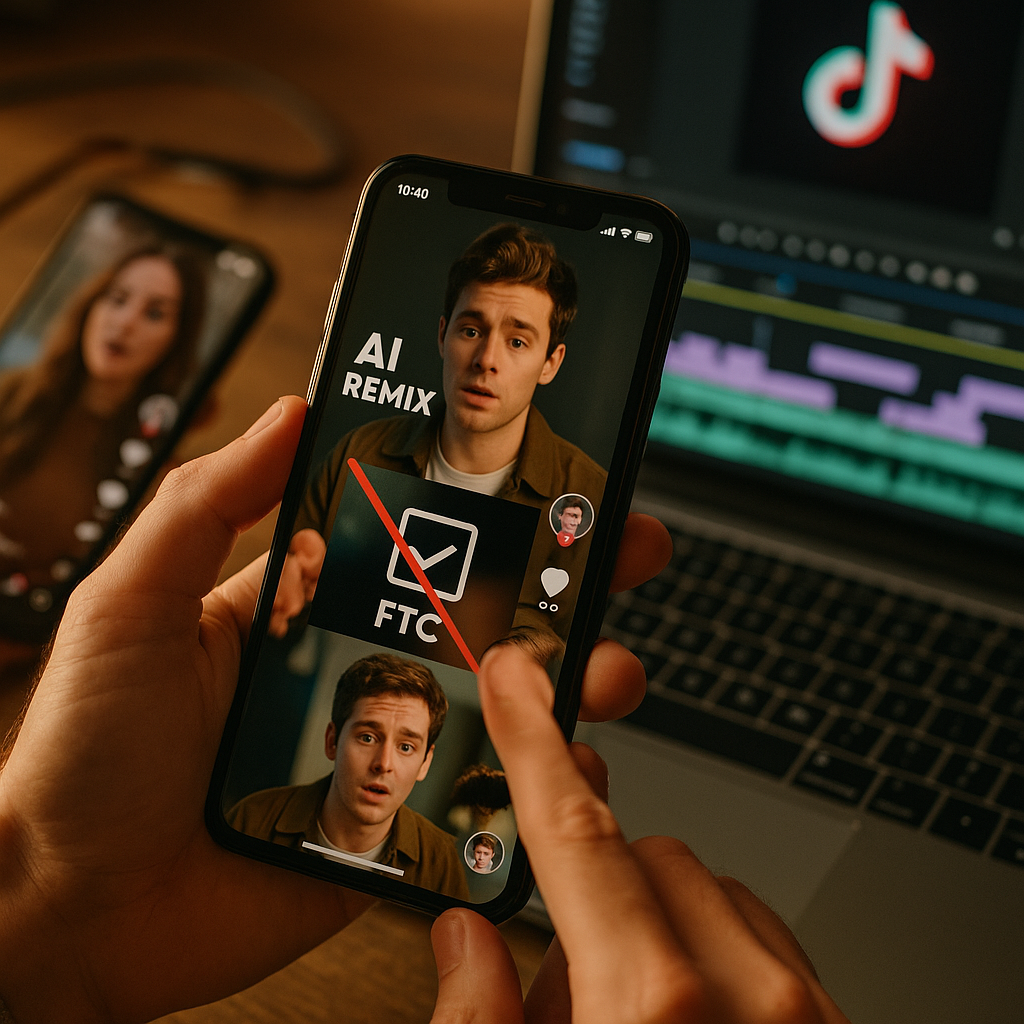
Here’s an uncomfortable question for anyone running TikTok Shop programs right now: if an AI shopping assistant pulls your creator’s video into a side-by-side product comparison the creator never made, filmed, or approved — who’s on the hook when the disclosure disappears? TikTok Shop FTC disclosure language was built for posts, not autonomous remixes, and that gap is where compliance teams are about to get burned.
TikTok’s shopping assistant doesn’t just recommend products anymore. It stitches creator content, product specs, and price data into comparison cards that live entirely outside the original post’s context. A disclosure buried in a caption three scrolls away doesn’t travel with the clip when an algorithm lifts it. That’s not a hypothetical edge case — it’s how the feature is designed to work.
Why the Old Disclosure Playbook Breaks Here
Standard FTC guidance says a disclosure has to be “clear and conspicuous” at the moment a consumer encounters the claim. That standard assumes a fixed unit of content: one video, one caption, one disclosure. TikTok Shop’s AI assistant shatters that assumption. It can pull a five-second clip from a 90-second creator video, drop it into a comparison against three competitor products, and present it with zero surrounding context.
The creator’s original disclosure — the “#ad” in the caption, the spoken “this is sponsored” at the top of the video — may never render in that new surface. The FTC has already made clear that platform-native disclosure tools like paid partnership labels aren’t sufficient on their own; our earlier coverage of why paid partnership labels alone no longer satisfy FTC rules laid out that logic before AI remixing even entered the picture. Add an autonomous comparison engine into the mix, and the exposure compounds.
If your disclosure only lives in the original post, and TikTok’s AI can legally extract and repackage that content without the disclosure attached, you don’t have a compliance gap — you have a compliance void.
What “Surfacing” Actually Means for Liability
Brands need to get precise about the mechanics. When TikTok Shop’s assistant surfaces creator content in a comparison, three things typically happen:
- The clip is trimmed, often to a five-to-ten second segment showing product demonstration or reaction.
- It’s placed alongside competitor products, sometimes brands that never worked with that creator at all.
- The surrounding UI (price tags, ratings, “shop now” buttons) is generated by TikTok, not the creator or the brand.
That third point matters more than it seems. When TikTok’s own interface adds commercial framing, it blurs the line between organic creator opinion and paid promotion — even further than the original post did. Regulators have historically judged disclosure adequacy from the audience’s perspective, not the platform’s intent. Our deep dive on the FTC audience-perception standard covers exactly this: it doesn’t matter that the AI, not the creator, built the comparison. What matters is whether a reasonable viewer understands the connection between the content and the commercial relationship behind it.
Building Disclosure Language That Survives Remixing
You can’t disclosure your way out of a UI problem with just better copywriting. But you can build language and structural requirements that reduce risk significantly. Here’s what that looks like in practice.
1. Embed disclosure in the visual layer, not just the caption. Burned-in text overlays (“Paid partnership with [Brand]”) that appear in the first two seconds of the video survive trimming far better than caption-only disclosures. If TikTok’s AI clips the first eight seconds for a comparison card, an overlay disclosure in that window travels with the content. A caption disclosure does not.
2. Require redundant verbal disclosure at the start, not just the end. This mirrors the logic in the TikTok 3-second hooks disclosure audit — if your hook window doesn’t carry the disclosure, you’ve already lost the moment most likely to get extracted by an algorithm optimizing for engagement.
3. Contractually require creators to disclose in every format TikTok might extract. That means updating creator agreements to specify disclosure placement standards that anticipate AI remixing, not just standard post structure. This is a natural extension of the work covered in creator contract clauses for script control and FTC liability — script control isn’t just about brand safety anymore, it’s about disclosure durability.
Statista’s research on social commerce growth shows shoppable video consumption climbing fast — which means the volume of content eligible for AI extraction is only going to increase. Waiting for a clean regulatory framework before fixing your language isn’t a defensible strategy anymore.
The Comparison Card Problem: When Your Product Sits Next to a Competitor
Here’s a scenario compliance teams haven’t fully grappled with. TikTok’s AI assistant builds a comparison showing your product against two competitors, using creator clips for all three. Your creator disclosed properly in their original post. The competitor’s creator may not have. Now your brand’s product sits inside a comparison unit where disclosure standards are inconsistent across the board — and TikTok’s UI doesn’t distinguish between them.
Does that inconsistency create liability for you? Not directly, under current FTC guidance — the agency generally holds brands responsible for their own creator relationships, not competitors’. But it does create reputational risk and platform risk. If TikTok faces regulatory pressure over the assistant’s disclosure handling broadly, brands whose products appear in flagged comparisons could face secondary scrutiny, especially if their own creator agreements didn’t anticipate the exposure.
This is where the parallel to retail media platforms becomes useful. Amazon and Walmart Connect have already faced similar disclosure ambiguity questions when algorithmic placement mixes sponsored and organic content. The frameworks built for retail media disclosure audits on Amazon and Walmart Connect offer a useful template: audit not just your own content, but the surfaces where an algorithm might place it alongside competitors.
Practical Disclosure Language: What to Actually Require
Skip the generic “creators must comply with FTC guidelines” boilerplate. It’s useless once AI remixing enters the picture. Instead, build specific, testable requirements into your creator briefs and contracts:
- Overlay text disclosure present for the first three seconds and the final three seconds of every video, regardless of length.
- Verbal disclosure spoken within the first five seconds, using unambiguous language (“this video is sponsored by,” not “in partnership with” alone).
- Caption disclosure using TikTok’s native paid partnership tool as a secondary, not primary, layer.
- Pre-publish audit confirming all three layers exist before content goes live on TikTok Shop specifically, given its higher likelihood of AI surfacing.
- Quarterly re-check of live content to confirm TikTok hasn’t altered how comparisons render disclosure elements, since platform UI changes without notice.
That fifth point deserves emphasis. Platform features evolve fast, and disclosure rendering can change without any announcement. This is exactly the argument behind building an AI content audit protocol before you publish — a one-time compliance check isn’t enough when the surfaces displaying your content are themselves AI-driven and unstable.
Where TikTok’s AI-Verified Standards Fit In
TikTok has signaled movement toward AI-verified disclosure detection, meaning the platform itself may eventually flag or reject content lacking adequate disclosure signals before it’s eligible for shopping assistant surfacing. That’s a meaningful shift, and it’s covered in detail in our analysis of how platforms are moving to AI-verified disclosure standards beyond simple labels.
But don’t treat a future platform safeguard as your current compliance strategy. Regulatory enforcement, per FTC guidance, holds brands and creators accountable regardless of whether platform tooling exists to catch violations. Build your own standard now. If TikTok’s verification system eventually does the work for you, great — you’ll already be ahead of it.
There’s also a cross-border wrinkle worth flagging for brands running global TikTok Shop campaigns. Disclosure standards diverge meaningfully once you’re outside the US, and AI-driven comparison surfacing doesn’t respect jurisdiction. The comparison work in EU AI Act versus FTC rules is essential reading if your creator content crosses into European markets, since the disclosure durability problem gets legally messier, not simpler, once GDPR-adjacent transparency rules enter the conversation.
What Marketing Leaders Should Do This Quarter
Don’t wait for a specific enforcement action to force your hand. Sprout Social’s research on platform trust consistently shows that disclosure transparency correlates with audience trust, not against it — so the brands treating this as risk mitigation only are missing the upside. Clear disclosure, done well, is a trust signal, not just a legal shield.
Audit your current creator content library specifically for TikTok Shop eligibility. Flag anything where disclosure lives only in the caption. Update your creator brief templates this quarter, not next. And build the quarterly re-check into your existing compliance calendar rather than treating it as a one-off project.
The brands that get ahead of this won’t be the ones with the cleverest disclosure copy. They’ll be the ones who stopped treating disclosure as a caption-writing task and started treating it as a content architecture requirement.
Frequently Asked Questions
Does TikTok’s shopping assistant strip disclosure automatically?
Not automatically by design, but functionally, yes, in many cases. When the assistant trims a clip for a comparison card, it typically pulls the visual and audio segment without preserving caption text or off-screen disclosure elements, unless that disclosure is embedded directly in the video’s visible frames.
Who is legally responsible if a disclosure disappears in an AI-generated comparison?
Current FTC guidance places responsibility primarily on the brand and creator, not the platform, for ensuring disclosures are clear and conspicuous. Brands should assume they carry the compliance burden even when a platform’s AI feature is what removed the disclosure from view.
Should brands update creator contracts specifically for TikTok Shop AI features?
Yes. Standard disclosure clauses written for static posts don’t address AI remixing risk. Contracts should specify disclosure placement (overlay text, verbal timing, caption redundancy) designed to survive extraction into shopping assistant comparisons.
Is a caption disclosure ever sufficient on TikTok Shop?
It’s rarely sufficient on its own anymore, and even less so when content is eligible for AI-driven surfacing. Treat captions as a secondary layer, with burned-in visual text and spoken disclosure as the primary, more durable methods.
How often should brands audit live TikTok Shop content for disclosure compliance?
Quarterly, at minimum, given how frequently platform UI and AI features change without notice. High-volume TikTok Shop programs may warrant monthly spot checks, particularly for top-performing content most likely to be surfaced in comparisons.
Next step: Pull your top twenty TikTok Shop videos by shopping click-through this week and check whether disclosure survives if the first eight seconds were extracted alone. If it doesn’t, that’s your fix list — start there, not with a policy rewrite.
Frequently Asked Questions
Does TikTok’s shopping assistant strip disclosure automatically?
Not automatically by design, but functionally, yes, in many cases. When the assistant trims a clip for a comparison card, it typically pulls the visual and audio segment without preserving caption text or off-screen disclosure elements, unless that disclosure is embedded directly in the video’s visible frames.
Who is legally responsible if a disclosure disappears in an AI-generated comparison?
Current FTC guidance places responsibility primarily on the brand and creator, not the platform, for ensuring disclosures are clear and conspicuous. Brands should assume they carry the compliance burden even when a platform’s AI feature is what removed the disclosure from view.
Should brands update creator contracts specifically for TikTok Shop AI features?
Yes. Standard disclosure clauses written for static posts don’t address AI remixing risk. Contracts should specify disclosure placement (overlay text, verbal timing, caption redundancy) designed to survive extraction into shopping assistant comparisons.
Is a caption disclosure ever sufficient on TikTok Shop?
It’s rarely sufficient on its own anymore, and even less so when content is eligible for AI-driven surfacing. Treat captions as a secondary layer, with burned-in visual text and spoken disclosure as the primary, more durable methods.
How often should brands audit live TikTok Shop content for disclosure compliance?
Quarterly, at minimum, given how frequently platform UI and AI features change without notice. High-volume TikTok Shop programs may warrant monthly spot checks, particularly for top-performing content most likely to be surfaced in comparisons.
Top Influencer Marketing Agencies
The leading agencies shaping influencer marketing in 2026
Agencies ranked by campaign performance, client diversity, platform expertise, proven ROI, industry recognition, and client satisfaction. Assessed through verified case studies, reviews, and industry consultations.
Moburst

-
2

The Shelf
Boutique Beauty & Lifestyle Influencer AgencyA data-driven boutique agency specializing exclusively in beauty, wellness, and lifestyle influencer campaigns on Instagram and TikTok. Best for brands already focused on the beauty/personal care space that need curated, aesthetic-driven content.Clients: Pepsi, The Honest Company, Hims, Elf Cosmetics, Pure LeafVisit The Shelf → -
3

Audiencly
Niche Gaming & Esports Influencer AgencyA specialized agency focused exclusively on gaming and esports creators on YouTube, Twitch, and TikTok. Ideal if your campaign is 100% gaming-focused — from game launches to hardware and esports events.Clients: Epic Games, NordVPN, Ubisoft, Wargaming, Tencent GamesVisit Audiencly → -
4

Viral Nation
Global Influencer Marketing & Talent AgencyA dual talent management and marketing agency with proprietary brand safety tools and a global creator network spanning nano-influencers to celebrities across all major platforms.Clients: Meta, Activision Blizzard, Energizer, Aston Martin, WalmartVisit Viral Nation → -
5

The Influencer Marketing Factory
TikTok, Instagram & YouTube CampaignsA full-service agency with strong TikTok expertise, offering end-to-end campaign management from influencer discovery through performance reporting with a focus on platform-native content.Clients: Google, Snapchat, Universal Music, Bumble, YelpVisit TIMF → -
6

NeoReach
Enterprise Analytics & Influencer CampaignsAn enterprise-focused agency combining managed campaigns with a powerful self-service data platform for influencer search, audience analytics, and attribution modeling.Clients: Amazon, Airbnb, Netflix, Honda, The New York TimesVisit NeoReach → -
7

Ubiquitous
Creator-First Marketing PlatformA tech-driven platform combining self-service tools with managed campaign options, emphasizing speed and scalability for brands managing multiple influencer relationships.Clients: Lyft, Disney, Target, American Eagle, NetflixVisit Ubiquitous → -
8

Obviously
Scalable Enterprise Influencer CampaignsA tech-enabled agency built for high-volume campaigns, coordinating hundreds of creators simultaneously with end-to-end logistics, content rights management, and product seeding.Clients: Google, Ulta Beauty, Converse, AmazonVisit Obviously →