


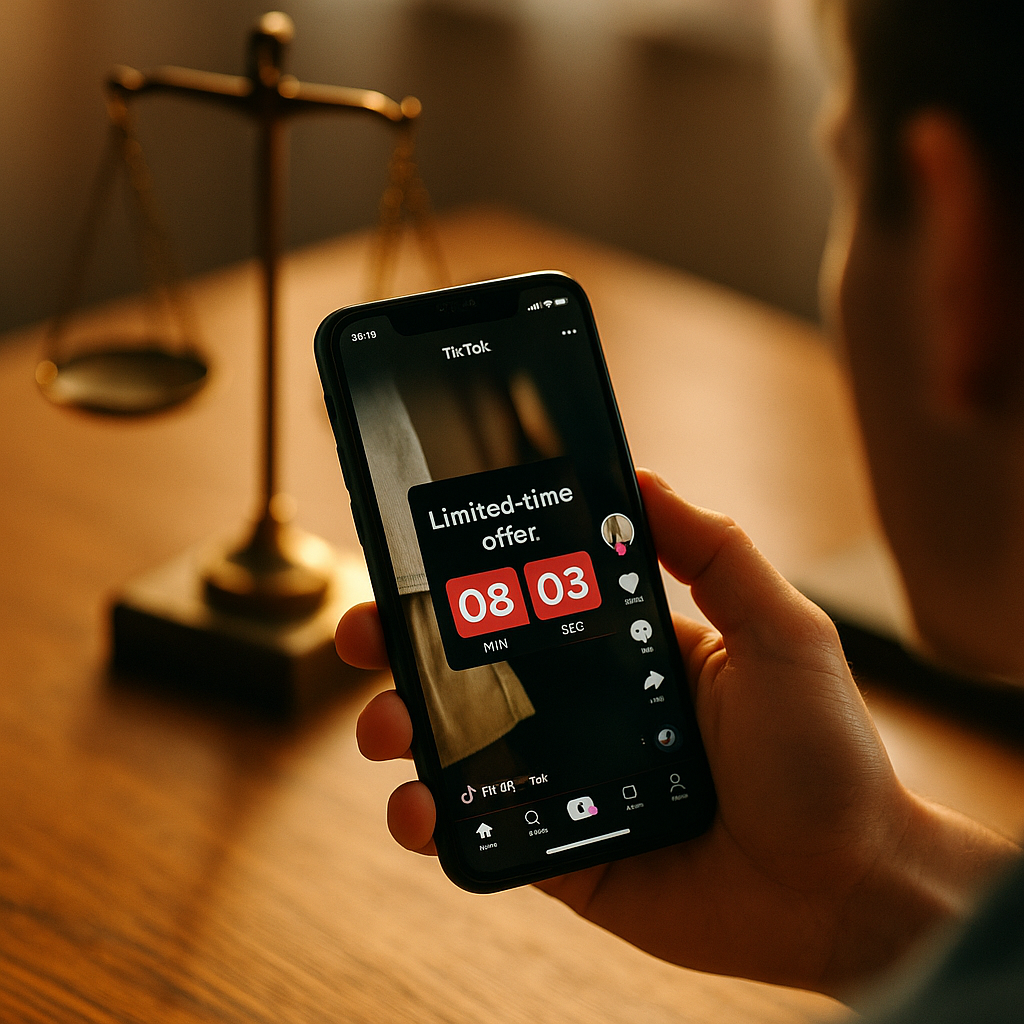
Nineteen states now have deceptive-urgency or “false scarcity” statutes on the books, and most brand marketing teams have never read a single one. Meanwhile, TikTok Shop’s native countdown timer widget gets slapped onto livestreams by creators dozens of times a week, often with zero legal review. If that timer resets, restarts, or simply lies, the brand behind the product — not just the creator — can end up holding the liability. The primary keyword here is compliance framework for brand liability, and it’s not theoretical anymore.
Why Countdown Timers Became a Legal Trapdoor
Countdown timers work. That’s the problem. TikTok Shop’s live commerce format leans hard on urgency mechanics — flash-sale badges, “only 3 left” stock counters, and timers ticking down to zero. Creators love them because they spike conversion during a live. Brands love them because GMV goes up. Regulators, increasingly, do not love them at all.
The core legal issue is simple: if a timer implies a deadline that doesn’t actually exist — the discount continues after the timer hits zero, or the same “limited time” timer resets for the next viewer session — that’s a textbook deceptive practice under most state consumer protection statutes. States like California, New York, and Texas have specific language addressing false urgency and scarcity claims in e-commerce, and several have amended their statutes in the past two years to explicitly name livestream shopping formats.
A countdown timer that resets for every new viewer isn’t a marketing tactic. In at least a dozen states, it’s a documented statutory violation waiting for a plaintiff’s attorney to notice.
Here’s the part brand legal teams miss: TikTok’s platform-level tools make the timer easy to deploy but don’t verify the underlying claim. The widget will happily count down from any number the creator sets, regardless of whether the promotion actually ends when it says it does. TikTok isn’t the party facing the enforcement action. You are.
Who Actually Carries the Risk?
Brand legal teams often assume the creator absorbs liability because they’re the one on camera, setting the timer, saying the words. That’s not how deceptive advertising law works in practice. The Federal Trade Commission and most state attorneys general treat the brand as the principal advertiser — the party that benefits commercially from the deception — and creators as agents acting on the brand’s behalf, especially when there’s a paid partnership, an affiliate code, or a TikTok Shop product listing tied to the brand’s seller account.
That means indemnification clauses in creator contracts matter, but they don’t eliminate exposure. A state AG can still name the brand as a defendant even if the contract says the creator is “solely responsible” for on-screen claims. Courts have generally been unsympathetic to brands trying to outsource statutory compliance through boilerplate contract language alone.
This mirrors what we’ve already seen play out with FTC disclosure enforcement. If you’ve followed how countdown timer rules intersect with FTC guidance, you know the federal side of this is already tightening. State deceptive-urgency statutes are the second wave, and they layer on top rather than replace federal exposure.
Mapping the State Statute Landscape
There’s no single “false urgency” law. Instead, brands are dealing with a patchwork:
- General deceptive practices acts (most states) that prohibit false claims about time-limited offers as a subset of broader unfair-and-deceptive-acts-or-practices (UDAP) statutes.
- Automatic renewal and dark pattern laws (California’s SB 1149-style provisions and similar statutes in Colorado) that increasingly define “dark patterns” to include manipulated urgency indicators.
- Livestream-specific commerce rules emerging in states with large e-commerce enforcement units, which explicitly reference countdown timers, stock counters, and “X people are viewing this” social-proof widgets.
The compliance headache is that these statutes don’t harmonize. A timer practice that’s borderline in Texas might be a clear violation in California. Multiply that across a national creator program running simultaneous TikTok Shop lives, and you have fifty overlapping risk profiles for a single livestream event.
This is structurally similar to the challenge brands already face with livestream compliance frameworks for regulated categories like supplements — except urgency-statute risk applies to nearly every product vertical, not just health claims.
Building the Actual Framework
A workable compliance framework needs four layers: pre-live approval, real-time monitoring, post-live documentation, and contractual risk transfer. Skip any one layer and you’ve got a gap a plaintiff’s attorney can drive through.
Layer One: Pre-Live Timer Rules
Before any creator goes live with a countdown widget, the brand’s compliance function should require a written urgency-claim brief. This isn’t bureaucratic overkill — it’s the single cheapest risk mitigation available. The brief should specify:
- The exact discount start and end time, matched precisely to the timer duration displayed.
- Confirmation that the promotion will not be extended, relaunched, or repeated with an identical timer immediately after expiration.
- Real inventory numbers if any stock-count claim (“only 12 left”) is used — pulled from actual TikTok Shop backend data, not an arbitrary number the creator picks for drama.
- A defined script or talking-point guardrail preventing creators from verbally reinforcing false scarcity (“this will never happen again” claims that contradict a recurring promotional cadence).
Brands running multiple creators on the same SKU during a campaign window should centralize this brief so ten different creators aren’t running ten different, possibly contradictory, countdown claims simultaneously.
Layer Two: Real-Time Monitoring
Static approval isn’t enough because live commerce is, by definition, live. Creators improvise. A creator under pressure to hit a GMV target might restart a timer mid-stream or verbally claim urgency that wasn’t in the approved script. Brands need either a compliance staffer watching the stream in real time or an automated monitoring tool that flags urgency-related keywords and screen-capture evidence of timer behavior.
This is where a lot of mid-size brands underinvest. Enterprise programs running dozens of simultaneous TikTok Shop lives can’t manually watch every stream, so the practical answer is a monitoring layer similar to what’s already used for FTC disclosure audits on short-form hooks — repurposed to flag urgency-statute triggers instead of disclosure omissions.
Layer Three: Documentation as Your Defense
If a state AG or a private plaintiff’s firm comes knocking, the brand’s best defense is a clean paper trail showing the urgency claim was accurate at the time it was made. Screenshot the actual inventory count. Timestamp the promotion window. Archive the livestream recording, not just the clipped highlight reel TikTok’s algorithm might resurface later.
In deceptive-urgency litigation, the burden often shifts to the brand to prove the claim was true. No documentation means no defense, regardless of good intent.
Retention should run at minimum through the applicable state’s statute of limitations for consumer protection claims, which in most jurisdictions runs three to four years. That’s a long tail for a livestream that lasted ninety minutes.
Layer Four: Contract Language That Actually Transfers Risk
Indemnification clauses need to be specific to urgency claims, not generic disclosure boilerplate. Contracts should require creators to use only brand-approved timer settings, prohibit manual timer resets, and include a cure period allowing the brand to pull a livestream recording or issue a correction if a false-urgency claim slips through. Pair this with the kind of structured liability language already being used for AI agent liability riders in media buying — the underlying logic of allocating risk between automated tools, human operators, and the brand principal transfers cleanly to livestream urgency mechanics.
What This Costs vs. What a Violation Costs
Building this framework isn’t free. Expect a mid-size brand to spend somewhere in the range of a modest compliance headcount allocation or a monitoring tool subscription, plus legal review hours for the initial policy build. Compare that to the cost of a single state AG enforcement action, which routinely includes civil penalties per violation (often $2,500-$10,000 per instance in states with per-transaction penalty structures), plus the reputational cost of a public consent order.
Multiply per-violation penalties across a livestream that reached tens of thousands of viewers, and the math stops being close. This isn’t a “nice to have” compliance investment — it’s cheaper than one bad week.
Brands should also weigh this against broader creator commerce compliance obligations already in motion, including disclosure standards that go beyond simple labeling and unified disclosure approaches across gifted and affiliate content. Urgency-statute compliance isn’t a separate silo — it should sit inside the same governance structure as your existing FTC and state disclosure program.
Practical Signals Your Program Is Exposed
- Creators are given TikTok Shop seller access without a written urgency-claim policy attached.
- No one on the brand side is watching livestreams in real time during high-volume campaign windows.
- Inventory counts shown on-screen don’t match backend TikTok Shop data.
- The same “24-hour flash sale” timer has appeared in more than one livestream from the same creator.
- Creator contracts reference “FTC compliance” generally but never mention state deceptive-urgency or dark pattern statutes by name.
If two or more of these apply to your program right now, you have an active exposure gap, not a hypothetical one.
According to industry data tracked by eMarketer, livestream shopping continues to grow as a share of total social commerce, which means the volume of urgency-driven claims brands are exposed to is only climbing. Regulatory guidance from the FTC already treats false urgency as a recognized dark pattern category, and state attorneys general are actively building enforcement capacity around livestream commerce specifically. Tools referenced by platforms like TikTok’s advertising resources continue to add commerce features faster than most brand compliance teams can build policy around them.
The fix isn’t complicated, but it does require treating countdown timers as a legal instrument, not just a conversion lever. Build the four-layer framework, document everything, and rewrite your creator contracts before your next livestream campaign — not after a state AG letter arrives.
FAQs
Can a brand be held liable for a creator’s countdown timer claims?
Yes. Most state consumer protection statutes treat the brand as the principal advertiser when a creator promotes a paid partnership or sells through the brand’s TikTok Shop seller account, regardless of contract language assigning “sole responsibility” to the creator.
What makes a countdown timer legally deceptive?
A timer becomes deceptive when it implies a deadline or scarcity that doesn’t match reality — for example, a discount that continues after the timer expires, a timer that resets for each new viewer, or a stock count that doesn’t reflect actual inventory.
Do state deceptive-urgency statutes apply nationally or just where the brand is based?
They generally apply based on where the consumer is located, not where the brand or creator is based. A national livestream can trigger exposure across every state where a viewer completed a purchase.
How long should brands retain livestream documentation?
At minimum, through the applicable state’s statute of limitations for consumer protection claims, which is typically three to four years, though some states allow longer windows for ongoing or repeated violations.
Can indemnification clauses fully protect a brand from this liability?
No. Indemnification clauses can transfer financial responsibility between the brand and creator after a violation, but they don’t prevent a state AG or private plaintiff from naming the brand directly as a defendant.
Top Influencer Marketing Agencies
The leading agencies shaping influencer marketing in 2026
Agencies ranked by campaign performance, client diversity, platform expertise, proven ROI, industry recognition, and client satisfaction. Assessed through verified case studies, reviews, and industry consultations.
Moburst

-
2

The Shelf
Boutique Beauty & Lifestyle Influencer AgencyA data-driven boutique agency specializing exclusively in beauty, wellness, and lifestyle influencer campaigns on Instagram and TikTok. Best for brands already focused on the beauty/personal care space that need curated, aesthetic-driven content.Clients: Pepsi, The Honest Company, Hims, Elf Cosmetics, Pure LeafVisit The Shelf → -
3

Audiencly
Niche Gaming & Esports Influencer AgencyA specialized agency focused exclusively on gaming and esports creators on YouTube, Twitch, and TikTok. Ideal if your campaign is 100% gaming-focused — from game launches to hardware and esports events.Clients: Epic Games, NordVPN, Ubisoft, Wargaming, Tencent GamesVisit Audiencly → -
4

Viral Nation
Global Influencer Marketing & Talent AgencyA dual talent management and marketing agency with proprietary brand safety tools and a global creator network spanning nano-influencers to celebrities across all major platforms.Clients: Meta, Activision Blizzard, Energizer, Aston Martin, WalmartVisit Viral Nation → -
5

The Influencer Marketing Factory
TikTok, Instagram & YouTube CampaignsA full-service agency with strong TikTok expertise, offering end-to-end campaign management from influencer discovery through performance reporting with a focus on platform-native content.Clients: Google, Snapchat, Universal Music, Bumble, YelpVisit TIMF → -
6

NeoReach
Enterprise Analytics & Influencer CampaignsAn enterprise-focused agency combining managed campaigns with a powerful self-service data platform for influencer search, audience analytics, and attribution modeling.Clients: Amazon, Airbnb, Netflix, Honda, The New York TimesVisit NeoReach → -
7

Ubiquitous
Creator-First Marketing PlatformA tech-driven platform combining self-service tools with managed campaign options, emphasizing speed and scalability for brands managing multiple influencer relationships.Clients: Lyft, Disney, Target, American Eagle, NetflixVisit Ubiquitous → -
8

Obviously
Scalable Enterprise Influencer CampaignsA tech-enabled agency built for high-volume campaigns, coordinating hundreds of creators simultaneously with end-to-end logistics, content rights management, and product seeding.Clients: Google, Ulta Beauty, Converse, AmazonVisit Obviously →