


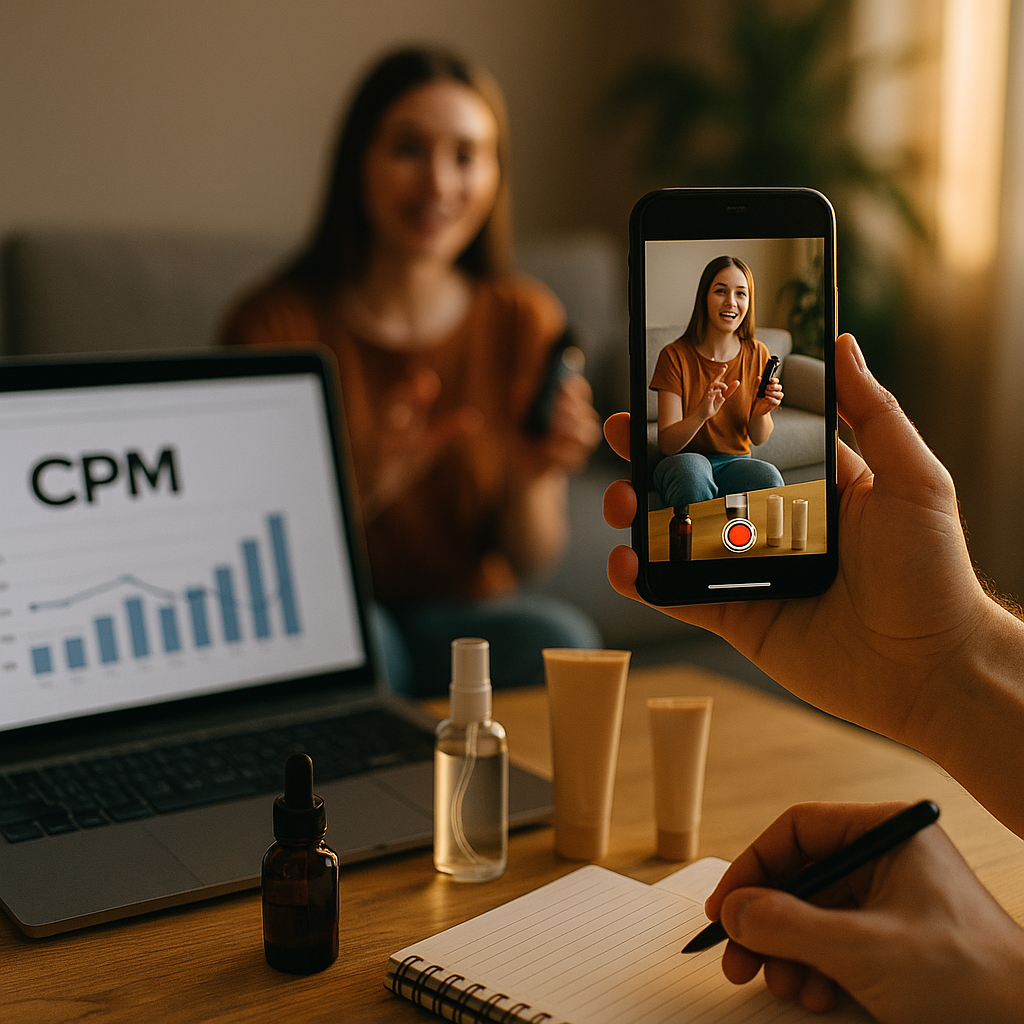
Ask a media buyer what kills their Advantage+ performance and most won’t say targeting. They’ll say creative fatigue. The ‘document, don’t create’ production model exists because brands finally admitted their polished campaign videos can’t feed the algorithm fast enough, so they’re paying creators to film like it’s a group chat, not a shoot.
The Shift Nobody Announced But Everyone Made
Somewhere between 2022 and now, the influencer brief quietly changed. Instead of “create a beautiful 30-second story about our product,” briefs started reading more like: “film yourself opening this, reacting honestly, no script.” That’s the documentation model in a sentence. Creators aren’t producing polished content anymore. They’re capturing raw, plausible-seeming moments that paid social algorithms treat as native, trustworthy, and — critically — cheap to make at volume.
This isn’t a stylistic preference. It’s an economic response to how Meta’s Advantage+ and TikTok’s Smart Performance campaigns actually work. These systems don’t reward the single best ad. They reward hundreds of creative variants they can test, kill, and iterate on in days. A single hero video, however gorgeous, is a liability in that world. It’s one data point. Documentation-style UGC gives algorithms dozens of near-identical-but-slightly-different data points to chew on.
Brands running Advantage+ and Smart Performance campaigns increasingly need creative volume over creative perfection — the algorithm optimizes faster with fifty raw variants than five polished ones.
What “Output-Based” Actually Means for Agency Contracts
The phrase “output-based” is doing real work here, and brand teams should understand what it changes contractually. Traditional influencer agency deals were relationship-based: pay for access to a creator’s audience, their creative judgment, their brand fit. Output-based deals flip that. You’re paying per deliverable, per usable asset, sometimes per approved hook. The creator becomes less a talent partner and more a content supplier.
Agencies like those built around this model — think of the wave of “UGC farms” and creator collectives that emerged specifically to serve paid social teams — structure pricing around unit economics: cost per raw clip, cost per edited variant, cost per whitelisted asset ready for ad accounts. It’s manufacturing logic applied to a creative process.
That’s a meaningful shift for procurement teams too. If you’re used to negotiating flat sponsorship fees, you’ll need new contract language covering usage rights, whitelisting duration, and asset ownership at the individual clip level, not just the campaign level. Get this wrong and you’ll be renegotiating rights every time a media buyer wants to refresh a Spark Ad.
Why Brands Are Choosing Volume Over Virality
Here’s the uncomfortable truth: most brands never needed viral content. They needed ad inventory. Virality is a vanity outcome that occasionally happens to organic content; ad performance is a media-buying outcome that happens when you have enough creative variants to let the platform’s optimization engine do its job.
Emarketer has noted for several cycles running that creator-made content increasingly outperforms brand-produced ads on cost-per-acquisition metrics, specifically because it reads as unsponsored even when it’s fully paid and disclosed. Document-style footage — bathroom mirror selfies, car reviews, unboxing shot on a phone propped against a coffee mug — carries that unsponsored texture even at scale.
So the calculus for brand marketers becomes simple, if slightly cynical: don’t ask “will this go viral?” Ask “will this survive fifty A/B tests without looking like an ad?” That’s a wholly different creative brief, and it’s one most in-house creative teams were never built to write.
The Operational Machine Behind the Model
Scaling documentation-style UGC isn’t a creative challenge so much as a logistics one. Output-based agencies have essentially built manufacturing pipelines dressed up as creator programs. A few components show up again and again:
- Standardized capture kits. Creators get shot lists, not scripts — five to eight specific moments to film (unboxing, first reaction, close-up of a feature, a testimonial-style monologue) that editors can later mix and match into dozens of ad cuts.
- Rapid intake and QA. Raw footage gets uploaded to shared drives or platform-specific tools within 24-48 hours, reviewed against brand safety and FTC disclosure requirements, then routed to editors.
- Editing at scale, not per-creator. One editing team might touch footage from 40 different creators in a week, cutting the same raw clips into a dozen different hooks, captions, and pacing variants.
- Direct whitelisting into ad accounts. The final step skips organic posting entirely in many cases. Content goes straight into Meta’s ad manager or TikTok’s Spark Ads as paid inventory, never appearing on the creator’s own feed.
That last point trips up a lot of brand teams new to this model. If the content never runs organically, is it still “influencer marketing”? Functionally, no. It’s paid media production that happens to use creator faces and creator authenticity signals. That distinction matters for how you budget it, disclose it, and measure it.
Discovery and Vetting Still Matter — Maybe More
Volume production doesn’t mean quality control disappears; if anything, it becomes more important because you’re scaling exposure to whichever creators you choose. A single bad-fit creator in a documentation pipeline can generate dozens of unusable clips, wasting editing hours and ad spend on assets that never should have shipped.
This is where discovery tooling earns its budget line. Teams evaluating creator databases for this kind of high-volume, lower-touch sourcing should look closely at how platforms handle fit signals beyond follower count — our creator discovery buyers guide breaks down what actually predicts usable output versus vanity metrics. Similarly, if you’re comparing platforms built for scaling nano-creator rosters specifically, the GRIN vs Upfluence comparison is directly relevant since nano-creators are disproportionately the ones producing this style of content.
Fraud, Fatigue, and the Risks Nobody’s Pricing In
Scale creates its own risks. When you’re running hundreds of creators through a documentation pipeline, manual vetting breaks down fast. Bot-inflated followings, engagement farms, and outright fabricated creator profiles slip through more easily when your team is optimizing for throughput rather than relationship depth.
Fraud detection tooling has become less of a nice-to-have and more of a prerequisite for output-based programs. Agencies serious about this model are pairing sourcing platforms with dedicated fraud layers — our fraud-detection tools comparison covers what to look for, and the trendHERO vs Openinfluence breakdown is particularly useful for teams sourcing at the micro and nano tier where fraud rates tend to spike.
At high volume, a 5% fraud rate in your creator pipeline isn’t a rounding error — it’s dozens of wasted briefs, wasted editing hours, and wasted ad spend every single month.
There’s also creative fatigue to manage, ironically the very problem this model was built to solve. Feeding an algorithm fifty variants of the same three hooks eventually produces diminishing returns too. Agencies that do this well rotate creator cohorts every four to six weeks and diversify shot lists constantly, treating creative refresh cadence as seriously as media buyers treat bid strategy.
Compliance Isn’t Optional Just Because It’s “Raw”
One dangerous assumption brand teams make: that because documentation-style content looks casual, it’s exempt from the same disclosure rigor as polished campaigns. It isn’t. The FTC’s endorsement guidelines apply regardless of production value. A shaky, unscripted phone video that’s paid and whitelisted into ads still needs clear, conspicuous disclosure, and regulators have shown no patience for the argument that “it looks organic, so it doesn’t count.”
UK brands running similar programs should keep the ICO’s guidance in view too, particularly around data handling when creators submit footage through third-party capture tools that may process personal data in the background.
Practically, this means output-based agencies need disclosure checks built into intake QA, not bolted on afterward. If a creator’s raw footage doesn’t include a spoken or on-screen disclosure and the edit doesn’t add one, that clip shouldn’t clear review, no matter how well it tests.
Measuring What Actually Works
Because documentation content is priced and produced like inventory, it should be measured like inventory too: cost per usable asset, cost per thousand impressions once whitelisted, and creative fatigue curves per hook. Vanity engagement metrics (likes, shares on the creator’s own post) are mostly irrelevant here since much of this content never runs organically.
Brands serious about this model are increasingly pairing it with server-side tracking and identity resolution to connect ad-level creative performance back to actual purchase behavior, not just platform-reported clicks. If your current attribution setup can’t answer “which of these forty UGC variants actually drove incremental revenue,” that’s a gap worth closing before you scale spend further — see our server-side tracking guide for what compliant setups look like in practice.
Platforms like Sprout Social and reporting from Statista continue to show creator-sourced content outperforming brand-produced assets on cost efficiency, which is precisely why this model keeps expanding rather than fading as a trend.
Where This Goes Next
The next logical step, already underway at a handful of agencies, is treating creators explicitly as raw-footage suppliers with tiered pricing based on output speed and usability rate, not follower count at all. That’s a genuinely different labor market than influencer marketing as most brand teams learned it, and it rewards creators who can reliably deliver bankable, algorithm-friendly footage over creators with big but unpredictable audiences.
If you’re evaluating agencies or platforms for this kind of work, ask directly how they price output, how they handle whitelisting rights, and how fast they can turn raw footage into ad-ready cuts. Those three answers will tell you more than any case study reel.
Start small: run one output-based cohort of ten to fifteen creators against a single product line for six weeks, track cost per usable asset against your current agency retainer model, and let the numbers make the case before you scale spend.
FAQs
What does “document, don’t create” actually mean in a creator brief?
It means giving creators a shot list of realistic moments to capture — unboxing, first reaction, a feature close-up — rather than a scripted concept. The goal is footage that reads as unscripted and native to the platform, which performs better in paid social algorithms than polished, obviously-produced content.
Is this model replacing traditional influencer partnerships?
Not entirely, but it’s capturing a growing share of budget specifically earmarked for paid social ad inventory. Brand-building partnerships with larger creators still have a place; documentation-style UGC is filling the volume gap that Advantage+ and Smart Performance campaigns created.
How is output-based pricing different from standard influencer fees?
Output-based pricing is tied to deliverables — raw clips, edited variants, whitelisted assets — rather than a flat sponsorship fee for a single post. It shifts contract structure toward per-unit cost, usage rights duration, and whitelisting terms rather than one-time creative fees.
Does documentation-style content still need FTC disclosure?
Yes. Production value has no bearing on disclosure requirements. Paid, whitelisted content must carry clear and conspicuous disclosure regardless of how raw or unscripted it appears.
What’s the biggest operational risk in scaling this model?
Fraud and fit mismatches compound quickly at volume. A small percentage of low-quality or fraudulent creators can generate a disproportionate amount of wasted footage, editing time, and ad spend if vetting isn’t automated and rigorous.
Visible FAQ (JSON-LD Below)
Top Influencer Marketing Agencies
The leading agencies shaping influencer marketing in 2026
Agencies ranked by campaign performance, client diversity, platform expertise, proven ROI, industry recognition, and client satisfaction. Assessed through verified case studies, reviews, and industry consultations.
Moburst

-
2

The Shelf
Boutique Beauty & Lifestyle Influencer AgencyA data-driven boutique agency specializing exclusively in beauty, wellness, and lifestyle influencer campaigns on Instagram and TikTok. Best for brands already focused on the beauty/personal care space that need curated, aesthetic-driven content.Clients: Pepsi, The Honest Company, Hims, Elf Cosmetics, Pure LeafVisit The Shelf → -
3

Audiencly
Niche Gaming & Esports Influencer AgencyA specialized agency focused exclusively on gaming and esports creators on YouTube, Twitch, and TikTok. Ideal if your campaign is 100% gaming-focused — from game launches to hardware and esports events.Clients: Epic Games, NordVPN, Ubisoft, Wargaming, Tencent GamesVisit Audiencly → -
4

Viral Nation
Global Influencer Marketing & Talent AgencyA dual talent management and marketing agency with proprietary brand safety tools and a global creator network spanning nano-influencers to celebrities across all major platforms.Clients: Meta, Activision Blizzard, Energizer, Aston Martin, WalmartVisit Viral Nation → -
5

The Influencer Marketing Factory
TikTok, Instagram & YouTube CampaignsA full-service agency with strong TikTok expertise, offering end-to-end campaign management from influencer discovery through performance reporting with a focus on platform-native content.Clients: Google, Snapchat, Universal Music, Bumble, YelpVisit TIMF → -
6

NeoReach
Enterprise Analytics & Influencer CampaignsAn enterprise-focused agency combining managed campaigns with a powerful self-service data platform for influencer search, audience analytics, and attribution modeling.Clients: Amazon, Airbnb, Netflix, Honda, The New York TimesVisit NeoReach → -
7

Ubiquitous
Creator-First Marketing PlatformA tech-driven platform combining self-service tools with managed campaign options, emphasizing speed and scalability for brands managing multiple influencer relationships.Clients: Lyft, Disney, Target, American Eagle, NetflixVisit Ubiquitous → -
8

Obviously
Scalable Enterprise Influencer CampaignsA tech-enabled agency built for high-volume campaigns, coordinating hundreds of creators simultaneously with end-to-end logistics, content rights management, and product seeding.Clients: Google, Ulta Beauty, Converse, AmazonVisit Obviously →