


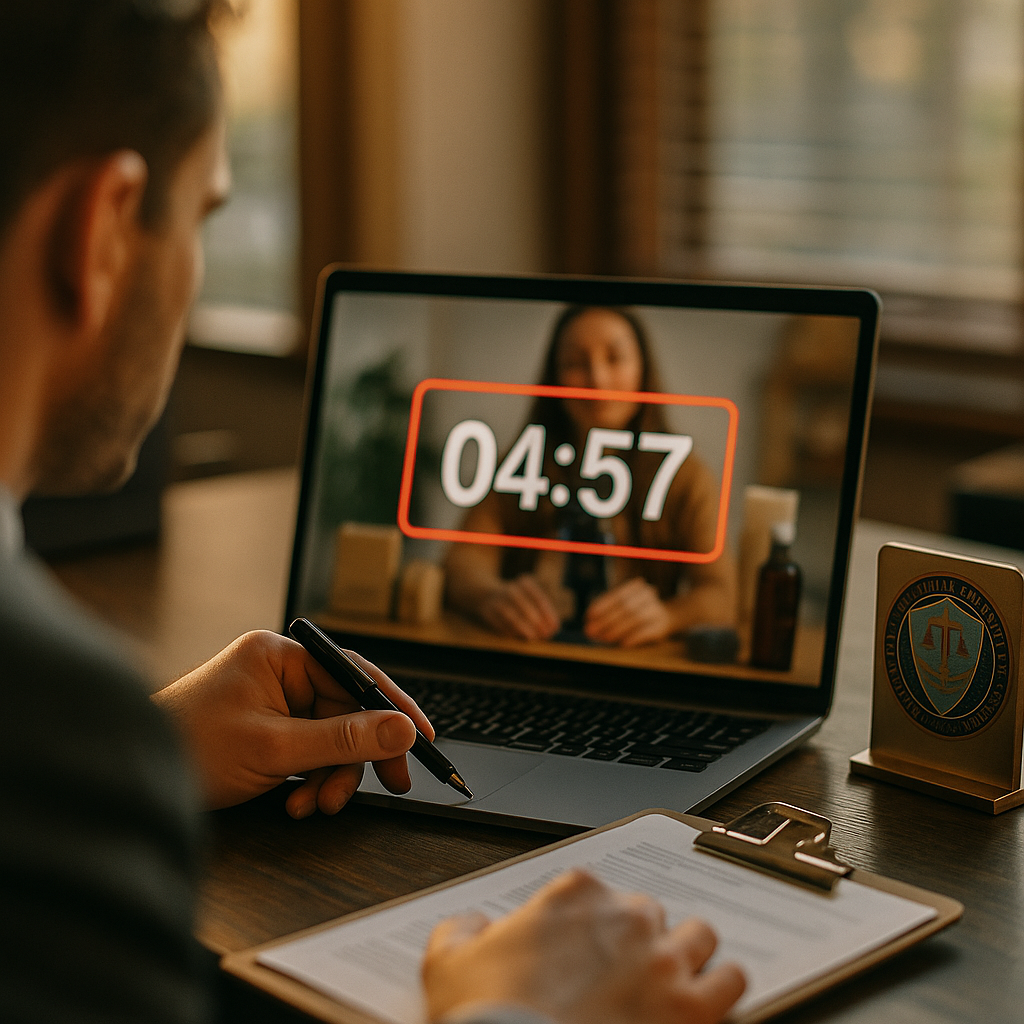
A countdown timer that resets every time a viewer refreshes the page isn’t urgency — it’s a fabrication. And the FTC has made clear it’s watching. If your brand runs livestream shopping events with ticking clocks, “only 3 left” banners, or flash-sale graphics, your legal team needs an audit process, not a hope-and-pray policy. The livestream shopping countdown timer has become one of the most litigated UI elements in ecommerce, and most brands still treat it as a design decision instead of a compliance risk.
Why This Suddenly Matters to Legal, Not Just Marketing
Countdown timers used to be a growth-hacking footnote. Now they’re a headline risk. The FTC’s rule on fake reviews and deceptive endorsements already signaled the agency’s appetite for policing manufactured urgency, and state attorneys general have followed with their own deceptive-practices enforcement, often under mini-FTC Act statutes that give them independent teeth.
Livestream shopping makes this worse, not better. A TikTok Shop or Amazon Live event compresses the sales funnel into minutes. Hosts say “only 12 units left” while a graphic ticks down from ten minutes. Viewers can’t fact-check that in real time. If the claim is false, or if the timer resets for the next viewer, you’ve built a deception machine and put it on autoplay for six hours straight.
A countdown that quietly resets after each livestream session isn’t a marketing tactic — under FTC guidance, it’s the textbook definition of a deceptive urgency claim.
Legal teams that treat this as “marketing’s problem” are the same ones fielding demand letters eighteen months later. Better to own the audit now.
What the FTC Actually Prohibits Here
The FTC doesn’t have a rule titled “Countdown Timers.” Instead, deceptive-urgency claims fall under Section 5 of the FTC Act’s general prohibition on unfair or deceptive acts or practices, reinforced by the agency’s longstanding guidance on advertising substantiation. The core test: would a reasonable consumer be misled about a material fact that affects their purchase decision?
Three patterns draw the most scrutiny:
- Fake scarcity — claiming limited inventory when stock is actually plentiful or replenished automatically.
- Fake urgency — a timer that doesn’t actually control price, availability, or offer expiration, and simply resets or restarts.
- Undisclosed repeat offers — presenting a “one-time only” deal that reappears in the next livestream, the next day, or the next hour.
The FTC’s enforcement actions against ecommerce dark patterns, documented on ftc.gov, consistently cite the gap between the claim displayed and the operational reality behind it. If your backend can prove the timer maps to a real event, you’re fine. If it can’t, you have exposure regardless of intent.
The Livestream-Specific Wrinkle
Standard ecommerce countdown audits assume a static webpage. Livestream shopping breaks that assumption in several ways.
First, hosts improvise. A creator on a brand’s TikTok Shop livestream might say “this is the last batch” without checking inventory dashboards in real time. That’s a verbal urgency claim stacked on top of a visual one, and it’s harder to control because it’s live speech, not pre-approved copy.
Second, replay and clip culture complicates timing. A livestream that airs at 8 PM with a “sale ends tonight” timer often gets clipped and reposted the next day, sometimes by the brand’s own social team, with the countdown graphic still visible and clearly wrong. Viewers watching the clip see an expired countdown treated as current.
Third, multiple concurrent sessions create inconsistency. If a brand runs simultaneous livestreams across TikTok Shop and Amazon Live with different inventory pools but identical countdown graphics, you risk two different “truths” airing at once. That’s a coordination failure legal rarely catches because it sits between platform teams.
This is closely related to the disclosure problems covered in TikTok countdown timers and state deceptive-urgency law risk, where state-level statutes add another enforcement layer on top of federal rules.
Building the Audit: A Five-Point Framework
Skip the generic “review your marketing claims” checklist. Here’s what an actual audit needs to test.
1. Backend-to-Frontend Reconciliation
Pull the inventory management system data for the exact SKU shown during the livestream. Compare it against what the host claimed on air and what the graphic displayed. Do this for a sample of past streams, not just the next one. If your ecommerce platform (Shopify, Salesforce Commerce Cloud, whatever you run) can’t produce a timestamped inventory snapshot, that’s your first finding: no substantiation trail exists.
2. Timer Logic Audit
Ask your dev team, in writing, how the countdown timer is generated. Is it tied to an actual offer-expiration field in the database, or is it a client-side JavaScript countdown that just… starts when the page loads? The second version resets for every new viewer and is functionally indistinguishable from a lie. This is the single most common failure point legal teams find once they actually ask the question.
3. Script and Talking-Points Review
Creator scripts or talking-point sheets should explicitly prohibit unverified urgency claims (“last one,” “selling out fast,” “price goes up at midnight”) unless a specific data source backs them up in real time. Build this into creator briefs alongside disclosure language, similar to how TikTok Shop livestream disclosure clauses are now standard in creator contracts.
4. Clip and Repost Lifecycle Check
Map every place a livestream clip can end up: brand TikTok, creator reposts, UGC compilations, paid ad boosts. Countdown graphics and urgency claims need an expiration protocol, meaning someone owns pulling or editing clips once the underlying offer lapses. Most brands have zero process for this. It’s the audit finding that surprises legal teams most often.
5. Cross-Platform Consistency Test
If the same promotion runs on TikTok Shop, Instagram Live, and Amazon Live simultaneously, verify the inventory pool and messaging match across all three. Divergent claims about the “same” sale, even if each is individually accurate, invite a pattern-of-deception argument.
For a more granular version of this checklist mapped specifically to TikTok Shop’s tools, see TikTok Shop countdown timer legal checklist for FTC rules.
Documentation: Your Best (and Only) Defense
Regulators don’t expect perfection. They expect a good-faith substantiation process. If the FTC or a state AG comes knocking, the question isn’t “was the countdown 100% accurate at all times” — it’s “did the brand have a reasonable basis for the claim when it was made, and can it prove that basis.”
That means your audit output can’t just be a verbal sign-off from marketing. You need:
- Timestamped inventory logs tied to each livestream session
- Screenshots or recordings of the countdown graphic at stream start and end
- Creator script approvals showing urgency language was reviewed pre-air
- A takedown log showing when expired-offer clips were pulled or edited
The brands getting burned aren’t the ones running scarcity tactics — they’re the ones who can’t produce a single document proving the scarcity was real.
Retailers running retail media livestreams face a parallel version of this problem; the audit logic in retail media disclosure audits for Amazon and Walmart Connect is worth cross-referencing if your livestream program touches marketplace-owned channels.
Who Should Own This, Operationally?
This can’t sit entirely with outside counsel reviewing quarterly. Countdown timers move too fast for a quarterly cadence. The workable model splits ownership three ways: legal sets the standard and reviews sample audits monthly, marketing ops builds the backend reconciliation into the livestream production checklist, and a designated compliance liaison (sometimes in-house counsel, sometimes a trust-and-safety hire) signs off on scripts before air.
Brands running high-volume programs, think multiple livestreams weekly, increasingly build this into their broader content audit protocol rather than treating it as a one-off legal review. The framework in how to build an AI content audit protocol before you publish applies well here, especially as more brands use AI tools to generate countdown graphics and dynamic pricing displays automatically.
Industry data backs the urgency (no pun intended) of getting this right. Livestream shopping in the US is projected to keep growing steadily according to eMarketer estimates, meaning more brands are running more countdown-driven events with less legal oversight per stream than a traditional ad campaign would ever get. Volume is outpacing governance. That gap is exactly where enforcement actions come from.
Next Step
Don’t wait for a state AG letter to find out your countdown timer resets on page load. Run the five-point audit on your last three livestreams this week, and if you can’t produce a timestamped inventory log for even one of them, that’s your top priority fix before your next scheduled event.
FAQs
Is a livestream shopping countdown timer illegal under FTC rules?
Not inherently. Countdown timers are legal marketing tools as long as they reflect a real, verifiable offer condition. They become a problem when the timer resets, doesn’t correspond to actual inventory or pricing changes, or misleads a reasonable viewer about scarcity.
What counts as “deceptive urgency” under FTC guidance?
Deceptive urgency is any claim implying a time-limited or scarce offer that isn’t actually time-limited or scarce. Examples include timers that restart for each viewer, “limited stock” claims when inventory is continuously replenished, and “one-time” deals repeated across multiple livestreams.
Does this apply to creator-hosted livestreams or only brand-owned ones?
Both. If a brand sponsors or directs a creator’s livestream and the creator makes unverified urgency claims, the brand can share liability for deceptive practices, especially if the brand supplied talking points or approved the script.
How often should legal audit livestream countdown timers?
High-volume programs (multiple livestreams weekly) should build reconciliation checks into every event’s production checklist, with legal reviewing a sample monthly. Lower-volume programs can audit quarterly, but any audit cadence needs documented inventory and script records for every stream, not just the ones reviewed.
What documentation should brands keep to defend against a deceptive-urgency claim?
Timestamped inventory logs, screenshots or recordings of countdown graphics at stream start and end, creator script approvals showing urgency claims were reviewed pre-air, and a takedown log for expired-offer clips that continue circulating after the sale ends.
Top Influencer Marketing Agencies
The leading agencies shaping influencer marketing in 2026
Agencies ranked by campaign performance, client diversity, platform expertise, proven ROI, industry recognition, and client satisfaction. Assessed through verified case studies, reviews, and industry consultations.
Moburst

-
2

The Shelf
Boutique Beauty & Lifestyle Influencer AgencyA data-driven boutique agency specializing exclusively in beauty, wellness, and lifestyle influencer campaigns on Instagram and TikTok. Best for brands already focused on the beauty/personal care space that need curated, aesthetic-driven content.Clients: Pepsi, The Honest Company, Hims, Elf Cosmetics, Pure LeafVisit The Shelf → -
3

Audiencly
Niche Gaming & Esports Influencer AgencyA specialized agency focused exclusively on gaming and esports creators on YouTube, Twitch, and TikTok. Ideal if your campaign is 100% gaming-focused — from game launches to hardware and esports events.Clients: Epic Games, NordVPN, Ubisoft, Wargaming, Tencent GamesVisit Audiencly → -
4

Viral Nation
Global Influencer Marketing & Talent AgencyA dual talent management and marketing agency with proprietary brand safety tools and a global creator network spanning nano-influencers to celebrities across all major platforms.Clients: Meta, Activision Blizzard, Energizer, Aston Martin, WalmartVisit Viral Nation → -
5

The Influencer Marketing Factory
TikTok, Instagram & YouTube CampaignsA full-service agency with strong TikTok expertise, offering end-to-end campaign management from influencer discovery through performance reporting with a focus on platform-native content.Clients: Google, Snapchat, Universal Music, Bumble, YelpVisit TIMF → -
6

NeoReach
Enterprise Analytics & Influencer CampaignsAn enterprise-focused agency combining managed campaigns with a powerful self-service data platform for influencer search, audience analytics, and attribution modeling.Clients: Amazon, Airbnb, Netflix, Honda, The New York TimesVisit NeoReach → -
7

Ubiquitous
Creator-First Marketing PlatformA tech-driven platform combining self-service tools with managed campaign options, emphasizing speed and scalability for brands managing multiple influencer relationships.Clients: Lyft, Disney, Target, American Eagle, NetflixVisit Ubiquitous → -
8

Obviously
Scalable Enterprise Influencer CampaignsA tech-enabled agency built for high-volume campaigns, coordinating hundreds of creators simultaneously with end-to-end logistics, content rights management, and product seeding.Clients: Google, Ulta Beauty, Converse, AmazonVisit Obviously →