


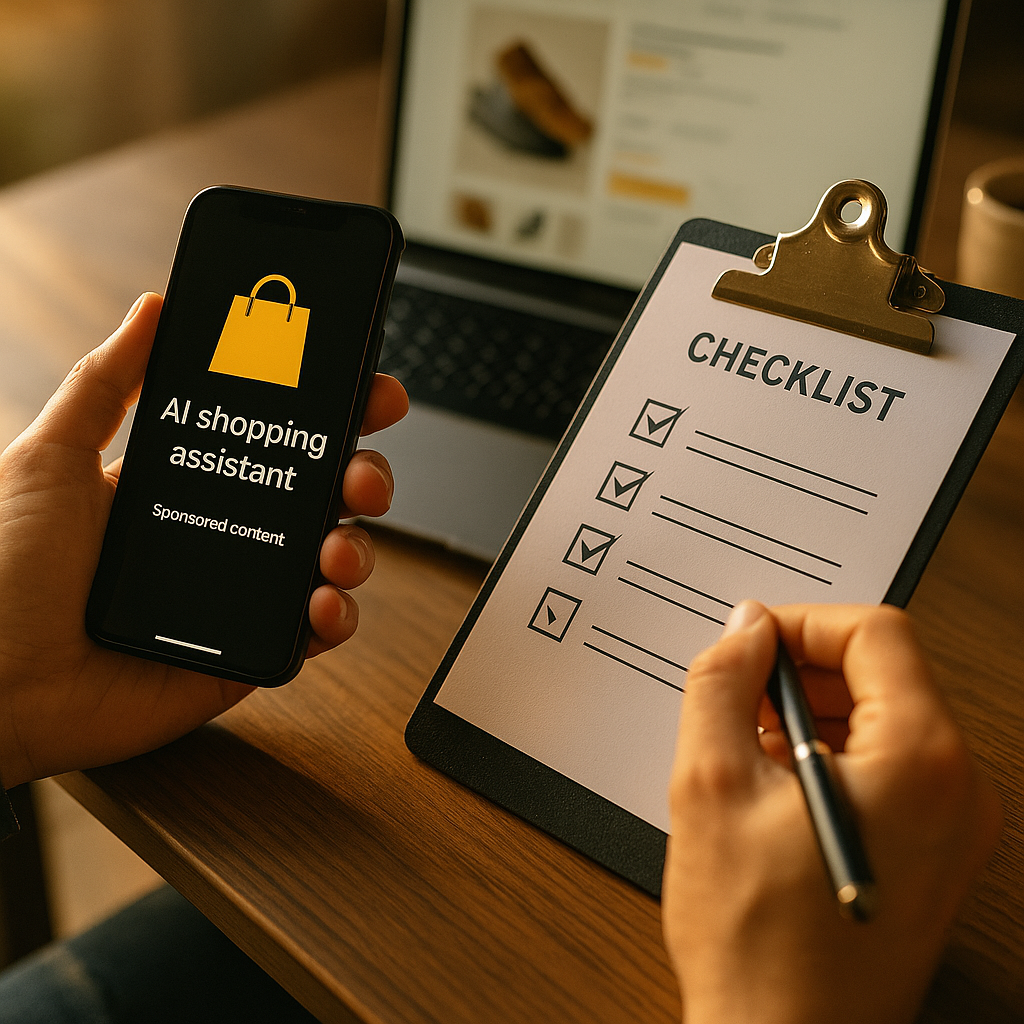
By some estimates, over 60% of online shoppers will interact with an AI shopping agent this year, whether they realize it or not. Here’s the uncomfortable question that follows: who’s liable when that agent recommends a product because of an undisclosed brand relationship? The AI shopping agent compliance checklist your legal team hasn’t finished writing yet is about to become mandatory reading.
Agentic commerce isn’t a future-state hypothetical anymore. ChatGPT shopping, Perplexity’s shopping assistant, Amazon’s Rufus, Google’s Gemini-powered shopping tools — these systems are already recommending, comparing, and in some cases completing purchases on behalf of users. The FTC has taken notice, and its endorsement guidance, historically built for human influencers holding up a product on camera, is stretching to cover machines that talk like influencers but never blink.
Why the FTC Is Widening the Net
The FTC’s Endorsement Guides were written for a world of humans endorsing products to other humans. But the agency has been explicit, in enforcement actions and public statements, that the underlying principle — don’t deceive consumers about material connections — is technology-agnostic. It doesn’t matter if the “endorser” is a creator, a chatbot, or an autonomous shopping agent stitched into a checkout flow. If money, free product, or preferential ranking influenced the recommendation, and the consumer doesn’t know that, it’s a problem.
Regulators have already signaled concern about AI systems that blur the line between organic recommendation and paid placement. The Commission’s guidance on endorsements and testimonials increasingly gets cited in discussions about algorithmic recommendations, not just human ones. That’s a meaningful shift for any brand paying to get surfaced inside an AI shopping experience.
If your AI shopping agent recommends your product because you paid for placement, and the interface doesn’t say so clearly, you’re running the same legal risk as an influencer who forgets to type #ad.
This isn’t theoretical for retail media teams. Amazon and Walmart Connect have both been building sponsored-placement logic into their AI shopping tools, and disclosure practices there are already under scrutiny — see our breakdown of retail media disclosure audits for how that’s playing out in practice.
What Counts as an “Endorsement” When There’s No Human Involved?
Good question. And frankly, the FTC hasn’t issued a bright-line rule that answers it perfectly. But based on existing guidance and enforcement patterns, three scenarios are almost certainly going to trigger disclosure obligations:
- Paid ranking or placement: Your product appears higher in an AI agent’s recommendations because you paid for it, whether through a retail media deal, an API partnership, or a data-sharing arrangement.
- Material connections baked into training or tuning: If a brand paid to have its products weighted more favorably during model fine-tuning or prompt engineering, that’s a material connection even if no single transaction is “sponsored.”
- Affiliate-style commission structures: If the platform running the shopping agent earns a commission when the agent completes a purchase, and that commission structure shapes which products get recommended, disclosure expectations likely apply.
Notice the pattern. It’s not about whether a human said the words. It’s about whether money changed hands and whether that fact is hidden from the consumer making the decision.
The Compliance Checklist
Here’s where it gets operational. If your brand is paying to appear inside AI shopping agents, or building your own agent to recommend products, run through this list before launch — and quarterly after that.
1. Map every material connection in the recommendation chain
Start with a simple exercise: trace the path from “user asks a question” to “agent recommends your product” to “purchase completes.” Document every point where money, data, or preferential treatment enters that chain. Retail media placements, affiliate commissions, co-marketing deals with the platform provider — all of it needs to be on paper before you can assess disclosure risk.
2. Confirm disclosure language actually renders in the agent’s response
This is where a lot of brands will get tripped up. A disclosure buried in a platform’s terms of service doesn’t satisfy the FTC’s “clear and conspicuous” standard. The disclosure needs to appear in the actual interaction — the chat response, the product card, the checkout summary — not three clicks away in a policy document. Test this yourself. Ask the agent about your product category and see what actually shows up on screen.
3. Audit for “deceptive optimization”
If your team is running A/B tests on how an AI agent phrases recommendations to maximize conversion, and one of those variants happens to obscure the sponsored nature of the placement, that’s a red flag. Optimization for conversion and optimization for concealment can look identical in a dashboard. They are not identical legally.
4. Get contractual guarantees from every AI shopping platform you work with
Don’t just take a platform’s word that “we handle disclosure on our end.” Get it in writing. Contracts with AI shopping platforms, retail media networks, or agentic commerce vendors should specify exactly how sponsored placement will be disclosed, where liability sits if disclosure fails, and what audit rights your brand retains. This is functionally the same conversation the industry has already had around liability riders for autonomous bidding agents — the shopping-agent version just extends it to the consumer-facing side of the transaction.
5. Build a change-log for agent behavior
AI shopping agents get retrained, re-tuned, and updated constantly. A disclosure practice that was compliant last quarter can silently break after a model update changes how recommendations are phrased or ranked. Treat this the same way you’d treat model deprecation risk in any other vendor contract: require notice when the underlying model changes, and re-test disclosure rendering after every update.
6. Separate “recommendation” disclosure from “autonomous purchase” disclosure
Here’s a nuance a lot of compliance teams are missing. An agent that recommends a product creates one kind of disclosure obligation. An agent that autonomously completes a purchase — using stored payment credentials, no human confirmation click — creates a second, arguably heavier one. Consumers need to know both that the recommendation was influenced by a paid relationship, and that the transaction itself was executed without their final review. State-level consumer protection laws are starting to layer additional requirements on top of the FTC’s baseline here, particularly around consent and cancellation rights.
7. Document your own agent’s training data provenance
If you’re building a proprietary shopping agent for your own e-commerce site, the compliance conversation extends further back. What data trained the recommendation logic? Did it include creator content, reviews, or influencer posts that themselves carried disclosure obligations? If your agent surfaces or paraphrases influencer endorsements without preserving the original disclosure, you may be inheriting a compliance gap. This connects directly to the consent issues we’ve covered in AI remix consent clauses for creator contracts.
Where Brands Are Getting This Wrong Right Now
The most common mistake isn’t malicious concealment. It’s assuming that because no human is talking, the endorsement rules don’t apply. That assumption is going to age badly.
The second most common mistake: treating AI shopping agent compliance as a one-time legal review instead of an ongoing operational process. Influencer disclosure compliance took years for brands to operationalize properly — building audit protocols, contract language, and monitoring systems. The same maturity curve is now compressed into a much shorter window for agentic commerce, because the FTC has already shown its hand on adjacent issues like AI-generated content and synthetic media. For a sense of how fast this space moves, look at how quickly platforms had to reconcile AI labeling with FTC disclosure rules once regulators started paying attention.
Treat AI shopping agent compliance the way you’d treat any high-velocity regulatory area: build the audit cadence now, not after the first enforcement action names a brand in your category.
There’s also a data governance layer that’s easy to overlook. Every AI shopping agent runs on data — purchase history, browsing behavior, sometimes biometric or demographic signals used for personalization. The contracts governing that data flow need the same scrutiny you’d apply to any AI marketing platform relationship. Our data governance clause framework is a useful starting point if you haven’t audited those agreements recently.
What Good Looks Like
Brands that get ahead of this will build three things: a documented disclosure standard that travels across every AI shopping platform they touch, contract language that pushes liability and audit rights back onto platform vendors where appropriate, and a recurring testing cadence that catches drift when models update. None of this is exotic. It’s the same discipline the industry already applies to gifted and affiliate post disclosure, just pointed at a newer, faster-moving surface.
For a broader view of how this fits into the wider compliance picture, our AI shopping agent compliance framework lays out the structural pieces brand and legal teams need to align on before scaling any agentic commerce partnership.
Industry benchmarking from firms like eMarketer and Statista continues to show accelerating consumer adoption of AI-assisted shopping, which means the regulatory attention isn’t going to slow down either. Get the checklist running before enforcement makes it mandatory reading for your legal team under worse circumstances.
Frequently Asked Questions
Does FTC endorsement guidance actually apply to AI shopping agents?
The FTC hasn’t issued an AI-shopping-agent-specific rule, but its existing Endorsement Guides are built around material connections and consumer deception, not around whether the endorser is human. Legal experts widely expect enforcement to extend to autonomous recommendation systems where paid placement isn’t disclosed.
Who is liable if an AI shopping agent fails to disclose a sponsored placement?
Liability likely extends to both the brand paying for placement and the platform operating the agent, similar to how both advertisers and influencers can face FTC scrutiny in traditional endorsement cases. Contracts should explicitly allocate this risk rather than leaving it ambiguous.
What’s the difference between disclosure for recommendations versus autonomous purchases?
A recommendation disclosure tells the consumer a paid relationship influenced what was suggested. An autonomous purchase disclosure addresses the fact that a transaction was completed without a final human confirmation click, which raises separate consent and cancellation-rights questions under state consumer protection laws.
How often should brands audit their AI shopping agent partnerships?
At minimum quarterly, and immediately after any known model update or retraining event on the platform side. Disclosure rendering can silently break when underlying models change, so testing needs to be continuous, not a one-time launch checklist.
Can retail media placements inside AI shopping tools trigger endorsement rules?
Yes. If a brand pays for preferential placement inside an AI shopping agent’s recommendations, that payment is a material connection under FTC principles, regardless of whether the placement looks like an organic answer to the shopper.
Frequently Asked Questions
Does FTC endorsement guidance actually apply to AI shopping agents?
The FTC hasn’t issued an AI-shopping-agent-specific rule, but its existing Endorsement Guides are built around material connections and consumer deception, not around whether the endorser is human. Legal experts widely expect enforcement to extend to autonomous recommendation systems where paid placement isn’t disclosed.
Who is liable if an AI shopping agent fails to disclose a sponsored placement?
Liability likely extends to both the brand paying for placement and the platform operating the agent, similar to how both advertisers and influencers can face FTC scrutiny in traditional endorsement cases. Contracts should explicitly allocate this risk rather than leaving it ambiguous.
What’s the difference between disclosure for recommendations versus autonomous purchases?
A recommendation disclosure tells the consumer a paid relationship influenced what was suggested. An autonomous purchase disclosure addresses the fact that a transaction was completed without a final human confirmation click, which raises separate consent and cancellation-rights questions under state consumer protection laws.
How often should brands audit their AI shopping agent partnerships?
At minimum quarterly, and immediately after any known model update or retraining event on the platform side. Disclosure rendering can silently break when underlying models change, so testing needs to be continuous, not a one-time launch checklist.
Can retail media placements inside AI shopping tools trigger endorsement rules?
Yes. If a brand pays for preferential placement inside an AI shopping agent’s recommendations, that payment is a material connection under FTC principles, regardless of whether the placement looks like an organic answer to the shopper.
Top Influencer Marketing Agencies
The leading agencies shaping influencer marketing in 2026
Agencies ranked by campaign performance, client diversity, platform expertise, proven ROI, industry recognition, and client satisfaction. Assessed through verified case studies, reviews, and industry consultations.
Moburst

-
2

The Shelf
Boutique Beauty & Lifestyle Influencer AgencyA data-driven boutique agency specializing exclusively in beauty, wellness, and lifestyle influencer campaigns on Instagram and TikTok. Best for brands already focused on the beauty/personal care space that need curated, aesthetic-driven content.Clients: Pepsi, The Honest Company, Hims, Elf Cosmetics, Pure LeafVisit The Shelf → -
3

Audiencly
Niche Gaming & Esports Influencer AgencyA specialized agency focused exclusively on gaming and esports creators on YouTube, Twitch, and TikTok. Ideal if your campaign is 100% gaming-focused — from game launches to hardware and esports events.Clients: Epic Games, NordVPN, Ubisoft, Wargaming, Tencent GamesVisit Audiencly → -
4

Viral Nation
Global Influencer Marketing & Talent AgencyA dual talent management and marketing agency with proprietary brand safety tools and a global creator network spanning nano-influencers to celebrities across all major platforms.Clients: Meta, Activision Blizzard, Energizer, Aston Martin, WalmartVisit Viral Nation → -
5

The Influencer Marketing Factory
TikTok, Instagram & YouTube CampaignsA full-service agency with strong TikTok expertise, offering end-to-end campaign management from influencer discovery through performance reporting with a focus on platform-native content.Clients: Google, Snapchat, Universal Music, Bumble, YelpVisit TIMF → -
6

NeoReach
Enterprise Analytics & Influencer CampaignsAn enterprise-focused agency combining managed campaigns with a powerful self-service data platform for influencer search, audience analytics, and attribution modeling.Clients: Amazon, Airbnb, Netflix, Honda, The New York TimesVisit NeoReach → -
7

Ubiquitous
Creator-First Marketing PlatformA tech-driven platform combining self-service tools with managed campaign options, emphasizing speed and scalability for brands managing multiple influencer relationships.Clients: Lyft, Disney, Target, American Eagle, NetflixVisit Ubiquitous → -
8

Obviously
Scalable Enterprise Influencer CampaignsA tech-enabled agency built for high-volume campaigns, coordinating hundreds of creators simultaneously with end-to-end logistics, content rights management, and product seeding.Clients: Google, Ulta Beauty, Converse, AmazonVisit Obviously →