


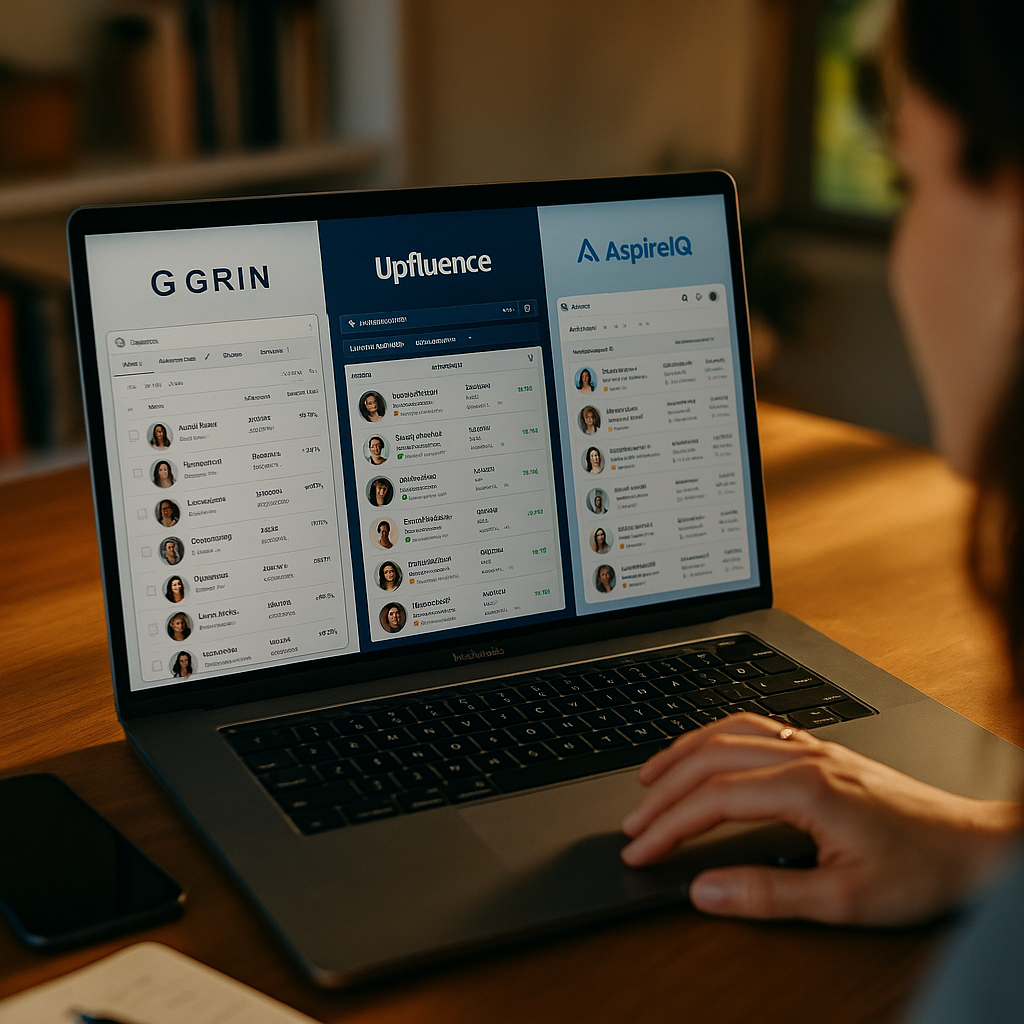
Run a nano-creator program past 500 active profiles and the cracks in your discovery tooling start showing fast. Manual vetting collapses. Spreadsheets lie. The question isn’t whether you need AI-assisted discovery — it’s which platform’s module actually holds up at volume. This comparison of GRIN, Upfluence, and AspireIQ looks specifically at high-volume nano-creator roster management, not the polished demo version every vendor shows you.
Why Nano-Creator Volume Breaks Most Discovery Tools
Nano-creators (typically 1K-10K followers) generate outsized engagement relative to cost — that’s the whole pitch. Brands like Chipotle and Gymshark have built entire ambassador tiers around this math. But the operational reality is brutal: managing 2,000 nano-creators requires the same relationship infrastructure as managing 50 macro-influencers, multiplied by forty. Discovery isn’t the hard part. Filtering, deduplicating, and continuously refreshing a roster that size is where platforms either earn their subscription fee or become expensive shelfware.
Most AI discovery modules were originally built for macro and mid-tier search — find the right 20 creators for a campaign. Retrofitting that architecture for thousands of nano profiles updating weekly is a different engineering problem entirely.
GRIN: Strong CRM Backbone, Discovery Still Playing Catch-Up
GRIN’s core strength has always been relationship management, not discovery. Its AI-assisted search layer pulls from a database that’s respectable in size but noticeably thinner on nano-tier creators compared to its mid-tier and macro coverage. For brands running high-volume nano programs, this means more manual sourcing upfront and heavier reliance on GRIN’s Chrome extension to pull creators from Instagram and TikTok directly.
Where GRIN earns points is post-discovery workflow. Once a nano-creator is in the system, GRIN’s automation for contracts, product seeding, and payment is genuinely fast. That matters enormously at scale — if you’re managing 3,000 relationships, the discovery-to-activation handoff needs to be near-instant or your team drowns in admin. We covered this trade-off in more depth in our GRIN pricing breakdown, and the enterprise cost structure only makes sense if you’re leaning hard on that CRM muscle rather than the discovery engine itself.
The platforms that win at nano-creator scale aren’t necessarily the ones with the biggest database — they’re the ones with the fastest discovery-to-contract pipeline.
Where GRIN Falls Short
- AI lookalike search returns fewer nano-tier results than competitors in fashion, beauty, and lifestyle verticals
- Fraud and fake-follower flagging is less granular than dedicated vetting tools
- Bulk import from CSV or CRM lists works but lacks real-time enrichment
Upfluence: Built for Volume, Weaker on Qualitative Signals
Upfluence’s AI discovery module is the closest thing to purpose-built for this exact use case. Its database indexes hundreds of millions of creator profiles, and the search filters (engagement rate, audience location, past brand mentions) are granular enough to build nano-creator segments in the tens of thousands. If pure volume and filtering speed are your top priority, Upfluence generally wins that head-to-head.
The trade-off shows up in qualitative signal detection. Upfluence’s AI is strong at pattern-matching against structured data — follower counts, hashtag usage, posting frequency — but weaker at surfacing brand-fit nuance the way a human strategist would. At nano scale that’s a real risk, because nano-creators succeed on authenticity signals that don’t always show up cleanly in a database query. We broke down this exact scaling tension in GRIN vs Upfluence for nano-creator scaling, and the conclusion holds: Upfluence wins on raw throughput, GRIN wins on relationship depth.
Upfluence also integrates ecommerce and influencer data more tightly than the other two, which matters if your nano program is commission-driven rather than flat-fee. For Shopify-native brands running affiliate-style nano programs, this integration alone can justify the platform choice.
AspireIQ: The Dark Horse for Community-Style Rosters
AspireIQ (now operating under the Aspire brand) built its AI discovery around community and UGC use cases first, influencer search second. That heritage shows. Its module is genuinely good at surfacing creators who’ve already engaged organically with a brand — comment history, tagged content, hashtag mentions — which is exactly the signal you want when building a nano ambassador program from an existing customer base.
Where Aspire lags is raw database breadth. It doesn’t index as many total creator profiles as Upfluence, and cold discovery (finding creators with zero prior brand connection) is noticeably slower. For brands starting a nano program from scratch with no existing community, that’s a meaningful gap. We ran a side-by-side audit on this exact scenario in our AI creator discovery audit, and Aspire consistently underperformed on cold-start volume while overperforming on warm-audience conversion quality.
The Practical Verdict
None of these three is a clean universal winner. That’s not a cop-out — it’s the honest state of the market in 2026. Here’s the shorthand:
- Choose Upfluence if you’re building a nano roster from cold search and need database breadth above everything else.
- Choose GRIN if discovery volume matters less than fast contract-to-payment workflows once creators are onboarded.
- Choose AspireIQ if your nano program is community-sourced and you’re converting existing fans rather than cold-prospecting strangers.
Fraud Detection Gets Harder, Not Easier, at Nano Scale
Here’s the part vendors gloss over: fraud risk doesn’t shrink when you move to nano-tier creators. It changes shape. Bot-inflated follower counts are less common at 5K followers, but engagement-pod fraud and undisclosed paid partnerships are rampant precisely because platforms don’t scrutinize nano accounts as closely as macro ones. If you’re running thousands of nano relationships, manual vetting per creator is mathematically impossible.
None of the three platforms reviewed here has fraud detection as strong as dedicated vetting tools. If fraud risk is a top concern (and per FTC disclosure enforcement trends, it should be), it’s worth layering a specialized tool on top. Our comparison of AI fraud detection tools for influencer vetting covers several options that plug into these discovery platforms via API rather than replacing them outright.
At nano scale, fraud risk doesn’t decrease — it just becomes invisible to teams relying on discovery-module vetting alone.
What This Means for Budget Allocation
Discovery tooling choice has downstream budget implications most teams underestimate. If your discovery module is weak on nano coverage, you’ll spend more on manual sourcing labor to compensate — that’s a hidden cost that doesn’t show up in the platform’s pricing page. Conversely, a platform with excellent discovery but clunky payment workflows (looking at less mature tools here) burns budget on operational friction instead.
The smarter framing: treat discovery module selection as a build-vs-buy decision at the workflow level, not just a feature checklist. According to eMarketer’s influencer marketing forecasts, nano and micro-tier spend continues outpacing macro-tier growth, which means the operational cost of poor discovery tooling compounds every quarter you delay fixing it. Teams also increasingly track when to reallocate budget between tiers dynamically — our piece on AI dashboards that flag nano-to-micro spend shifts is a useful companion read if you’re managing a blended-tier program rather than pure nano.
One more practical note: whichever platform you choose, budget for a quarterly database audit. Nano-creator accounts churn fast — creators go private, pivot niches, or simply stop posting. A roster that was clean in Q1 can be 15-20% stale by Q3 if nobody’s re-validating it.
FAQs
Frequently Asked Questions
Which platform has the largest nano-creator database?
Upfluence generally indexes the largest raw volume of nano-tier profiles among the three, making it the strongest choice for cold discovery at scale. GRIN and AspireIQ have smaller nano-tier coverage but compensate with stronger workflow or community-matching features respectively.
Is AspireIQ a good fit for brands with no existing creator community?
Not really. AspireIQ’s AI discovery module is optimized for surfacing creators who’ve already engaged organically with a brand. Cold discovery — finding creators with zero prior connection — is slower and less comprehensive than Upfluence’s approach.
Do these platforms handle fraud detection well at nano scale?
No, not on their own. All three platforms have weaker fraud and fake-engagement detection compared to dedicated vetting tools. Brands managing large nano rosters should layer a specialized fraud detection tool on top rather than relying solely on the native discovery module.
How often should a nano-creator roster be re-audited?
Quarterly at minimum. Nano-creator accounts churn quickly — creators go private, change niches, or go inactive — so a roster validated in one quarter can be significantly stale within two.
Can these platforms integrate with ecommerce and CRM systems?
Yes, to varying degrees. Upfluence has the tightest ecommerce integration, which suits commission-based nano programs. GRIN’s strength is CRM-style contract and payment automation. AspireIQ integrates well with UGC and community management tools but less deeply with ecommerce platforms.
Bottom line: pick your platform based on where your nano program actually starts — cold search favors Upfluence, existing community favors AspireIQ, and operational scale favors GRIN’s workflow engine. Run a 90-day pilot with real roster data before committing to an annual contract; the demo environment will never show you what breaks at 2,000 profiles.
Top Influencer Marketing Agencies
The leading agencies shaping influencer marketing in 2026
Agencies ranked by campaign performance, client diversity, platform expertise, proven ROI, industry recognition, and client satisfaction. Assessed through verified case studies, reviews, and industry consultations.
Moburst

-
2

The Shelf
Boutique Beauty & Lifestyle Influencer AgencyA data-driven boutique agency specializing exclusively in beauty, wellness, and lifestyle influencer campaigns on Instagram and TikTok. Best for brands already focused on the beauty/personal care space that need curated, aesthetic-driven content.Clients: Pepsi, The Honest Company, Hims, Elf Cosmetics, Pure LeafVisit The Shelf → -
3

Audiencly
Niche Gaming & Esports Influencer AgencyA specialized agency focused exclusively on gaming and esports creators on YouTube, Twitch, and TikTok. Ideal if your campaign is 100% gaming-focused — from game launches to hardware and esports events.Clients: Epic Games, NordVPN, Ubisoft, Wargaming, Tencent GamesVisit Audiencly → -
4

Viral Nation
Global Influencer Marketing & Talent AgencyA dual talent management and marketing agency with proprietary brand safety tools and a global creator network spanning nano-influencers to celebrities across all major platforms.Clients: Meta, Activision Blizzard, Energizer, Aston Martin, WalmartVisit Viral Nation → -
5

The Influencer Marketing Factory
TikTok, Instagram & YouTube CampaignsA full-service agency with strong TikTok expertise, offering end-to-end campaign management from influencer discovery through performance reporting with a focus on platform-native content.Clients: Google, Snapchat, Universal Music, Bumble, YelpVisit TIMF → -
6

NeoReach
Enterprise Analytics & Influencer CampaignsAn enterprise-focused agency combining managed campaigns with a powerful self-service data platform for influencer search, audience analytics, and attribution modeling.Clients: Amazon, Airbnb, Netflix, Honda, The New York TimesVisit NeoReach → -
7

Ubiquitous
Creator-First Marketing PlatformA tech-driven platform combining self-service tools with managed campaign options, emphasizing speed and scalability for brands managing multiple influencer relationships.Clients: Lyft, Disney, Target, American Eagle, NetflixVisit Ubiquitous → -
8

Obviously
Scalable Enterprise Influencer CampaignsA tech-enabled agency built for high-volume campaigns, coordinating hundreds of creators simultaneously with end-to-end logistics, content rights management, and product seeding.Clients: Google, Ulta Beauty, Converse, AmazonVisit Obviously →