


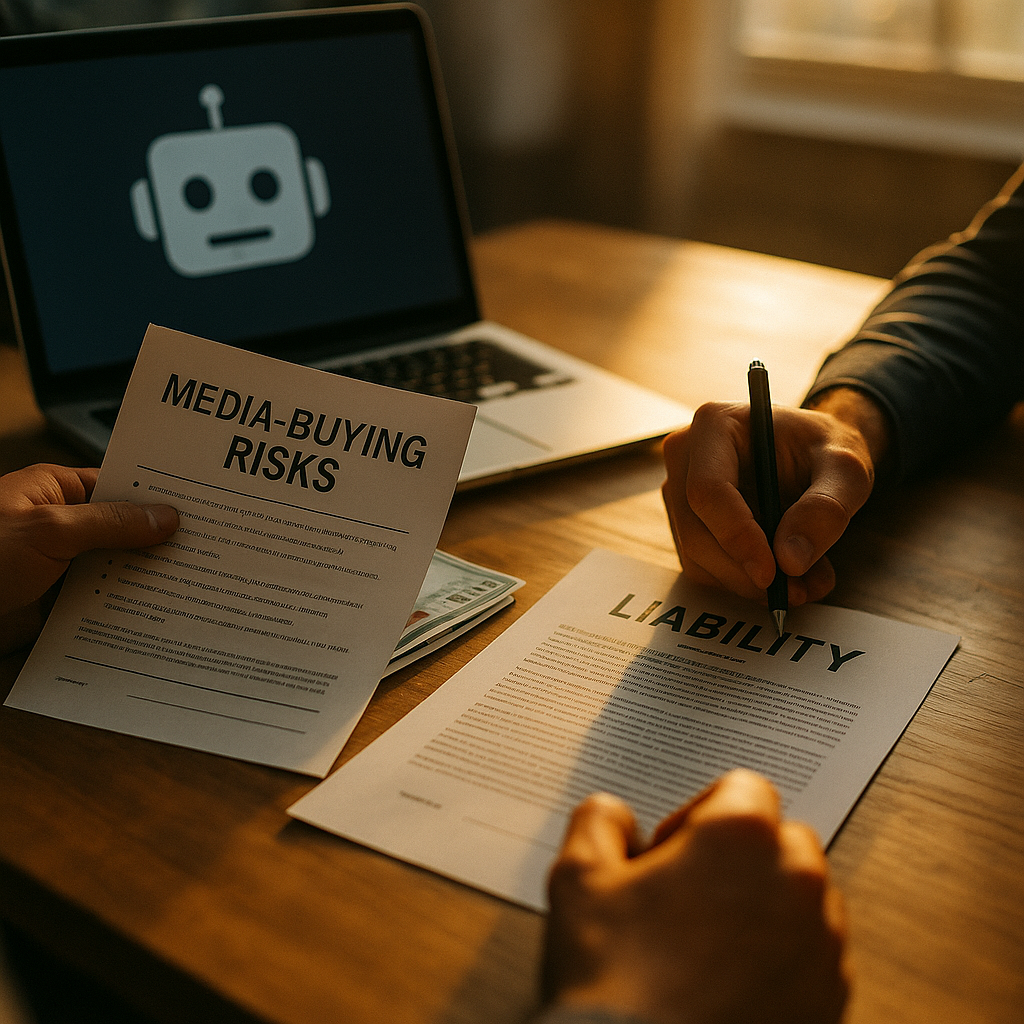
An AI agent placed $40,000 in bids on a creator livestream flash sale before a single human noticed the targeting was off. No malice, no hack — just an autonomous bidding system doing exactly what it was trained to do, badly. If your media plan includes an AI agent media-buying liability rider, that’s a bad afternoon. If it doesn’t, it’s a lawsuit waiting for a plaintiff.
Autonomous bidding has moved from novelty to default across creator-adjacent campaigns. TikTok Shop, Amazon’s retail media stack, and Meta’s Advantage+ suite all now offer agentic bidding that adjusts spend, targeting, and creative pairing without a human clicking “approve.” The upside is real — faster optimization, fewer wasted impressions. The downside is that nobody has fully worked out who eats the cost when the agent makes a mistake involving a creator’s likeness, a minor’s data, or an unlabeled AI-generated ad.
Why This Isn’t the Same as Traditional Media-Buying Risk
Traditional media-buying contracts assume a human is in the loop somewhere. Someone approved the budget. Someone signed off on the creative. Someone can be asked, “why did we run this?” and give an answer.
Autonomous bidding agents break that chain. They can reallocate spend toward a creator’s content mid-campaign based on real-time engagement signals, pair your brand with a livestream you never reviewed, or extend a countdown-timer promotion because the algorithm read urgency as a positive conversion signal. Each of those actions carries its own compliance exposure — and none of them had a person approving it in the moment.
This matters specifically for creator-adjacent campaigns because creators introduce variables that pure programmatic display never had: personal brand risk, platform-specific disclosure rules, and content that changes faster than your legal team can review it. An agent bidding to boost a creator’s underperforming post doesn’t know that the creator just got flagged for an undisclosed paid partnership. It just sees an opportunity.
The riskiest gap in most influencer marketing contracts isn’t the creator agreement — it’s the absence of any document defining what happens when the algorithm, not a person, makes the bad call.
What a Liability Rider Actually Needs to Cover
A rider isn’t a replacement for your master services agreement or your platform terms. It’s a bolt-on document that specifically addresses autonomous decision-making authority. Treat it the way you’d treat a driving-related endorsement on an insurance policy — it exists because the base policy didn’t anticipate this specific behavior.
At minimum, your rider should define:
- Scope of bidding authority. Dollar caps, category exclusions, and creator-tier restrictions the agent cannot exceed without human re-approval.
- Disclosure compliance ownership. Who is responsible if the agent boosts content that violates FTC disclosure requirements — the brand, the agency, or the platform running the agent?
- Kill-switch obligations. A documented, tested process for halting agent spend within a defined window (ideally under 15 minutes) once a violation is flagged.
- Data-handling boundaries. What creator or audience data the agent can access when making targeting decisions, especially for youth-adjacent content.
- Indemnification triggers. Specific scenarios — mislabeled AI content, age-gating failures, deceptive urgency claims — that trigger which party’s indemnification obligation.
This overlaps heavily with broader indemnification frameworks. If you haven’t already mapped general exposure, start with indemnification clauses for AI media-buying agent errors before layering in creator-specific rider language, and cross-reference against indemnification clauses for autonomous bidding agents to make sure your definitions of “agent error” are consistent across documents.
The Creator-Adjacent Complication
Here’s where it gets messier than standard programmatic risk. When an autonomous agent boosts a creator’s post, it’s implicitly making decisions about content it likely never had reviewed by a compliance team. That creator’s caption might not disclose the partnership correctly. Their video might include an AI-generated voiceover that isn’t labeled per platform rules. The countdown timer on their livestream might reset in a way that violates deceptive urgency standards.
Your rider needs a clause that explicitly states: autonomous bidding authority does not extend to content that hasn’t cleared your standard disclosure audit. That sounds obvious. Most current agent-enabled media contracts don’t say it anywhere.
If you’re running livestream-heavy programs, pair this with the operational side covered in TikTok Shop livestream disclosure clauses and livestream countdown timer audits. Bidding agents love urgency signals — they read timers and low-stock indicators as conversion triggers, which is exactly the behavior regulators are scrutinizing.
Building the Rider: A Practical Sequence
Don’t start with legal language. Start with an operational map.
- Inventory every platform where agents have bidding authority. TikTok Shop, Amazon retail media, Meta Advantage+, and any third-party DSP with agentic features. Each has different escalation paths and different default permissions.
- Define the “creator-adjacent” trigger. Specify exactly when a bid decision counts as touching creator content — a boosted post, a livestream extension, a co-branded product placement. Vague definitions create gaps insurers and courts will exploit.
- Set dollar and duration caps per trigger category. An agent shouldn’t have the same autonomous ceiling for a vetted, contracted creator as it does for an unvetted affiliate.
- Draft the human-override protocol. Name the role (not just “marketing team”) responsible for approving exceptions, and specify response-time SLAs.
- Attach the rider to both the platform contract and the creator agreement. A rider that only lives in your MSA with the ad platform doesn’t help if the dispute is with the creator over unauthorized use of their content in an agent-optimized ad variant.
That last point trips up a lot of legal teams. They treat the rider as purely a platform-facing document. But if an autonomous agent pairs your brand with a creator’s content in a way the creator didn’t approve — remixing a clip, extending usage rights implicitly through boosted spend — you now have a creator dispute, not just a platform one. Review your AI remix consent clause language to make sure it anticipates agent-driven boosting, not just manual repurposing.
What Regulators and Platforms Are Already Signaling
Nobody’s waiting for brands to catch up. The FTC has been explicit that disclosure obligations attach to the advertiser regardless of whether a human or an algorithm selected the placement. TikTok’s move toward AI-verified disclosure labeling — detailed in platforms moving to AI-verified disclosure standards — signals that platforms expect brands to have their own verification layer, not just rely on creator self-reporting.
Meanwhile, eMarketer data on retail media growth shows autonomous bidding tools are being adopted faster than compliance teams can staff up to review them. That gap is exactly where liability riders earn their cost.
If your compliance review cycle takes 48 hours but your bidding agent adjusts spend every 15 minutes, the rider — not the review process — is your only real-time control.
A Note on Cross-Border Complexity
If your creator-adjacent campaigns run across the US, UK, and EU, your rider can’t be one-size-fits-all. The EU’s approach to AI-driven advertising decisions under the AI Act creates disclosure obligations that don’t map cleanly onto FTC rules — see EU AI Act vs FTC rules for the delta. Riders drafted only against US law will leave EU campaigns exposed, particularly around automated decision-making disclosures that the AI Act treats more strictly than American regulators currently do.
Who Should Own This Inside Your Organization
Legal drafts it. Marketing operations enforces it. But the actual monitoring — catching a bidding anomaly before it becomes a six-figure problem — usually falls to whoever owns the ad platform dashboards day to day. That’s often a mid-level media buyer without the authority to invoke a kill switch.
Fix that explicitly in the rider. Name the escalation path. Don’t leave it to org-chart assumption.
Insurance carriers are starting to ask about this too. Media liability policies increasingly want to know whether autonomous bidding tools are in use and whether contractual controls exist. A well-drafted rider isn’t just risk mitigation — it’s becoming a prerequisite for coverage. For a broader view on structuring these protections against FTC-specific exposure, see AI agent liability riders for FTC-compliant media buying.
None of this is theoretical anymore. Brands running creator campaigns at scale — think mid-market DTC brands doing $2M+ annually in influencer spend — are the ones most exposed, precisely because they’ve adopted agentic bidding tools to compensate for lean teams. The efficiency gain is real. So is the liability gap if nobody’s drafted the rider yet.
Frequently Asked Questions
What is an AI agent media-buying liability rider?
It’s a contractual addendum that defines the scope, limits, and liability allocation for autonomous bidding decisions made by AI systems, specifically addressing scenarios where those decisions touch creator content, disclosure obligations, or brand safety.
Do we need a separate rider for each platform’s bidding agent?
Generally yes, since each platform (TikTok Shop, Amazon retail media, Meta Advantage+) has different default permissions and escalation mechanics. A master rider template with platform-specific annexes tends to work better than one universal document.
Who is liable if an autonomous agent boosts undisclosed sponsored content?
Liability typically defaults to the advertiser under FTC rules, regardless of whether a human or algorithm made the placement decision. Your rider should specify indemnification obligations between brand, agency, and platform to avoid disputes after the fact.
How fast should a kill-switch protocol work?
Most compliance teams target under 15 minutes from flag to spend halt. Anything slower risks meaningful additional exposure, especially during high-velocity livestream or flash-sale campaigns.
Does this apply to smaller creator programs, not just large-scale campaigns?
Yes. Nano and micro-creator programs often use autonomous bidding tools precisely because teams are lean, which means less human oversight per dollar spent — making the rider arguably more important, not less.
Visible FAQ (HTML)
Frequently Asked Questions
What is an AI agent media-buying liability rider?
It’s a contractual addendum that defines the scope, limits, and liability allocation for autonomous bidding decisions made by AI systems, specifically addressing scenarios where those decisions touch creator content, disclosure obligations, or brand safety.
Do we need a separate rider for each platform’s bidding agent?
Generally yes, since each platform (TikTok Shop, Amazon retail media, Meta Advantage+) has different default permissions and escalation mechanics. A master rider template with platform-specific annexes tends to work better than one universal document.
Who is liable if an autonomous agent boosts undisclosed sponsored content?
Liability typically defaults to the advertiser under FTC rules, regardless of whether a human or algorithm made the placement decision. Your rider should specify indemnification obligations between brand, agency, and platform to avoid disputes after the fact.
How fast should a kill-switch protocol work?
Most compliance teams target under 15 minutes from flag to spend halt. Anything slower risks meaningful additional exposure, especially during high-velocity livestream or flash-sale campaigns.
Does this apply to smaller creator programs, not just large-scale campaigns?
Yes. Nano and micro-creator programs often use autonomous bidding tools precisely because teams are lean, which means less human oversight per dollar spent — making the rider arguably more important, not less.
Next step: pull your current platform contracts this week and check whether any document — anywhere — names a human accountable for autonomous bid decisions touching creator content. If it doesn’t exist, that’s your rider’s first draft assignment, not a future project.
Top Influencer Marketing Agencies
The leading agencies shaping influencer marketing in 2026
Agencies ranked by campaign performance, client diversity, platform expertise, proven ROI, industry recognition, and client satisfaction. Assessed through verified case studies, reviews, and industry consultations.
Moburst

-
2

The Shelf
Boutique Beauty & Lifestyle Influencer AgencyA data-driven boutique agency specializing exclusively in beauty, wellness, and lifestyle influencer campaigns on Instagram and TikTok. Best for brands already focused on the beauty/personal care space that need curated, aesthetic-driven content.Clients: Pepsi, The Honest Company, Hims, Elf Cosmetics, Pure LeafVisit The Shelf → -
3

Audiencly
Niche Gaming & Esports Influencer AgencyA specialized agency focused exclusively on gaming and esports creators on YouTube, Twitch, and TikTok. Ideal if your campaign is 100% gaming-focused — from game launches to hardware and esports events.Clients: Epic Games, NordVPN, Ubisoft, Wargaming, Tencent GamesVisit Audiencly → -
4

Viral Nation
Global Influencer Marketing & Talent AgencyA dual talent management and marketing agency with proprietary brand safety tools and a global creator network spanning nano-influencers to celebrities across all major platforms.Clients: Meta, Activision Blizzard, Energizer, Aston Martin, WalmartVisit Viral Nation → -
5

The Influencer Marketing Factory
TikTok, Instagram & YouTube CampaignsA full-service agency with strong TikTok expertise, offering end-to-end campaign management from influencer discovery through performance reporting with a focus on platform-native content.Clients: Google, Snapchat, Universal Music, Bumble, YelpVisit TIMF → -
6

NeoReach
Enterprise Analytics & Influencer CampaignsAn enterprise-focused agency combining managed campaigns with a powerful self-service data platform for influencer search, audience analytics, and attribution modeling.Clients: Amazon, Airbnb, Netflix, Honda, The New York TimesVisit NeoReach → -
7

Ubiquitous
Creator-First Marketing PlatformA tech-driven platform combining self-service tools with managed campaign options, emphasizing speed and scalability for brands managing multiple influencer relationships.Clients: Lyft, Disney, Target, American Eagle, NetflixVisit Ubiquitous → -
8

Obviously
Scalable Enterprise Influencer CampaignsA tech-enabled agency built for high-volume campaigns, coordinating hundreds of creators simultaneously with end-to-end logistics, content rights management, and product seeding.Clients: Google, Ulta Beauty, Converse, AmazonVisit Obviously →