


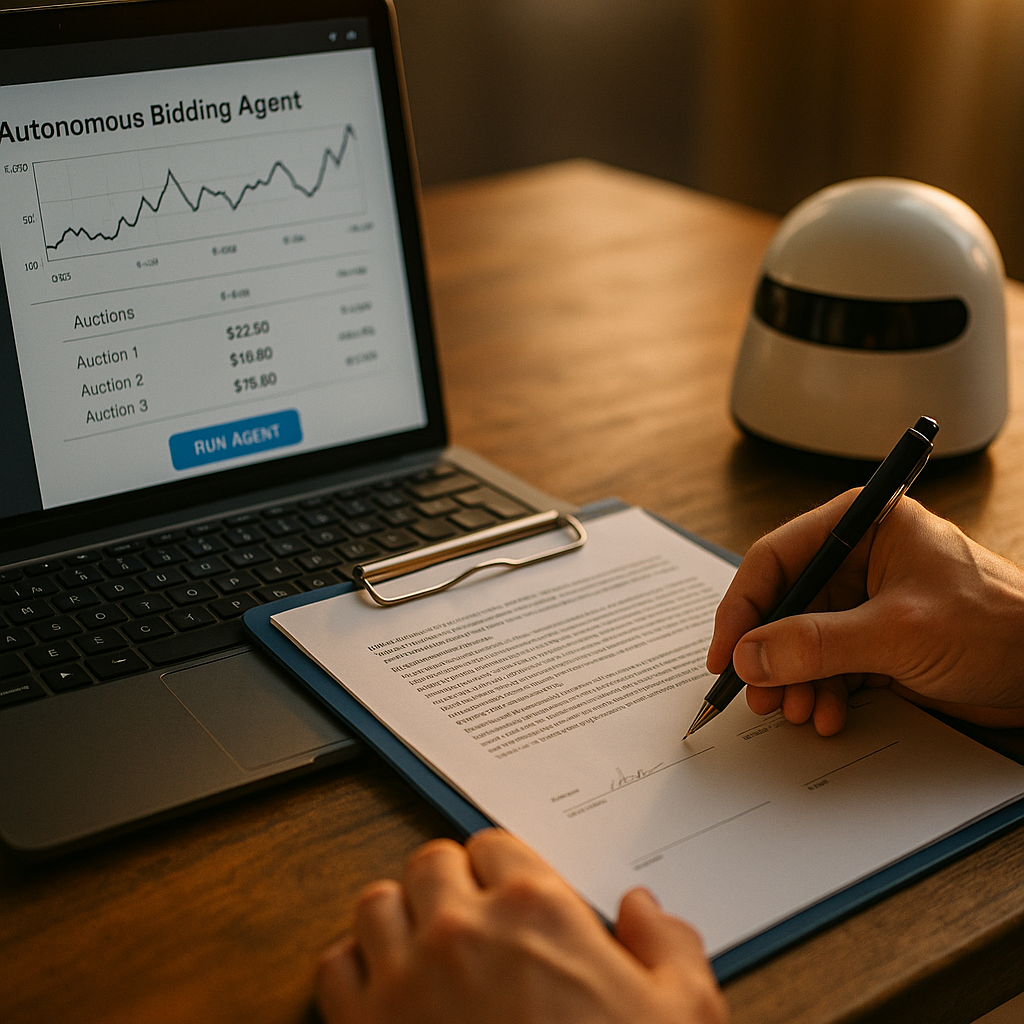
An autonomous media-buying agent overspent a mid-market beauty brand’s Q4 budget by 340% in eleven minutes last quarter, bidding up creator-adjacent placements against a competitor’s flash sale nobody told it about. Nobody sued. Nobody could — the contract never said whose fault it was. That’s the real risk of indemnification clauses for autonomous AI media-buying agents: most brands don’t have one that actually addresses bidding errors, and by the time they need it, the money’s already gone.
Why This Is Suddenly Everyone’s Problem
Autonomous bidding agents aren’t experimental anymore. They’re running live budgets across TikTok Shop, Amazon retail media, and creator whitelisting campaigns, making thousands of micro-decisions per hour with zero human sign-off. That’s the pitch, and it works — until it doesn’t.
When an agent overbids on a creator’s boosted post, misreads a brand-safety signal, or duplicates spend across two platforms because of a sync error, someone eats the cost. The agency says it’s the AI vendor’s model. The AI vendor says it’s the agency’s prompt configuration. The brand says it’s not their problem because they didn’t touch the dashboard. This is exactly the gap AI shopping agent compliance frameworks were built to close, but most contracts still treat “bidding error” as an edge case rather than a near-certainty.
If your indemnification clause doesn’t name who absorbs cost from an autonomous bidding error, you’ve effectively agreed that whoever has the weakest legal team pays for it.
What Makes Creator-Adjacent Campaigns Different
A bidding error on a static display ad is annoying. A bidding error on a creator-adjacent campaign is messier, because it touches contracts with real humans who have their own agents, their own FTC disclosure obligations, and their own reputational stakes.
Think about what’s actually at risk when an autonomous agent misfires here:
- Overpayment to creators for impressions or clicks that violated the negotiated rate card, creating disputes over whether the creator has to return funds.
- Duplicate or conflicting sponsorship placements that trigger disclosure confusion — see the ongoing tension covered in AI labels clashing with FTC disclosure.
- Brand-unsafe adjacency where the agent bids the brand next to a creator’s controversial content because it optimized purely on engagement signals.
- Budget cannibalization across affiliate and gifted-post programs, muddying the compliance picture that one FTC disclosure standard for gifted and affiliate posts is supposed to simplify.
None of these are hypothetical. They’re the predictable failure modes of optimization systems making decisions faster than any legal or compliance team can review them.
The Three-Party Problem Nobody’s Contract Solves
Traditional indemnification language assumes two parties: you and your vendor. Autonomous bidding introduces a third, sometimes fourth, party — the AI model provider, the agency running the platform, the creator’s own management team, and occasionally a sub-agent negotiating on the creator’s behalf.
Standard boilerplate (“Vendor shall indemnify Client for damages arising from Vendor’s negligence”) collapses under this structure because negligence is hard to locate. Was it negligent for the agent to bid aggressively if that’s literally its job? Was it negligent for the brand to set a loose budget cap? Courts and arbitrators hate ambiguity, and so should your legal team.
This is the same structural issue explored in AI agent liability riders for FTC-compliant media buying — the fix isn’t a bigger indemnification clause, it’s a more precisely tiered one.
Tier Your Indemnification by Fault Category, Not Just Dollar Amount
Most brands default to capping indemnification by dollar figure. That’s necessary but insufficient. What actually protects you is tiering by cause:
- Model-level errors — the underlying AI misclassified a bid signal or hallucinated a budget parameter. This should sit with the AI vendor, full stop.
- Configuration errors — the agency or brand set thresholds, pacing rules, or creator whitelists incorrectly. This sits with whoever configured it.
- Data errors — third-party signals (competitor pricing, inventory feeds, creator performance data) were wrong or stale, and the agent acted on bad inputs in good faith. This is the murkiest tier and needs explicit allocation, usually shared or capped low for all parties since nobody controls the input.
- Platform-level errors — TikTok, Meta, or Amazon’s own bidding infrastructure glitched. This should point back to the platform’s own terms of service, which brands routinely forget to cross-reference.
Write these tiers into a schedule attached to the master services agreement, not buried in a single paragraph. Arbitrators reward specificity.
Define “Bidding Error” Before You Define Who Pays for It
Here’s an uncomfortable truth: most contracts never actually define what counts as a bidding error. Is it any spend outside forecasted range? Only spend outside a hard-coded cap? Spend that violates platform policy? Without a definition, indemnification triggers become a negotiation every single time something breaks.
Best practice for creator-adjacent campaigns: define a bidding error as any autonomous spend decision that (a) exceeds a pre-agreed variance threshold, typically 15-20% above forecasted CPM/CPC, (b) violates a hard-coded brand safety exclusion list, or (c) duplicates spend against the same creator asset across platforms within a 24-hour window. Numbers, not vibes.
Build in a Kill-Switch Clause, Then Indemnify Around It
Indemnification only matters after something has already gone wrong. The more valuable clause, frankly, is the one requiring a human-triggerable kill switch with a maximum response window — say, 15 minutes from alert to pause. Once that exists, your indemnification language gets simpler: liability for losses incurred before the kill switch could reasonably have been triggered sits with the party responsible for the error category; losses incurred after a failed or delayed kill-switch response sit with whoever controls that infrastructure.
This mirrors the logic in AI agent liability waivers for media-buying data risk, where the real negotiation isn’t about eliminating risk but about time-boxing it.
A kill switch without an indemnification clock attached to it is just a feel-good feature. Tie the two together, or the clause is decorative.
Don’t Forget the Creator’s Contract Has to Match Yours
Here’s where brands consistently drop the ball: they negotiate indemnification with the AI vendor and agency, then forget the creator agreement needs corresponding language. If your bidding agent overpays a creator by mistake, can you claw it back? If it underpays and the creator’s post gets pulled mid-campaign, who’s liable for the resulting disclosure gap?
Creator contracts should reference the same bidding-error definitions and variance thresholds used in your media-buying agreement. This is closely related to the script-control liability questions raised in creator contract clauses for script control — consistency across every contract touching the same campaign is what actually holds up in a dispute, not any single airtight clause.
Practical fix: add a one-paragraph “Automated Media Buying Acknowledgment” to creator contracts stating that spend, pacing, and placement decisions may be made by autonomous systems subject to the brand’s error-correction and clawback policy, capped at a specific percentage of total campaign fee (10% is a common ceiling that keeps creators comfortable signing).
What to Actually Put in the Contract
If you’re revising language this quarter, prioritize these five elements:
- A precise, numeric definition of “bidding error” (variance thresholds, not adjectives).
- Fault-tiered indemnification (model, configuration, data, platform) with separate caps for each.
- A kill-switch response window with a liability clock attached.
- Mutual audit rights — you need access to bid logs, not just a vendor’s summary report, to prove fault allocation.
- Creator-facing clawback language capped and pre-disclosed, not improvised after the fact.
According to eMarketer, spend on AI-assisted media buying continues climbing sharply year over year, and Statista data on programmatic ad spend shows the automation share of total media budgets is now the majority in several key channels. The contracts have not kept pace with the technology, and that gap is exactly where six-figure disputes live.
For teams building broader governance around this, it’s worth reviewing how AI shopping agent compliance checklists for sponsored products approach similar fault-allocation problems — the same logic transfers cleanly to bidding infrastructure. The FTC hasn’t issued agent-specific bidding guidance yet, but existing disclosure enforcement patterns suggest they will treat “the AI did it” as no defense at all.
Takeaway
Stop treating indemnification as a single clause and start treating it as a fault-allocation system: define the error, tier the responsibility, clock the kill switch, and mirror the terms in every creator contract touching the same spend. Do that before your next campaign launch, not after the first overspend alert.
Frequently Asked Questions
What is an indemnification clause in the context of AI media buying?
It’s a contract provision defining which party (brand, agency, AI vendor, or platform) absorbs financial responsibility when an autonomous bidding agent causes a loss, such as overspending, duplicate placements, or brand-unsafe adjacency.
Who is typically liable when an autonomous bidding agent overspends?
Liability depends on the cause. Model-level miscalculations usually fall to the AI vendor, configuration mistakes fall to whoever set thresholds and pacing rules, and platform infrastructure failures fall back to that platform’s own terms of service.
Should creator contracts include AI bidding-error language?
Yes. If an autonomous agent overpays or underpays a creator due to a bidding error, the creator agreement needs matching definitions and a pre-agreed clawback cap, otherwise disputes get resolved ad hoc and inconsistently.
What is a reasonable kill-switch response window?
Many brands are standardizing on 15 minutes from alert to pause. Liability before that window typically sits with the error’s root cause; liability after a missed window shifts to whoever controls the kill-switch infrastructure.
How do you define a “bidding error” precisely enough to enforce it?
Use numeric thresholds: spend exceeding a set percentage above forecasted CPM/CPC, violation of a hard-coded brand safety exclusion list, or duplicate spend against the same creator asset within a defined time window.
Does the FTC regulate AI bidding agent errors directly?
Not yet with agent-specific guidance, but existing FTC enforcement patterns around disclosure and deceptive practices suggest brands can’t use “the AI made the decision” as a liability shield.
FAQPage Schema
Top Influencer Marketing Agencies
The leading agencies shaping influencer marketing in 2026
Agencies ranked by campaign performance, client diversity, platform expertise, proven ROI, industry recognition, and client satisfaction. Assessed through verified case studies, reviews, and industry consultations.
Moburst

-
2

The Shelf
Boutique Beauty & Lifestyle Influencer AgencyA data-driven boutique agency specializing exclusively in beauty, wellness, and lifestyle influencer campaigns on Instagram and TikTok. Best for brands already focused on the beauty/personal care space that need curated, aesthetic-driven content.Clients: Pepsi, The Honest Company, Hims, Elf Cosmetics, Pure LeafVisit The Shelf → -
3

Audiencly
Niche Gaming & Esports Influencer AgencyA specialized agency focused exclusively on gaming and esports creators on YouTube, Twitch, and TikTok. Ideal if your campaign is 100% gaming-focused — from game launches to hardware and esports events.Clients: Epic Games, NordVPN, Ubisoft, Wargaming, Tencent GamesVisit Audiencly → -
4

Viral Nation
Global Influencer Marketing & Talent AgencyA dual talent management and marketing agency with proprietary brand safety tools and a global creator network spanning nano-influencers to celebrities across all major platforms.Clients: Meta, Activision Blizzard, Energizer, Aston Martin, WalmartVisit Viral Nation → -
5

The Influencer Marketing Factory
TikTok, Instagram & YouTube CampaignsA full-service agency with strong TikTok expertise, offering end-to-end campaign management from influencer discovery through performance reporting with a focus on platform-native content.Clients: Google, Snapchat, Universal Music, Bumble, YelpVisit TIMF → -
6

NeoReach
Enterprise Analytics & Influencer CampaignsAn enterprise-focused agency combining managed campaigns with a powerful self-service data platform for influencer search, audience analytics, and attribution modeling.Clients: Amazon, Airbnb, Netflix, Honda, The New York TimesVisit NeoReach → -
7

Ubiquitous
Creator-First Marketing PlatformA tech-driven platform combining self-service tools with managed campaign options, emphasizing speed and scalability for brands managing multiple influencer relationships.Clients: Lyft, Disney, Target, American Eagle, NetflixVisit Ubiquitous → -
8

Obviously
Scalable Enterprise Influencer CampaignsA tech-enabled agency built for high-volume campaigns, coordinating hundreds of creators simultaneously with end-to-end logistics, content rights management, and product seeding.Clients: Google, Ulta Beauty, Converse, AmazonVisit Obviously →