


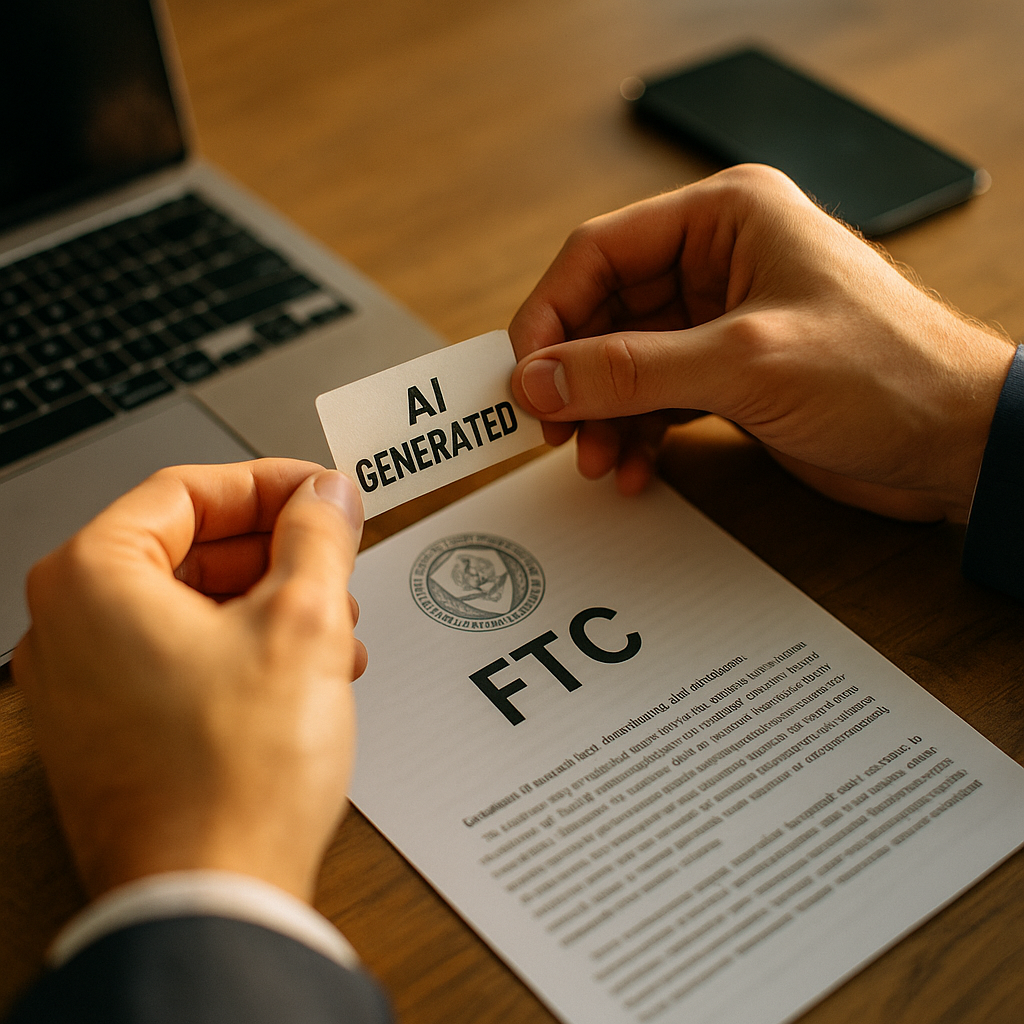
A single TikTok post can carry an “AI-generated” tag the platform slapped on automatically, while your brand’s own disclosure says “Paid Partnership.” Which one governs when a regulator comes knocking? Neither, actually — and that gap is where the real platform-native AI content labels FTC material connection problem lives. Most compliance teams haven’t caught up to it.
This isn’t a hypothetical edge case anymore. It’s a Tuesday.
The Collision Nobody Built a Process For
Platform AI labels and FTC disclosure requirements were built to solve different problems, for different audiences, under different legal theories. Platforms label AI content to manage authenticity perception and satisfy their own trust-and-safety teams. The FTC requires material connection disclosures to prevent consumers from being deceived about who’s paying for an endorsement. One is a product feature. The other is federal law.
They were never designed to talk to each other. So when a creator uses an AI voice clone in a sponsored video, and TikTok auto-tags it “AI-generated content” while the brand’s contract requires “#ad” in the first three seconds, you get two signals on one post that say different things to two different regulatory bodies — platform policy and the FTC. Consumers see both. Regulators, increasingly, are looking at both too.
A platform’s AI label tells viewers how content was made. An FTC disclosure tells viewers who paid for it. Confusing the two isn’t a technicality — it’s the exact ambiguity the FTC’s endorsement guidance was written to eliminate.
The FTC’s Endorsement Guides don’t care what a platform’s metadata says. They care whether a “reasonable consumer” understood the material connection between the brand and the endorser. An AI disclosure badge sitting three inches away from a vague or missing sponsorship tag doesn’t satisfy that standard — it can actually undercut it, because viewers may assume the AI label is the *only* disclosure needed.
Why the Two Labels Actually Conflict
Here’s the mechanism. Platforms like YouTube, TikTok, and Meta have rolled out automated and creator-declared AI disclosure tools over the past two years. YouTube’s “altered or synthetic content” label. TikTok’s AI-generated content tag. Meta’s “AI info” label applied to images and video detected via C2PA metadata or creator self-disclosure. These labels are triggered by technical criteria: was generative AI used in production, yes or no.
FTC material connection disclosure is triggered by an entirely different question: is there a financial or business relationship between the endorser and the brand that would affect how a consumer weighs the endorsement? A creator could use zero AI tools and still owe a full disclosure. A creator could use heavy AI generation and have no material connection to disclose at all if it’s not sponsored content.
The conflict shows up in three recurring scenarios:
- Label present, disclosure missing: Platform auto-tags AI voice-over or AI avatar use, but the creator forgets or the brand never enforced the sponsorship disclosure. Viewers see “AI-generated” and assume that’s the whole story.
- Disclosure present, label contradicts intent: Creator writes “#ad” properly, but the platform’s AI label appears in a way that implies the endorsement itself — the opinion, the recommendation — was synthetic or scripted by AI, undermining perceived authenticity and creating a separate deception risk.
- Both present, placement conflict: Both labels exist but the platform’s UI buries one behind a “see more” tap or a small icon, while the other sits prominently. The FTC has been explicit that disclosures buried behind clicks don’t count.
Our sister piece on when platform AI labels clash with FTC disclosure broke down the mechanics of this collision in more detail. What we’re addressing here is the operational fix: what do you actually do when it happens on a live post?
Who’s Liable When the Signals Disagree?
Short answer: you are. Not TikTok. Not the AI voice tool vendor. Your brand, and often your agency of record, carry the endorsement liability regardless of what the platform’s label says or doesn’t say.
The FTC has been consistent on this point for over a decade: platforms are not a compliance shield. A platform’s automated label is a UX feature, not a legal disclosure made on your behalf. If a platform mislabels content, or fails to surface an AI tag prominently, that’s a platform product issue — it does not transfer your disclosure obligation anywhere. This is the same logic behind why AI liability clauses in creator contracts have become non-negotiable in the last renewal cycle. If your contracts don’t explicitly assign responsibility for reconciling these two signals, you’re relying on hope as a compliance strategy.
There’s a second liability layer too: synthetic performers and AI avatars. If a brand runs a fully AI-generated spokesperson, the disclosure question gets more complex, because now you’re disclosing both the AI nature of the performer and the material connection simultaneously. We mapped a workable approach to this in synthetic performer disclosure across NY, CA, and EU AI Act jurisdictions, and the same layered-disclosure logic applies here: one clause can’t just say “disclose AI use.” It needs to specify format, placement, and priority when multiple disclosure types stack on a single asset.
Building the Reconciliation Protocol
Treat this like any other compliance conflict: establish a hierarchy, document it, and make it contractually binding before content goes live. Here’s the framework we recommend to brand legal and marketing ops teams.
1. FTC disclosure always takes visual priority
Material connection disclosure must be unavoidable, unambiguous, and in the primary viewing plane, per the FTC’s own guidance and consistent enforcement history. If a platform’s AI label competes for the same visual real estate, your contract needs to require creators to place the sponsorship disclosure first, in-video, verbally and on-screen, not just rely on platform metadata tags.
2. Never let an AI label substitute for a paid disclosure
This is the single most common mistake we see in brand audits. Someone on the social team assumes “well, TikTok already tagged it as AI content, so we’re covered.” That’s a category error. Document it explicitly in your creator brief: AI labels and paid disclosures are separate requirements, both mandatory, neither substitutes for the other.
3. Pre-flight every AI-assisted asset before publish
Before any AI-generated or AI-assisted content goes live, run it through a compliance checklist that checks both platform label triggers and FTC disclosure placement. This is exactly the gap addressed in our pre-flight checklist for AI-generated ad assets — catching the conflict before it’s public is dramatically cheaper than a post-hoc takedown.
4. Build a sign-off matrix that names an owner
Ambiguity dies when someone’s name is on the line. A sign-off matrix for AI creator contracts should specify exactly who verifies disclosure placement, who verifies AI label accuracy, and who has final publish authority when the two conflict.
5. Escalate consistently, not case-by-case
When a platform label and your FTC disclosure conflict in a way you can’t resolve pre-publish, don’t improvise. Route it through a documented escalation path. Our escalation matrix aligning FTC, state AG, and platform risk is built for exactly this kind of multi-signal conflict, and it saves you from re-litigating the same judgment call every time a new creator hits publish.
If your team can’t answer “who has final sign-off when the AI label and the ad disclosure disagree” in under ten seconds, you don’t have a policy. You have a hope.
What This Looks Like in a Real Campaign
Picture a beauty brand running a livestream shopping event where the host uses an AI-cloned voice-over for a pre-recorded segment spliced into a live show. TikTok’s platform tools may auto-tag the pre-recorded segment as AI-generated content. Meanwhile, the brand’s disclosure requirement demands “Paid Partnership” tagging visible throughout, live and pre-recorded alike.
If those two signals aren’t reconciled ahead of time, viewers get a confusing mix: an AI tag appearing mid-stream with no reinforced sponsorship disclosure alongside it. That’s precisely the kind of scenario covered in our livestream shopping compliance escalation protocol, where multiple real-time risk signals need a tiered response instead of a single blanket rule.
Now scale that across a hundred creators posting on TikTok Shop, Amazon Live, and Instagram Reels simultaneously, each platform with slightly different AI labeling triggers and UI placement. This is why reconciling Amazon and Walmart disclosure rules with your core FTC obligations follows the same playbook: map every platform’s native signal against the federal baseline, then set your brand standard at whichever is stricter. Never assume platform compliance equals FTC compliance. They’re measuring different things.
The Data Backs the Urgency
eMarketer and Statista data both show generative AI adoption in influencer content creation climbing sharply, with a majority of surveyed marketers now using AI tools somewhere in their creator content pipeline — voice cloning, script generation, avatar creation, or automated editing. As adoption climbs, so does the surface area for label conflicts. Every AI touchpoint is a potential place where platform metadata and FTC disclosure requirements diverge.
Meanwhile, platforms themselves are moving fast and inconsistently. Meta’s Business Help Center, TikTok’s Ads Manager guidance, and Google/YouTube’s Support documentation all describe different triggers, different label placements, and different appeal processes for AI content tags. There is no unified standard. That means your internal reconciliation policy is doing work the platforms haven’t done for you, and won’t do for you anytime soon.
Don’t Forget the Contract Layer
None of this works without contract language that anticipates the conflict instead of reacting to it. Review your creator agreements for three gaps: does the contract specify disclosure placement hierarchy when platform AI labels are present? Does it assign responsibility for verifying platform label accuracy before publish? And does it include an indemnification structure that reflects who actually controls the AI tooling used?
If you’re using AI-assisted matching or negotiation tools to source creators at scale, this gets more complicated, not less. Review whether your creator matching tool carries its own AI Act risk classification, and make sure your auto-negotiation compliance checklist accounts for disclosure clauses being set correctly at scale, not just per-deal.
FAQs
Frequently Asked Questions
Does a platform’s AI-generated content label satisfy FTC disclosure requirements?
No. A platform’s AI label communicates how content was produced, not who paid for it. The FTC requires a clear, unavoidable material connection disclosure regardless of whether the platform has separately tagged the content as AI-generated. Brands need both signals present and properly placed.
Who is legally responsible if a platform’s AI label contradicts the brand’s disclosure?
The brand and its agency of record carry the endorsement liability, not the platform. Platform labeling tools are product features, not compliance mechanisms, so any conflict between the two signals still falls on the brand to resolve before and after publish.
What should a brand do if a platform buries the AI label or the FTC disclosure behind a tap-to-reveal UI element?
Escalate immediately and document the platform’s UI behavior. The FTC has consistently held that disclosures hidden behind clicks, hashtags buried in a block of text, or auto-collapsed captions do not meet the “clear and conspicuous” standard, regardless of platform default settings.
Should creator contracts specify exact placement for AI labels versus sponsorship disclosures?
Yes. Contracts should require the material connection disclosure to appear first and most prominently, specify verbal and on-screen placement, and explicitly state that platform AI tags never substitute for the sponsorship disclosure.
How often should brands audit AI-generated content for disclosure conflicts?
Every asset using AI tools should go through pre-publish review, not periodic spot checks. Given how fast platform labeling rules change, quarterly policy reviews plus per-asset pre-flight checks are the minimum standard for brands running active AI-assisted creator campaigns.
The Next Move
Stop treating platform AI labels and FTC disclosures as if one satisfies the other. Write the hierarchy into your creator contracts this quarter, name an owner for pre-publish sign-off, and audit your last 90 days of AI-assisted content for exactly this conflict before a regulator or a platform does it for you.
Frequently Asked Questions
Does a platform’s AI-generated content label satisfy FTC disclosure requirements?
No. A platform’s AI label communicates how content was produced, not who paid for it. The FTC requires a clear, unavoidable material connection disclosure regardless of whether the platform has separately tagged the content as AI-generated. Brands need both signals present and properly placed.
Who is legally responsible if a platform’s AI label contradicts the brand’s disclosure?
The brand and its agency of record carry the endorsement liability, not the platform. Platform labeling tools are product features, not compliance mechanisms, so any conflict between the two signals still falls on the brand to resolve before and after publish.
What should a brand do if a platform buries the AI label or the FTC disclosure behind a tap-to-reveal UI element?
Escalate immediately and document the platform’s UI behavior. The FTC has consistently held that disclosures hidden behind clicks, hashtags buried in a block of text, or auto-collapsed captions do not meet the “clear and conspicuous” standard, regardless of platform default settings.
Should creator contracts specify exact placement for AI labels versus sponsorship disclosures?
Yes. Contracts should require the material connection disclosure to appear first and most prominently, specify verbal and on-screen placement, and explicitly state that platform AI tags never substitute for the sponsorship disclosure.
How often should brands audit AI-generated content for disclosure conflicts?
Every asset using AI tools should go through pre-publish review, not periodic spot checks. Given how fast platform labeling rules change, quarterly policy reviews plus per-asset pre-flight checks are the minimum standard for brands running active AI-assisted creator campaigns.
Top Influencer Marketing Agencies
The leading agencies shaping influencer marketing in 2026
Agencies ranked by campaign performance, client diversity, platform expertise, proven ROI, industry recognition, and client satisfaction. Assessed through verified case studies, reviews, and industry consultations.
Moburst

-
2

The Shelf
Boutique Beauty & Lifestyle Influencer AgencyA data-driven boutique agency specializing exclusively in beauty, wellness, and lifestyle influencer campaigns on Instagram and TikTok. Best for brands already focused on the beauty/personal care space that need curated, aesthetic-driven content.Clients: Pepsi, The Honest Company, Hims, Elf Cosmetics, Pure LeafVisit The Shelf → -
3

Audiencly
Niche Gaming & Esports Influencer AgencyA specialized agency focused exclusively on gaming and esports creators on YouTube, Twitch, and TikTok. Ideal if your campaign is 100% gaming-focused — from game launches to hardware and esports events.Clients: Epic Games, NordVPN, Ubisoft, Wargaming, Tencent GamesVisit Audiencly → -
4

Viral Nation
Global Influencer Marketing & Talent AgencyA dual talent management and marketing agency with proprietary brand safety tools and a global creator network spanning nano-influencers to celebrities across all major platforms.Clients: Meta, Activision Blizzard, Energizer, Aston Martin, WalmartVisit Viral Nation → -
5

The Influencer Marketing Factory
TikTok, Instagram & YouTube CampaignsA full-service agency with strong TikTok expertise, offering end-to-end campaign management from influencer discovery through performance reporting with a focus on platform-native content.Clients: Google, Snapchat, Universal Music, Bumble, YelpVisit TIMF → -
6

NeoReach
Enterprise Analytics & Influencer CampaignsAn enterprise-focused agency combining managed campaigns with a powerful self-service data platform for influencer search, audience analytics, and attribution modeling.Clients: Amazon, Airbnb, Netflix, Honda, The New York TimesVisit NeoReach → -
7

Ubiquitous
Creator-First Marketing PlatformA tech-driven platform combining self-service tools with managed campaign options, emphasizing speed and scalability for brands managing multiple influencer relationships.Clients: Lyft, Disney, Target, American Eagle, NetflixVisit Ubiquitous → -
8

Obviously
Scalable Enterprise Influencer CampaignsA tech-enabled agency built for high-volume campaigns, coordinating hundreds of creators simultaneously with end-to-end logistics, content rights management, and product seeding.Clients: Google, Ulta Beauty, Converse, AmazonVisit Obviously →