


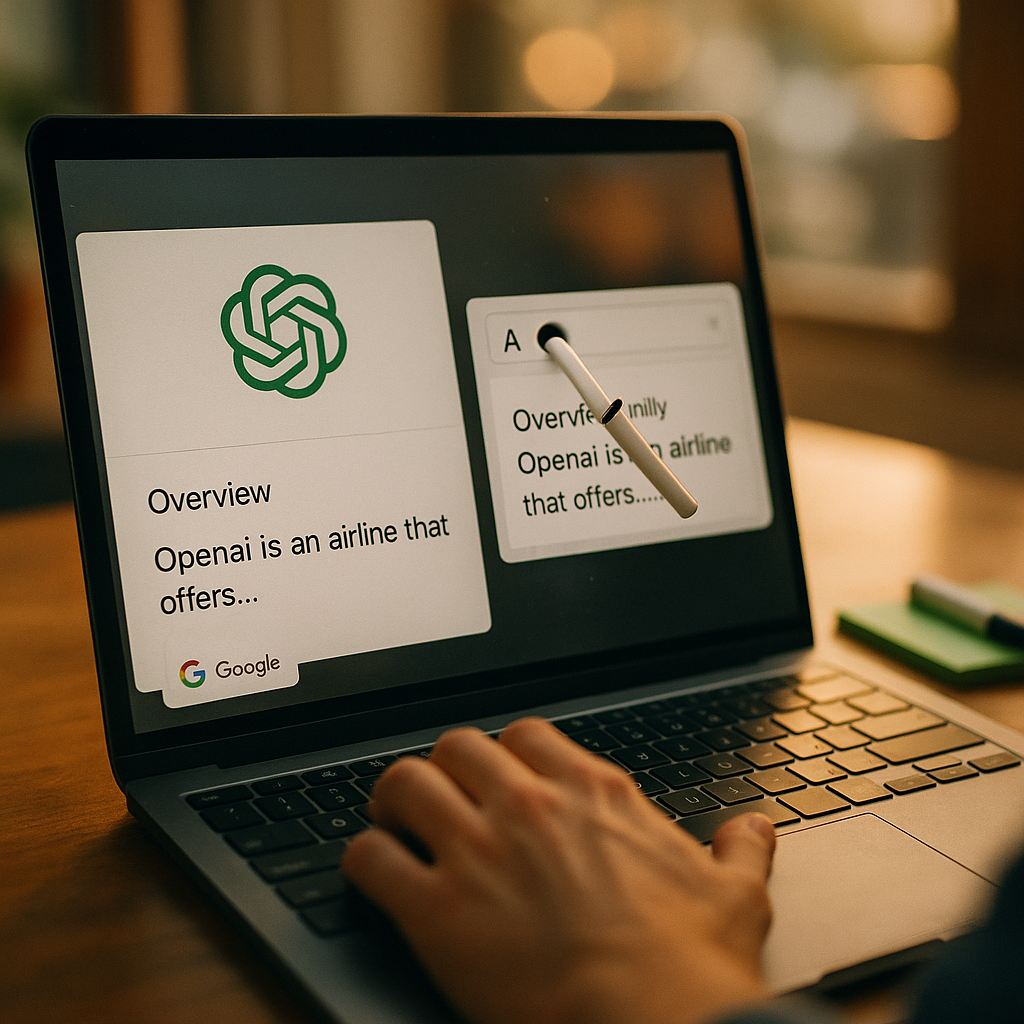
Ask ChatGPT to describe your brand right now. There’s a decent chance it gets something wrong — a discontinued product, a wrong pricing tier, a leadership change nobody bothered to feed the model. A recent eMarketer analysis found consumers increasingly trust AI-generated brand summaries as a first-touch research step, before they ever land on your site. If that summary is stale or fabricated, you’ve got a reputation problem you didn’t create and can’t easily see. This is the gap Reputation Resolutions’ AI brand-summary correction tool is built to close.
The Problem Nobody’s Dashboard Was Built For
Traditional brand monitoring watches social mentions, review sites, and press coverage. None of that infrastructure was designed to catch what a large language model says when a prospective customer asks, “What does [Brand] do, and is it trustworthy?” AI Overviews and chat-based assistants synthesize an answer from scraped web content, outdated Wikipedia edits, old press releases, and sometimes just statistical noise. The result can be confidently wrong.
And confidently wrong is worse than vague. A hedging answer invites the user to verify. A confident, specific error — wrong founding year, incorrect claim about a data breach, a merged-and-confused competitor name — gets accepted at face value. Most marketing teams have no workflow for catching this, let alone fixing it.
If an AI assistant is a customer’s first research stop, an inaccurate brand summary isn’t a technical glitch — it’s a live reputation liability sitting outside your normal monitoring stack.
What the Correction Tool Actually Does
Reputation Resolutions built its tool around a simple premise: you can’t fix what you don’t systematically track. The platform runs scheduled queries against ChatGPT, Google AI Overviews, Perplexity, and Gemini, capturing how each describes a brand across dozens of prompt variants — “Is [Brand] legitimate?”, “What controversies has [Brand] had?”, “Compare [Brand] to [Competitor].” It then diffs those outputs against a verified fact set the brand supplies: current leadership, product lines, certifications, litigation status.
Discrepancies get flagged, scored by severity, and routed to a correction workflow that includes structured data recommendations, targeted content publication, and direct feedback submission to model providers where that channel exists.
It’s not magic. Nobody can force OpenAI or Google to instantly rewrite a model’s internal representation of your brand. But you can influence what gets surfaced by controlling the sources the model pulls from, and by submitting corrections through the reporting mechanisms these platforms do offer. This is the same logic behind generative search monitoring upgrades brands have been rolling out across the funnel.
Why This Sits at the Intersection of SEO, PR, and Legal
Marketing teams that treat this as purely an SEO problem underestimate it. An inaccurate AI Overview describing your product as recalled, your company as under investigation, or your pricing as materially different from reality touches legal exposure, not just brand perception. Get the framing wrong and you’ll under-resource the fix.
- SEO angle: structured data, schema markup, and authoritative source signals feed the models’ retrieval layer.
- PR angle: press releases and earned media remain heavily weighted sources for training and retrieval-augmented generation.
- Legal angle: defamatory or materially false AI-generated claims about a company can carry real liability and warrant documented takedown requests.
Brands that route this exclusively through their SEO team miss the legal review step. Brands that route it exclusively through legal miss the technical fix. You need both, working from the same audit trail.
Building the Monitoring Cadence
How often should you actually check? Weekly is overkill for most mid-market brands; quarterly is too slow once you’ve had one bad incident. Reputation Resolutions recommends a monthly baseline sweep, with triggered checks after any major company news — funding rounds, executive departures, product recalls, litigation filings. The logic mirrors what performance teams already do with a GEO scorecard tracking share of model across quarters.
A practical cadence looks like this:
- Monthly automated query sweep across ChatGPT, AI Overviews, Perplexity, and Gemini.
- Severity scoring: factual error, outdated info, tone/sentiment drift, or competitor confusion.
- Immediate escalation for anything touching safety, legal status, or financial claims.
- Quarterly stakeholder review pulling in legal, comms, and SEO leads together.
- Annual audit of which corrections actually stuck versus which recurred.
That last step matters more than people expect. Models get retrained or updated, and a correction that worked in one output cycle can quietly revert. This isn’t a “fix once” project. It’s ongoing infrastructure, closer in spirit to a structured data audit framework than a one-time PR cleanup.
DIY Monitoring vs. a Managed Tool — Be Honest About Bandwidth
Could your team run this manually? Sure, for a while. Open five browser tabs, run the same twenty prompts monthly, screenshot the outputs, compare against last quarter. It works until someone goes on leave, or the quarter gets busy, or nobody remembers which prompts were run last time. Manual processes decay. That’s not a knock on any team — it’s just how ad hoc monitoring behaves under real workload.
The case for a dedicated tool isn’t novelty, it’s consistency and documentation. When legal asks “when did we first flag this inaccuracy and what did we do about it,” you need a timestamped audit trail, not someone’s memory of a Slack thread. Reputation Resolutions’ platform keeps that history intact, which matters both for internal accountability and for any external dispute process with a platform provider.
The real value of a correction tool isn’t the fix itself — it’s the auditable record proving you monitored, flagged, and acted in good faith.
What Brands Get Wrong When Fixing AI Descriptions
A few recurring mistakes show up across brands attempting this without a structured process:
- Chasing every model simultaneously. Prioritize by where your customers actually research — usually ChatGPT and Google AI Overviews first, niche assistants later.
- Publishing a correction once and walking away. Retrieval-based systems need reinforcement across multiple authoritative sources, not a single blog post.
- Ignoring schema markup. Structured data remains one of the few direct levers brands have over how AI systems parse company facts. See the product page SEO checklist for AI crawlers for the mechanics.
- Treating hallucinations as unfixable. Many are fixable — they’re often sourced from a single outdated page the model over-weighted. Find that page first.
- No feedback loop with legal. Especially for anything touching claims about safety, compliance, or financial health.
The broader lesson connects to what underperforming AI marketing programs keep proving: the model isn’t usually the failure point. The underlying data is. Feed AI systems clean, current, well-structured information and most of the “hallucination” problem shrinks on its own.
Where This Fits in the Broader AI-Era Brand Stack
Brand-summary correction shouldn’t live in isolation. It connects directly to work brands are already doing on zero-click search discovery, where the goal is winning citations rather than clicks, and to internal generative search monitoring dashboards tracking share of voice across AI answers. Some organizations are even building in-house fact-check agents to catch hallucinations before they reach a customer-facing summary at all.
The point is that reputation monitoring in an AI-mediated search environment isn’t a standalone initiative anymore — it’s one module in a larger generative-search operating system your brand needs regardless of which vendor you use to run it.
Regulatory bodies are paying attention too. The FTC has signaled interest in AI-generated claims about products and services, and UK’s ICO has published guidance touching data accuracy obligations that arguably extend to AI-mediated representations of a company. This isn’t purely a marketing nice-to-have; it’s edging toward compliance territory.
Next Step
Run the audit this week: query ChatGPT, Google AI Overviews, and Perplexity with the ten questions a skeptical prospect would ask about your brand, then compare the answers against your verified facts. Whatever you find, don’t just note it — document it, assign an owner, and build the monthly cadence before a bad answer becomes a bad headline.
FAQs
What is an AI brand-summary correction tool?
It’s a monitoring and remediation platform that tracks how AI systems like ChatGPT and Google AI Overviews describe a brand, flags factual errors or outdated claims, and coordinates fixes through structured data, content publication, and direct correction requests to model providers.
How often should brands check AI-generated descriptions of their company?
A monthly baseline sweep is a reasonable default for most brands, with immediate ad hoc checks triggered by major news like leadership changes, product recalls, or litigation.
Can you actually get ChatGPT or Google to correct a wrong brand description?
You can’t force an instant rewrite, but you can influence future outputs by correcting the underlying sources the model retrieves from, submitting feedback through available reporting channels, and reinforcing accurate information through structured data and authoritative publications.
Who should own this process internally — SEO, PR, or legal?
All three, coordinated. SEO handles the technical and structured data fixes, PR manages the authoritative source strategy, and legal reviews anything touching factual claims with liability exposure.
Is this different from traditional online reputation management?
Yes. Traditional ORM focuses on search rankings, reviews, and social sentiment. AI brand-summary monitoring specifically targets how generative AI systems synthesize and present information about a brand, which follows different retrieval and weighting logic than a standard search results page.
Top Influencer Marketing Agencies
The leading agencies shaping influencer marketing in 2026
Agencies ranked by campaign performance, client diversity, platform expertise, proven ROI, industry recognition, and client satisfaction. Assessed through verified case studies, reviews, and industry consultations.
Moburst

-
2

The Shelf
Boutique Beauty & Lifestyle Influencer AgencyA data-driven boutique agency specializing exclusively in beauty, wellness, and lifestyle influencer campaigns on Instagram and TikTok. Best for brands already focused on the beauty/personal care space that need curated, aesthetic-driven content.Clients: Pepsi, The Honest Company, Hims, Elf Cosmetics, Pure LeafVisit The Shelf → -
3

Audiencly
Niche Gaming & Esports Influencer AgencyA specialized agency focused exclusively on gaming and esports creators on YouTube, Twitch, and TikTok. Ideal if your campaign is 100% gaming-focused — from game launches to hardware and esports events.Clients: Epic Games, NordVPN, Ubisoft, Wargaming, Tencent GamesVisit Audiencly → -
4

Viral Nation
Global Influencer Marketing & Talent AgencyA dual talent management and marketing agency with proprietary brand safety tools and a global creator network spanning nano-influencers to celebrities across all major platforms.Clients: Meta, Activision Blizzard, Energizer, Aston Martin, WalmartVisit Viral Nation → -
5

The Influencer Marketing Factory
TikTok, Instagram & YouTube CampaignsA full-service agency with strong TikTok expertise, offering end-to-end campaign management from influencer discovery through performance reporting with a focus on platform-native content.Clients: Google, Snapchat, Universal Music, Bumble, YelpVisit TIMF → -
6

NeoReach
Enterprise Analytics & Influencer CampaignsAn enterprise-focused agency combining managed campaigns with a powerful self-service data platform for influencer search, audience analytics, and attribution modeling.Clients: Amazon, Airbnb, Netflix, Honda, The New York TimesVisit NeoReach → -
7

Ubiquitous
Creator-First Marketing PlatformA tech-driven platform combining self-service tools with managed campaign options, emphasizing speed and scalability for brands managing multiple influencer relationships.Clients: Lyft, Disney, Target, American Eagle, NetflixVisit Ubiquitous → -
8

Obviously
Scalable Enterprise Influencer CampaignsA tech-enabled agency built for high-volume campaigns, coordinating hundreds of creators simultaneously with end-to-end logistics, content rights management, and product seeding.Clients: Google, Ulta Beauty, Converse, AmazonVisit Obviously →