


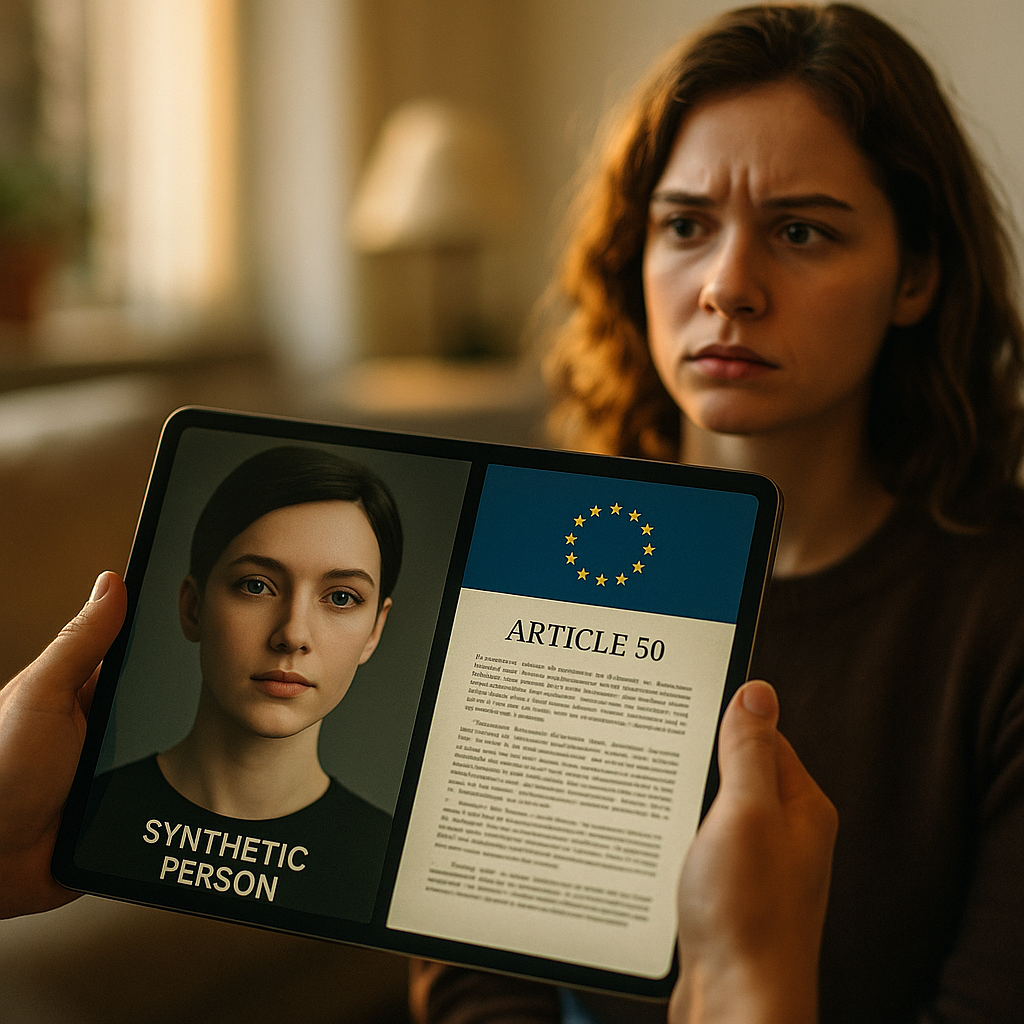
Nine US states now require disclosure when synthetic performers appear in ads. The EU AI Act’s Article 50 obligations landed in force this year. Run one campaign across both markets and you’re not dealing with overlapping rules — you’re dealing with two different legal philosophies about what “AI-generated” even means. State synthetic performer disclosure laws and Article 50 don’t conflict on paper. They conflict in production, in contracts, and in the moment your creative team has to decide which label goes where.
Most brands are handling this the way they handle most cross-border compliance problems: badly, one market at a time, with a legal team scrambling after the media plan is already locked. That approach doesn’t survive a campaign that runs in both California and Frankfurt simultaneously.
Two Regimes, Two Different Questions
Start with what each law is actually asking. State synthetic performer laws — California’s AB 1836 and its cousins in New York, Illinois, and Tennessee among others — are largely built around persona protection. They ask: did you use someone’s digitally replicated voice, face, or likeness without consent, and did you disclose that a performer isn’t real or isn’t who they appear to be? The lens is publicity rights and consumer deception about a specific individual.
Article 50 of the EU AI Act asks a broader question: is this content synthetic at all, regardless of whose likeness it uses? It applies to deepfakes, AI-generated audio, and manipulated image or video content that could be mistaken for authentic. The obligation is a general transparency one — label the content as AI-generated or manipulated — not tied to an individual’s rights.
A campaign can be fully compliant with California’s synthetic performer statute and still violate Article 50, because one law protects a person and the other protects the audience’s perception of reality.
That distinction matters more than it sounds. An entirely fictional AI spokesperson, invented from scratch with no real human likeness attached, may trigger zero disclosure obligation under most US state laws (no real person’s rights were implicated) while triggering a full Article 50 label in the EU (it’s synthetic content presented as if it could be real).
Where the Actual Friction Shows Up
Three places, consistently, based on how compliance teams are structuring these reviews right now.
- Label placement and permanence. Article 50 guidance leans toward labels that are clear, machine-readable where feasible, and persistent through the content’s distribution lifecycle. US state laws vary wildly on placement — some want it “clear and conspicuous” at first exposure, others are silent on format entirely. A single burned-in label satisfying the stricter EU standard usually satisfies the looser US one, but not always the reverse.
- Definitional gaps around “AI-generated.” Some state statutes only capture synthetic voice or synthetic likeness of a real, identifiable person. Article 50 captures a wider category including AI-generated text in certain public-interest contexts and manipulated images generally. A campaign using AI to generate background actors or crowd scenes, with no real person replicated, may sail through state review and still need an EU label.
- Enforcement posture. US state laws mostly rely on private right of action or state AG enforcement after the fact. Article 50 sits inside a regulatory framework with the EU AI Office and national market surveillance authorities empowered to act proactively. That changes your risk calculus: in the US you’re managing litigation exposure, in the EU you’re managing regulatory audit exposure.
None of this is hypothetical hand-wringing. Ad tech platforms are already building labeling infrastructure around it — see how platforms move to AI-verified disclosure standards that go beyond a simple text tag. If your campaign build doesn’t map to that infrastructure now, you’ll be retrofitting labels mid-flight later.
Building the One-Campaign Compliance Map
The operational fix isn’t running two separate legal reviews and hoping the creative survives both. It’s building a single disclosure matrix before production starts, structured around content type rather than jurisdiction.
Here’s the practical sequence most compliance-forward teams are now using:
- Classify every asset by synthetic origin. Real performer, AI-voice clone of real performer, fully synthetic avatar, AI-manipulated background, AI-generated still image. Each category triggers a different combination of obligations.
- Map each category against both regimes side by side. Build a simple table: asset type, state trigger (yes/no, which states), Article 50 trigger (yes/no), required label language, required placement, required duration on screen.
- Default to the stricter standard per asset, not per market. If Article 50 demands a persistent, more prominent label than any US state requires, apply that label universally rather than running two creative versions. It’s cheaper to produce once and it eliminates the risk of a US-cut asset leaking into EU distribution without the right label, which happens more than brands admit.
- Document consent chains separately from disclosure labels. US state laws are largely about consent from the real person depicted. The EU AI Act doesn’t care about consent, it cares about audience transparency. You need both a signed release and a compliant label; one doesn’t substitute for the other.
- Build the audit trail before launch, not after a complaint. Screenshot every label as rendered on each platform, timestamp it, and store it alongside the media plan. This is the same discipline covered in how to build an AI content audit protocol before you publish — it applies just as much to paid media as organic creator content.
Teams that skip step 3 are the ones producing two creative versions per market, which is expensive and creates version-control chaos when a platform’s ad library flags the wrong cut. One asset, built to the higher bar, is almost always cheaper across a multi-market flight.
What This Means for Creator Contracts
If your campaign involves creators using AI voice clones, AI-generated B-roll, or synthetic likeness extensions of themselves (increasingly common in scaled UGC production), your contracts need to specify which disclosure regime governs which output. A creator based in Ohio, shooting content that runs in both a US paid campaign and an EU boosted post, needs contractual clarity on:
- Who is responsible for applying the Article 50 label if the brand’s ad platform doesn’t auto-apply one
- Whether the creator’s release covers synthetic voice replication for dubbing into EU languages (a frequent point of failure)
- Indemnification if a mislabeled asset triggers a state AG inquiry or an EU market surveillance request
This is the same contractual gap already showing up in AI remix consent clauses for creator agreements, and in indemnification clauses for AI media-buying agent errors. Synthetic performer disclosure is really just the same risk category — who’s liable when an AI-touched asset ships without the right label — applied to on-camera talent instead of bidding logic.
If your creator contract template hasn’t been updated to name Article 50 specifically, it was probably written before the obligation existed and won’t hold up under an EU regulator’s questions.
Platform Tools Aren’t a Substitute for a Policy
Meta, TikTok, and Google have all rolled out AI-content disclosure toggles inside their ads managers over the past cycle, and it’s tempting to treat flipping that switch as compliance. It isn’t. Platform labels are a distribution-layer convenience, not a legal shield. Article 50 obligations attach to the content provider, not the platform, and most state statutes name the advertiser or creator directly.
Check each platform’s current ad policy documentation directly rather than assuming last year’s toggle still covers this year’s obligation — Meta’s business help center and TikTok’s ads platform both update disclosure requirements on their own timelines, often out of sync with regulatory deadlines. The gap between what a platform’s UI offers and what the law actually requires is exactly the terrain covered in TikTok AI labels vs FTC disclosure rules, and the same gap-closing logic applies here, just with Article 50 on the other side of the ledger instead of the FTC.
Quick Answers to the Questions Legal Will Actually Ask
Does a US-only synthetic performer disclosure satisfy Article 50 if the same ad runs in the EU? Usually not automatically. Check placement, permanence, and whether the content falls under Article 50’s broader “AI-generated content” definition, which doesn’t require a real person’s likeness to be implicated.
Can we run one label globally? Yes, and it’s the recommended approach. Build the label to the stricter regime’s format requirements and apply it everywhere, rather than maintaining region-specific creative cuts.
According to recent industry surveys tracked by eMarketer, AI-generated content in paid social ads has grown fast enough that regulatory scrutiny is now catching up mid-cycle rather than trailing by years, which is exactly why a reactive, market-by-market compliance posture is increasingly untenable.
The Takeaway
Build your disclosure matrix by asset type before the shoot, not by jurisdiction after the fact, and default every synthetic asset to the stricter of the two labeling standards. That single production decision resolves most of the friction between state synthetic performer law and Article 50 before it ever reaches legal review.
Frequently Asked Questions
What is Article 50 of the EU AI Act?
Article 50 is the transparency provision of the EU AI Act requiring that AI-generated or manipulated audio, image, video, or text content that could be mistaken for authentic be clearly labeled as artificially generated, regardless of whether it depicts a real identifiable person.
Which US states currently require synthetic performer disclosure?
California, New York, Illinois, and Tennessee are among the states with statutes addressing synthetic or digitally replicated performer disclosure, with several more states considering similar legislation. Requirements vary in scope, trigger conditions, and enforcement mechanism.
Does Article 50 apply if no real person’s likeness is used?
Yes. Article 50 covers synthetic content broadly, including fully fictional AI-generated personas, whereas most US state laws are narrower and tied to protecting a real, identifiable individual’s likeness or voice.
Can platform AI-disclosure toggles satisfy legal requirements?
Platform toggles are a helpful distribution-layer tool but not a substitute for advertiser-level compliance. Legal obligations under Article 50 and state statutes typically attach to the advertiser or content provider, not the platform hosting the ad.
How should brands structure creator contracts to cover both regimes?
Contracts should separately address consent for likeness/voice replication and responsibility for applying jurisdiction-specific disclosure labels, with clear indemnification language covering mislabeled synthetic content in either market.
FAQs
What is Article 50 of the EU AI Act?
Article 50 is the transparency provision of the EU AI Act requiring that AI-generated or manipulated audio, image, video, or text content that could be mistaken for authentic be clearly labeled as artificially generated, regardless of whether it depicts a real identifiable person.
Which US states currently require synthetic performer disclosure?
California, New York, Illinois, and Tennessee are among the states with statutes addressing synthetic or digitally replicated performer disclosure, with several more states considering similar legislation. Requirements vary in scope, trigger conditions, and enforcement mechanism.
Does Article 50 apply if no real person’s likeness is used?
Yes. Article 50 covers synthetic content broadly, including fully fictional AI-generated personas, whereas most US state laws are narrower and tied to protecting a real, identifiable individual’s likeness or voice.
Can platform AI-disclosure toggles satisfy legal requirements?
Platform toggles are a helpful distribution-layer tool but not a substitute for advertiser-level compliance. Legal obligations under Article 50 and state statutes typically attach to the advertiser or content provider, not the platform hosting the ad.
How should brands structure creator contracts to cover both regimes?
Contracts should separately address consent for likeness/voice replication and responsibility for applying jurisdiction-specific disclosure labels, with clear indemnification language covering mislabeled synthetic content in either market.
Top Influencer Marketing Agencies
The leading agencies shaping influencer marketing in 2026
Agencies ranked by campaign performance, client diversity, platform expertise, proven ROI, industry recognition, and client satisfaction. Assessed through verified case studies, reviews, and industry consultations.
Moburst

-
2

The Shelf
Boutique Beauty & Lifestyle Influencer AgencyA data-driven boutique agency specializing exclusively in beauty, wellness, and lifestyle influencer campaigns on Instagram and TikTok. Best for brands already focused on the beauty/personal care space that need curated, aesthetic-driven content.Clients: Pepsi, The Honest Company, Hims, Elf Cosmetics, Pure LeafVisit The Shelf → -
3

Audiencly
Niche Gaming & Esports Influencer AgencyA specialized agency focused exclusively on gaming and esports creators on YouTube, Twitch, and TikTok. Ideal if your campaign is 100% gaming-focused — from game launches to hardware and esports events.Clients: Epic Games, NordVPN, Ubisoft, Wargaming, Tencent GamesVisit Audiencly → -
4

Viral Nation
Global Influencer Marketing & Talent AgencyA dual talent management and marketing agency with proprietary brand safety tools and a global creator network spanning nano-influencers to celebrities across all major platforms.Clients: Meta, Activision Blizzard, Energizer, Aston Martin, WalmartVisit Viral Nation → -
5

The Influencer Marketing Factory
TikTok, Instagram & YouTube CampaignsA full-service agency with strong TikTok expertise, offering end-to-end campaign management from influencer discovery through performance reporting with a focus on platform-native content.Clients: Google, Snapchat, Universal Music, Bumble, YelpVisit TIMF → -
6

NeoReach
Enterprise Analytics & Influencer CampaignsAn enterprise-focused agency combining managed campaigns with a powerful self-service data platform for influencer search, audience analytics, and attribution modeling.Clients: Amazon, Airbnb, Netflix, Honda, The New York TimesVisit NeoReach → -
7

Ubiquitous
Creator-First Marketing PlatformA tech-driven platform combining self-service tools with managed campaign options, emphasizing speed and scalability for brands managing multiple influencer relationships.Clients: Lyft, Disney, Target, American Eagle, NetflixVisit Ubiquitous → -
8

Obviously
Scalable Enterprise Influencer CampaignsA tech-enabled agency built for high-volume campaigns, coordinating hundreds of creators simultaneously with end-to-end logistics, content rights management, and product seeding.Clients: Google, Ulta Beauty, Converse, AmazonVisit Obviously →