


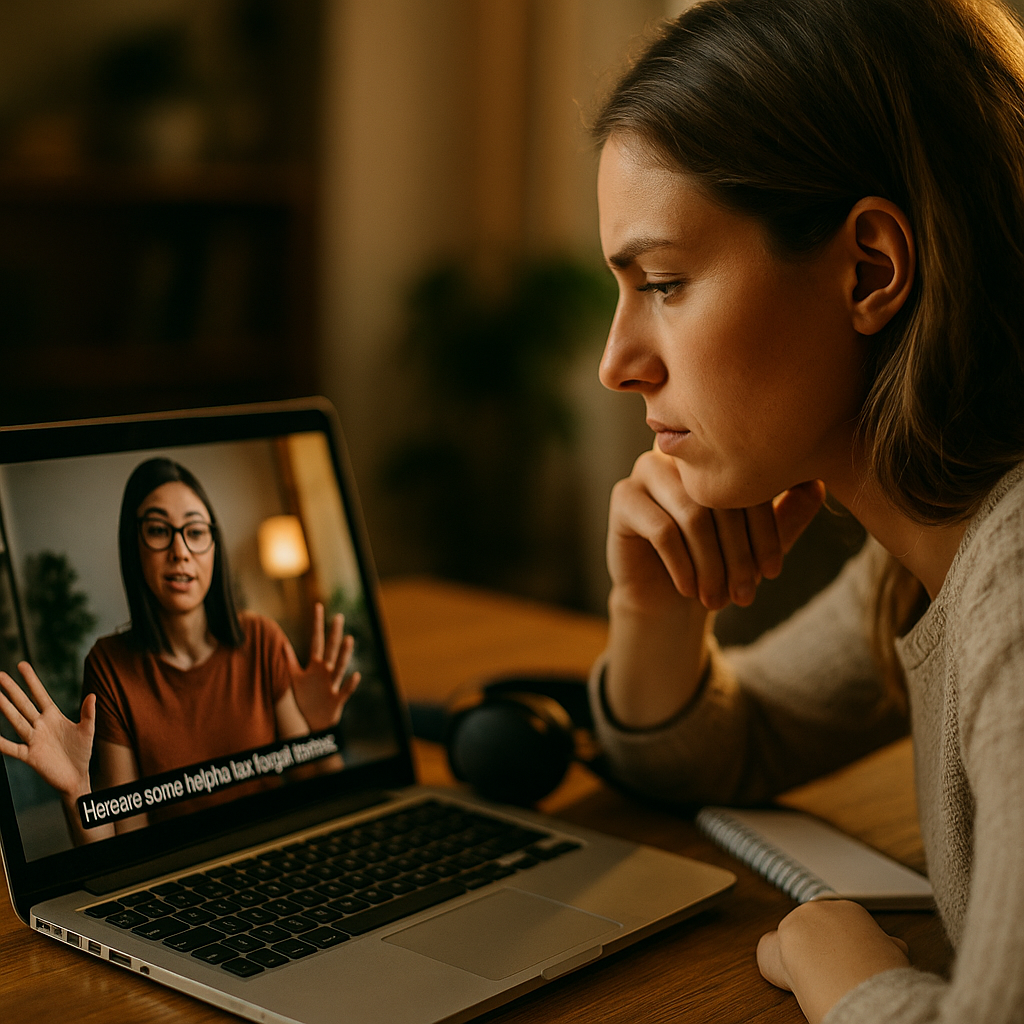
Over 1,200 ADA-related digital accessibility lawsuits hit U.S. companies in a single recent year, and video content without captions is now one of the most cited defects. If your influencer program is pumping out creator video without an accessibility compliance checklist attached to the brief, you are not saving time. You are stacking legal exposure on top of a marketing budget that was never built to absorb it.
Accessibility Stopped Being Optional the Moment Video Became the Default Format
Short-form video is no longer a supplemental tactic. It is the primary unit of brand storytelling on TikTok, Instagram Reels, YouTube Shorts, and increasingly, connected TV. That shift matters because accessibility law was written for a web of text and static images, and regulators, courts, and plaintiffs’ attorneys have spent the last few years catching up to video.
The Department of Justice finalized rules under Title II of the ADA requiring state and local government digital content to meet WCAG 2.1 AA, and Title III litigation against private businesses has followed the same logic even without a matching final rule. Meanwhile, the European Accessibility Act became enforceable, pulling e-commerce, banking, and consumer tech brands operating in the EU into a much stricter compliance net that explicitly covers audiovisual media services.
Translation for a CMO: if your creators are producing video that promotes your product, and that video lives on your owned channels, your app, or gets embedded on your site, accessibility rules likely apply to you, not just the platform hosting it.
Brands routinely assume TikTok’s or Instagram’s auto-caption feature satisfies legal accessibility requirements. It does not. Auto-generated captions average error rates of 5 to 15 percent depending on audio quality and accent, and a caption riddled with mistakes can be treated as inaccessible under WCAG standards.
What Accessibility Compliance Actually Requires for Video
Strip away the legal jargon and creator video accessibility boils down to a short list of concrete deliverables. None of these are exotic. Most are cheap. The failure point is almost always process, not technology.
- Closed captions that are accurate, synchronized, and readable. WCAG 2.2 (the current standard most courts and regulators reference) requires captions for prerecorded audio content, with accuracy expectations well above what raw auto-caption tools deliver out of the box.
- Audio descriptions for visually critical content. If a creator demos a product silently and the value proposition depends on watching what happens, viewers who are blind or low vision need a narrated equivalent.
- Sufficient color contrast on any on-screen text or graphics. Trendy pastel-on-pastel text overlays that look great on a phone screen often fail basic contrast ratio tests.
- Keyboard and screen-reader navigable video players. This applies when creator content is embedded on brand-owned pages, not the platform’s native player.
- Transcripts. Not legally mandatory everywhere, but increasingly expected, and they double as an SEO asset.
None of that is complicated in isolation. What trips brands up is scale. When you are running fifty creators across four platforms simultaneously, “we’ll add captions later” quietly becomes “we never added captions.”
Where the Legal Exposure Actually Lands
Here is the uncomfortable part: platforms are not liable for your marketing content. You are. TikTok’s terms of service do not indemnify you against an ADA claim tied to a branded video embedded on your landing page. Neither does Instagram’s. The creator who filmed it almost certainly is not carrying accessibility liability in their contract either, unless you put it there.
This is the same structural gap that shows up across influencer marketing compliance generally. Brands assume risk transfers to the platform or the talent, and it usually does not. It is the same logic explored in coverage of creator liability gaps, and it applies just as cleanly to accessibility as it does to IP disputes or FTC disclosure failures.
Retailers and consumer brands are disproportionately targeted because plaintiffs’ firms scan for low-hanging fruit: a product demo video with no captions, embedded on a checkout-adjacent page, promoted heavily in paid media. That combination signals both non-compliance and financial capacity to settle, which is exactly what makes a brand attractive to litigate against.
Building Accessibility Into the Creator Brief, Not the Cleanup Process
The fix is not a legal department memo nobody reads. It is a workflow change at the brief stage, before a single frame gets shot.
- Specify caption standards in the creator contract. Require accurate closed captions burned in or delivered as a separate SRT file meeting a defined accuracy threshold, not just “add captions.”
- Assign review ownership. Someone on the brand side, or an agency partner, needs to actually check caption accuracy against the audio track before publish. This takes minutes per video and catches the majority of errors.
- Build accessibility into standardized talent agreements. The same way brands have moved toward standardized base contracts to scale rosters without renegotiating terms every time, accessibility clauses belong in that base template, not bolted on ad hoc.
- Audit before amplification, not after. If a creator video is getting boosted with paid spend or embedded on owned properties, that is the moment it crosses from “organic content, lower scrutiny” to “brand advertising, full scrutiny.”
- Document your process. If a claim ever surfaces, having a repeatable accessibility QA workflow is a meaningfully better legal position than having none.
Agencies running influencer programs at volume should treat this the same way they treat creator contract audits: a periodic sweep, not a one-time fix. Compliance drifts. New creators join rosters without the updated brief. Old videos stay live long after the original team that produced them has moved on.
Platform Realities Brands Need to Stop Ignoring
Every major platform has invested in accessibility tooling, but tooling is not the same as compliance. YouTube’s automatic captioning has improved substantially, and Google’s own guidance on caption accuracy standards is worth reviewing before assuming the default output clears a legal bar. TikTok and Instagram both support native caption stickers, but creators frequently disable or skip them because they interrupt aesthetic choices, and brands rarely enforce otherwise.
Connected TV adds another layer entirely. As creator content increasingly gets repurposed into CTV placements, accessibility rules intersect with the disclosure obligations covered in streaming ad disclosure compliance, and FCC captioning rules for televised content are stricter and more consistently enforced than anything currently governing social feeds.
Worth noting too: platform algorithm behavior is quietly nudging brands toward better accessibility practices even when compliance is not the stated goal. Research summarized by Sprout Social has repeatedly shown captioned video outperforming uncaptioned video on watch time and completion rate, largely because most people scroll social feeds with sound off. Accessibility and performance point the same direction here, which makes the business case easier to sell internally than most compliance asks.
The Audience Cost of Getting This Wrong
Beyond litigation risk, there is a straightforward market-size argument. Roughly 1 in 4 adults in the U.S. lives with a disability according to CDC data, and a meaningful share of that population manages hearing or vision conditions that directly affect video consumption. eMarketer and other research groups have flagged accessible commerce as an underserved, high-loyalty segment precisely because so few brands compete for it well. Ignoring accessibility is not just a legal risk. It is walking away from addressable revenue.
Add in the compounding effect of algorithmic reach. Platforms have been tightening how they handle content flagged for compliance issues, a dynamic covered in depth in the analysis of platform regulations suppressing reach. Accessibility complaints and takedown requests can trigger the same visibility penalties as other compliance flags, meaning a captioning failure does not just risk a lawsuit. It can quietly throttle the exact organic reach the campaign was built to generate.
Next Step
Pull your last quarter of creator video content and run a five-minute caption accuracy spot check on your ten highest-spend assets. If more than two fail, your brief template is the problem, not the creators, and it needs an accessibility clause before the next production cycle starts.
FAQs
Does ADA compliance actually apply to social media influencer content?
It applies more directly when that content is embedded on brand-owned websites or apps, or amplified through paid media. Native platform posts sit in a legal gray area, but courts have increasingly extended accessibility expectations to any digital content a business uses commercially, including creator video.
Are auto-generated captions from TikTok or Instagram good enough for legal compliance?
Generally no. Auto-caption error rates commonly run between 5 and 15 percent depending on audio clarity, and WCAG standards call for accurate, synchronized captions. Brands should review or edit auto-captions before treating a video as compliant.
Who is liable if a creator posts an inaccessible video promoting our brand?
In most cases, the brand carries the primary risk, since platforms and creator contracts rarely include accessibility indemnification by default. Building accessibility requirements into the creator contract and brief is the most reliable way to shift and reduce that exposure.
What is the minimum accessibility standard brands should target for creator video?
WCAG 2.2 AA is the most widely referenced benchmark by regulators and courts. At minimum, that means accurate closed captions, sufficient text contrast on overlays, and audio descriptions for any content where visuals carry essential meaning.
Does accessibility compliance actually help campaign performance, or is it purely a cost center?
It typically helps performance. Captioned video consistently shows higher completion rates on sound-off feeds, and accessible content reaches audiences with disabilities that many competitors are effectively ignoring, making it a rare case where compliance and ROI point the same direction.
Top Influencer Marketing Agencies
The leading agencies shaping influencer marketing in 2026
Agencies ranked by campaign performance, client diversity, platform expertise, proven ROI, industry recognition, and client satisfaction. Assessed through verified case studies, reviews, and industry consultations.
Moburst

-
2

The Shelf
Boutique Beauty & Lifestyle Influencer AgencyA data-driven boutique agency specializing exclusively in beauty, wellness, and lifestyle influencer campaigns on Instagram and TikTok. Best for brands already focused on the beauty/personal care space that need curated, aesthetic-driven content.Clients: Pepsi, The Honest Company, Hims, Elf Cosmetics, Pure LeafVisit The Shelf → -
3

Audiencly
Niche Gaming & Esports Influencer AgencyA specialized agency focused exclusively on gaming and esports creators on YouTube, Twitch, and TikTok. Ideal if your campaign is 100% gaming-focused — from game launches to hardware and esports events.Clients: Epic Games, NordVPN, Ubisoft, Wargaming, Tencent GamesVisit Audiencly → -
4

Viral Nation
Global Influencer Marketing & Talent AgencyA dual talent management and marketing agency with proprietary brand safety tools and a global creator network spanning nano-influencers to celebrities across all major platforms.Clients: Meta, Activision Blizzard, Energizer, Aston Martin, WalmartVisit Viral Nation → -
5

The Influencer Marketing Factory
TikTok, Instagram & YouTube CampaignsA full-service agency with strong TikTok expertise, offering end-to-end campaign management from influencer discovery through performance reporting with a focus on platform-native content.Clients: Google, Snapchat, Universal Music, Bumble, YelpVisit TIMF → -
6

NeoReach
Enterprise Analytics & Influencer CampaignsAn enterprise-focused agency combining managed campaigns with a powerful self-service data platform for influencer search, audience analytics, and attribution modeling.Clients: Amazon, Airbnb, Netflix, Honda, The New York TimesVisit NeoReach → -
7

Ubiquitous
Creator-First Marketing PlatformA tech-driven platform combining self-service tools with managed campaign options, emphasizing speed and scalability for brands managing multiple influencer relationships.Clients: Lyft, Disney, Target, American Eagle, NetflixVisit Ubiquitous → -
8

Obviously
Scalable Enterprise Influencer CampaignsA tech-enabled agency built for high-volume campaigns, coordinating hundreds of creators simultaneously with end-to-end logistics, content rights management, and product seeding.Clients: Google, Ulta Beauty, Converse, AmazonVisit Obviously →