


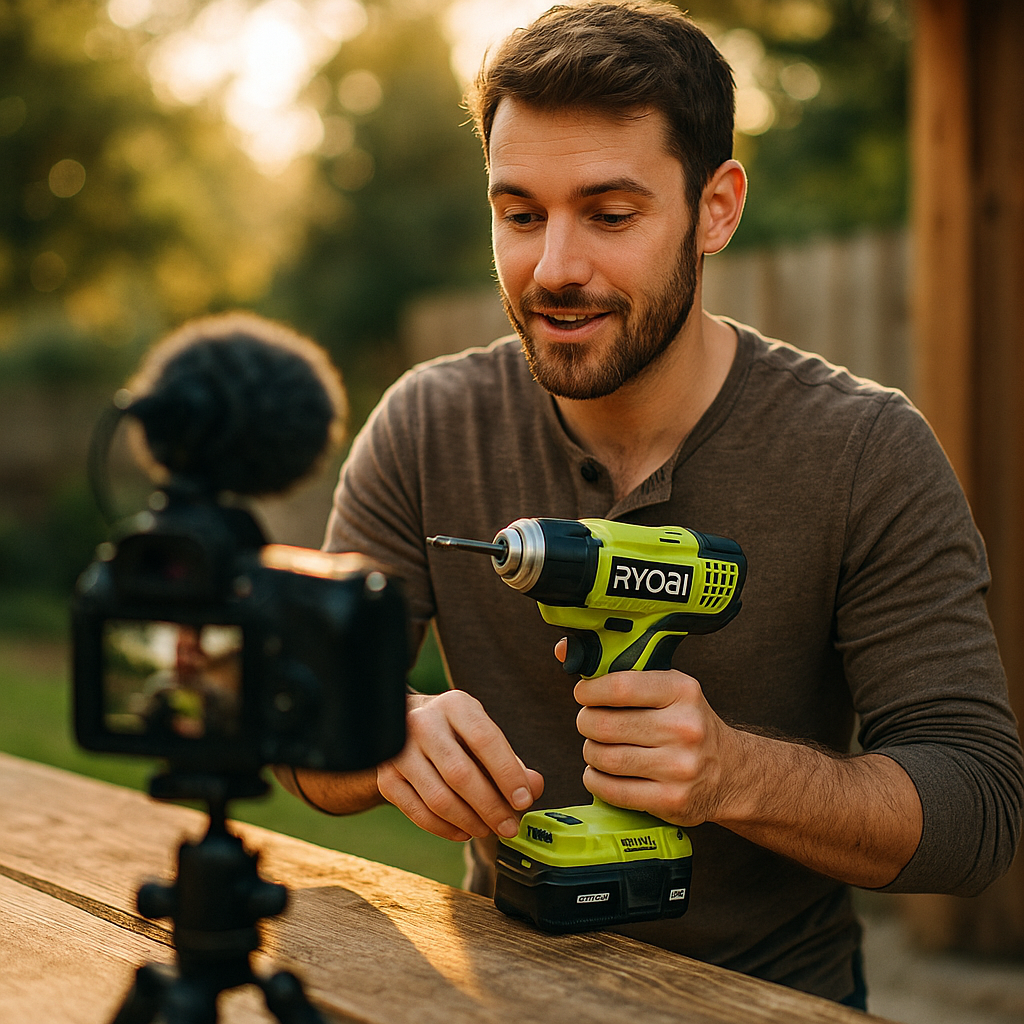
What if your highest-performing acquisition channel wasn’t a paid social campaign, but a guy in his driveway reviewing a $99 drill? That’s Ryobi’s reality. The power tool brand quietly built a cordless tool reviews engine out of weekend-warrior nano-creators, and it now outperforms every paid channel in the marketing mix. No celebrity endorsements. No six-figure ambassador deals. Just thousands of ordinary people filming themselves building a deck.
The Problem With Tool Marketing (And Why Ads Weren’t Working)
Power tools are a brutal category to advertise. Buyers don’t trust brand claims about torque, runtime, or battery compatibility — they trust the guy who’s actually used the drill for six months and dropped it off a ladder twice. Ryobi’s category is also crowded: DeWalt, Milwaukee, Makita, and Craftsman all fight for the same home-improvement aisle, and most of them lean on pro-contractor endorsements and big-box retail media.
Ryobi took the opposite bet. Instead of chasing licensed contractors or DIY celebrities, the brand leaned into the unglamorous middle: weekend warriors, homeowners, garage tinkerers, and small-scale renovators who post because they’re proud of the deck they built, not because they’re getting paid a fortune to do it. This is nano-creator territory — typically 1,000 to 20,000 followers — and it’s a segment most tool brands ignored in favor of scale.
What Counts as a “Nano-Creator” in the Tool Category?
In influencer marketing generally, nano-creators sit at the bottom of the follower pyramid but often the top of the trust pyramid. In tools specifically, that means:
- Homeowners documenting a renovation or build on YouTube Shorts or TikTok
- Garage and workshop accounts with a few thousand loyal subscribers
- Local tradespeople who post project walkthroughs as a side hustle, not a business
- Parents building furniture, sheds, or playsets and reviewing the tools along the way
These creators aren’t polished. Their lighting is bad. Their audio picks up power saws in the background. That’s exactly the point — the content reads as unscripted proof, not sponsored content, even when it technically is.
Ryobi’s nano-creator program reportedly delivers cost-per-acquisition figures a fraction of paid social, because the “review” format does the conversion work that an ad script can’t: it shows the tool failing, struggling, and eventually succeeding in a real project.
The Seeding Model: Low Cost, High Volume
Ryobi’s approach mirrors what other brands have discovered when they shift budget from macro deals to volume seeding — a pattern also visible in Stanley’s nano-creator seeding playbook and Duluth Trading’s workwear seeding strategy. The mechanics are simple, and they’ve become something close to a category standard for physical product brands:
- Seed the tool, not the script. Ryobi ships product to creators with minimal creative direction — no talking points, no mandatory hashtags beyond basic disclosure. The brand trusts the tool to do the selling.
- Prioritize project-based content over unboxing. A review that shows the tool mid-project (cutting deck boards, assembling a shed, drilling into brick) converts better than a spec-sheet rundown.
- Let volume do what precision targeting can’t. Instead of picking 20 “perfect” creators, Ryobi seeds hundreds, accepting that most posts will be modest but a handful will break out organically.
- Track sell-through, not just engagement. Retail data from Home Depot (Ryobi’s primary retail partner) lets the brand tie creator content spikes to actual point-of-sale lift, not just video views.
Why Weekend Warriors Beat Pro Contractors on ROAS
Pro-contractor content looks great. It’s also, ironically, less persuasive to the actual buyer. Most Ryobi customers aren’t contractors — they’re homeowners buying their first cordless drill set or upgrading a battery platform. A tradesperson using a tool eight hours a day signals durability, sure, but it doesn’t answer the buyer’s real question: will this work for someone like me, who uses it twice a month?
Weekend-warrior content answers that question directly. It’s relatable failure and relatable success in the same video. The creator drops the drill, curses, keeps going, finishes the shelf. That arc is what turns a skeptical scroller into a buyer, and it’s a big part of why nano-creator content in categories like cookware and home goods has consistently shown stronger purchase-intent signals than polished influencer content, according to research from eMarketer on creator-driven purchase behavior.
This mirrors what’s happened in other durable-goods categories. YETI built a premium cooler category largely on the back of everyday users showing the product in real conditions rather than studio ads. Ryobi’s version is muddier, louder, and full of sawdust — but the trust mechanic is identical.
The Compliance Layer Brands Keep Underestimating
Here’s where a lot of marketing teams get nervous, and rightly so. Seeding hundreds of nano-creators with free product means hundreds of disclosure decisions happening outside your direct control. The FTC’s endorsement guidelines require clear disclosure any time there’s a material connection between a brand and a creator, and “I got this for free” absolutely counts.
Ryobi’s program reportedly manages this through:
- Standardized disclosure language built into seeding agreements, even for zero-cash gifting
- Platform-native disclosure tools (TikTok’s branded content toggle, Instagram’s paid partnership label) required as a condition of participation
- Spot audits on high-performing content to catch missed disclosures before they become a compliance headache
This isn’t optional infrastructure. It’s the difference between a scalable nano-creator program and a legal liability with good engagement numbers. Brands running high-volume seeding without a disclosure system are gambling with FTC exposure, and regulators have shown increasing willingness to enforce against both creators and brands.
Measuring ROAS When the Funnel Isn’t Linear
Tool purchases aren’t impulse buys. Someone watches a cordless drill review, doesn’t buy for three weeks, then walks into Home Depot and buys the exact kit they saw reviewed. That delay breaks last-click attribution models, and it’s a headache Ryobi has had to solve with blended measurement rather than platform-native attribution alone.
What seems to work, based on patterns across similar retail-anchored brands, is triangulating:
- Retail media and point-of-sale data from big-box partners
- Branded search lift during and after creator content spikes
- Promo code or affiliate link redemption, even when it captures only a fraction of true conversions
- Share-of-voice tracking via social listening tools like Sprout Social to catch organic resharing beyond the original seeded post
This multi-signal approach is increasingly standard for brands trying to prove influencer ROI in categories with long consideration windows, similar to how Vuori tracked its nano-to-macro creator ladder impact across a slower apparel purchase cycle.
What Other Brands Can Steal From the Ryobi Playbook
You don’t need to sell power tools to apply this model. The underlying principle transfers to any considered purchase with a demonstrable use case: appliances, outdoor gear, fitness equipment, even software with a visible workflow.
- Seed wide before you seed deep. A hundred modest creators often outperform five expensive ones in aggregate reach and trust signal.
- Design for the “failure moment.” Content that shows a product struggling and recovering converts better than a flawless demo. Don’t script it away.
- Build disclosure into onboarding, not as an afterthought. Every seeded creator should receive compliance language before product ships, not after content posts.
- Blend attribution models. If your purchase cycle has a delay, don’t rely on single-touch attribution. Combine retail data, search lift, and listening tools.
- Let category context set the creator bar. Tools need real project use. Beauty needs real skin. Food needs a real kitchen. Match the creator’s authenticity signal to what actually builds trust in your category — a lesson also visible in how Poppi rebuilt trust with kitchen-table content.
The Uncomfortable Truth for Big-Budget Marketers
Ryobi’s nano-creator engine works precisely because it looks cheap. That’s not a bug in the strategy, it’s the strategy. Polish reads as paid. Rough footage reads as real. For a brand competing against premium-positioned rivals on trust rather than price, that trade-off has turned into one of the more efficient acquisition channels in its marketing mix, and a template other durable-goods brands are now studying closely.
Frequently Asked Questions
What makes nano-creators effective for cordless tool reviews?
Nano-creators typically post unscripted, project-based content that shows real-world use, including product struggles and failures. That authenticity builds more purchase confidence than polished pro-contractor content, especially for everyday buyers rather than tradespeople.
How does Ryobi measure ROAS from a nano-creator program?
Ryobi blends retail point-of-sale data, branded search lift, promo code redemption, and social listening rather than relying on single-touch attribution, since tool purchases often happen weeks after a creator’s review is seen.
Is gifting product to creators enough to trigger FTC disclosure rules?
Yes. Free product counts as a material connection under FTC endorsement guidelines, so creators must disclose it clearly, regardless of whether cash payment was involved.
Can this nano-creator seeding model work outside the tool category?
Yes. It transfers well to any product with a visible, demonstrable use case — appliances, outdoor gear, fitness equipment — where showing real use builds more trust than a traditional ad.
How many creators does a brand need to seed to see results?
There’s no fixed number, but the model depends on volume over precision. Seeding hundreds of nano-creators, accepting modest performance from most, tends to outperform a handful of expensive, highly-targeted placements.
The Takeaway
Ryobi didn’t out-advertise its rivals. It out-sourced trust to the people already using its tools, and built a compliance and measurement system solid enough to scale that trust safely. If your category has a visible use case and a skeptical buyer, that’s your playbook too.
Top Influencer Marketing Agencies
The leading agencies shaping influencer marketing in 2026
Agencies ranked by campaign performance, client diversity, platform expertise, proven ROI, industry recognition, and client satisfaction. Assessed through verified case studies, reviews, and industry consultations.
Moburst

-
2

The Shelf
Boutique Beauty & Lifestyle Influencer AgencyA data-driven boutique agency specializing exclusively in beauty, wellness, and lifestyle influencer campaigns on Instagram and TikTok. Best for brands already focused on the beauty/personal care space that need curated, aesthetic-driven content.Clients: Pepsi, The Honest Company, Hims, Elf Cosmetics, Pure LeafVisit The Shelf → -
3

Audiencly
Niche Gaming & Esports Influencer AgencyA specialized agency focused exclusively on gaming and esports creators on YouTube, Twitch, and TikTok. Ideal if your campaign is 100% gaming-focused — from game launches to hardware and esports events.Clients: Epic Games, NordVPN, Ubisoft, Wargaming, Tencent GamesVisit Audiencly → -
4

Viral Nation
Global Influencer Marketing & Talent AgencyA dual talent management and marketing agency with proprietary brand safety tools and a global creator network spanning nano-influencers to celebrities across all major platforms.Clients: Meta, Activision Blizzard, Energizer, Aston Martin, WalmartVisit Viral Nation → -
5

The Influencer Marketing Factory
TikTok, Instagram & YouTube CampaignsA full-service agency with strong TikTok expertise, offering end-to-end campaign management from influencer discovery through performance reporting with a focus on platform-native content.Clients: Google, Snapchat, Universal Music, Bumble, YelpVisit TIMF → -
6

NeoReach
Enterprise Analytics & Influencer CampaignsAn enterprise-focused agency combining managed campaigns with a powerful self-service data platform for influencer search, audience analytics, and attribution modeling.Clients: Amazon, Airbnb, Netflix, Honda, The New York TimesVisit NeoReach → -
7

Ubiquitous
Creator-First Marketing PlatformA tech-driven platform combining self-service tools with managed campaign options, emphasizing speed and scalability for brands managing multiple influencer relationships.Clients: Lyft, Disney, Target, American Eagle, NetflixVisit Ubiquitous → -
8

Obviously
Scalable Enterprise Influencer CampaignsA tech-enabled agency built for high-volume campaigns, coordinating hundreds of creators simultaneously with end-to-end logistics, content rights management, and product seeding.Clients: Google, Ulta Beauty, Converse, AmazonVisit Obviously →