


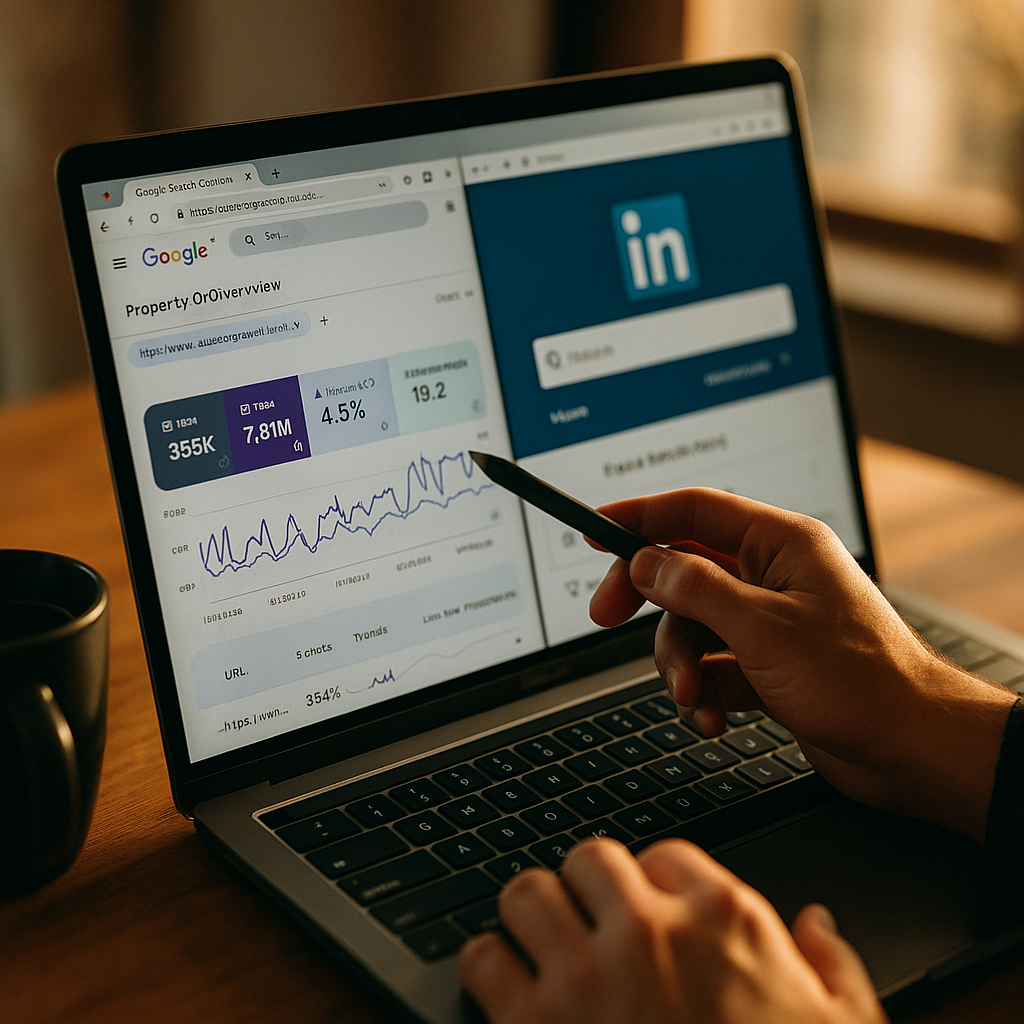
Ask ten B2B marketers where their branded search traffic originates, and nine will guess “Google.” Almost none will say LinkedIn. Yet LinkedIn posts, company pages, and even Creator profiles get indexed and ranked constantly — and most brands have zero visibility into it. Setting up LinkedIn as a Google Search Console property is the unsexy technical move that fixes this blind spot, turning guesswork about B2B discovery into a measurable, first-party data stream.
Why this matters now, not later
LinkedIn stopped being a static resume site years ago. It’s now a publishing platform with its own SEO gravity — company pages rank, individual posts rank, newsletters rank, and Creator mode profiles increasingly show up in branded and category searches. Google crawls public LinkedIn content the same way it crawls any other indexable page. The catch is that almost no marketing team treats LinkedIn URLs as owned digital assets worth monitoring the way they’d monitor a blog post or landing page.
That’s a mistake, especially with B2B buying committees doing more anonymous research before ever touching a sales rep. According to Gartner’s B2B research, buyers spend the majority of their purchase journey in independent, self-guided research, and increasingly, that research includes scrolling LinkedIn feeds and searching Google for company names alongside “LinkedIn” or “reviews.” If you don’t know which of your LinkedIn URLs are getting impressions and clicks from Google, you’re flying blind on a channel that’s shaping pipeline.
LinkedIn content indexed by Google is first-party discovery data hiding in plain sight — most B2B teams simply never bothered to look for it.
What “LinkedIn as a GSC property” actually means
To be precise: you’re not verifying ownership of linkedin.com itself. Nobody outside LinkedIn can do that. What you’re doing is adding a URL-prefix property in Google Search Console scoped to your specific company page, newsletter, or Creator profile path — for example, linkedin.com/company/your-brand or linkedin.com/newsletters/your-newsletter-id.
Google Search Console allows URL-prefix verification via HTML tag, domain provider, Google Analytics, or Google Tag Manager. Since you don’t control LinkedIn’s backend, the realistic verification path is usually through a Google Analytics property already linked to tracking on associated owned pages, or in some cases, the domain-wide DNS approach if your organization has delegated subdomain control (rare, and not applicable to standard LinkedIn company pages).
Here’s the more common and reliable workaround marketers actually use: rather than fighting for a full verified property, they monitor LinkedIn URL performance through the Google Search Console domain property for their own site, cross-referenced with a manual query segment, or they use the “URL Inspection” tool to spot-check whether specific LinkedIn URLs are indexed at all. Some enterprise SEO teams with sanctioned access at the organizational level (through a verified LinkedIn Page admin plus domain-level Search Console access) can go further using structured data validation on newsletter articles, since LinkedIn newsletters generate crawlable, canonical URLs with article schema.
The practical takeaway: full property verification is aspirational for most teams, but query-level monitoring of LinkedIn-owned URLs is achievable today, and it’s more valuable than teams assume.
What you can actually measure once it’s set up
Once you’ve got visibility, even partial, into how LinkedIn URLs perform in Google’s index, a few data points become genuinely useful for strategy:
- Impressions for branded + category queries. Are people searching “[your company] LinkedIn” or “[category] thought leadership LinkedIn”? That’s demand signal you can’t get from LinkedIn’s native analytics.
- Click-through rate on indexed posts vs. company page. Some brands find their executive’s personal posts outrank the company page for the same query — a strong argument for investing in executive thought leadership over corporate content.
- Indexation lag. LinkedIn newsletters and articles often get indexed within days. Standard feed posts, less reliably. Knowing the difference changes what format you use for SEO-intentional content.
- Query cannibalization. If your LinkedIn company page and your own website are both ranking for the same branded query, you may be splitting authority instead of consolidating it.
None of this replaces LinkedIn’s own Campaign Manager or page analytics. It supplements them with the one thing LinkedIn’s dashboard can’t show you: how Google’s algorithm actually perceives and surfaces your content to people who never opened the LinkedIn app.
The compliance and attribution angle brands keep missing
There’s a risk-mitigation case here too, not just an opportunity case. B2B marketing teams are under growing pressure to prove multi-touch attribution, especially as budgets tighten and CFOs ask harder questions about channel ROI. If a prospect discovers your brand via a Google search that surfaces a LinkedIn post, and that interaction never gets logged anywhere, your attribution model has a hole in it. Marketing ops teams building out attribution stacks in tools like HubSpot increasingly need to account for “dark social” and indexed-social discovery as a distinct touchpoint, separate from paid social and separate from organic website search.
There’s also a governance angle. Legal and compliance teams reviewing influencer and creator disclosures on LinkedIn (particularly relevant after LinkedIn’s expanded Creator tools) want to know which posts are publicly indexed and discoverable, because indexed content carries different reputational exposure than content visible only to a logged-in LinkedIn audience. A post that’s indexable by Google is, functionally, public web content — subject to the same scrutiny as a press release.
An indexed LinkedIn post isn’t “social content” anymore in the risk sense — it’s public web content, and it should be governed like one.
Building the actual playbook
Treat this as a five-step operational process, not a one-off audit.
- Inventory your indexable LinkedIn assets. Company page, showcase pages, newsletters, and any executive Creator profiles that regularly publish on behalf of the brand.
- Run manual URL Inspection checks in Search Console for a sample of recent posts and newsletter editions. Note indexation speed and whether Google is serving a rich snippet or a bare link.
- Cross-reference branded search queries in your existing verified domain property. Look for query patterns that suggest people are searching for your LinkedIn presence specifically, then check if that traffic is landing on LinkedIn or your owned site.
- Standardize on formats that index reliably. Newsletters with structured article schema outperform standard feed posts for indexation consistency. If SEO visibility matters to your content strategy, that should influence format choice, not just engagement metrics.
- Loop in legal/compliance for review cadence. Any indexed post carrying a paid partnership, sponsorship, or affiliate disclosure needs the same review rigor you’d apply to a landing page, especially given FTC disclosure guidance that doesn’t distinguish between platforms.
This isn’t a massive lift. Most of it is a quarterly audit process, not daily monitoring. But it closes a gap that’s been sitting open since LinkedIn’s algorithm shifted toward rewarding trusted, consistent voices over volume, a change covered in depth in our breakdown of the LinkedIn trusted-voice algorithm. If LinkedIn is now surfacing fewer, higher-trust creators and posts, and Google is indexing a subset of that content, the intersection of the two is exactly where your best organic B2B discovery opportunities live.
Where this connects to the rest of your creator stack
This isn’t just an SEO exercise, it’s part of a broader shift toward treating platform discovery data as something brands actively own and interrogate, rather than accept at face value from platform dashboards. The same logic that applies to LinkedIn indexation applies across the creator economy: TikTok’s search behavior shifts forced brands to rebuild product content for discovery, not just engagement. YouTube’s trust-weighting changes, detailed in our piece on how YouTube ranks creator trust over volume, forced similar recalibration. LinkedIn’s Google-indexed footprint is simply the B2B-specific version of a pattern playing out across every platform: discovery is no longer confined to the app it happens in.
For teams already tracking LinkedIn’s native analytics tools, pairing that with Search Console data closes the loop. Our earlier coverage of LinkedIn’s analytics tools and creator ROI data is a useful companion resource if you’re building out a full-funnel measurement stack that spans native platform metrics and external search visibility.
If you’re still relying purely on reach and impressions inside LinkedIn’s own dashboard, you’re missing the half of the picture that happens outside the app entirely. That’s the half Search Console can actually show you.
Data from eMarketer and Statista consistently shows B2B buyers now conduct extensive pre-sales research entirely outside vendor-owned channels. LinkedIn indexed content is one of the few places brands can still capture and measure that invisible research phase, if they bother to look.
Next step: Pull your last 90 days of Search Console query data, filter for branded terms, and check how many click through to a LinkedIn URL instead of your own site. If it’s more than a handful, you’ve just found a discovery channel you weren’t measuring — go build the audit process before your next budget review.
FAQs
Can you fully verify LinkedIn as a Google Search Console property?
Not in the traditional sense. You can’t claim ownership of linkedin.com. What’s achievable is monitoring specific LinkedIn URLs (company pages, newsletters, Creator posts) through URL Inspection and cross-referencing branded query data in a property you do control.
Does Google actually index LinkedIn posts and company pages?
Yes, public LinkedIn content is crawlable and frequently indexed, particularly newsletters with structured article schema and company pages. Indexation speed and consistency vary by content type.
Why would a B2B brand care about LinkedIn’s Google indexation at all?
Because a significant share of B2B research happens through Google searches that surface LinkedIn content, not just LinkedIn’s native search or feed. Ignoring this means missing a measurable discovery channel that influences pipeline.
What’s the easiest first step for a marketing team to try this?
Use the URL Inspection tool in an existing Search Console property to check whether recent LinkedIn company page posts or newsletters are indexed, then cross-check branded query data for LinkedIn-related searches.
Does this replace LinkedIn’s native analytics?
No. It supplements native analytics by showing how Google’s algorithm surfaces your LinkedIn content to searchers who never opened the app, a data layer LinkedIn’s own dashboard doesn’t provide.
Top Influencer Marketing Agencies
The leading agencies shaping influencer marketing in 2026
Agencies ranked by campaign performance, client diversity, platform expertise, proven ROI, industry recognition, and client satisfaction. Assessed through verified case studies, reviews, and industry consultations.
Moburst

-
2

The Shelf
Boutique Beauty & Lifestyle Influencer AgencyA data-driven boutique agency specializing exclusively in beauty, wellness, and lifestyle influencer campaigns on Instagram and TikTok. Best for brands already focused on the beauty/personal care space that need curated, aesthetic-driven content.Clients: Pepsi, The Honest Company, Hims, Elf Cosmetics, Pure LeafVisit The Shelf → -
3

Audiencly
Niche Gaming & Esports Influencer AgencyA specialized agency focused exclusively on gaming and esports creators on YouTube, Twitch, and TikTok. Ideal if your campaign is 100% gaming-focused — from game launches to hardware and esports events.Clients: Epic Games, NordVPN, Ubisoft, Wargaming, Tencent GamesVisit Audiencly → -
4

Viral Nation
Global Influencer Marketing & Talent AgencyA dual talent management and marketing agency with proprietary brand safety tools and a global creator network spanning nano-influencers to celebrities across all major platforms.Clients: Meta, Activision Blizzard, Energizer, Aston Martin, WalmartVisit Viral Nation → -
5

The Influencer Marketing Factory
TikTok, Instagram & YouTube CampaignsA full-service agency with strong TikTok expertise, offering end-to-end campaign management from influencer discovery through performance reporting with a focus on platform-native content.Clients: Google, Snapchat, Universal Music, Bumble, YelpVisit TIMF → -
6

NeoReach
Enterprise Analytics & Influencer CampaignsAn enterprise-focused agency combining managed campaigns with a powerful self-service data platform for influencer search, audience analytics, and attribution modeling.Clients: Amazon, Airbnb, Netflix, Honda, The New York TimesVisit NeoReach → -
7

Ubiquitous
Creator-First Marketing PlatformA tech-driven platform combining self-service tools with managed campaign options, emphasizing speed and scalability for brands managing multiple influencer relationships.Clients: Lyft, Disney, Target, American Eagle, NetflixVisit Ubiquitous → -
8

Obviously
Scalable Enterprise Influencer CampaignsA tech-enabled agency built for high-volume campaigns, coordinating hundreds of creators simultaneously with end-to-end logistics, content rights management, and product seeding.Clients: Google, Ulta Beauty, Converse, AmazonVisit Obviously →