


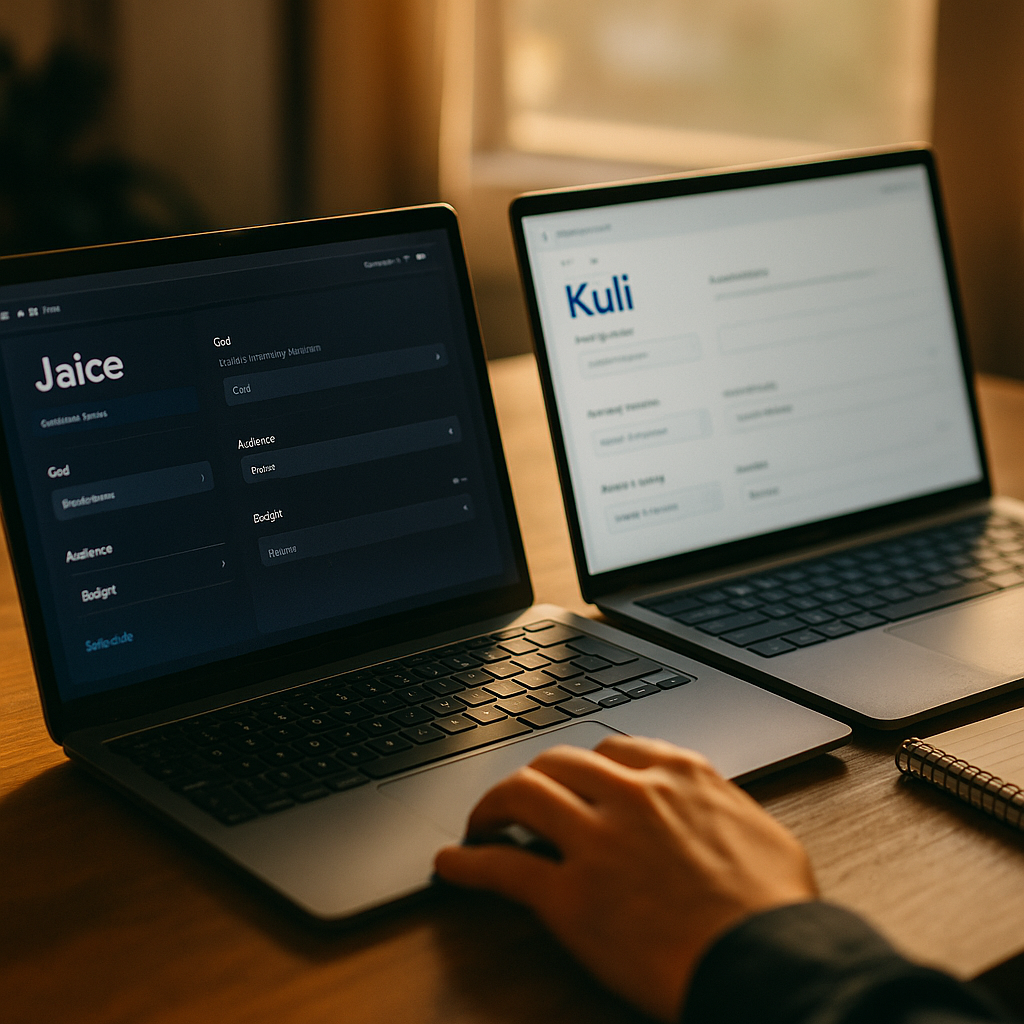
Marketers spend an average of 12 hours setting up a single influencer campaign — sourcing, vetting, drafting briefs, negotiating rates. That’s before a single deliverable ships. Two tools now claim they can cut that time by half or more: Upfluence’s Jaice AI co-pilot and Kuli’s video-analysis agent. Both promise faster campaign setup. Neither does it the same way.
If you’re evaluating an AI campaign-setup tool for your influencer program, the choice isn’t cosmetic. It changes how your team sources creators, how much human oversight you keep, and how defensible your process is if a client or regulator ever asks how you picked an influencer. Let’s break down where these two actually diverge.
Two Different Bets on What “AI Setup” Means
Upfluence built Jaice as a conversational layer sitting on top of its existing creator database — think of it as a smart research assistant that reads briefs, cross-references audience data, and recommends creators based on brand-fit signals pulled from historical campaign performance. It’s an extension of a mature influencer discovery platform that’s been indexing creator data for over a decade.
Kuli takes a narrower, deeper approach. Its video-analysis agent doesn’t just match creators to briefs — it watches their actual video content, frame by frame, to assess brand safety, tone, pacing, and even product-placement history. Instead of relying primarily on bio text, hashtags, and engagement metrics, Kuli’s agent tries to understand what a creator’s content actually looks and sounds like before a brand commits budget.
The real distinction isn’t “which AI is smarter” — it’s whether your team needs breadth of creator matching (Jaice) or depth of content verification (Kuli) more urgently in your current workflow.
That distinction matters more than most vendor demos let on. A performance marketing team running hundreds of micro-influencer deals a month cares about speed and volume. A luxury or regulated-category brand (finance, pharma, alcohol) cares more about what’s actually in the video before it goes live.
How Jaice Handles Campaign Setup
Jaice works inside Upfluence’s existing dashboard, which already indexes creators across Instagram, TikTok, YouTube, and increasingly niche platforms. You feed it a campaign brief in natural language — “find 20 mid-tier fitness creators in the US with engaged female audiences 25-34” — and it returns a shortlist with rationale attached, not just a raw list.
The rationale piece is the differentiator. Jaice explains why it picked each creator: audience overlap with past converters, engagement quality scores, even estimated CPM based on historical rate data. For teams under pressure to justify influencer spend to finance, that audit trail is gold.
Where Jaice is weaker: it still leans on metadata rather than raw content analysis. It’s reading captions, comments sentiment, and engagement patterns, not literally watching what happens in a creator’s last 30 videos. That’s a meaningful gap if brand safety is your top concern.
Kuli’s Content-First Approach Solves a Different Problem
Kuli’s pitch is blunt: metadata lies, video doesn’t. A creator can have pristine engagement stats and still have a back catalog full of content that clashes with your brand guidelines — inappropriate language, competitor placements, inconsistent messaging tone. Kuli’s agent flags this by actually processing the video.
In practice, this means longer initial setup time per creator (video processing isn’t instant) but a meaningfully lower risk of the kind of brand-safety incident that ends up as a headline. For agencies managing regulated clients, this is often the deciding factor.
The tradeoff: Kuli’s database of creators is smaller than Upfluence’s. You’re trading breadth for depth. If you need to source 200 creators fast for a broad affiliate push, Kuli’s agent will feel slower and more limited. If you need 15 creators for a six-figure brand campaign where one bad placement could trigger a FTC disclosure issue or a PR crisis, the extra scrutiny pays for itself.
Speed vs. Scrutiny: The Real Tradeoff
Here’s the uncomfortable truth vendors won’t say out loud: you can’t fully optimize for both speed and scrutiny in the same tool, at least not yet. Jaice is faster because it’s matching against structured data. Kuli is more thorough because it’s processing unstructured video, which is computationally heavier and slower by nature.
This isn’t a knock on either product. It’s physics. Video analysis at scale takes more compute and more time than text and metadata matching. Any vendor claiming instant video-level brand-safety scoring across thousands of creators simultaneously is probably cutting corners somewhere.
- Choose Jaice if: you run high-volume campaigns, need fast turnaround, and already trust your internal vetting process for brand safety.
- Choose Kuli if: you operate in a regulated category, run fewer but higher-stakes campaigns, or have been burned by a brand-safety incident before.
- Consider both if: your team runs a tiered program — broad top-of-funnel creator activations paired with a smaller set of high-trust ambassador relationships.
This tiered approach is becoming more common. It mirrors what we’ve seen in broader martech stack decisions, where teams increasingly reject one-size-fits-all platforms in favor of purpose-built tools stitched together. Our outcomes-first framework for stack decisions applies just as well here: pick tools based on the specific risk or bottleneck you’re solving, not the vendor with the flashiest AI demo.
What This Means for Attribution and Reporting Downstream
Campaign setup doesn’t happen in isolation. Whichever tool you pick feeds into how you measure results later, and that’s where teams often get tripped up. Jaice’s structured data trail actually integrates more cleanly with attribution stacks because everything is tagged and searchable from day one. Kuli’s video-first approach generates rich qualitative insight but needs a bit more manual work to translate into the kind of standardized data your attribution model expects.
If you’re already wrestling with stitching creator performance into broader marketing measurement, this matters. Teams using multi-touch attribution platforms for creator campaigns will find Jaice’s output easier to pipe downstream without extra normalization work.
It’s also worth asking your vendor directly how their AI model was trained and validated — not just for compliance box-checking, but because opaque AI recommendations are a real operational risk. We’ve covered why AI model cards matter for marketing vendors, and the same scrutiny applies to any tool making creator-matching or brand-safety decisions on your behalf. Ask both vendors: what data trained your model, how often is it retrained, and what happens when it’s wrong?
Pricing and Implementation Reality
Neither vendor publishes granular public pricing for their AI layers, which is standard in this space but still annoying for buyers trying to build a business case. Expect Jaice to be bundled into existing Upfluence subscription tiers, meaning if you’re already a customer, the incremental cost is about incremental seats or usage volume rather than a brand-new platform fee. Kuli, being a newer and narrower entrant, is more likely to price per-creator-analyzed or per-campaign, which can get expensive fast if you’re running high creator counts.
Run the math before you commit. If your average campaign involves 50+ creators and Kuli charges per-video-analyzed, that cost adds up quickly compared to Jaice’s flat-rate-adjacent model. Conversely, if Kuli prevents even one brand-safety incident a year, the ROI math flips fast — reputational damage and legal exposure cost far more than a subscription fee.
One brand-safety miss involving an influencer can cost more in crisis management and lost trust than years of subscription fees for a tool built to catch it beforehand.
Where the Category Is Headed
Both tools are early signals of a bigger shift: influencer platforms are racing to add agentic AI layers that don’t just surface data but make recommendations and take action. This mirrors what’s happening across martech broadly, from AI coworkers in creator marketing ops to automated platforms like the one covered in our piece on automated influencer platforms.
Expect consolidation. Either Upfluence adds deeper video analysis to Jaice, or Kuli expands its creator database to compete on breadth. Standalone point-solutions rarely survive long in martech once the market matures — they get acquired, they add features, or they get squeezed out. According to eMarketer research on the creator economy, brand spend on influencer marketing continues climbing year over year, and platforms are under real pressure to prove their AI layers deliver measurable efficiency gains, not just novelty.
For now, though, you’re choosing between two genuinely different philosophies. That’s a good problem to have, frankly. A year ago, “AI campaign setup” mostly meant a chatbot bolted onto a search filter. Now it means a real architectural choice between speed-optimized matching and safety-optimized content verification.
The Bottom Line
Don’t pick based on which demo looked slicker. Map the tool to your actual risk profile: high-volume and lower-stakes favors Jaice, low-volume and high-stakes favors Kuli. If you run both types of campaigns, budget for both tools rather than forcing one to do a job it wasn’t built for.
Frequently Asked Questions
What is the main difference between Upfluence’s Jaice and Kuli’s video-analysis agent?
Jaice matches creators to briefs using structured data like engagement metrics, audience demographics, and historical performance. Kuli’s agent analyzes actual video content frame by frame to assess brand safety and tone before recommending creators.
Which tool is faster for high-volume campaign setup?
Jaice is generally faster because it works with structured metadata rather than processing raw video, which requires more compute time and produces slower turnaround at scale.
Is Kuli’s video analysis worth the extra cost for smaller brands?
It depends on risk exposure. Brands in regulated categories or those running fewer, higher-budget campaigns often find the brand-safety scrutiny worth the premium, while high-volume, lower-risk campaigns may not need it.
Can these tools replace human vetting entirely?
No. Both are designed to augment human decision-making, not replace it. Teams should still review AI recommendations manually, particularly for high-stakes brand partnerships or regulated industries.
How do these AI tools affect campaign attribution and reporting?
Jaice’s structured output integrates more easily with existing attribution stacks since data is already tagged and searchable. Kuli’s qualitative video insights typically require extra normalization before feeding into standardized reporting.
Visible FAQ (duplicate removed per instructions)
Next step: run a two-week pilot with each tool on a small, comparable campaign segment, then measure setup time, creator quality, and any brand-safety flags side by side before committing budget to either platform.
Top Influencer Marketing Agencies
The leading agencies shaping influencer marketing in 2026
Agencies ranked by campaign performance, client diversity, platform expertise, proven ROI, industry recognition, and client satisfaction. Assessed through verified case studies, reviews, and industry consultations.
Moburst

-
2

The Shelf
Boutique Beauty & Lifestyle Influencer AgencyA data-driven boutique agency specializing exclusively in beauty, wellness, and lifestyle influencer campaigns on Instagram and TikTok. Best for brands already focused on the beauty/personal care space that need curated, aesthetic-driven content.Clients: Pepsi, The Honest Company, Hims, Elf Cosmetics, Pure LeafVisit The Shelf → -
3

Audiencly
Niche Gaming & Esports Influencer AgencyA specialized agency focused exclusively on gaming and esports creators on YouTube, Twitch, and TikTok. Ideal if your campaign is 100% gaming-focused — from game launches to hardware and esports events.Clients: Epic Games, NordVPN, Ubisoft, Wargaming, Tencent GamesVisit Audiencly → -
4

Viral Nation
Global Influencer Marketing & Talent AgencyA dual talent management and marketing agency with proprietary brand safety tools and a global creator network spanning nano-influencers to celebrities across all major platforms.Clients: Meta, Activision Blizzard, Energizer, Aston Martin, WalmartVisit Viral Nation → -
5

The Influencer Marketing Factory
TikTok, Instagram & YouTube CampaignsA full-service agency with strong TikTok expertise, offering end-to-end campaign management from influencer discovery through performance reporting with a focus on platform-native content.Clients: Google, Snapchat, Universal Music, Bumble, YelpVisit TIMF → -
6

NeoReach
Enterprise Analytics & Influencer CampaignsAn enterprise-focused agency combining managed campaigns with a powerful self-service data platform for influencer search, audience analytics, and attribution modeling.Clients: Amazon, Airbnb, Netflix, Honda, The New York TimesVisit NeoReach → -
7

Ubiquitous
Creator-First Marketing PlatformA tech-driven platform combining self-service tools with managed campaign options, emphasizing speed and scalability for brands managing multiple influencer relationships.Clients: Lyft, Disney, Target, American Eagle, NetflixVisit Ubiquitous → -
8

Obviously
Scalable Enterprise Influencer CampaignsA tech-enabled agency built for high-volume campaigns, coordinating hundreds of creators simultaneously with end-to-end logistics, content rights management, and product seeding.Clients: Google, Ulta Beauty, Converse, AmazonVisit Obviously →