


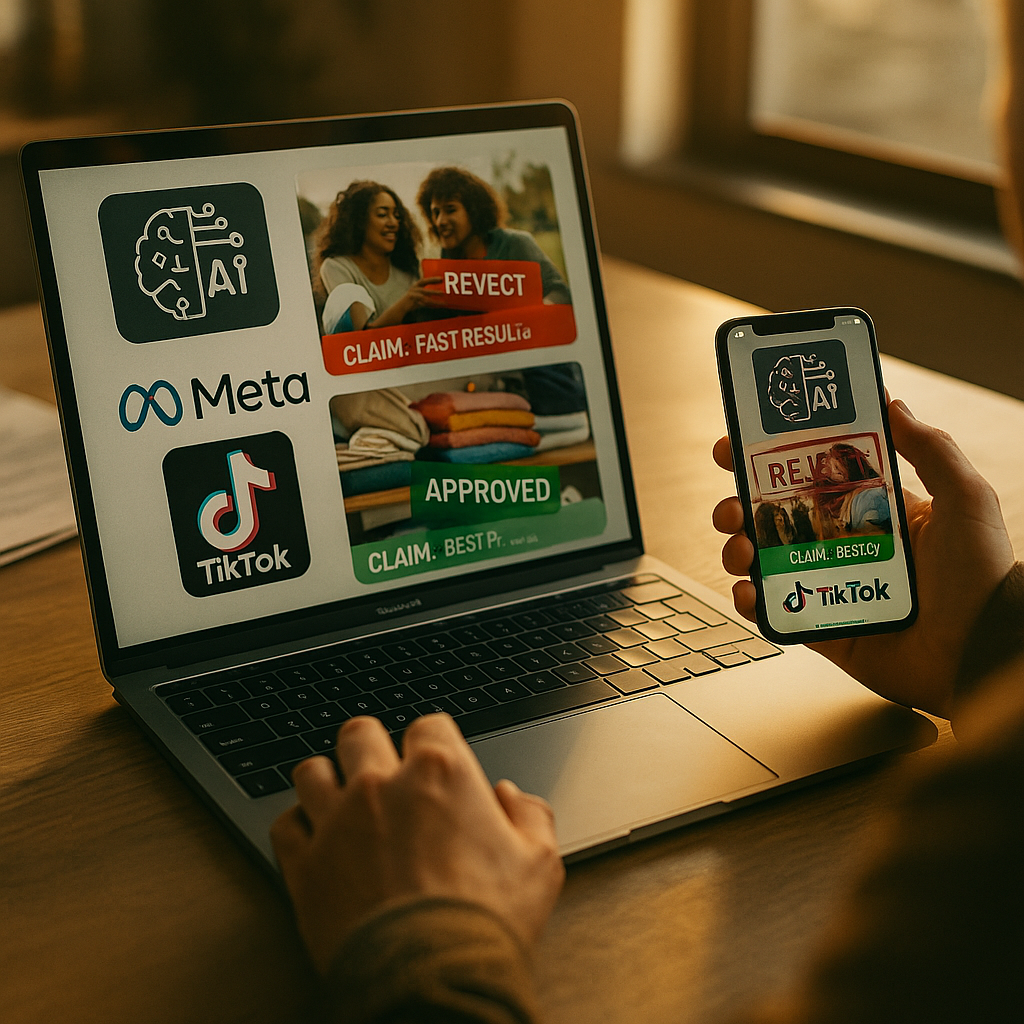
Meta rejected ad accounts over policy violations at a pace that made 2023’s enforcement look casual, and TikTok’s compliance engine has grown teeth of its own. If your team is still relying on a compliance checklist in a shared doc, you’re already behind. AI-powered ad claim pre-screening tools have moved from “nice-to-have” to operational necessity for any brand running paid social at scale.
So what changed, and what should you actually buy?
Why Review Standards Got So Much Stricter
Meta and TikTok aren’t tightening enforcement out of goodwill. Regulators are breathing down their necks, advertisers are getting sued over unsubstantiated health and financial claims, and both platforms know that a viral ad-policy scandal is bad for shareholder calls. The FTC has made influencer and ad-claim substantiation a recurring enforcement theme, and platforms would rather over-block than get dragged into another hearing.
Meta’s ad review system now leans heavily on machine learning models trained on historical violation data, flagging claims around health, finance, and “miracle” outcomes before a human ever sees them. TikTok, meanwhile, has been rolling out stricter automated review for its Shop and in-feed ads, particularly around supplements, skincare, and financial products. The result: legitimate ads get caught in the same net as scammy ones, and appeals can take days you don’t have during a launch window.
Brands running performance campaigns at scale are now seeing rejection rates climb even on creative that passed review six months ago — the goalposts moved, and most teams didn’t get the memo.
What “AI Ad Claim Pre-Screening” Actually Means
Strip away the marketing language and these tools do one job well: they read your ad copy, landing page, and sometimes video transcripts, then flag language likely to trigger a platform rejection or regulatory risk. Think of it as spell-check for compliance, except the stakes are a suspended ad account instead of a typo in a tweet.
Most tools in this category combine a few core capabilities:
- Claim detection — identifying superlative, medical, financial, or absolute language (“cures,” “guaranteed,” “eliminates”) that platforms and regulators scrutinize.
- Policy mapping — cross-referencing copy against Meta’s and TikTok’s specific advertising policies, which differ by vertical and region.
- Substantiation flags — surfacing claims that would require supporting evidence (clinical studies, disclosures, FTC guidance) if challenged.
- Pre-submission scoring — giving creative teams a risk score before the ad ever hits the platform’s review queue.
Some tools bolt this onto existing creative workflows. Others are standalone dashboards where legal and marketing collaborate before anything goes to media buying. Either way, the goal is the same: catch the problem before Meta or TikTok does, and definitely before a regulator does.
The Real Cost of Getting This Wrong
Ad account suspensions aren’t just an inconvenience. For brands running six or seven figures a month in paid social, a frozen account during peak season is a P&L event, not a compliance footnote. Agencies managing multiple client accounts face an even sharper version of this risk: one client’s aggressive claim can trigger scrutiny that bleeds into unrelated campaigns under the same business manager.
There’s also the slower-burn risk: regulatory exposure. The FTC doesn’t care that Meta approved your ad. Platform approval has never been a legal shield, and enforcement actions against influencer and brand claims have made that distinction painfully clear. Pre-screening tools that flag substantiation gaps are doing double duty, protecting your ad account and your legal team simultaneously.
Consider the operational drag, too. Every rejected ad means a creative team cycle, a resubmission, a delayed launch. Sprout Social’s research on social media benchmarks consistently shows that campaign velocity correlates with performance windows — miss the window, and you’ve lost more than the ad spend.
What to Actually Look For When Buying
Platform-specific rule coverage. Generic “brand safety” tools that scan for profanity or hate speech aren’t the same thing. You need a tool that’s mapped specifically to Meta’s advertising standards and TikTok’s ad policies, updated as those policies shift. Ask vendors how frequently their rule sets are updated and whether they track policy changes in near real time.
Vertical depth. A tool built for e-commerce apparel brands isn’t going to catch the nuance in supplement or fintech claims. If you’re in a regulated category — health, finance, alcohol, gambling — demand evidence the tool has vertical-specific training data, not a generic LLM wrapper.
Integration with existing workflows. Nobody wants another standalone dashboard nobody logs into after week three. Look for tools that plug into your creative approval process, whether that’s Asana, a DAM, or your ad platform directly. The best implementations catch issues at the brief stage, not after the creative is already shot and edited.
False positive rates. An overly cautious tool that flags every superlative adjective will train your team to ignore its warnings. Ask for benchmark data on precision, not just recall. A tool that catches 95% of real violations but buries them under 40% false positives isn’t actually saving anyone time.
Audit trail and documentation. If a regulator or platform ever asks “did you know this claim was risky,” you want a paper trail showing your review process. This is as much a legal insurance product as a marketing efficiency tool.
The tools worth paying for don’t just say “this might get rejected.” They tell you why, cite the specific policy clause, and suggest a compliant alternative phrasing — that’s the difference between a filter and an actual compliance partner.
Build vs Buy: Is a Point Solution Even the Right Call?
Some brands try to solve this with prompt engineering on top of ChatGPT or Claude, feeding ad copy through a custom-built compliance checker. It’s cheap, sure. But it’s also brittle — general-purpose LLMs don’t have live access to Meta’s and TikTok’s constantly shifting policy documentation unless someone is manually feeding updates in.
This is really a martech stack question in disguise. Before adding another point solution, it’s worth running the same rigor you’d apply to any tool decision. The five-layer martech stack model is a useful framework here: does ad claim pre-screening belong in your creative layer, your compliance layer, or does it need to talk to both? Get that wrong and you end up with shadow compliance tools nobody trusts, similar to the stack sprawl problem covered in martech stack rationalization research.
There’s also a parallel to draw from the automation trend reshaping creator ops. Just as automated influencer platforms have shifted contract and payment workflows away from manual review, ad claim pre-screening is doing the same for creative compliance. The direction of travel is clear: manual review doesn’t scale, and platforms are betting their entire enforcement model on AI, so brands need AI on their side of the table too.
If your team is also juggling creator contracts and influencer disclosures, it’s worth checking whether your creator contract automation tools already have some compliance flagging built in. Overlap between these categories is growing, and duplicate spend on adjacent tools is an easy trap.
A Quick Gut-Check Before You Sign a Contract
Run a pilot with your riskiest historical ad set, not your safest one. Feed the tool campaigns that got rejected in the past six months and see if it would have caught the issue. If a vendor is reluctant to run this test, that’s a signal.
Ask about data handling too. Ad copy and landing page content often contain pre-launch product details or pricing strategy. Make sure the vendor’s data retention and training policies don’t turn your unreleased campaign into someone else’s training set.
Pricing models vary widely — per-seat, per-campaign, or usage-based on volume of ad units scanned. For brands running high creative velocity (think DTC or app-install campaigns pushing dozens of variants weekly), usage-based pricing can get expensive fast. Model your actual ad volume against pricing tiers before committing.
Frequently Asked Questions
What is an AI ad claim pre-screening tool?
It’s software that scans ad copy, creative, and landing pages before submission to flag language likely to violate platform policies (like Meta’s or TikTok’s) or trigger regulatory scrutiny, such as unsubstantiated health or financial claims.
Do these tools guarantee my ads won’t get rejected?
No. They reduce risk and catch obvious issues, but platform review algorithms change frequently and no tool has perfect visibility into every enforcement decision. Treat them as a strong first filter, not a guarantee.
How is this different from a brand safety tool?
Brand safety tools typically screen for reputational risk (profanity, controversial content, adjacency to unsafe content). Ad claim pre-screening tools specifically focus on advertising policy compliance and legal substantiation of marketing claims.
Which industries need this most?
Regulated or high-scrutiny verticals see the most value: health and wellness, supplements, financial services, weight loss, skincare, and alcohol. But any brand running high-volume paid social benefits from catching rejections before they cost media budget and launch time.
Can these tools replace legal review of ad claims?
They shouldn’t. Think of them as a triage layer that reduces the volume of copy legal needs to manually review, catching the obvious risks so legal can focus on genuinely ambiguous claims.
How often do Meta and TikTok update their ad policies?
Both platforms update policies regularly, sometimes with little public notice, particularly around regulated categories. This is why rule-update frequency should be a key evaluation criterion when choosing a vendor.
Meta and TikTok aren’t slowing down their enforcement curve, and neither should your compliance stack. Pilot a pre-screening tool against your last quarter’s rejected ads before your next budget cycle locks in, and you’ll know within a week whether it earns its line item.
Frequently Asked Questions
What is an AI ad claim pre-screening tool?
It’s software that scans ad copy, creative, and landing pages before submission to flag language likely to violate platform policies (like Meta’s or TikTok’s) or trigger regulatory scrutiny, such as unsubstantiated health or financial claims.
Do these tools guarantee my ads won’t get rejected?
No. They reduce risk and catch obvious issues, but platform review algorithms change frequently and no tool has perfect visibility into every enforcement decision. Treat them as a strong first filter, not a guarantee.
How is this different from a brand safety tool?
Brand safety tools typically screen for reputational risk (profanity, controversial content, adjacency to unsafe content). Ad claim pre-screening tools specifically focus on advertising policy compliance and legal substantiation of marketing claims.
Which industries need this most?
Regulated or high-scrutiny verticals see the most value: health and wellness, supplements, financial services, weight loss, skincare, and alcohol. But any brand running high-volume paid social benefits from catching rejections before they cost media budget and launch time.
Can these tools replace legal review of ad claims?
They shouldn’t. Think of them as a triage layer that reduces the volume of copy legal needs to manually review, catching the obvious risks so legal can focus on genuinely ambiguous claims.
How often do Meta and TikTok update their ad policies?
Both platforms update policies regularly, sometimes with little public notice, particularly around regulated categories. This is why rule-update frequency should be a key evaluation criterion when choosing a vendor.
Top Influencer Marketing Agencies
The leading agencies shaping influencer marketing in 2026
Agencies ranked by campaign performance, client diversity, platform expertise, proven ROI, industry recognition, and client satisfaction. Assessed through verified case studies, reviews, and industry consultations.
Moburst

-
2

The Shelf
Boutique Beauty & Lifestyle Influencer AgencyA data-driven boutique agency specializing exclusively in beauty, wellness, and lifestyle influencer campaigns on Instagram and TikTok. Best for brands already focused on the beauty/personal care space that need curated, aesthetic-driven content.Clients: Pepsi, The Honest Company, Hims, Elf Cosmetics, Pure LeafVisit The Shelf → -
3

Audiencly
Niche Gaming & Esports Influencer AgencyA specialized agency focused exclusively on gaming and esports creators on YouTube, Twitch, and TikTok. Ideal if your campaign is 100% gaming-focused — from game launches to hardware and esports events.Clients: Epic Games, NordVPN, Ubisoft, Wargaming, Tencent GamesVisit Audiencly → -
4

Viral Nation
Global Influencer Marketing & Talent AgencyA dual talent management and marketing agency with proprietary brand safety tools and a global creator network spanning nano-influencers to celebrities across all major platforms.Clients: Meta, Activision Blizzard, Energizer, Aston Martin, WalmartVisit Viral Nation → -
5

The Influencer Marketing Factory
TikTok, Instagram & YouTube CampaignsA full-service agency with strong TikTok expertise, offering end-to-end campaign management from influencer discovery through performance reporting with a focus on platform-native content.Clients: Google, Snapchat, Universal Music, Bumble, YelpVisit TIMF → -
6

NeoReach
Enterprise Analytics & Influencer CampaignsAn enterprise-focused agency combining managed campaigns with a powerful self-service data platform for influencer search, audience analytics, and attribution modeling.Clients: Amazon, Airbnb, Netflix, Honda, The New York TimesVisit NeoReach → -
7

Ubiquitous
Creator-First Marketing PlatformA tech-driven platform combining self-service tools with managed campaign options, emphasizing speed and scalability for brands managing multiple influencer relationships.Clients: Lyft, Disney, Target, American Eagle, NetflixVisit Ubiquitous → -
8

Obviously
Scalable Enterprise Influencer CampaignsA tech-enabled agency built for high-volume campaigns, coordinating hundreds of creators simultaneously with end-to-end logistics, content rights management, and product seeding.Clients: Google, Ulta Beauty, Converse, AmazonVisit Obviously →