


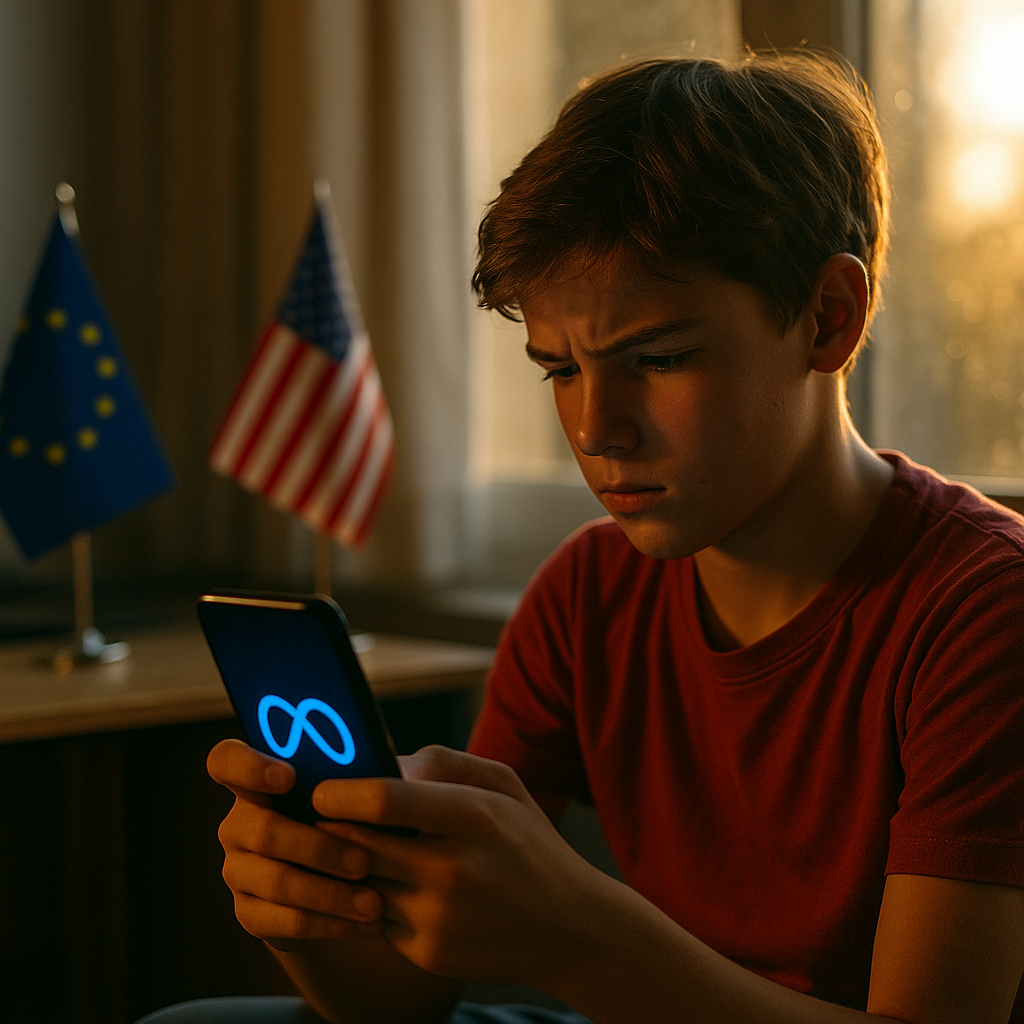
One ruling in Brussels can now cost a global brand more than a US state AG investigation ever could. That’s the new reality after the EU’s Meta addictive-design ruling landed, putting engagement-optimized feeds under direct legal scrutiny. Add a patchwork of American youth safety statutes, and marketers running cross-border campaigns are stuck reconciling two regulatory philosophies that don’t speak the same language. So what does a compliant global playbook actually look like right now?
What the EU Ruling Actually Says
The EU’s decision against Meta centers on a familiar but newly weaponized concept: that certain design mechanics — infinite scroll, autoplay, variable reward notifications — constitute manipulative design under the bloc’s Digital Services Act (DSA) framework, not just poor UX choices. Regulators argued these features exploit cognitive vulnerabilities, particularly among minors, and that “addictive design” is a compliance category, not a marketing buzzword.
This matters for brands because the ruling doesn’t just target Meta’s product team. It creates downstream liability questions for anyone building campaigns that lean on the same mechanics: countdown-driven urgency, gamified loyalty loops, algorithmic amplification of youth-targeted content. If the platform’s underlying design is legally suspect, brand campaigns riding that design aren’t automatically insulated.
Brands that treated platform compliance as Meta’s problem alone are discovering the EU ruling reclassifies engagement tactics as a shared liability, not a platform-only issue.
Meanwhile, US States Are Writing Their Own Rulebook
Contrast that with the US approach, which is fragmented, state-by-state, and largely focused on age verification and parental consent rather than design mechanics themselves. Utah, Arkansas, and a growing list of states have passed or proposed youth social media laws requiring age verification, curfew restrictions, or parental consent for minors under 16 or 18, depending on jurisdiction.
The distinction is subtle but critical: the EU is regulating how platforms are built. US states are largely regulating who gets access and under what conditions. A campaign that satisfies Utah’s consent requirements says nothing about whether its creative leans on the manipulative design patterns now flagged in Brussels. These are two different compliance surfaces, and treating them as one checklist is where legal teams get burned.
Vermont’s approach adds another layer entirely, with notice-and-cure provisions that affect how brands structure creator agreements regardless of the underlying design debate — a wrinkle covered in depth in our breakdown of Vermont’s contract overhaul requirements.
Why This Isn’t Just a Legal Team Problem
Marketing leads often assume regulatory reconciliation is a job for outside counsel. It isn’t, not entirely. Media buyers choosing which creative formats to greenlight, which platforms to prioritize for youth-adjacent categories, and which creator partnerships to whitelist are making compliance decisions in real time, often without realizing it.
Consider a beauty brand running a TikTok Shop campaign with a countdown timer promotion targeted at an 18-24 demographic that skews younger in practice. That’s not hypothetical — it’s the exact scenario explored in our piece on countdown timers and state scarcity law risk. Layer the EU’s addictive-design scrutiny on top, and that same countdown mechanic — designed to create urgency — becomes a candidate for regulatory attention on both continents, for different legal reasons.
Where the Two Frameworks Actually Overlap
Despite different starting points, EU and US approaches converge on a few practical points brands can act on immediately:
- Algorithmic amplification targeting minors. Both frameworks scrutinize content that’s algorithmically pushed to underage users, even if the brand didn’t explicitly target that demographic.
- Data collection tied to engagement optimization. The EU ruling ties addictive design partly to how user data fuels personalization loops. US state privacy laws, increasingly influenced by FTC enforcement priorities, are moving toward similar scrutiny of data-driven engagement tactics.
- Dark patterns in checkout and conversion flows. Scarcity messaging, forced continuity, and manipulative opt-outs are getting flagged on both sides of the Atlantic, just under different statutory names.
That overlap is your leverage point. Instead of building separate compliance tracks for EU and US campaigns, smart teams are identifying the intersection and designing to the stricter standard globally. It costs more upfront. It saves you from running twelve versions of the same campaign.
Building One Global Standard Instead of Twelve Local Patches
Here’s the operational reality: maintaining separate creative, contract, and disclosure standards for each jurisdiction is a resourcing nightmare for any brand running influencer or paid social programs at scale. According to eMarketer estimates, global marketers now manage campaigns across an average of six or more regulatory environments simultaneously when you count platform-specific rules layered on top of jurisdictional law. Nobody has the headcount to legal-review that many permutations per campaign cycle.
The more sustainable model, and the one gaining traction among enterprise marketing teams, is a unified disclosure and design standard that meets the highest bar across all target markets. This mirrors the approach outlined in our one-contract disclosure standard framework, adapted here for design-pattern compliance rather than just disclosure language.
Practically, that means:
- Auditing creative for addictive-design flags (autoplay loops, artificial urgency, algorithmic push mechanics) before launch, not after a regulator asks.
- Applying the strictest age-verification standard across all markets, even where local law permits looser thresholds.
- Documenting design decisions with a rationale trail, so if a regulator in either jurisdiction asks “why did you build it this way,” there’s a defensible answer on file.
- Running quarterly reviews that treat design compliance as a renewal-gate item, similar to how quarterly creator compliance audits already function for disclosure and FTC risk.
The Creator Contract Layer Nobody’s Updating Yet
Most creator agreements were drafted around disclosure and endorsement rules, not design-pattern liability. That gap is showing. If a creator’s content format includes gamified elements, escalating urgency cues, or algorithm-friendly hooks that a regulator later flags as manipulative, whose liability is that? Brand, creator, or platform?
Right now, most contracts don’t say. Building indemnification language that accounts for design-pattern risk, not just claims substantiation or FTC endorsement rules, is the next frontier for legal teams. It’s the same instinct behind emerging indemnification clauses for AI-selected creators — the liability landscape keeps outrunning the paperwork.
Age Verification: The Friction Point Everyone Underestimates
US state laws increasingly require robust age verification, sometimes going beyond a simple birthdate checkbox toward ID verification or third-party age estimation tools. The EU ruling doesn’t mandate a specific verification mechanism, but its addictive-design findings implicitly raise the bar: if a platform can’t reliably confirm it isn’t serving manipulative content to minors, that’s part of the liability calculus.
For brands, this means age-gating can’t be an afterthought bolted onto a landing page. It needs to be baked into campaign architecture from brief to launch. Platforms are responding unevenly. Meta has expanded age-verification tooling in response to regulatory pressure, and Meta’s business tools now include more granular audience-exclusion controls for youth-adjacent categories. TikTok has done similarly for TikTok Shop sellers, a shift documented in our coverage of real IP verification requirements for sellers.
None of this is uniform across platforms yet, which means brand-side compliance teams still carry the burden of stitching together a coherent standard rather than relying on platform defaults.
What Happens If You Ignore the Overlap?
Regulators on both continents are showing appetite for cross-referencing enforcement actions. An FTC investigation increasingly cites international precedent; EU regulators have referenced US state-level youth safety statutes in public commentary on the DSA’s scope. This cross-pollination means a violation flagged in one jurisdiction doesn’t stay contained there. It becomes evidence, or at least a talking point, in the other.
Brands that assume geographic firewalls will protect them from spillover liability are making a bet regulators are actively working to eliminate. Sprout Social’s research on platform trust consistently shows consumer sentiment shifts fast once a brand gets tagged in a regulatory story, regardless of which jurisdiction technically has authority. Reputational risk doesn’t respect borders even when law does.
Practical Next Steps for Global Campaign Teams
Start with an internal design audit, not a legal memo. Map every campaign format currently in market against both the EU’s addictive-design criteria and the strictest applicable US state youth safety standard. Flag overlaps. Flag gaps. Then build a single creative and contract standard that clears the higher bar, market by market exceptions only where legally required, not by default.
This isn’t about slowing campaigns down. It’s about building once instead of rebuilding after an enforcement letter arrives.
Frequently Asked Questions
What is the EU’s Meta addictive-design ruling about?
It’s a regulatory decision finding that certain platform design mechanics, such as infinite scroll and algorithmic engagement loops, may constitute manipulative design under the EU’s Digital Services Act, with particular concern for minor users.
Do US youth safety laws regulate the same design features as the EU ruling?
Not exactly. Most US state laws focus on age verification and parental consent, while the EU ruling targets the underlying design mechanics themselves. The two frameworks overlap around algorithmic targeting and manipulative conversion tactics but aren’t identical in scope.
How does this affect brands running influencer campaigns across both regions?
Brands need a unified compliance standard that satisfies the stricter of the two frameworks rather than maintaining separate regional playbooks, since regulators in both jurisdictions increasingly reference each other’s enforcement actions.
Are creator contracts currently equipped to handle addictive-design liability?
Generally, no. Most creator agreements were written around disclosure and endorsement compliance, not design-pattern liability, which means indemnification language needs updating to reflect this emerging risk category.
What’s the first step for a brand trying to reconcile both frameworks?
Run an internal audit of current campaign creative and contracts against both the EU’s addictive-design criteria and the strictest applicable US state youth safety law, then build one global standard around the highest bar.
The brands that win this cycle won’t be the ones with the cleverest legal workaround. They’ll be the ones who built a single, defensible design and disclosure standard before regulators forced the issue. Start the audit this quarter, not after the next enforcement headline.
Top Influencer Marketing Agencies
The leading agencies shaping influencer marketing in 2026
Agencies ranked by campaign performance, client diversity, platform expertise, proven ROI, industry recognition, and client satisfaction. Assessed through verified case studies, reviews, and industry consultations.
Moburst

-
2

The Shelf
Boutique Beauty & Lifestyle Influencer AgencyA data-driven boutique agency specializing exclusively in beauty, wellness, and lifestyle influencer campaigns on Instagram and TikTok. Best for brands already focused on the beauty/personal care space that need curated, aesthetic-driven content.Clients: Pepsi, The Honest Company, Hims, Elf Cosmetics, Pure LeafVisit The Shelf → -
3

Audiencly
Niche Gaming & Esports Influencer AgencyA specialized agency focused exclusively on gaming and esports creators on YouTube, Twitch, and TikTok. Ideal if your campaign is 100% gaming-focused — from game launches to hardware and esports events.Clients: Epic Games, NordVPN, Ubisoft, Wargaming, Tencent GamesVisit Audiencly → -
4

Viral Nation
Global Influencer Marketing & Talent AgencyA dual talent management and marketing agency with proprietary brand safety tools and a global creator network spanning nano-influencers to celebrities across all major platforms.Clients: Meta, Activision Blizzard, Energizer, Aston Martin, WalmartVisit Viral Nation → -
5

The Influencer Marketing Factory
TikTok, Instagram & YouTube CampaignsA full-service agency with strong TikTok expertise, offering end-to-end campaign management from influencer discovery through performance reporting with a focus on platform-native content.Clients: Google, Snapchat, Universal Music, Bumble, YelpVisit TIMF → -
6

NeoReach
Enterprise Analytics & Influencer CampaignsAn enterprise-focused agency combining managed campaigns with a powerful self-service data platform for influencer search, audience analytics, and attribution modeling.Clients: Amazon, Airbnb, Netflix, Honda, The New York TimesVisit NeoReach → -
7

Ubiquitous
Creator-First Marketing PlatformA tech-driven platform combining self-service tools with managed campaign options, emphasizing speed and scalability for brands managing multiple influencer relationships.Clients: Lyft, Disney, Target, American Eagle, NetflixVisit Ubiquitous → -
8

Obviously
Scalable Enterprise Influencer CampaignsA tech-enabled agency built for high-volume campaigns, coordinating hundreds of creators simultaneously with end-to-end logistics, content rights management, and product seeding.Clients: Google, Ulta Beauty, Converse, AmazonVisit Obviously →