


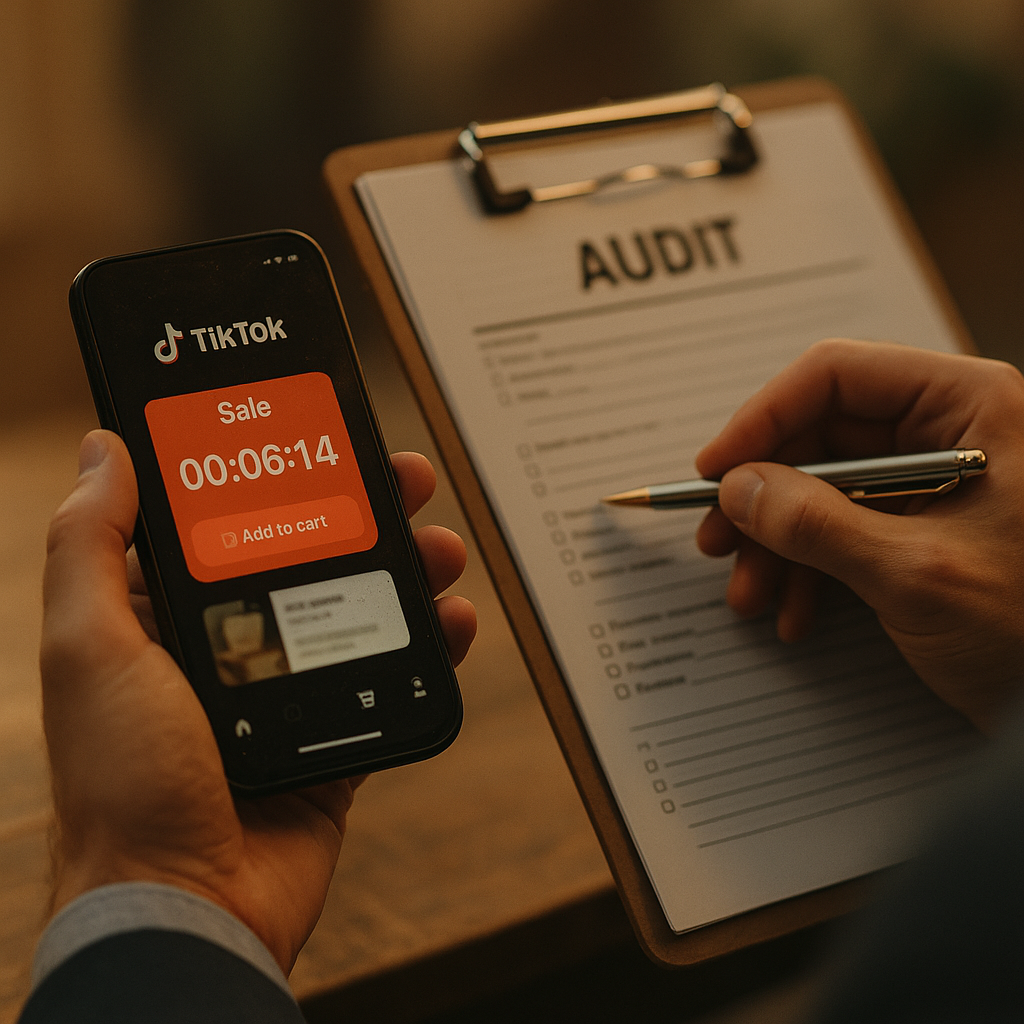
Forty-two states now have scarcity or false-advertising statutes broad enough to cover a fake countdown clock. Yet most TikTok Shop live-shopping urgency audit programs still treat “10 minutes left!!” banners as a UX detail instead of a legal exposure. If your brand hasn’t cross-checked its live-shopping countdown timers against state deceptive-practices law, you’re one screenshot away from a demand letter.
Live shopping runs on urgency. Hosts count down, prices “drop,” stock bars flash red. It works — TikTok Shop’s own merchant data points to conversion lifts north of 20% when urgency mechanics are active. But urgency mechanics sit at the exact intersection where FTC guidance, state consumer-protection statutes, and platform terms overlap and occasionally contradict each other. That’s the gap this framework closes.
Why “10 Minutes Left” Is a Legal Question, Not a Marketing Tactic
Countdown timers aren’t inherently illegal. The problem is when the timer lies — resets after hitting zero, runs on a loop regardless of actual inventory, or displays a “discount” price that was never the real price to begin with. That’s textbook deceptive scarcity, and it’s been prosecutable for decades under Section 5 of the FTC Act. What’s changed is enforcement appetite and the state-level statutory patchwork layered on top.
California’s Unfair Competition Law (Business and Professions Code Section 17200) and its False Advertising Law give the state attorney general and private plaintiffs standing to sue over fabricated urgency. New York’s General Business Law Section 349 does the same, with a lower bar for consumer harm. Texas, Florida, and Illinois all have their own deceptive trade practices acts that scarcity claims can trigger. None of these were written with livestream shopping in mind, but courts have shown no hesitation applying old statutes to new formats.
A countdown timer that resets every time a new viewer joins the stream isn’t a UX quirk — in most state courts, it’s manufactured scarcity, and manufactured scarcity is the textbook definition of deceptive urgency.
The TikTok Shop Wrinkle
TikTok Shop’s livestream format compounds the risk because urgency claims are verbal, visual, and often improvised by the host in real time. A banner might say “limited stock,” while the host verbally claims “only 12 left” — a number nobody on the brand side can verify mid-stream. Multiply that across dozens of concurrent affiliate-run streams and you get an audit surface that’s basically impossible to monitor live. That’s exactly why a standing framework, not reactive spot-checks, is the only workable approach.
For background on the FTC’s specific concerns with timer mechanics, see our countdown timer compliance checklist and the companion piece on endorsement rules versus timer mechanics.
The Four Claim Types That Trigger State Scarcity Laws
Not every urgency element carries the same risk. Break your audit into four claim categories, because each maps to a different legal theory and a different fix.
- Fabricated countdown timers. A visual clock counting to zero that doesn’t correspond to any actual event — no price change, no stock cutoff, nothing happens when it hits zero. This is the cleanest deceptive-practices case a regulator could bring.
- Phantom stock claims. “Only 3 left” language with no inventory system backing it up. If your brand can’t produce an inventory log showing real-time stock counts matching the on-screen claim, you have no defense.
- Reference price inflation. Showing a “was $89, now $39” discount when the item never sold at $89. This is a false reference pricing claim, and it’s one of the FTC’s oldest enforcement categories, now getting fresh scrutiny in the livestream context.
- Recurring “flash” sales. A discount that resets every stream, every day, indefinitely. At some point “limited time” stops being limited, and state courts have found that repetition alone can be evidence of deception.
Each category needs its own audit trail. Screenshots aren’t enough — you need timestamped logs showing what the timer displayed, what inventory actually existed, and what price history preceded the “sale.”
Building the Audit Framework: Five Checkpoints
Here’s the operational structure. Treat this as a recurring compliance cycle, not a one-time review.
- Pre-stream claim substantiation. Before any host goes live, require documented proof for every urgency claim scripted into the stream: actual inventory count, actual price history, actual promotion end date. This mirrors the substantiation discipline we outline in how to substantiate creator claims before content goes live, applied specifically to scarcity mechanics.
- Live monitoring with timestamp capture. Use screen-recording or TikTok Shop’s own analytics export to capture what viewers actually saw, when. If a regulator in New York asks what your countdown displayed at 8:47 PM, you need an answer that isn’t “we’re not sure.”
- Post-stream reconciliation. Within 24 hours, reconcile the claimed inventory against actual sales data. Did “only 5 left” hold up against 40 units sold? That’s your smoking gun if a state AG comes knocking.
- State-law mapping. Maintain a living matrix of which states have active scarcity or false-advertising statutes with private right of action, and flag campaigns reaching consumers in those states differently. California, New York, and Illinois should sit at the top of your risk tier.
- Host script review. Affiliate hosts improvise. Build a pre-approved script or talking-points doc for urgency language, and require hosts to acknowledge it before going live. This is less about controlling creativity and more about controlling liability.
Document every checkpoint. If your legal team can’t produce a paper trail within 48 hours of a complaint, the audit framework isn’t working, it’s theater.
What Counts as “Real-Time” Under State Law?
This is where brands trip up most often. A discount described as “real-time” or “live” implies the price is actively fluctuating in response to actual demand or inventory. If your pricing engine sets the “discount” the moment the stream starts and never adjusts, calling it “real-time” is itself a misrepresentation, separate from the countdown timer issue entirely. State false-advertising statutes generally don’t require intent to deceive, only that a reasonable consumer would be misled. That’s a low bar, and it’s one most livestream urgency copy clears without much effort.
Reasonable-consumer standards don’t care whether your marketing team meant to mislead anyone. If the average viewer would believe the price is genuinely dropping in real time, and it isn’t, you’re exposed regardless of intent.
Where This Overlaps With FTC Enforcement
State scarcity law doesn’t replace FTC oversight, it stacks on top of it. The FTC has been explicit that manufactured urgency claims can violate Section 5’s prohibition on unfair or deceptive practices, and the agency has referenced dark-pattern countdown timers specifically in prior guidance (see ftc.gov for current enforcement priorities). What state law adds is private right of action in many jurisdictions, meaning consumers themselves — not just regulators — can sue. That materially raises the volume of potential claims a brand faces, especially at TikTok Shop scale where a single livestream can reach hundreds of thousands of viewers across multiple states simultaneously.
We’ve covered the FTC side of livestream timers extensively, including the livestream countdown timer audit for FTC deceptive urgency and the related disclosure language brands should be using when timers reset mid-stream. Pair those with your state-law matrix and you’ve got both layers covered.
Operationalizing This Without Killing Conversion
The pushback I hear most from brand marketers: doesn’t fixing this gut the urgency that makes live shopping work? Not necessarily. Real scarcity converts just as well as fake scarcity, and it doesn’t carry legal risk.
Practical fixes that preserve conversion while reducing exposure:
- Tie countdown timers to actual inventory depletion via API, not a static clock.
- Cap “was” pricing to prices actually charged for a minimum defensible period (many states use 30 days as a reference point for legitimate former-price claims).
- Train hosts to say “while supplies last” only when supplies are, in fact, finite and tracked.
- Add a visible disclosure noting that promotional pricing may vary by stream, satisfying clear-and-conspicuous expectations without killing the pace of the show.
This is also a contract issue, not just a creative one. Your affiliate and host agreements should explicitly require adherence to pre-approved urgency scripts, with indemnification language covering unauthorized claims. If you haven’t updated those contracts to reflect this, our guide on livestream disclosure clauses for FTC and state law is the place to start, alongside general guardrails in TikTok Shop’s legal checklist for sellers.
Industry data backs the urgency-without-deception approach. According to eMarketer, live commerce is one of the fastest-growing retail channels in the US, and brands that get flagged for deceptive practices early tend to see outsized reputational damage relative to the transaction value involved — the story travels further than the sale did. Platforms like Sprout Social and HubSpot have both published guidance on social commerce trust signals worth reviewing as you build internal training materials.
FAQs
Frequently Asked Questions
What makes a TikTok Shop countdown timer illegal under state law?
A timer becomes legally risky when it doesn’t correspond to a real event, such as an actual inventory cutoff or price change. If the clock hits zero and nothing happens, or it resets for new viewers, most state deceptive-practices statutes treat that as manufactured urgency.
Which states have the strictest scarcity and urgency laws?
California, New York, and Illinois currently carry the highest enforcement and litigation risk, largely because their consumer-protection statutes allow private lawsuits, not just regulator action, over deceptive urgency claims.
Do brands or affiliate hosts bear liability for false scarcity claims?
Both can be liable, but brands typically carry primary exposure since they control pricing and inventory data. Affiliate contracts should include indemnification clauses addressing unauthorized urgency claims made by hosts during live streams.
How long should we retain livestream urgency audit records?
Most compliance teams retain screen captures, inventory logs, and price history for at least two years, aligning with common state statute-of-limitations windows for deceptive trade practice claims.
Is “while supplies last” language automatically safe?
No. It’s only defensible if supplies are genuinely finite and tracked in real time. Using the phrase as a stock rhetorical device without actual inventory backing is itself a misrepresentation.
How does this framework relate to FTC compliance?
State scarcity laws layer on top of FTC Section 5 obligations. FTC guidance addresses deceptive urgency at the federal level; state statutes often add private right of action, increasing the number of parties who can bring a claim.
Frequently Asked Questions
What makes a TikTok Shop countdown timer illegal under state law?
A timer becomes legally risky when it doesn’t correspond to a real event, such as an actual inventory cutoff or price change. If the clock hits zero and nothing happens, or it resets for new viewers, most state deceptive-practices statutes treat that as manufactured urgency.
Which states have the strictest scarcity and urgency laws?
California, New York, and Illinois currently carry the highest enforcement and litigation risk, largely because their consumer-protection statutes allow private lawsuits, not just regulator action, over deceptive urgency claims.
Do brands or affiliate hosts bear liability for false scarcity claims?
Both can be liable, but brands typically carry primary exposure since they control pricing and inventory data. Affiliate contracts should include indemnification clauses addressing unauthorized urgency claims made by hosts during live streams.
How long should we retain livestream urgency audit records?
Most compliance teams retain screen captures, inventory logs, and price history for at least two years, aligning with common state statute-of-limitations windows for deceptive trade practice claims.
Is “while supplies last” language automatically safe?
No. It’s only defensible if supplies are genuinely finite and tracked in real time. Using the phrase as a stock rhetorical device without actual inventory backing is itself a misrepresentation.
How does this framework relate to FTC compliance?
State scarcity laws layer on top of FTC Section 5 obligations. FTC guidance addresses deceptive urgency at the federal level; state statutes often add private right of action, increasing the number of parties who can bring a claim.
Run the five-checkpoint audit on your next three livestreams before you run it on three hundred. If the inventory logs don’t match the on-screen claims, fix the pricing engine before you fix the copy.
Top Influencer Marketing Agencies
The leading agencies shaping influencer marketing in 2026
Agencies ranked by campaign performance, client diversity, platform expertise, proven ROI, industry recognition, and client satisfaction. Assessed through verified case studies, reviews, and industry consultations.
Moburst

-
2

The Shelf
Boutique Beauty & Lifestyle Influencer AgencyA data-driven boutique agency specializing exclusively in beauty, wellness, and lifestyle influencer campaigns on Instagram and TikTok. Best for brands already focused on the beauty/personal care space that need curated, aesthetic-driven content.Clients: Pepsi, The Honest Company, Hims, Elf Cosmetics, Pure LeafVisit The Shelf → -
3

Audiencly
Niche Gaming & Esports Influencer AgencyA specialized agency focused exclusively on gaming and esports creators on YouTube, Twitch, and TikTok. Ideal if your campaign is 100% gaming-focused — from game launches to hardware and esports events.Clients: Epic Games, NordVPN, Ubisoft, Wargaming, Tencent GamesVisit Audiencly → -
4

Viral Nation
Global Influencer Marketing & Talent AgencyA dual talent management and marketing agency with proprietary brand safety tools and a global creator network spanning nano-influencers to celebrities across all major platforms.Clients: Meta, Activision Blizzard, Energizer, Aston Martin, WalmartVisit Viral Nation → -
5

The Influencer Marketing Factory
TikTok, Instagram & YouTube CampaignsA full-service agency with strong TikTok expertise, offering end-to-end campaign management from influencer discovery through performance reporting with a focus on platform-native content.Clients: Google, Snapchat, Universal Music, Bumble, YelpVisit TIMF → -
6

NeoReach
Enterprise Analytics & Influencer CampaignsAn enterprise-focused agency combining managed campaigns with a powerful self-service data platform for influencer search, audience analytics, and attribution modeling.Clients: Amazon, Airbnb, Netflix, Honda, The New York TimesVisit NeoReach → -
7

Ubiquitous
Creator-First Marketing PlatformA tech-driven platform combining self-service tools with managed campaign options, emphasizing speed and scalability for brands managing multiple influencer relationships.Clients: Lyft, Disney, Target, American Eagle, NetflixVisit Ubiquitous → -
8

Obviously
Scalable Enterprise Influencer CampaignsA tech-enabled agency built for high-volume campaigns, coordinating hundreds of creators simultaneously with end-to-end logistics, content rights management, and product seeding.Clients: Google, Ulta Beauty, Converse, AmazonVisit Obviously →