


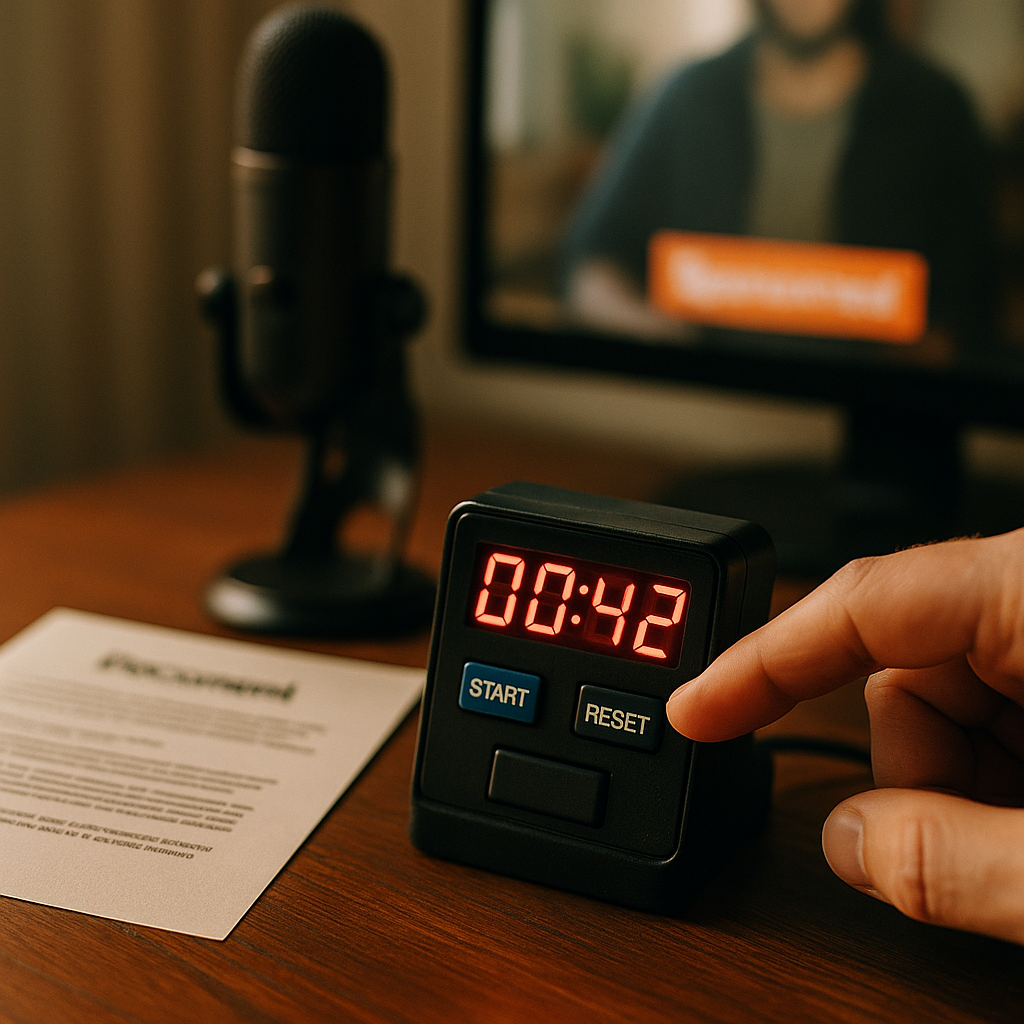
A countdown timer hits zero, then quietly resets to 15 minutes. Nobody says a word. Multiply that across a six-hour TikTok Shop livestream and you’ve got a pattern regulators now recognize on sight. FTC disclosure language for livestream shopping wasn’t built for timers that reset — and that gap is where brands are getting burned.
This isn’t a hypothetical. The FTC has spent the last two years sharpening its stance on dark patterns and manufactured scarcity, and countdown timers sit at the center of that scrutiny. If your livestream program uses timers that refresh, extend, or “surprise restock” mid-broadcast, you need disclosure language built specifically for that moment — not a generic affiliate disclaimer bolted onto the stream description.
Why Mid-Broadcast Timer Resets Are a Distinct Risk Category
Standard influencer disclosure covers one thing: is this content paid or gifted? Timer resets create a second, separate problem — is the urgency claim itself true? A timer that says “offer ends in 10 minutes” and then resets to 10 minutes again is making a factual claim about scarcity that didn’t happen. That’s not an FTC disclosure gap. That’s potentially a deceptive practice under Section 5 of the FTC Act.
The two issues get conflated constantly. A creator can disclose “#ad” perfectly and still run afoul of the FTC if the countdown clock resets without explanation. Brands that treat these as the same compliance checkbox are missing half the exposure.
A timer reset without an on-screen explanation isn’t a UX glitch. It’s a claim about scarcity that the platform, the creator, and the brand all just made together — and none of them can prove it’s true.
Our earlier analysis of the deceptive urgency problem in livestreams laid out the baseline risk. This piece goes further: what specific language do you need when the timer itself changes behavior mid-broadcast?
The Four Trigger Moments That Require New Disclosure Copy
Not every livestream moment carries the same risk. Legal and compliance teams should treat these four triggers as distinct disclosure events, each requiring its own scripted language:
- Natural timer expiration with immediate extension — the clock hits zero and a new countdown begins without a stated reason.
- Inventory-triggered reset — a “sold out” flash followed by a fresh timer tied to restocked units.
- Host-triggered extension — the creator manually extends the deal because engagement is high (a discretionary, non-inventory reason).
- Multi-segment stream resets — a six-hour broadcast where each hour introduces a “new” flash sale with its own timer.
Each of these needs a different disclosure sentence. Lumping them together under one generic “prices and offers may change” disclaimer is exactly the kind of vague language the FTC has flagged as insufficient in recent guidance on endorsement and dark pattern enforcement.
Building the Disclosure Framework: Sentence by Sentence
Here’s the operational core. For each trigger moment, brands should require creators (or platform-generated overlays) to use structured language that names the reason for the reset. Generic won’t cut it anymore.
Trigger 1: Timer expires, then restarts
Required disclosure: “This countdown has reset because [new inventory/new offer] became available. It is not the same deal as before.” This single sentence does two things — it names the cause and it explicitly denies false continuity, which is the actual deceptive mechanism regulators care about.
Trigger 2: Inventory-driven reset
Required disclosure: “Additional units were added at [time]. This is a new batch, not an extension of the original offer.” If the brand can’t verify a genuine inventory event, this language cannot be used. Full stop.
Trigger 3: Host discretion
This one’s trickier because creators love extending deals for engagement. Require: “[Creator name] is extending this offer at their discretion. The original deadline has passed.” Naming the creator as the decision-maker (not “the deal”) shifts the claim from a fact about scarcity to a fact about a person’s choice — a meaningfully different and more defensible claim.
Trigger 4: Multi-segment streams
Each new segment needs its own on-screen label: “New segment, new offer. Previous countdown has ended.” Brands running six-hour marathon streams often skip this because it feels repetitive. Skip it at your own risk — this is precisely the pattern state attorneys general have started investigating under deceptive-pricing statutes, a trend we cover in state-level countdown timer risk.
Where Platform Tools Fall Short
TikTok Shop, Whatnot, and Amazon Live all offer native countdown timer widgets. None of them, as of now, include a required “reason for reset” field. That’s a gap brands have to fill contractually, not technically.
Practically, that means your creator agreements need a clause requiring verbal or on-screen acknowledgment every time a timer resets — regardless of whether the platform’s tooling prompts for it. Relying on platform defaults is how brands end up owning liability for a UX decision they didn’t make. We’ve mapped the broader contractual exposure in TikTok Shop livestream disclosure clauses, and the timer-reset scenario is one of the sharpest edges in that framework.
One more wrinkle: multi-host streams. When a second creator joins mid-broadcast and the timer resets to mark a “new segment,” who’s responsible for the disclosure? Contractually, assign it to whichever creator has camera control at the moment of reset, and require a handoff acknowledgment. Ambiguity here is exactly what regulators exploit when assigning liability across brand, platform, and creator.
Building the Compliance Checklist
Legal teams don’t need a philosophy here. They need a checklist. Here’s the minimum viable version for any brand running livestream countdown mechanics:
- Document the actual inventory or business reason behind every timer reset, in real time, with a timestamp.
- Require creators to verbally state the reset reason within 10 seconds of the timer changing.
- Maintain an on-screen text overlay mirroring the verbal disclosure for accessibility and screen-recording evidence.
- Log every reset event to a compliance archive tied to the specific broadcast ID, retrievable for at least 24 months.
- Audit a sample of past broadcasts monthly for undisclosed resets before they become a pattern regulators can point to.
That last point matters more than brands think. A single undisclosed reset is a mistake. A recurring pattern across 40 broadcasts is evidence of a business practice — and that’s the threshold where FTC enforcement actions actually get built. Recent enforcement trends echo consumer research from eMarketer showing livestream shopping engagement spikes specifically around perceived scarcity, which is exactly why regulators are watching this mechanic so closely.
Auditing Language Against Existing Frameworks
If your brand already has a disclosure audit process for gifted or affiliate content, don’t build a parallel system for livestream timers. Fold it in. The same rigor that governs gifted and affiliate disclosure standards should extend to real-time urgency claims — the underlying principle (don’t let a claim mislead a reasonable consumer) doesn’t change just because the format is live video instead of a static post.
It also helps to borrow structure from adjacent compliance work. Brands that have already built countdown timer legal checklists for standard TikTok Shop listings have a head start — the reset-specific language above simply extends that checklist to cover live, dynamic scenarios rather than static product pages.
For teams building this from scratch, resources like HubSpot’s marketing compliance guides and platform-specific policy pages such as TikTok’s advertising policies are useful starting points, though neither addresses the reset-specific nuance directly. That’s the gap this framework is meant to close.
What Happens When You Get This Wrong
Skip the reset disclosure, and you’re not just risking an FTC letter. You’re risking a state-level deceptive trade practices claim, a platform policy strike, and — increasingly — a viral screen recording of the exact moment your timer “magically” refreshed. Compliance here isn’t paperwork. It’s reputational armor.
Start small: pick your highest-volume livestream format, write the four trigger-moment scripts above, and require them in your next creator brief before your next broadcast airs.
FAQs
Does every countdown timer reset require a new FTC disclosure?
Yes, if the reset could reasonably be interpreted as a new or extended offer. A timer that silently restarts implies continuity or renewed scarcity, both of which are factual claims that need to be either true or explicitly corrected on screen.
Is a generic “prices and offers may vary” disclaimer enough to cover timer resets?
No. The FTC has increasingly rejected blanket disclaimers as insufficient when a specific, verifiable event (like a reset) occurs. The disclosure needs to name the reason for the reset, not just gesture at the possibility of change.
Who is liable when a platform’s native timer widget resets without a brand’s input?
Liability typically flows to whoever controls the offer terms, usually the brand or the creator running the promotion, not the platform. This is why contractual clauses requiring reset acknowledgment matter more than relying on platform defaults.
How long should brands retain records of livestream timer resets?
A minimum of 24 months is a reasonable baseline, matching typical statute-of-limitations windows for consumer protection claims in most US states. Longer retention is advisable for high-volume or high-risk product categories.
Can a creator’s discretionary extension ever be exempt from disclosure?
No. Even discretionary extensions need on-screen acknowledgment naming the creator as the decision-maker. The exemption doesn’t exist; only the specific wording of the disclosure changes based on the trigger type.
FAQs
Does every countdown timer reset require a new FTC disclosure?
Yes, if the reset could reasonably be interpreted as a new or extended offer. A timer that silently restarts implies continuity or renewed scarcity, both of which are factual claims that need to be either true or explicitly corrected on screen.
Is a generic “prices and offers may vary” disclaimer enough to cover timer resets?
No. The FTC has increasingly rejected blanket disclaimers as insufficient when a specific, verifiable event (like a reset) occurs. The disclosure needs to name the reason for the reset, not just gesture at the possibility of change.
Who is liable when a platform’s native timer widget resets without a brand’s input?
Liability typically flows to whoever controls the offer terms, usually the brand or the creator running the promotion, not the platform. This is why contractual clauses requiring reset acknowledgment matter more than relying on platform defaults.
How long should brands retain records of livestream timer resets?
A minimum of 24 months is a reasonable baseline, matching typical statute-of-limitations windows for consumer protection claims in most US states. Longer retention is advisable for high-volume or high-risk product categories.
Can a creator’s discretionary extension ever be exempt from disclosure?
No. Even discretionary extensions need on-screen acknowledgment naming the creator as the decision-maker. The exemption doesn’t exist; only the specific wording of the disclosure changes based on the trigger type.
Top Influencer Marketing Agencies
The leading agencies shaping influencer marketing in 2026
Agencies ranked by campaign performance, client diversity, platform expertise, proven ROI, industry recognition, and client satisfaction. Assessed through verified case studies, reviews, and industry consultations.
Moburst

-
2

The Shelf
Boutique Beauty & Lifestyle Influencer AgencyA data-driven boutique agency specializing exclusively in beauty, wellness, and lifestyle influencer campaigns on Instagram and TikTok. Best for brands already focused on the beauty/personal care space that need curated, aesthetic-driven content.Clients: Pepsi, The Honest Company, Hims, Elf Cosmetics, Pure LeafVisit The Shelf → -
3

Audiencly
Niche Gaming & Esports Influencer AgencyA specialized agency focused exclusively on gaming and esports creators on YouTube, Twitch, and TikTok. Ideal if your campaign is 100% gaming-focused — from game launches to hardware and esports events.Clients: Epic Games, NordVPN, Ubisoft, Wargaming, Tencent GamesVisit Audiencly → -
4

Viral Nation
Global Influencer Marketing & Talent AgencyA dual talent management and marketing agency with proprietary brand safety tools and a global creator network spanning nano-influencers to celebrities across all major platforms.Clients: Meta, Activision Blizzard, Energizer, Aston Martin, WalmartVisit Viral Nation → -
5

The Influencer Marketing Factory
TikTok, Instagram & YouTube CampaignsA full-service agency with strong TikTok expertise, offering end-to-end campaign management from influencer discovery through performance reporting with a focus on platform-native content.Clients: Google, Snapchat, Universal Music, Bumble, YelpVisit TIMF → -
6

NeoReach
Enterprise Analytics & Influencer CampaignsAn enterprise-focused agency combining managed campaigns with a powerful self-service data platform for influencer search, audience analytics, and attribution modeling.Clients: Amazon, Airbnb, Netflix, Honda, The New York TimesVisit NeoReach → -
7

Ubiquitous
Creator-First Marketing PlatformA tech-driven platform combining self-service tools with managed campaign options, emphasizing speed and scalability for brands managing multiple influencer relationships.Clients: Lyft, Disney, Target, American Eagle, NetflixVisit Ubiquitous → -
8

Obviously
Scalable Enterprise Influencer CampaignsA tech-enabled agency built for high-volume campaigns, coordinating hundreds of creators simultaneously with end-to-end logistics, content rights management, and product seeding.Clients: Google, Ulta Beauty, Converse, AmazonVisit Obviously →