


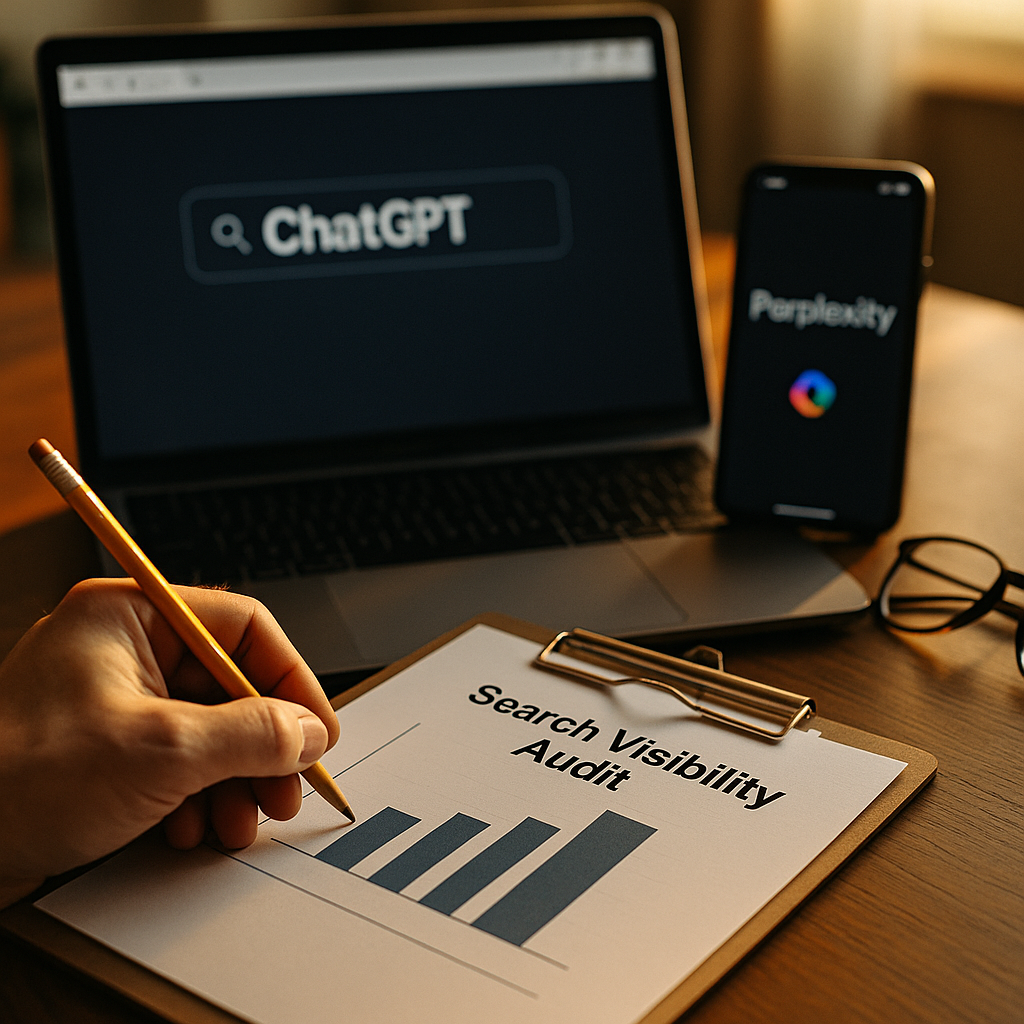
Ask ChatGPT about your brand tomorrow morning. Would it get your pricing right? Your product lineup? Would it even mention your top competitor first? A AI search visibility audit isn’t optional anymore, it’s the only way to know what millions of buyers are being told about you before they ever reach your website.
Most marketing teams still treat generative AI platforms like a black box they can’t measure. That’s a mistake. You can measure it, systematically, and the brands doing this quarterly are catching hallucinations, pricing errors, and competitive misrepresentation before those errors compound into lost deals.
Why This Isn’t Just Another SEO Checklist
Traditional SEO audits check rankings, backlinks, page speed. AI search visibility audits check something stranger: whether a language model’s internal representation of your brand matches reality. These are fundamentally different problems.
Google’s AI Overviews, ChatGPT, and Perplexity don’t “crawl and rank” your brand the way a search engine does. They synthesize an answer from scraped web content, training data, and (for some tools) live retrieval. That synthesis can go wrong in ways traditional SEO never accounted for: outdated pricing baked into training data, a competitor’s press release outweighing your own site, or a Reddit thread from three years ago treated as gospel.
A brand can rank #1 organically and still be misrepresented, or omitted entirely, in an AI-generated answer. Visibility and accuracy are now two separate battles.
This matters because AI-driven referral traffic is growing fast, even if it’s still a fraction of total search volume. eMarketer and Statista have both tracked rising consumer reliance on AI chat tools for product research, and B2B buyers are following the same pattern during vendor shortlisting. If the model gets your category positioning wrong, you’re losing consideration before a human ever clicks through.
The Core Framework: Five Testing Passes
Run these five passes across ChatGPT, Perplexity, and Google AI Overviews. Don’t skip a platform just because it feels less “important” — each one sources and weights information differently, and inconsistency between them is itself a signal.
Pass 1: Baseline Brand Query
Start simple. Ask each platform: “What is [Brand Name] and what does it do?” Then: “Who are [Brand Name]’s main competitors?” Log the exact output verbatim. You’re checking for three failure modes: factual errors (wrong founding year, wrong HQ, discontinued products still listed), omission (your newest product line isn’t mentioned at all), and competitive distortion (a competitor gets more favorable framing).
Do this from multiple accounts and, where possible, logged out. Personalization and chat history can skew results, so a single test run tells you almost nothing. Run it at least three times per platform, on different days.
Pass 2: Category and Comparison Queries
This is where most brands get burned. Ask: “What’s the best [category] tool for [use case]?” or “[Your Brand] vs [Competitor], which is better?” These comparison prompts are where AI Overviews and Perplexity pull from third-party review sites, forums, and comparison blogs, sources you may have zero control over.
If a G2 review from two years ago is the dominant source shaping the model’s opinion of you, that’s a findability and content gap you can actually fix. This is the same logic behind generative engine optimization budget planning — you’re not optimizing for rankings, you’re optimizing for what gets cited as the authoritative source.
Pass 3: Factual Claims and Pricing Accuracy
Ask directly about pricing, features, certifications, and policies. “How much does [Brand]’s enterprise plan cost?” “Is [Brand] SOC 2 compliant?” “Does [Brand] offer a free trial?” These are the queries most likely to surface stale or hallucinated information, because pricing pages change constantly and models don’t always retrieve the latest version.
This is the exact failure mode covered in our hallucination detection protocol for product claims, and it deserves its own recurring check, not just a one-time audit. Pricing hallucinations are a legal and trust risk, not just an SEO nuisance.
Pass 4: Sentiment and Framing
Beyond facts, check tone. Ask: “What are common complaints about [Brand]?” or “Is [Brand] a good place to work?” AI models tend to synthesize sentiment from review aggregators, Glassdoor, and social chatter. If the model is surfacing a narrative that’s outdated, resolved, or wildly unrepresentative, you need to know, because prospects asking these questions are late-stage buyers doing due diligence.
Pass 5: Source Attribution Tracing
The most technical pass, and arguably the most valuable. When a platform cites sources (Perplexity and AI Overviews do this visibly; ChatGPT sometimes does with browsing enabled), record every domain cited. Build a frequency table. You’ll likely find a handful of third-party domains dominating your brand narrative, review aggregators, Wikipedia, industry directories, old press coverage.
This tells you exactly where to focus content and PR efforts. It also overlaps heavily with NAP consistency and identity resolution work, because inconsistent business details across directories are a common reason models cite conflicting facts.
Building the Scorecard
Raw transcripts are useless without structure. Build a scorecard with these columns: platform, query, response summary, accuracy score (1-5), sentiment score (1-5), sources cited, and a flag column for “critical error” (anything touching pricing, compliance, safety, or legal claims).
Weight critical errors heavily. A minor factual slip about your founding year is annoying. A hallucinated compliance certification could trigger a genuine regulatory problem, especially in regulated industries where the FTC has made clear that misleading claims carry liability regardless of who generated the text.
- Accuracy score: Does the response match verifiable facts on your owned properties?
- Sentiment score: Is the framing neutral, favorable, or unfavorable relative to reality?
- Source quality: Are citations first-party, reputable third-party, or low-authority/outdated?
- Competitive parity: How does your brand’s representation compare to your top two competitors on identical prompts?
That competitive parity column is the one execs actually care about. Nobody in a boardroom gets excited about “our AI accuracy score is 4.2 out of 5.” They get excited, or alarmed, when you show that a competitor’s brand summary is more complete and more favorable on the exact same prompt.
Who Should Own This, and How Often
This shouldn’t sit solely with SEO. It’s part brand, part comms, part legal, part product marketing. In practice, the teams that do this well assign a single owner (usually someone in brand or content strategy) who coordinates quarterly audits and pulls in legal for anything touching claims or compliance.
Monthly is overkill for most brands unless you’re in a fast-moving category or just went through a major rebrand, product launch, or funding round. Quarterly is the sweet spot for steady-state monitoring, with ad hoc checks triggered by major announcements. If you just changed your pricing model or got acquired, run the audit within a week, not next quarter.
Treat AI visibility audits like a crisis-prevention exercise, not a reporting exercise. The goal isn’t a pretty dashboard, it’s catching the hallucination before a prospect does.
What to Do With What You Find
Finding errors is the easy part. Fixing what an AI model “believes” about your brand is harder, because you can’t directly edit a model’s training data or force a re-crawl on demand. What you can do:
- Publish authoritative, structured content on your own domain that directly answers the exact queries you tested. Clear, factual, dated pages beat vague marketing copy for retrieval accuracy.
- Fix third-party listings that show up as cited sources, especially directories, G2/Capterra profiles, and Wikipedia where applicable.
- Use structured data markup so machines (search and AI crawlers alike) can parse facts unambiguously, this is where a lot of the identity resolution and NAP consistency work pays off.
- Re-test on a set cadence to see whether corrections actually shift model outputs. Sometimes they do within weeks. Sometimes it takes months, depending on how often the platform refreshes its retrieval index.
None of this works if your internal data is fragmented across five systems with three different versions of the truth. That’s not an AI problem, it’s an identity and data hygiene problem, and it’s the same one underlying most identity resolution challenges in AI marketing more broadly. Garbage in, garbage retrieved.
Also worth tracking: how much of your actual traffic and conversions are coming from AI referral sources in the first place. Without first-party tracking built for AI attribution, you’re auditing visibility for a channel you can’t even measure the payoff from.
The Uncomfortable Reality
You don’t control these models. You can’t buy your way to a better answer the way you can with a paid search placement, at least not yet, though tools attempting exactly that are emerging fast, as we covered in our look at LLM ad platforms merging organic and paid AI discovery. What you control is the quality, clarity, and consistency of the information available for these systems to retrieve.
That’s a strange kind of leverage. It’s indirect. It’s slower than a paid campaign. But it compounds, and brands that start auditing now will have cleaner AI representations a year from now than brands that wait until a hallucinated claim ends up in a customer complaint or, worse, a regulatory inquiry.
FAQs
Frequently Asked Questions
What is an AI search visibility audit?
It’s a structured process of testing how AI platforms like ChatGPT, Perplexity, and Google AI Overviews describe your brand, checking for factual accuracy, sentiment, competitive framing, and source attribution across repeated, controlled queries.
How often should brands run this audit?
Quarterly for most brands, with ad hoc checks after major events like rebrands, pricing changes, product launches, or acquisitions. Fast-moving or highly regulated categories may warrant monthly checks.
Can you actually fix what an AI model says about your brand?
Not directly. You can’t edit a model’s training data on demand. But publishing clear, structured, dated content on owned properties, correcting third-party listings, and using structured markup all influence what gets retrieved and cited over time.
Which platform matters most: ChatGPT, Perplexity, or Google AI Overviews?
All three, because they source and weight information differently. A brand can be accurately represented in one and badly misrepresented in another. Testing only one platform gives an incomplete, misleading picture.
How is this different from traditional SEO auditing?
Traditional SEO measures rankings and technical health. AI visibility audits measure whether a generative model’s synthesized answer about your brand is factually correct and fairly framed, which is a content-accuracy problem, not a rankings problem.
Who should own this process internally?
Typically brand or content strategy leads coordinate the audit, with legal involved for anything touching compliance, pricing, or safety claims, and SEO/content teams executing the fixes.
Pick one core query, your brand’s category positioning, and run it across all three platforms this week. If the answers contradict each other or your own website, you’ve just found your first fix.
Top Influencer Marketing Agencies
The leading agencies shaping influencer marketing in 2026
Agencies ranked by campaign performance, client diversity, platform expertise, proven ROI, industry recognition, and client satisfaction. Assessed through verified case studies, reviews, and industry consultations.
Moburst

-
2

The Shelf
Boutique Beauty & Lifestyle Influencer AgencyA data-driven boutique agency specializing exclusively in beauty, wellness, and lifestyle influencer campaigns on Instagram and TikTok. Best for brands already focused on the beauty/personal care space that need curated, aesthetic-driven content.Clients: Pepsi, The Honest Company, Hims, Elf Cosmetics, Pure LeafVisit The Shelf → -
3

Audiencly
Niche Gaming & Esports Influencer AgencyA specialized agency focused exclusively on gaming and esports creators on YouTube, Twitch, and TikTok. Ideal if your campaign is 100% gaming-focused — from game launches to hardware and esports events.Clients: Epic Games, NordVPN, Ubisoft, Wargaming, Tencent GamesVisit Audiencly → -
4

Viral Nation
Global Influencer Marketing & Talent AgencyA dual talent management and marketing agency with proprietary brand safety tools and a global creator network spanning nano-influencers to celebrities across all major platforms.Clients: Meta, Activision Blizzard, Energizer, Aston Martin, WalmartVisit Viral Nation → -
5

The Influencer Marketing Factory
TikTok, Instagram & YouTube CampaignsA full-service agency with strong TikTok expertise, offering end-to-end campaign management from influencer discovery through performance reporting with a focus on platform-native content.Clients: Google, Snapchat, Universal Music, Bumble, YelpVisit TIMF → -
6

NeoReach
Enterprise Analytics & Influencer CampaignsAn enterprise-focused agency combining managed campaigns with a powerful self-service data platform for influencer search, audience analytics, and attribution modeling.Clients: Amazon, Airbnb, Netflix, Honda, The New York TimesVisit NeoReach → -
7

Ubiquitous
Creator-First Marketing PlatformA tech-driven platform combining self-service tools with managed campaign options, emphasizing speed and scalability for brands managing multiple influencer relationships.Clients: Lyft, Disney, Target, American Eagle, NetflixVisit Ubiquitous → -
8

Obviously
Scalable Enterprise Influencer CampaignsA tech-enabled agency built for high-volume campaigns, coordinating hundreds of creators simultaneously with end-to-end logistics, content rights management, and product seeding.Clients: Google, Ulta Beauty, Converse, AmazonVisit Obviously →