


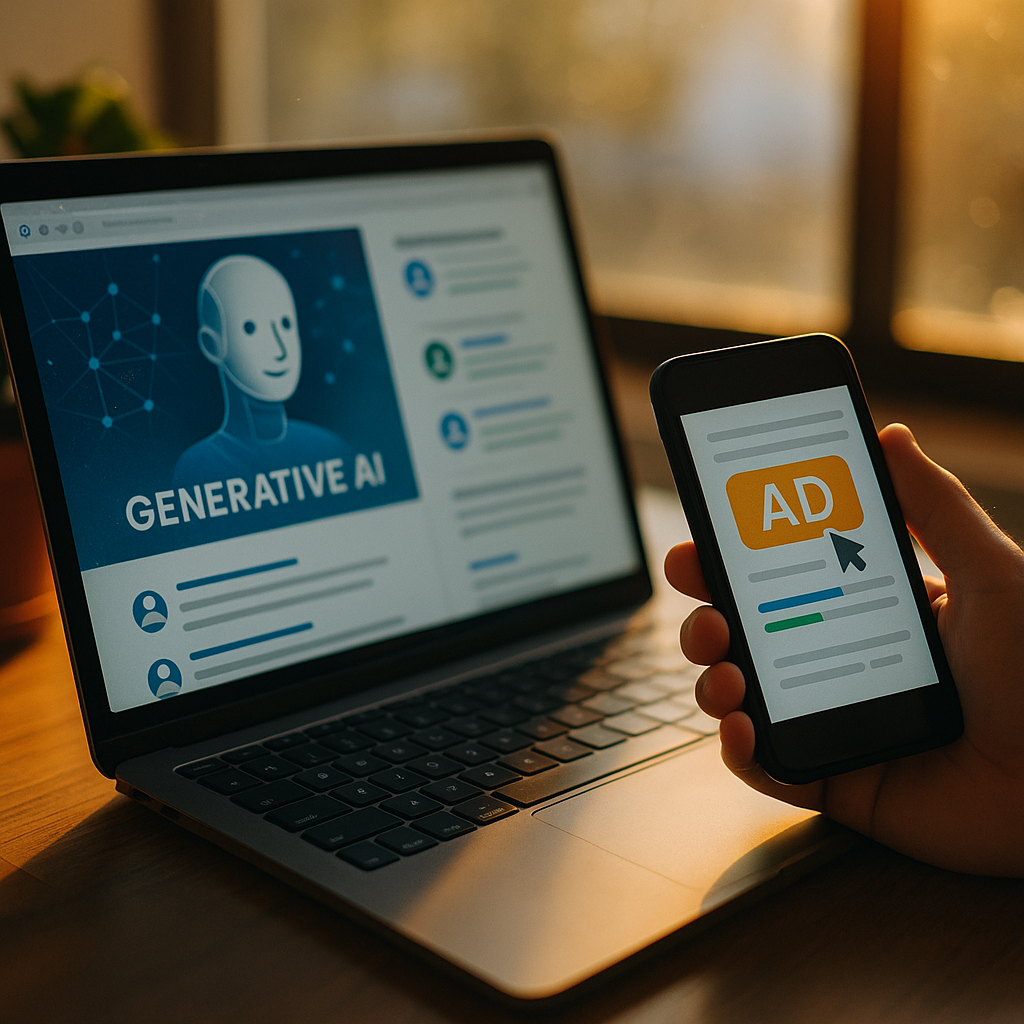
Nearly 60% of consumers now start product research inside an AI chat window instead of a search bar, according to recent industry surveys. So here’s the uncomfortable question every brand strategist should be asking: if ChatGPT or Perplexity recommends your competitor first, does your paid media budget even matter? Parsnipp’s smart LLM ads are built on the bet that it doesn’t, unless organic AI discovery and paid campaign creation finally talk to each other.
The Split That’s Been Quietly Costing Brands Money
For the last two years, marketing teams have run two parallel tracks with almost no crossover. One team optimizes for organic visibility in AI answer engines, tweaking structured data, building citation-worthy content, monitoring whether ChatGPT mentions the brand at all. Another team builds paid campaigns, still largely tuned to Google Ads and Meta auction logic that assumes a human is scrolling and clicking.
These two functions rarely share data. The SEO-adjacent team tracking AI mentions doesn’t feed insights into media buying. The paid team doesn’t know which prompts are already surfacing the brand organically, so they end up bidding against their own visibility. It’s redundant, and worse, it’s blind.
Brands running organic AI monitoring and paid campaigns as separate workflows are effectively paying twice to solve one discovery problem — once in content, once in media spend.
Parsnipp’s pitch is straightforward: stop treating AI discovery as a monitoring exercise and paid campaign creation as a separate discipline. Merge them into a single operational loop where what the LLM already says about your brand directly informs what you pay to amplify, correct, or compete against.
What Smart LLM Ads Actually Do
Smart LLM ads, as Parsnipp defines the category, aren’t display units bolted onto a chatbot interface. They’re campaign objects generated from real-time signals about how large language models describe, rank, or omit a brand across conversational queries. The system watches organic answer-engine behavior first, then builds and adjusts paid placements based on gaps it finds.
Practically, that means three things happen inside one workflow instead of three separate tools:
- Discovery monitoring — tracking how often and how favorably a brand appears in LLM-generated answers for category-relevant prompts.
- Gap detection — flagging where competitors dominate the organic answer but the brand has budget available to close the distance.
- Campaign generation — auto-drafting paid creative and targeting logic tuned to the specific query patterns where organic presence is weak.
This is a meaningfully different workflow from traditional paid search, where keyword lists get built from historical click data. Here, the input is conversational intent, often long-tail, often phrased as a question a person would actually ask an AI assistant rather than type into Google.
It echoes a shift already underway across the industry. Teams covering AI answer-engine monitoring have flagged this same blind spot for months: brands invest in traditional SEO while a growing share of discovery moves to conversational interfaces with zero paid infrastructure built for them. Parsnipp is one of the first platforms trying to close that loop end-to-end rather than just report on it.
Why This Convergence Matters for Budget Owners
Here’s the operational case, stripped of hype. If your organic AI presence is already strong for a category of queries, spending paid budget there is wasteful. If it’s weak or nonexistent, that’s exactly where paid dollars should go, and where they’ll likely perform best, because there’s no organic competition eating into share of voice.
That sounds obvious. Most media plans don’t actually work this way yet. Budget allocation is still largely driven by channel-level historical performance, not by real-time visibility gaps inside AI-generated answers. This is the same structural problem next-best-channel engines are trying to solve for traditional media mix, applied now to the newest and least-mapped discovery surface.
There’s a risk-mitigation angle too. Brands that don’t monitor LLM outputs have no idea if they’re being misrepresented, described inaccurately, or left out of comparison answers entirely. That’s a reputational blind spot as real as any social listening gap was a decade ago. Pairing monitoring with the ability to immediately act on it, via paid placement, correction content, or updated structured data, closes that exposure window fast.
How the Workflow Actually Runs
Skip the marketing deck version. Here’s roughly how a converged workflow like this operates in practice, based on how Parsnipp and comparable platforms in this emerging space structure the pipeline:
- Signal collection. The system queries a range of LLMs and AI search surfaces using category-relevant prompts, capturing whether and how the brand appears.
- Gap scoring. Each gap gets weighted by query volume estimates, competitive presence, and commercial intent, similar in spirit to how affinity scoring models weigh creator relevance over vanity metrics.
- Campaign drafting. Ad copy, targeting parameters, and budget recommendations get auto-generated for the highest-priority gaps.
- Human review. A strategist approves, edits, or kills the draft before it goes live. This step still matters enormously (more on that below).
- Feedback loop. Post-launch, the system re-monitors organic LLM answers to see if paid presence shifted the conversational narrative at all, then adjusts the next cycle.
That last step is the genuinely novel part. Traditional paid campaigns measure clicks, conversions, ROAS. This workflow also measures whether spending money changed how an AI assistant talks about you, which is a completely different kind of attribution problem, one closer to brand lift studies than performance marketing.
Teams already wrestling with this shift have written about the need for a dedicated budget line for AI answers, separate from traditional SEO and paid search line items. Parsnipp’s approach effectively operationalizes that recommendation by giving it a workflow instead of just a budget category.
Where This Gets Risky
No serious B2B publication should present this as frictionless. A few things brand and agency teams need to interrogate before adopting an automated LLM-ad workflow:
Attribution is still soft. Nobody has a clean, industry-standard way to prove that a paid placement changed an LLM’s organic output. The feedback loop described above is directional, not deterministic. Treat early results as hypotheses, not proof.
Automation without oversight is a compliance risk. Auto-generated ad copy pulled from AI-detected gaps can drift into claims that haven’t been legally reviewed, especially in regulated categories like finance, health, or supplements. The FTC has been explicit that AI-generated marketing content is held to the same disclosure and substantiation standards as anything else. This isn’t a gray area teams can automate their way around.
This mirrors concerns already raised about generative CMS agents automating campaigns: speed is real, but so is the risk of shipping content nobody actually reviewed line by line. The efficiency gain is legitimate. The governance gap is equally real, and it’s on the brand, not the vendor, when something goes wrong.
LLM outputs are volatile. Answer-engine outputs change based on model updates, prompt phrasing, even time of day in some cases. A gap-detection system built on a snapshot of GPT-5 or Gemini behavior this quarter might be chasing a target that’s already moved by the time a campaign launches. Budget owners should expect to revisit assumptions monthly, not quarterly.
Where It Fits in the Broader AI Marketing Stack
Parsnipp isn’t operating in isolation. It’s part of a broader consolidation trend where discrete martech functions, discovery, vetting, campaign build, reporting, are collapsing into fewer, more integrated systems. The same pattern shows up in AI-powered campaign setup tools compressing days of manual work into minutes, and in AI agent discovery tools doing the same for creator sourcing.
The common thread: platforms that used to specialize in one narrow task are expanding sideways, absorbing adjacent workflows, because the data collected for one purpose turns out to be useful for three others. Organic AI mentions data is a natural input for paid targeting. Creator vetting data is a natural input for brief generation. It’s all the same underlying problem, discovery and relevance, wearing different departmental hats.
For teams benchmarking whether this convergence trend is real or vendor noise, industry data offers some grounding. Research from eMarketer has tracked accelerating ad spend migration toward AI-native and conversational platforms, while Statista continues to document rising consumer reliance on AI assistants for pre-purchase research. Neither data point is Parsnipp-specific, but both support the underlying thesis: discovery is moving into conversational AI, and paid media infrastructure hasn’t fully caught up yet.
The Practical Next Step
Don’t wait for a perfect attribution model to start monitoring how LLMs describe your brand. Run a quarterly audit of AI answer-engine mentions against your top twenty commercial-intent queries, then direct paid budget specifically at the gaps that audit surfaces, with a human reviewing every piece of generated creative before it ships.
FAQs
What are smart LLM ads?
Smart LLM ads are paid campaigns generated from data about how large language models discuss a brand in conversational answers. Instead of starting from keyword history, they start from gaps in organic AI discovery and build targeting and creative around those gaps.
How is this different from traditional AI-driven ad targeting?
Traditional AI ad tools optimize existing campaign types (search, social) using machine learning on click and conversion data. Smart LLM ads use a different input entirely: real-time monitoring of conversational AI outputs, then convert that monitoring directly into new paid campaign drafts.
Can automated LLM-based campaign creation replace a media buying team?
No, and treating it that way is risky. Automated drafting speeds up creative and targeting generation, but human review remains essential for legal compliance, brand voice, and catching factual drift in AI-generated claims.
How do brands measure success with this kind of campaign?
Success gets measured on two levels: standard paid performance metrics like conversions and ROAS, plus a secondary, less mature metric tracking whether organic LLM mentions of the brand improved after the campaign ran. The second metric is still directional, not fully proven.
Is this relevant outside large enterprise brands?
Yes. Mid-market and even smaller brands are often more exposed to AI discovery gaps because they’ve historically under-invested in structured data and answer-engine-friendly content, making the paid gap-filling function potentially more valuable for them, not less.
Visible FAQ Section
FAQs
What are smart LLM ads?
Smart LLM ads are paid campaigns generated from data about how large language models discuss a brand in conversational answers. Instead of starting from keyword history, they start from gaps in organic AI discovery and build targeting and creative around those gaps.
How is this different from traditional AI-driven ad targeting?
Traditional AI ad tools optimize existing campaign types (search, social) using machine learning on click and conversion data. Smart LLM ads use a different input entirely: real-time monitoring of conversational AI outputs, then convert that monitoring directly into new paid campaign drafts.
Can automated LLM-based campaign creation replace a media buying team?
No, and treating it that way is risky. Automated drafting speeds up creative and targeting generation, but human review remains essential for legal compliance, brand voice, and catching factual drift in AI-generated claims.
How do brands measure success with this kind of campaign?
Success gets measured on two levels: standard paid performance metrics like conversions and ROAS, plus a secondary, less mature metric tracking whether organic LLM mentions of the brand improved after the campaign ran. The second metric is still directional, not fully proven.
Is this relevant outside large enterprise brands?
Yes. Mid-market and even smaller brands are often more exposed to AI discovery gaps because they’ve historically under-invested in structured data and answer-engine-friendly content, making the paid gap-filling function potentially more valuable for them, not less.
Top Influencer Marketing Agencies
The leading agencies shaping influencer marketing in 2026
Agencies ranked by campaign performance, client diversity, platform expertise, proven ROI, industry recognition, and client satisfaction. Assessed through verified case studies, reviews, and industry consultations.
Moburst

-
2

The Shelf
Boutique Beauty & Lifestyle Influencer AgencyA data-driven boutique agency specializing exclusively in beauty, wellness, and lifestyle influencer campaigns on Instagram and TikTok. Best for brands already focused on the beauty/personal care space that need curated, aesthetic-driven content.Clients: Pepsi, The Honest Company, Hims, Elf Cosmetics, Pure LeafVisit The Shelf → -
3

Audiencly
Niche Gaming & Esports Influencer AgencyA specialized agency focused exclusively on gaming and esports creators on YouTube, Twitch, and TikTok. Ideal if your campaign is 100% gaming-focused — from game launches to hardware and esports events.Clients: Epic Games, NordVPN, Ubisoft, Wargaming, Tencent GamesVisit Audiencly → -
4

Viral Nation
Global Influencer Marketing & Talent AgencyA dual talent management and marketing agency with proprietary brand safety tools and a global creator network spanning nano-influencers to celebrities across all major platforms.Clients: Meta, Activision Blizzard, Energizer, Aston Martin, WalmartVisit Viral Nation → -
5

The Influencer Marketing Factory
TikTok, Instagram & YouTube CampaignsA full-service agency with strong TikTok expertise, offering end-to-end campaign management from influencer discovery through performance reporting with a focus on platform-native content.Clients: Google, Snapchat, Universal Music, Bumble, YelpVisit TIMF → -
6

NeoReach
Enterprise Analytics & Influencer CampaignsAn enterprise-focused agency combining managed campaigns with a powerful self-service data platform for influencer search, audience analytics, and attribution modeling.Clients: Amazon, Airbnb, Netflix, Honda, The New York TimesVisit NeoReach → -
7

Ubiquitous
Creator-First Marketing PlatformA tech-driven platform combining self-service tools with managed campaign options, emphasizing speed and scalability for brands managing multiple influencer relationships.Clients: Lyft, Disney, Target, American Eagle, NetflixVisit Ubiquitous → -
8

Obviously
Scalable Enterprise Influencer CampaignsA tech-enabled agency built for high-volume campaigns, coordinating hundreds of creators simultaneously with end-to-end logistics, content rights management, and product seeding.Clients: Google, Ulta Beauty, Converse, AmazonVisit Obviously →