


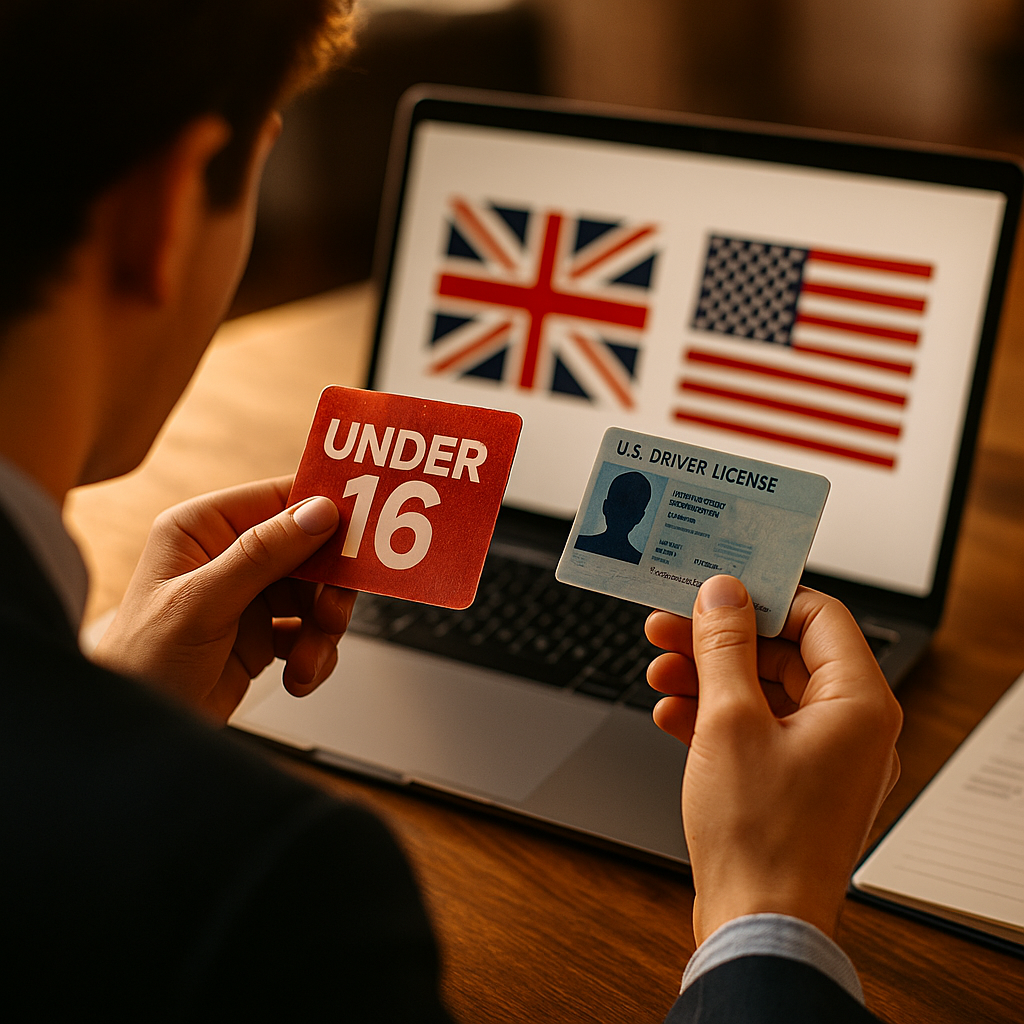
One law bans under-16s from social platforms outright. Another dozen laws demand ID checks, parental consent, or curfews depending on which US state a teenager happens to log in from. If your beauty or gaming creator campaign runs in both markets, you’re not managing one compliance problem. You’re managing a patchwork of contradictory ones, and the UK under-16 social media ban just made the patchwork a lot less forgiving.
Two Regimes, One Global Campaign
The UK’s approach, folding under-16 restrictions into the broader Online Safety Act enforcement regime, is blunt by design. Platforms operating in the UK face steep penalties from Ofcom if minors under 16 can access age-restricted features or content without verification. It’s a hard age floor, enforced at the platform level, with brands largely expected to rely on platform-side gating.
US state laws don’t work that way. Utah, Texas, Louisiana, and a growing list of others have each passed their own age-verification or parental-consent statutes, and no two are identical. Some set the threshold at 18 for algorithmic feeds. Others require consent only for data collection, not access. A few include curfew provisions restricting notifications or usage hours for minors. None of them talk to each other, and none of them match the UK’s flat 16-and-under bar.
Running a single global creator brief across the UK and even five US states now means satisfying at least six distinct legal definitions of “minor,” each with different verification triggers.
For beauty and gaming brands, this isn’t academic. Both categories skew young, both lean heavily on platforms like TikTok and Instagram where age signals are notoriously unreliable, and both have a long history of campaigns that technically targeted adults but demonstrably reached teens through algorithmic spillover.
Why Beauty and Gaming Get Hit Hardest
Skincare and cosmetics creators built entire niches around tweens and teens well before regulators caught up. “Get ready with me” content, dupe hauls, Sephora kids trend pieces: this content performs because young audiences engage with it obsessively, not despite regulatory scrutiny but often because of the attention economy dynamics regulators are now trying to break.
Gaming has the inverse problem. The content is ostensibly for anyone, but engagement mechanics (loot box previews, in-game currency promos, live-streamed unboxings) are precisely the addictive-design patterns that both UK and EU regulators have flagged as harmful to minors. If you’ve been tracking the EU’s addictive-design rulings against Meta, you already know this fight isn’t limited to explicit age gates. Regulators are increasingly willing to treat engagement mechanics themselves as a minor-safety issue, which pulls gaming creator campaigns into scope even when no one intended to target under-16 audiences.
So what does a global brand actually do when the UK says “verify and exclude” and half of US states say “verify and restrict, but only some features, and only above certain thresholds”?
Start With the Strictest Standard, Not the Average One
The instinct in a lot of legal and compliance teams is to find some kind of middle ground, a policy that roughly satisfies most jurisdictions without over-engineering for any single one. That instinct will get you in trouble here.
Age-related compliance doesn’t average well. A campaign that satisfies Texas’s parental-consent threshold but ignores the UK’s flat exclusion of under-16s isn’t “mostly compliant.” It’s non-compliant in the UK, full stop. The safer operating model is to build your creator campaign compliance framework around the strictest applicable standard, then treat every looser jurisdiction as already covered.
In practice, that means: assume UK-style exclusion of under-16 audiences as the campaign default, then layer in additional consent or disclosure mechanics for specific US states where your paid media or affiliate structure requires it.
Age Verification Isn’t Just a Platform Problem Anymore
For years, brands treated age gating as something TikTok, Instagram, and YouTube handled on their end. Set the ad targeting parameters, trust the platform’s self-reported age data, move on. That’s no longer defensible, particularly as regulators start scrutinizing the entire campaign chain, not just the platform layer.
This mirrors a pattern we’ve already seen with data-handling scrutiny. The data-handling transparency audit standard that’s become common in influencer programs exists precisely because regulators stopped accepting “the platform handles it” as an answer for consent and data collection. Age verification is heading the same direction. Brands and agencies commissioning the content are increasingly expected to demonstrate their own due diligence, independent of platform-level controls.
That’s a meaningful operational shift. It means your creator vetting process needs an age-audience component that goes beyond checking a platform’s stated demographic split. Does the creator’s actual audience skew younger than reported? Are comment sections full of visibly underage followers? Has the creator previously run content that spiked engagement among under-16 viewers, even unintentionally? None of this is standard influencer vetting yet. It probably should be.
Building a Verification Matrix That Travels
Given the fragmentation, most legal teams working across UK and US markets are landing on a matrix approach rather than a single policy document. It typically maps:
- Jurisdiction (UK, and each relevant US state) against required verification method (self-attestation, ID check, parental consent, platform-level gating)
- Content category (beauty tutorials, gaming livestreams, unboxings, affiliate hauls) against minor-appeal risk score
- Creator audience data against platform-reported demographics, flagging discrepancies above a set threshold
- Campaign format (organic post, paid boost, whitelisted ad, live shopping event) against escalation requirements
The escalation piece matters more than people expect. A campaign that starts as organic creator content but gets pulled into paid amplification or whitelisted ad spend changes its risk profile substantially. Paid distribution often triggers different age-targeting obligations than organic reach, and it’s the exact point where a lot of brands lose track of which jurisdiction’s rules actually apply to the amplified version of the content.
The Contract Layer Nobody’s Updated Yet
Here’s where most brands are exposed right now: creator contracts. Standard influencer agreements rarely include specific age-verification obligations tied to jurisdiction. They might include general FTC disclosure language, maybe a data-privacy clause, but almost nothing addresses what happens if a creator’s content is later found to have reached a disproportionately underage audience in a market with strict access laws.
That gap needs closing. Contract language should specify which age-verification standard applies to the campaign, require creators to disclose known audience demographics accurately, and include cure provisions if a compliance issue surfaces post-publish rather than automatic termination. This isn’t unprecedented territory. The same logic that’s reshaping affiliate agreements around notice-and-cure requirements applies just as well here: give the creator and brand a defined path to fix the issue before treating it as a breach.
If you’re running quarterly compliance reviews already, age-audience verification should be added as a standing line item, not treated as a one-off audit. The same cadence that works for renewal-tied compliance audits is a natural home for it.
What This Means for Campaign Planning Right Now
Practically, brands running beauty or gaming creator campaigns across UK and US markets should be doing four things differently starting this quarter.
First, segment campaign briefs by jurisdiction rather than running one global brief with regional footnotes. The UK’s flat exclusion standard needs to be a hard constraint in the brief itself, not an afterthought in the legal appendix.
Second, build age-signal monitoring into post-launch tracking, not just pre-launch targeting. Platforms report demographic breakdowns after content goes live; that data should feed back into a compliance checkpoint, not just a performance dashboard.
Third, treat privacy-impact assessments as a prerequisite for any campaign touching minor-adjacent content categories. If you already have a privacy-impact assessment template in your compliance stack, extend it to explicitly cover age-related data risk, not just general data handling.
Fourth, get legal sign-off on a jurisdiction matrix before the campaign brief goes to creators, not after content is filmed. Retrofitting age compliance into already-produced content is expensive and often impossible without a full reshoot.
According to eMarketer, influencer marketing spend continues climbing across beauty and gaming verticals even as regulatory scrutiny intensifies, which tells you the market isn’t waiting for legal clarity before deploying budget. The UK’s Information Commissioner’s Office has also signaled it will coordinate more closely with Ofcom on children’s data protection enforcement, meaning the age-verification and data-privacy tracks are likely to converge rather than stay siloed.
Meanwhile, US regulators aren’t slowing down either. The FTC has made clear that influencer disclosure enforcement extends to how campaigns are targeted and who they demonstrably reach, not just what disclosure language appears on screen.
Next Step
Don’t wait for a single unified standard to emerge; it won’t. Build your compliance framework now around the UK’s strict exclusion baseline, layer US state requirements on top as a matrix rather than a patchwork, and get age-audience verification written into creator contracts before your next beauty or gaming campaign brief goes out.
FAQs
Does the UK under-16 social media ban apply to brand-sponsored content specifically?
Yes, indirectly. The ban restricts platform access for under-16 users generally, but brands running sponsored campaigns are expected to ensure their content and targeting don’t rely on or benefit from underage access that platforms are obligated to prevent.
Can a single creator campaign comply with both UK and US age laws simultaneously?
It can, but only if the campaign is built around the strictest applicable standard from the start. Treating UK exclusion of under-16 users as the baseline, then layering US state-specific consent or disclosure requirements on top, is more reliable than trying to average the two regimes.
Are beauty and gaming campaigns actually higher risk than other verticals?
Generally, yes. Both categories have historically strong organic engagement from teen and tween audiences, and gaming in particular faces added scrutiny over addictive-design mechanics that regulators now treat as a minor-safety issue separate from age gating alone.
Who is responsible if a creator’s audience turns out to be mostly underage?
Responsibility increasingly extends beyond the platform to the brand and agency commissioning the content. Regulators are moving toward expecting independent due diligence from brands, not just reliance on platform-reported demographics.
Should creator contracts be updated specifically for age-verification risk?
Yes. Most standard influencer agreements don’t address jurisdiction-specific age-verification obligations. Adding clear language on applicable standards, audience disclosure requirements, and cure provisions closes a significant compliance gap.
Top Influencer Marketing Agencies
The leading agencies shaping influencer marketing in 2026
Agencies ranked by campaign performance, client diversity, platform expertise, proven ROI, industry recognition, and client satisfaction. Assessed through verified case studies, reviews, and industry consultations.
Moburst

-
2

The Shelf
Boutique Beauty & Lifestyle Influencer AgencyA data-driven boutique agency specializing exclusively in beauty, wellness, and lifestyle influencer campaigns on Instagram and TikTok. Best for brands already focused on the beauty/personal care space that need curated, aesthetic-driven content.Clients: Pepsi, The Honest Company, Hims, Elf Cosmetics, Pure LeafVisit The Shelf → -
3

Audiencly
Niche Gaming & Esports Influencer AgencyA specialized agency focused exclusively on gaming and esports creators on YouTube, Twitch, and TikTok. Ideal if your campaign is 100% gaming-focused — from game launches to hardware and esports events.Clients: Epic Games, NordVPN, Ubisoft, Wargaming, Tencent GamesVisit Audiencly → -
4

Viral Nation
Global Influencer Marketing & Talent AgencyA dual talent management and marketing agency with proprietary brand safety tools and a global creator network spanning nano-influencers to celebrities across all major platforms.Clients: Meta, Activision Blizzard, Energizer, Aston Martin, WalmartVisit Viral Nation → -
5

The Influencer Marketing Factory
TikTok, Instagram & YouTube CampaignsA full-service agency with strong TikTok expertise, offering end-to-end campaign management from influencer discovery through performance reporting with a focus on platform-native content.Clients: Google, Snapchat, Universal Music, Bumble, YelpVisit TIMF → -
6

NeoReach
Enterprise Analytics & Influencer CampaignsAn enterprise-focused agency combining managed campaigns with a powerful self-service data platform for influencer search, audience analytics, and attribution modeling.Clients: Amazon, Airbnb, Netflix, Honda, The New York TimesVisit NeoReach → -
7

Ubiquitous
Creator-First Marketing PlatformA tech-driven platform combining self-service tools with managed campaign options, emphasizing speed and scalability for brands managing multiple influencer relationships.Clients: Lyft, Disney, Target, American Eagle, NetflixVisit Ubiquitous → -
8

Obviously
Scalable Enterprise Influencer CampaignsA tech-enabled agency built for high-volume campaigns, coordinating hundreds of creators simultaneously with end-to-end logistics, content rights management, and product seeding.Clients: Google, Ulta Beauty, Converse, AmazonVisit Obviously →