


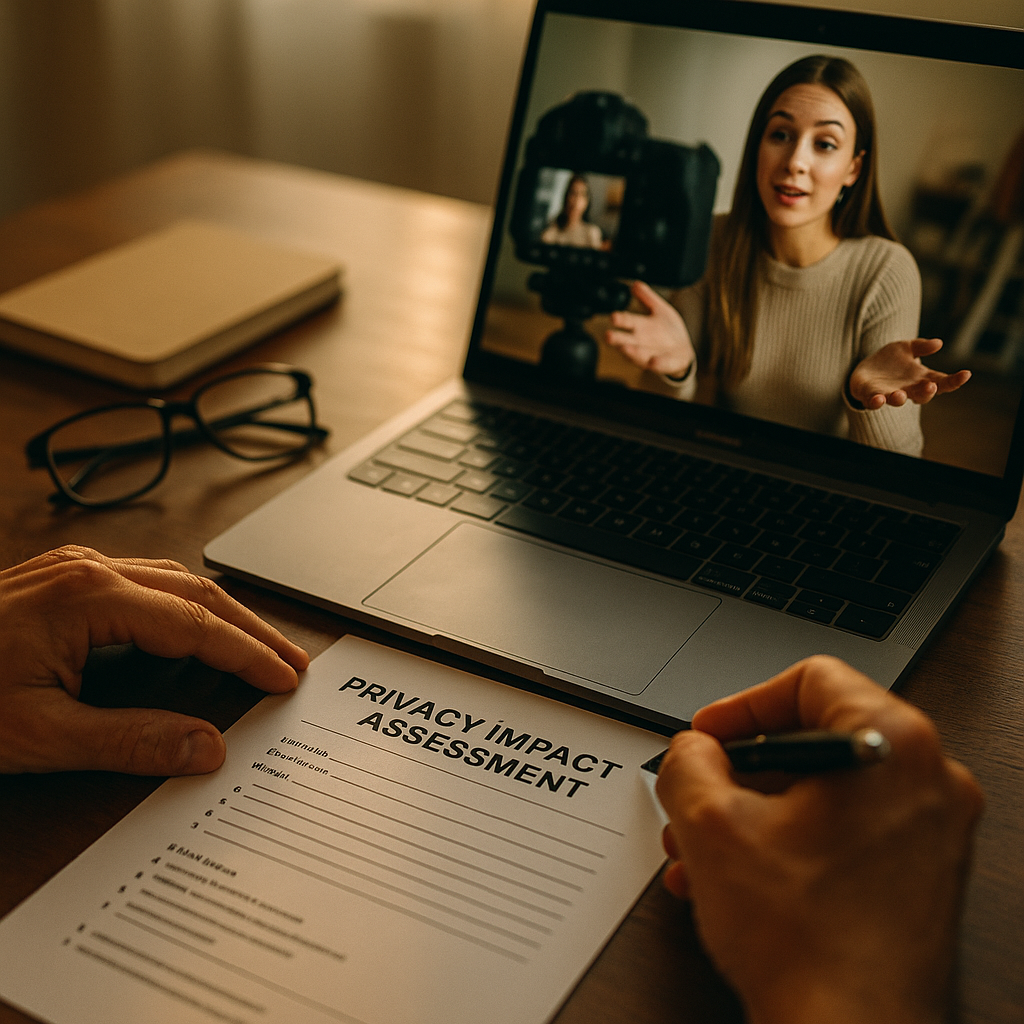
Only 14% of brands run any formal data-protection review on creator campaigns before launch, yet those same campaigns routinely collect emails, purchase data, and biometric identifiers through filters and try-on tools. A privacy-impact assessment for creator campaigns isn’t bureaucratic overhead. It’s the difference between catching a data-collection problem in the brief and explaining one to a regulator.
Creative teams move fast. Legal moves slow. Somewhere in between, nobody’s checking whether that new TikTok Shop affiliate flow is quietly harvesting phone numbers without a lawful basis. This gap is exactly where privacy-impact assessments (PIAs) belong — not as a gate that kills momentum, but as a five-minute checkpoint baked into the same approval flow that already reviews FTC disclosures and brand safety.
Why Creator Campaigns Are a Privacy Blind Spot
Traditional PIAs were built for internal systems: CRM migrations, new ad-tech vendors, website redesigns. Creator campaigns don’t look like those projects on paper, so they get waved through without review. But functionally, a single influencer post can trigger more data flows than a website launch.
Think about what actually happens in a typical creator activation. A TikTok Shop affiliate link routes purchase data through the platform, the creator’s own tracking pixel, and your ecommerce backend. An AR try-on filter captures facial geometry. A giveaway landing page collects emails and mailing addresses, often hosted on a third-party tool the creator picked without asking your compliance team. Each of these is a distinct processing activity, and under UK GDPR, several of them legally require a Data Protection Impact Assessment before they go live, not after.
A campaign brief that never asks “what personal data does this touch?” is a campaign brief that’s already failed its privacy review — it just doesn’t know it yet.
We’ve already covered how this plays out with checkout data privacy risks in social commerce and how cross-platform consent rules are forcing brands to rethink their data flows. A PIA template gives you a repeatable way to catch these issues before creative goes to the creator, not after the campaign is live and the data’s already moving.
What a Creator-Specific PIA Actually Needs to Cover
Generic corporate PIA templates fall apart when applied to influencer work because they assume you control the entire data pipeline. You don’t. The creator’s phone, their chosen link-tracking tool, their DM automation bot — all of it sits partly outside your infrastructure. Your template has to account for that.
Here’s the core structure that works for a mid-size brand running multiple concurrent campaigns:
- Data mapping section: What personal data does this specific campaign collect, and at what touchpoint? List every form, filter, link, DM flow, and checkout step separately.
- Legal basis check: For each data point identified, name the lawful basis — consent, contract, legitimate interest. If nobody can name one, the campaign doesn’t launch.
- Third-party processor inventory: Every tool the creator uses that touches your customers’ data (link shorteners, giveaway apps, AR filter SDKs) needs to be listed and, ideally, vetted against a processor agreement.
- Data minimization review: Are you collecting more than the campaign needs? A “win a free trip” giveaway rarely needs a date of birth and a home address up front.
- Cross-border transfer flag: If the creator is based outside your primary jurisdiction, or the platform routes data through servers abroad, flag it for legal sign-off.
- Retention and deletion plan: Who owns the data after the campaign ends, and when does it get purged?
- Risk score and sign-off: A simple low/medium/high rating tied to a named approver, not a committee.
Keep the whole thing to one page. If your creative team needs a legal dictionary to fill it out, they won’t fill it out.
Embedding the Assessment Into Creative Approval (Not Bolting It On)
The biggest reason PIAs fail in marketing organizations: they live in a separate system that nobody checks. Legal has a SharePoint folder. Creative has Asana. The two never talk, and the PIA becomes a compliance artifact instead of a decision tool.
Fix this by making the PIA a required field inside your existing creative approval workflow, not a parallel process. If you’re using Asana, Monday, or a dedicated influencer platform like CreatorIQ or Aspire, add the PIA as a gating checklist item before a brief can move from “draft” to “approved for outreach.” No completed assessment, no creator gets the brief.
This mirrors what smart teams are already doing with disclosure compliance. Our piece on automated disclosure scanners makes the same point: catching risk before publish is infinitely cheaper than catching it after. The same logic applies to data protection. A five-minute PIA at the brief stage costs you almost nothing. Unwinding a data breach notification after 50 creators have driven traffic to an unvetted giveaway tool costs you weeks and, potentially, regulatory exposure.
Who Should Own the Review?
Not legal alone — they’re too slow and too disconnected from campaign timelines to be the sole gatekeeper. The best-performing setups we’ve seen assign a trained “privacy champion” inside the marketing or influencer ops team, someone who can complete 80% of assessments independently and escalate the genuinely ambiguous ones to legal. This person doesn’t need a law degree. They need a template, thirty minutes of training, and clear escalation triggers (biometric data, cross-border transfers, minors, health-adjacent claims).
This is the same operating model brands use for substantiating creator claims before content goes live: a designated reviewer, a fast checklist, and a clear line to legal when something doesn’t fit the standard pattern.
Where This Intersects With AI-Matched Creator Deals
If you’re using AI tools to match creators to campaigns — and by now, most mid-to-large programs are — your PIA needs an additional layer. Algorithmic matching often pulls in behavioral and demographic data about both the creator and their audience, sometimes without a clear disclosed legal basis. This is squarely the territory covered in our guide on AI creator-matching DPAs, and it’s worth reading alongside your PIA template because Article 22 of the GDPR specifically addresses automated decision-making that produces legal or similarly significant effects.
The practical takeaway: if an algorithm is deciding which creators get paid opportunities based on profiled audience data, that’s a processing activity that belongs in your assessment, not just your legal team’s DPA review.
Common Mistakes That Undermine the Whole Exercise
A few patterns show up again and again when brands roll out PIA templates for the first time:
- Treating it as a one-time document. A PIA completed at kickoff is useless if the creator adds a new giveaway mechanic mid-campaign. Build in a trigger for re-review when scope changes.
- Skipping micro-influencers. Smaller creators are just as likely — arguably more likely — to use unvetted third-party tools for giveaways and link tracking. Don’t scale your rigor by follower count.
- No connection to the contract. If your PIA identifies a risk (say, a creator’s DM automation tool stores customer data indefinitely), that finding needs to translate into a contractual data-handling clause. Otherwise it’s just a document nobody enforces.
- Ignoring platform-side changes. When TikTok or Meta adjusts how Shop or Partnership Ads handle checkout data, your existing PIAs can go stale overnight. Our coverage of the TikTok Shop DPA fixes is a good example of how fast this terrain shifts.
The brands getting this right treat the PIA as a living check tied to the contract and the campaign timeline, not a form filed away after approval. That connects directly to broader transparency practices — see our data-handling transparency audit for how this fits into a full program-level review.
Regulatory Pressure Is Only Increasing
Data protection authorities across the UK, EU, and a growing number of US states are paying closer attention to influencer marketing specifically, not just digital advertising broadly. The UK Information Commissioner’s Office has flagged social media data collection as an enforcement priority, and state-level privacy laws in the US increasingly extend obligations to any party collecting consumer data, including creators acting as your contracted representatives. The FTC has also made clear that endorsement compliance and data practices are increasingly viewed together, not as separate silos.
Meanwhile, industry data from eMarketer shows social commerce spend climbing steadily, which means more checkout flows, more first-party data capture, and more surface area for a privacy misstep. The volume alone makes ad hoc review unsustainable.
Building the Template: A Starting Point
If you’re starting from zero, don’t try to build the perfect enterprise-grade PIA framework in one sitting. Start with a lightweight version — the seven-item structure above — and pilot it on your next three campaigns. Track how long it takes reviewers to complete, where they get stuck, and which questions consistently get skipped or misunderstood. Refine from there.
Tools like HubSpot or your existing marketing ops platform can host the template as a form with conditional logic, so a “no” answer on biometric data collection skips the AR-specific questions entirely. This keeps completion time low, which is the single biggest factor in whether creative teams actually use the thing.
One more point worth stressing: your PIA and your creator contract should speak the same language. If the assessment identifies a risk around third-party data sharing, the contract needs a clause that addresses it directly, similar to the approach outlined in our Vermont notice-and-cure privacy guide for affiliate data handling.
Start small: pick your riskiest active campaign type — probably anything involving checkout, giveaways, or AR filters — and run it through the seven-item template this week. You’ll find the gaps fast, and fixing them now costs a fraction of what fixing them after a data incident will.
FAQs
What is a privacy-impact assessment for creator campaigns?
It’s a structured review, completed before a campaign launches, that identifies what personal data the campaign collects, who processes it, what legal basis applies, and what risks need mitigation before creative goes live.
Do all creator campaigns need a full PIA?
No. Campaigns that don’t collect personal data beyond standard platform engagement metrics can typically skip a full assessment. Anything involving giveaways, checkout flows, AR filters, DM automation, or biometric data should trigger one.
Who should be responsible for completing the assessment?
A trained marketing or influencer-ops team member can handle most assessments using a standard checklist, escalating higher-risk cases (biometric data, cross-border transfers, minors) to legal or a dedicated privacy officer.
How does this differ from an FTC disclosure review?
Disclosure reviews focus on whether sponsorship is clearly and conspicuously labeled. Privacy-impact assessments focus on what data the campaign collects and whether that collection is lawful, minimized, and properly retained. Both should run through the same approval workflow but check different things.
What happens if a PIA identifies a high-risk issue after the campaign has already launched?
Pause the specific data-collecting element (the form, filter, or tracking link) while the issue is assessed, notify legal immediately, and document the remediation. Under GDPR and several US state laws, unresolved high-risk processing can carry direct liability, so speed matters more than perfect process.
Can AI creator-matching tools be covered under the same PIA template?
Not fully. AI matching introduces automated decision-making concerns under laws like GDPR Article 22 that a standard campaign PIA won’t catch. Pair your campaign template with a separate review of the matching tool’s data processing agreement.
FAQs
Top Influencer Marketing Agencies
The leading agencies shaping influencer marketing in 2026
Agencies ranked by campaign performance, client diversity, platform expertise, proven ROI, industry recognition, and client satisfaction. Assessed through verified case studies, reviews, and industry consultations.
Moburst

-
2

The Shelf
Boutique Beauty & Lifestyle Influencer AgencyA data-driven boutique agency specializing exclusively in beauty, wellness, and lifestyle influencer campaigns on Instagram and TikTok. Best for brands already focused on the beauty/personal care space that need curated, aesthetic-driven content.Clients: Pepsi, The Honest Company, Hims, Elf Cosmetics, Pure LeafVisit The Shelf → -
3

Audiencly
Niche Gaming & Esports Influencer AgencyA specialized agency focused exclusively on gaming and esports creators on YouTube, Twitch, and TikTok. Ideal if your campaign is 100% gaming-focused — from game launches to hardware and esports events.Clients: Epic Games, NordVPN, Ubisoft, Wargaming, Tencent GamesVisit Audiencly → -
4

Viral Nation
Global Influencer Marketing & Talent AgencyA dual talent management and marketing agency with proprietary brand safety tools and a global creator network spanning nano-influencers to celebrities across all major platforms.Clients: Meta, Activision Blizzard, Energizer, Aston Martin, WalmartVisit Viral Nation → -
5

The Influencer Marketing Factory
TikTok, Instagram & YouTube CampaignsA full-service agency with strong TikTok expertise, offering end-to-end campaign management from influencer discovery through performance reporting with a focus on platform-native content.Clients: Google, Snapchat, Universal Music, Bumble, YelpVisit TIMF → -
6

NeoReach
Enterprise Analytics & Influencer CampaignsAn enterprise-focused agency combining managed campaigns with a powerful self-service data platform for influencer search, audience analytics, and attribution modeling.Clients: Amazon, Airbnb, Netflix, Honda, The New York TimesVisit NeoReach → -
7

Ubiquitous
Creator-First Marketing PlatformA tech-driven platform combining self-service tools with managed campaign options, emphasizing speed and scalability for brands managing multiple influencer relationships.Clients: Lyft, Disney, Target, American Eagle, NetflixVisit Ubiquitous → -
8

Obviously
Scalable Enterprise Influencer CampaignsA tech-enabled agency built for high-volume campaigns, coordinating hundreds of creators simultaneously with end-to-end logistics, content rights management, and product seeding.Clients: Google, Ulta Beauty, Converse, AmazonVisit Obviously →