


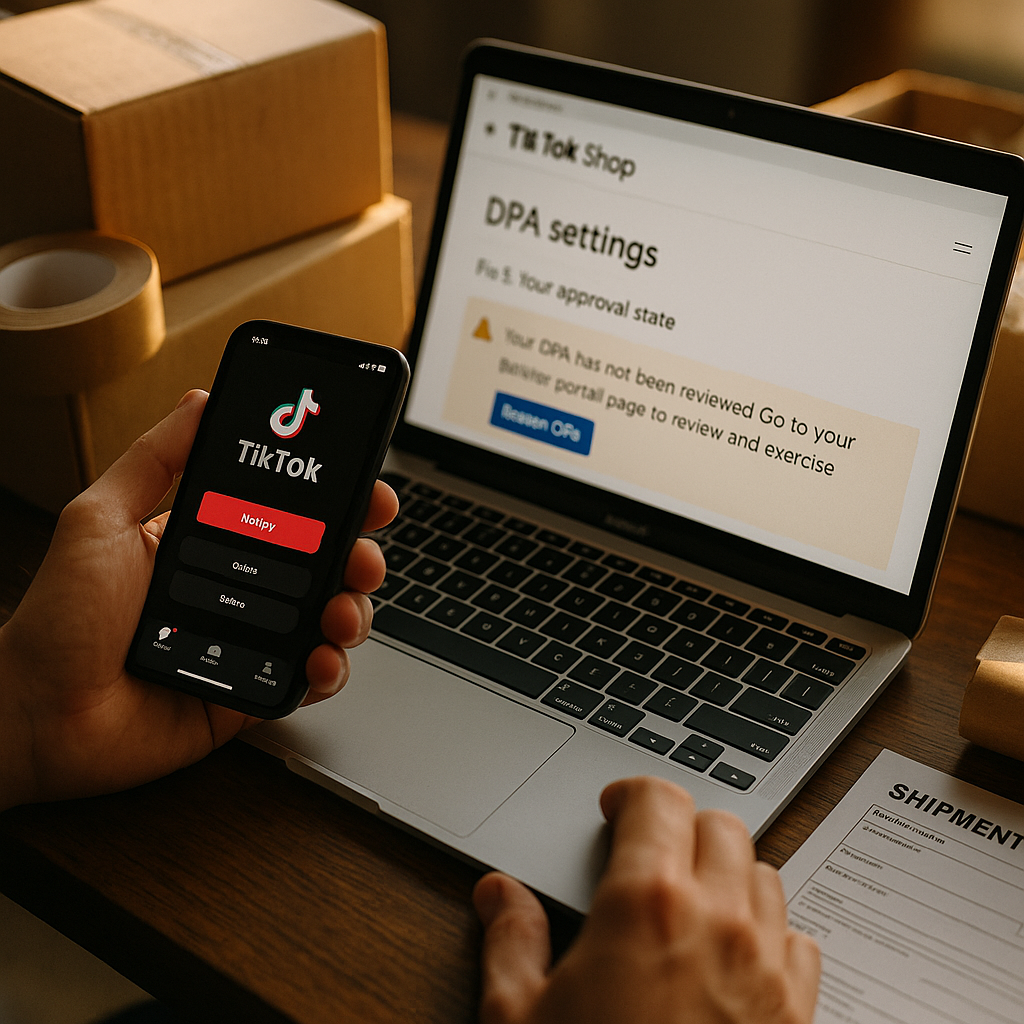
One mismatched business registration number. That’s all it takes to trigger TikTok Shop’s merchant verification freeze and lock a brand’s storefront mid-campaign. With enforcement now targeting document inconsistencies across seller entities, agencies, and shell subsidiaries, brand legal teams can no longer treat their TikTok Shop data processing addendum as boilerplate. This is a contract problem now, not just a compliance checkbox.
Why the Freeze Changes the DPA Conversation Entirely
TikTok Shop’s verification freeze isn’t a minor policy update. It’s a structural shift in how the platform treats identity data tied to merchant accounts. Any mismatch between the business name on a seller’s tax documents, banking records, or registration filings can now trigger an account hold, sometimes without advance notice.
For brands running influencer-driven storefronts through agencies of record, white-label sellers, or regional subsidiaries, this creates a compliance minefield. Your DPA with TikTok Shop was likely drafted around standard data-sharing terms: what customer data flows where, how long it’s retained, who processes it downstream. Few of those agreements anticipated a scenario where the platform freezes commerce functionality based on document verification mismatches that may originate from a vendor’s paperwork, not the brand’s.
If your legal team hasn’t audited who “owns” the merchant identity on TikTok Shop, you’re one clerical error away from a frozen storefront during peak campaign season.
That’s the real risk. Not fraud. Not a security breach. Just misaligned paperwork between entities that were never contractually required to reconcile their business documentation in the first place.
What’s Actually in Scope for the Verification Freeze
TikTok’s merchant verification process cross-references several data points: business registration name, tax ID, beneficial ownership disclosures, and banking institution details. When a brand operates through a third-party seller of record, or when a regional agency manages the storefront on the brand’s behalf, these data points often live in different systems, updated on different schedules, by different teams.
- Business registration mismatches — the legal entity name on the TikTok Shop account differs from the name on tax filings or payment processor records.
- Beneficial ownership gaps — parent company structures where the operating brand isn’t the listed owner of record.
- Cross-border entity confusion — a US brand operating a storefront through an EU subsidiary with separate registration documents.
- Agency-managed accounts — where the agency’s business documents, not the brand’s, are on file with TikTok Shop.
Any one of these can trip the freeze. And once frozen, reinstatement isn’t instant. Brands have reported multi-week resolution windows, which is an eternity when a product launch or livestream event is scheduled.
The DPA Gap Nobody Flagged Until Now
Most existing TikTok Shop data processing addendums cover the flow of customer data: purchase history, shipping addresses, payment tokens. They rarely address the flow of merchant identity data between the brand, its agencies, and its regional entities. That’s the gap the verification freeze exposes.
Legal teams need to treat merchant verification data as its own category of sensitive processing, distinct from consumer transaction data. It requires its own retention terms, its own accuracy warranties, and its own breach notification triggers if a mismatch causes commercial harm.
Structuring the DPA: Five Non-Negotiable Clauses
Here’s where legal teams should start when renegotiating or drafting a new TikTok Shop DPA in light of the freeze policy.
- Document reconciliation warranty. Require any third party managing the storefront (agency, reseller, regional subsidiary) to warrant that its business registration, tax, and banking documents match exactly across all TikTok-facing systems, and to update the brand within a fixed window (48-72 hours) of any change.
- Verification freeze notification clause. Build in a mandatory notice obligation: if any party managing the account receives a verification hold or freeze notice from TikTok, they must escalate to the brand’s legal or compliance team within 24 hours, not after the freeze has already disrupted a campaign.
- Data accuracy indemnification. If an agency or vendor’s document mismatch causes the freeze, the DPA should shift financial responsibility for resulting revenue loss or campaign disruption to that party. This mirrors the logic already used in indemnification clauses for AI-selected creator contracts, where liability follows the party that introduced the error.
- Entity mapping schedule. Attach a living document to the DPA that maps every legal entity touching the TikTok Shop account: parent company, subsidiary, agency of record, payment processor. Update it quarterly. This single artifact resolves most mismatch disputes before they escalate.
- Audit and remediation rights. The brand should retain the right to audit merchant documentation held by any processor or sub-processor at least twice a year, with remediation timelines specified for any discrepancy found.
None of this is exotic. It’s the same rigor legal teams already apply to creator parent company legal structure risks in co-branding deals. The freeze just forces brands to apply that same scrutiny to their own commerce infrastructure.
Who Owns the Data When Three Parties Touch One Storefront?
This is the question that trips up most legal reviews. A typical TikTok Shop setup might involve the brand (data controller for consumer information), an agency (processor for content and campaign data), and a regional reseller (processor for fulfillment and tax documentation). Under most interpretations consistent with GDPR-style frameworks, each of these roles carries different obligations.
The DPA needs to specify, in plain terms, which party is responsible for the accuracy of which document set. Ambiguity here is exactly what causes finger-pointing when a freeze hits. Brands that have already worked through DPA structures under GDPR Article 22 will recognize the pattern: clear controller-processor delineation prevents the “it wasn’t our data” argument during a crisis.
Don’t Forget the Downstream Privacy Angle
Merchant verification data isn’t just a commerce compliance issue, it’s personal data in many jurisdictions. Beneficial ownership disclosures often include names, addresses, and government ID numbers tied to individual business owners or officers. That means your TikTok Shop DPA needs to align with broader data privacy obligations, not just platform-specific commerce rules.
This overlaps directly with the checkout-adjacent privacy concerns raised in social commerce checkout data privacy risks. If a beneficial owner’s personal ID data is mishandled during a verification dispute, the brand faces exposure well beyond a frozen storefront. State-level laws with notice-and-cure provisions add another layer; legal teams already tracking Vermont’s notice-and-cure privacy rules should extend that same cure-period logic to merchant document disputes.
Merchant verification data sits at the intersection of commerce compliance and personal privacy law — treat it as a hybrid risk, not a pure operations issue.
Practical Steps for the Next Quarter
Waiting for a freeze notice is not a strategy. Brand legal teams should move now, before the next verification sweep catches an outdated agency filing or an unreconciled subsidiary registration.
- Pull every active TikTok Shop merchant account under the brand’s umbrella and confirm the registered business name matches tax and banking records exactly.
- Request updated DPAs or DPA amendments from every agency and reseller managing a storefront, incorporating the five clauses above.
- Build an internal escalation path so a verification freeze notice reaches legal within hours, not days.
- Cross-reference merchant documentation against any recent TikTok Shop IP verification checklist work already completed for seller compliance, since the underlying entity data often overlaps.
According to eMarketer, social commerce continues to command a growing share of retail media budgets, which means the cost of a frozen storefront compounds quickly during high-velocity sales periods. A one-week freeze during a major shopping event isn’t a paperwork inconvenience, it’s a measurable revenue hit that finance teams will ask about.
Platform-level guidance from TikTok for Business outlines merchant requirements, but it stops short of addressing the multi-entity complexity most enterprise brands actually operate under. That’s precisely why the DPA, not the platform’s public terms, needs to carry the operational detail.
Where Compliance Teams Should Sit at the Table
This isn’t purely a legal exercise. Compliance, finance, and the agency relationship owner all need visibility into the entity mapping schedule. A quarterly review cycle involving all three functions catches mismatches long before TikTok’s automated verification systems do. Firms managing multi-region influencer programs should treat this the same way they’d treat any cross-border regulatory exposure, methodically, with clear ownership, and with documentation that survives an audit.
Bottom line: update your TikTok Shop DPA now to assign explicit accountability for merchant document accuracy across every entity touching the storefront, then run a documentation audit before the next quarter’s sales events. Waiting for a freeze notice to force the conversation is the most expensive way to learn this lesson.
Frequently Asked Questions
What triggers TikTok Shop’s merchant verification freeze?
Mismatches between the business name, tax ID, or banking details listed on a merchant’s TikTok Shop account and the documents held by tax authorities, payment processors, or corporate registries. Freezes can also occur when beneficial ownership disclosures conflict with the account’s registered entity.
Does the freeze apply to brands using agencies to manage their storefronts?
Yes. If the agency’s business documentation is what’s on file with TikTok Shop, any mismatch on the agency’s side can freeze the brand’s storefront, even if the brand’s own paperwork is fully accurate.
What should a TikTok Shop DPA include to reduce this risk?
At minimum: a document reconciliation warranty, a mandatory freeze notification clause, indemnification for document-related disruptions, a quarterly entity mapping schedule, and audit rights over any processor’s merchant documentation.
How quickly can a frozen TikTok Shop account be reinstated?
Resolution timelines vary and TikTok has not published a fixed SLA. Brands should assume multi-week delays are possible and build contractual notification triggers that allow legal teams to intervene early rather than reactively.
Is merchant verification data considered personal data under privacy law?
Often, yes. Beneficial ownership disclosures typically include names and government ID numbers tied to individuals, which can bring the data within scope of state and international privacy regulations, not just platform commerce policies.
Top Influencer Marketing Agencies
The leading agencies shaping influencer marketing in 2026
Agencies ranked by campaign performance, client diversity, platform expertise, proven ROI, industry recognition, and client satisfaction. Assessed through verified case studies, reviews, and industry consultations.
Moburst

-
2

The Shelf
Boutique Beauty & Lifestyle Influencer AgencyA data-driven boutique agency specializing exclusively in beauty, wellness, and lifestyle influencer campaigns on Instagram and TikTok. Best for brands already focused on the beauty/personal care space that need curated, aesthetic-driven content.Clients: Pepsi, The Honest Company, Hims, Elf Cosmetics, Pure LeafVisit The Shelf → -
3

Audiencly
Niche Gaming & Esports Influencer AgencyA specialized agency focused exclusively on gaming and esports creators on YouTube, Twitch, and TikTok. Ideal if your campaign is 100% gaming-focused — from game launches to hardware and esports events.Clients: Epic Games, NordVPN, Ubisoft, Wargaming, Tencent GamesVisit Audiencly → -
4

Viral Nation
Global Influencer Marketing & Talent AgencyA dual talent management and marketing agency with proprietary brand safety tools and a global creator network spanning nano-influencers to celebrities across all major platforms.Clients: Meta, Activision Blizzard, Energizer, Aston Martin, WalmartVisit Viral Nation → -
5

The Influencer Marketing Factory
TikTok, Instagram & YouTube CampaignsA full-service agency with strong TikTok expertise, offering end-to-end campaign management from influencer discovery through performance reporting with a focus on platform-native content.Clients: Google, Snapchat, Universal Music, Bumble, YelpVisit TIMF → -
6

NeoReach
Enterprise Analytics & Influencer CampaignsAn enterprise-focused agency combining managed campaigns with a powerful self-service data platform for influencer search, audience analytics, and attribution modeling.Clients: Amazon, Airbnb, Netflix, Honda, The New York TimesVisit NeoReach → -
7

Ubiquitous
Creator-First Marketing PlatformA tech-driven platform combining self-service tools with managed campaign options, emphasizing speed and scalability for brands managing multiple influencer relationships.Clients: Lyft, Disney, Target, American Eagle, NetflixVisit Ubiquitous → -
8

Obviously
Scalable Enterprise Influencer CampaignsA tech-enabled agency built for high-volume campaigns, coordinating hundreds of creators simultaneously with end-to-end logistics, content rights management, and product seeding.Clients: Google, Ulta Beauty, Converse, AmazonVisit Obviously →