


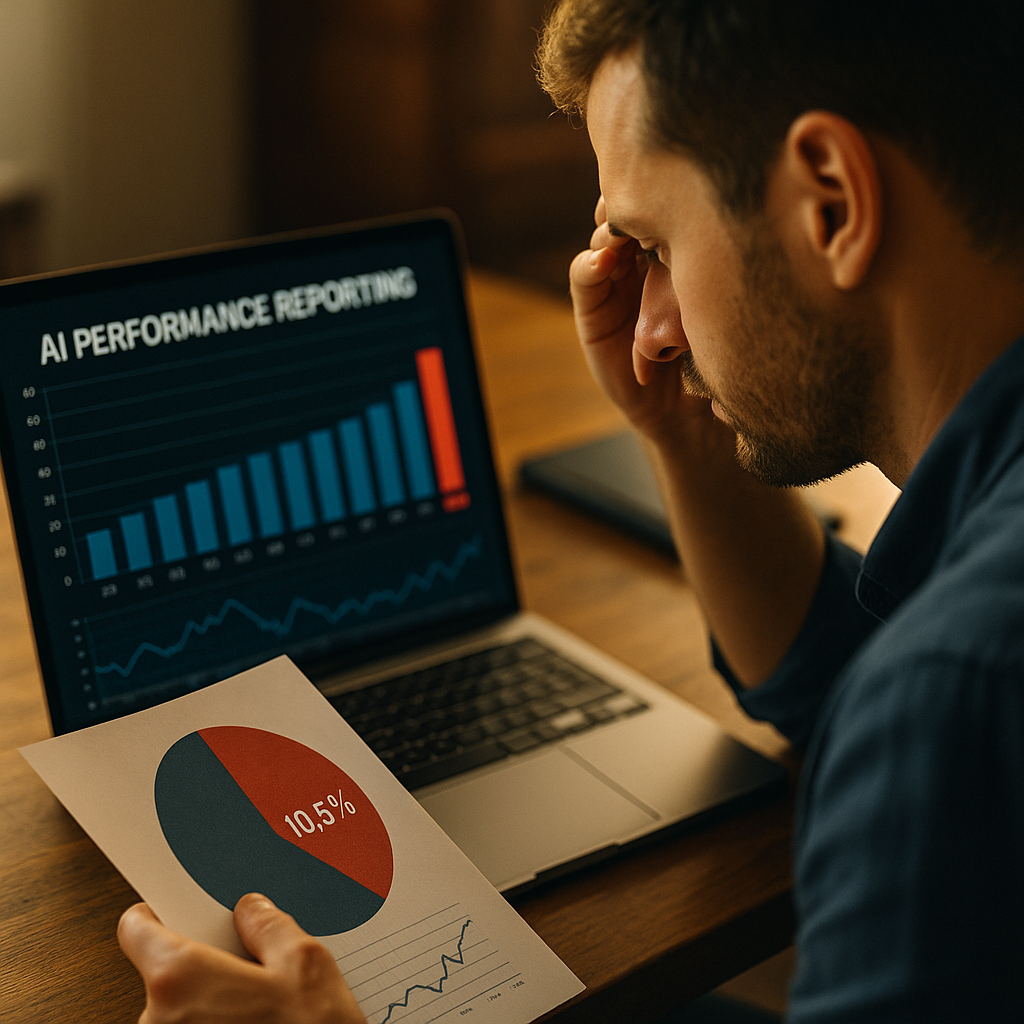
Only 10.6% of brands currently use AI-powered performance reporting in their influencer programs. Let that sink in. While marketers race to adopt AI for content generation and creator discovery, the part of the workflow that actually proves ROI — reporting — is stuck in spreadsheets, screenshots, and manual pivot tables. That’s not a technology gap. It’s a strategic blind spot.
The Adoption Number Nobody’s Talking About
Influencer marketing has quietly become one of the largest line items in brand marketing budgets. Yet the reporting infrastructure supporting it hasn’t kept pace. A 10.6% adoption rate for AI-powered performance reporting means roughly nine out of ten brands are still stitching together campaign results by hand: exporting CSVs from TikTok Creator Marketplace, copying engagement numbers from Instagram Insights, and building attribution stories in Google Sheets that fall apart the moment a stakeholder asks a hard question.
Compare that to other corners of the influencer workflow. AI-driven creator discovery tools have already cut sourcing time from weeks to hours. Brief generation, while still lagging, sits at a reported 21% adoption. Fraud detection in vetting hovers near 14%. Reporting, the stage where brands actually justify spend to finance teams, trails nearly all of them.
Brands have automated the front half of the influencer workflow — sourcing, vetting, briefing — but left the back half, the part that determines budget renewal, almost entirely manual.
Why This Gap Exists (It’s Not About Willingness)
Nobody enjoys building manual reports. So why hasn’t reporting automation caught on the way discovery and vetting have?
Three reasons show up consistently in conversations with brand-side marketers and agency ops leads:
- Fragmented data sources. Performance data lives across TikTok, Instagram, YouTube, affiliate platforms, and e-commerce backends. AI reporting tools need clean, structured inputs — and most brands’ data infrastructure isn’t there yet.
- Attribution ambiguity. Influencer impact is notoriously hard to isolate from other channels. If your underlying attribution model is shaky, no amount of AI polish fixes the output. This is the same root issue explored in deterministic vs. probabilistic attribution models.
- Trust deficit in AI outputs. Marketing leaders who’ve been burned by hallucinated insights or opaque dashboards are wary of handing reporting — the function tied directly to budget decisions — to a black-box system.
That last point matters more than most vendors admit. Reporting isn’t just a nice-to-have dashboard. It’s the artifact CFOs and CMOs use to decide whether influencer budgets grow or shrink next quarter. Getting it wrong has career consequences. Getting it slow has opportunity costs. Most teams choose slow.
What “AI-Powered Performance Reporting” Actually Means
The term gets thrown around loosely, so let’s be specific. AI-powered performance reporting typically includes:
- Automated data ingestion across platforms (no manual CSV exports)
- Natural-language summarization of campaign performance (“this creator drove a 14% lift in add-to-cart vs. baseline”)
- Anomaly detection that flags underperformance or suspicious spikes in real time
- Predictive modeling that forecasts remaining campaign performance based on early signals
- Auto-generated stakeholder-ready decks or dashboards, updated continuously rather than rebuilt weekly
This isn’t the same as a static dashboard with a few charts. Tools like Sprout Social and platform-native analytics have offered dashboards for years. What’s new — and still underused — is the layer that interprets the data and writes the narrative for you, cutting the time between “campaign ends” and “insight in hand” from days to minutes.
The Real Cost of Manual Reporting
Let’s talk numbers, because “it’s inefficient” undersells the problem.
Agencies running 15-20 concurrent influencer campaigns often dedicate one or two full-time staff purely to reporting compilation. That’s not strategy work. That’s data janitorial work. Meanwhile, campaign learnings that could inform mid-flight optimization arrive too late to act on, because the report took a week to assemble.
There’s also a compliance angle that’s easy to miss. Manual reporting makes it harder to maintain a defensible audit trail — who approved what performance claim, based on which data pull, at what point in the campaign. As scrutiny around marketing claims increases (see recent FTC enforcement activity on endorsement disclosures), having a clean, timestamped, AI-generated reporting trail isn’t just operational hygiene. It’s risk mitigation. This connects directly to the broader push toward explainable AI and audit trails in marketing operations.
If your influencer reporting can’t tell you why a creator underperformed until three weeks after the campaign ends, you’re not measuring performance. You’re documenting history.
Where the Underused Opportunity Actually Lives
Here’s the part brands miss: AI-powered reporting isn’t primarily a time-saver. That’s the surface-level pitch. The deeper value is in what it unlocks downstream.
When reporting is automated and near-real-time, brands can:
- Reallocate budget mid-campaign. If a creator tier is underdelivering by week two of a six-week campaign, that’s a decision point — not a postmortem note.
- Feed performance data back into vetting. Reporting outputs should inform which creators get invited back. Right now, that feedback loop is often broken because reporting is too slow or too siloed to connect with vetting and affinity scoring processes.
- Strengthen marketing-mix modeling inputs. Clean, structured influencer performance data makes MMM more accurate, particularly as brands lean on it more heavily post-cookie deprecation, a trend covered in this MMM revival analysis.
- Defend budgets faster. When finance asks “what did we get for this spend,” marketers with automated reporting answer in minutes. Everyone else schedules a follow-up meeting.
None of this is theoretical. It’s the difference between influencer marketing being treated as a measurable channel versus a “brand awareness” line item nobody can fully justify.
Why Adoption Will Accelerate, Whether You’re Ready or Not
A few forces are converging that make 10.6% adoption look like a temporary floor rather than a stable equilibrium.
First, platforms are pushing their own AI reporting layers. TikTok and Meta have both expanded native analytics with predictive and generative summarization features, following the broader industry shift documented across Meta Business and TikTok for Business tooling updates.
Second, the same AI infrastructure powering creator vetting agents is increasingly capable of ingesting and interpreting post-campaign data too. Vendors are bundling reporting into the same platforms handling discovery and vetting, which lowers the adoption barrier considerably. You’re not buying a separate tool; you’re activating a feature you already have.
Third — and this is the quiet driver — brand-side leadership is under more pressure to prove marketing ROI amid flat or shrinking budgets. According to eMarketer research on marketing spend trends, CFOs are scrutinizing channel-level performance more aggressively than in prior years. Manual reporting simply can’t keep pace with that scrutiny.
None of this guarantees smooth adoption. The same data fragmentation and trust issues that stalled adoption to begin with don’t disappear overnight. But the direction is clear, and the brands that wait for “someday” will be explaining last quarter’s results while competitors are already optimizing next quarter’s.
How to Actually Close the Gap
If you’re part of the 89.4% still reporting manually, here’s a practical starting sequence, not a five-year roadmap:
- Audit your data plumbing first. AI reporting tools amplify whatever data quality you already have. Garbage in, confidently-written garbage out. This is the same foundational work outlined in the four-layer data audit framework.
- Start with one campaign type. Don’t attempt full-funnel automation on day one. Pick your highest-volume creator tier (often nano or micro-creators) and pilot automated reporting there.
- Demand explainability from vendors. Any tool generating performance narratives should show its reasoning and data sources. Black-box outputs won’t survive a CFO’s questioning.
- Connect reporting to vetting and briefing. Siloed AI adoption across the workflow creates disconnected tools that don’t talk to each other. The value compounds when reporting insights loop back into discovery and briefing decisions.
- Set a human review checkpoint. Automation speeds up reporting; it shouldn’t remove accountability. Someone still signs off before a performance claim reaches leadership.
This isn’t about replacing analysts. It’s about giving them tools that stop them from spending Friday afternoons manually reconciling engagement rates across six platforms.
Next Step
Start by auditing whether your current reporting stack can even ingest cross-platform data cleanly. If it can’t, that’s your adoption blocker, not a lack of available AI tools. Fix the pipe before you buy the faucet.
Frequently Asked Questions
What is AI-powered performance reporting in influencer marketing?
It’s the use of AI systems to automatically ingest campaign data from multiple platforms, generate performance narratives, detect anomalies, and produce stakeholder-ready reports without manual compilation. It goes beyond static dashboards by interpreting data and writing insights in natural language.
Why is adoption of AI reporting tools so low compared to other AI use cases in influencer marketing?
Adoption lags mainly due to fragmented data across platforms, weak underlying attribution models, and lingering distrust of AI-generated insights tied to budget decisions. Reporting also tends to be prioritized last because discovery and vetting deliver more visible time savings earlier in the workflow.
Does AI reporting replace the need for human analysts?
No. AI reporting tools handle data aggregation and initial interpretation, but human review remains essential for validating claims before they reach leadership or influence budget decisions. The goal is to eliminate manual data-wrangling, not oversight.
How does automated reporting improve influencer marketing ROI?
It shortens the gap between campaign activity and actionable insight, allowing brands to reallocate budget mid-campaign, feed performance data back into creator vetting, and respond faster to finance and leadership questions about spend justification.
What should brands look for when evaluating AI reporting tools?
Prioritize tools that offer explainability (clear data sources and reasoning), integrate with existing discovery and vetting platforms, support cross-platform data ingestion, and allow human review checkpoints before reports are finalized.
FAQs
What is AI-powered performance reporting in influencer marketing?
It’s the use of AI systems to automatically ingest campaign data from multiple platforms, generate performance narratives, detect anomalies, and produce stakeholder-ready reports without manual compilation. It goes beyond static dashboards by interpreting data and writing insights in natural language.
Why is adoption of AI reporting tools so low compared to other AI use cases in influencer marketing?
Adoption lags mainly due to fragmented data across platforms, weak underlying attribution models, and lingering distrust of AI-generated insights tied to budget decisions. Reporting also tends to be prioritized last because discovery and vetting deliver more visible time savings earlier in the workflow.
Does AI reporting replace the need for human analysts?
No. AI reporting tools handle data aggregation and initial interpretation, but human review remains essential for validating claims before they reach leadership or influence budget decisions. The goal is to eliminate manual data-wrangling, not oversight.
How does automated reporting improve influencer marketing ROI?
It shortens the gap between campaign activity and actionable insight, allowing brands to reallocate budget mid-campaign, feed performance data back into creator vetting, and respond faster to finance and leadership questions about spend justification.
What should brands look for when evaluating AI reporting tools?
Prioritize tools that offer explainability (clear data sources and reasoning), integrate with existing discovery and vetting platforms, support cross-platform data ingestion, and allow human review checkpoints before reports are finalized.
Top Influencer Marketing Agencies
The leading agencies shaping influencer marketing in 2026
Agencies ranked by campaign performance, client diversity, platform expertise, proven ROI, industry recognition, and client satisfaction. Assessed through verified case studies, reviews, and industry consultations.
Moburst

-
2

The Shelf
Boutique Beauty & Lifestyle Influencer AgencyA data-driven boutique agency specializing exclusively in beauty, wellness, and lifestyle influencer campaigns on Instagram and TikTok. Best for brands already focused on the beauty/personal care space that need curated, aesthetic-driven content.Clients: Pepsi, The Honest Company, Hims, Elf Cosmetics, Pure LeafVisit The Shelf → -
3

Audiencly
Niche Gaming & Esports Influencer AgencyA specialized agency focused exclusively on gaming and esports creators on YouTube, Twitch, and TikTok. Ideal if your campaign is 100% gaming-focused — from game launches to hardware and esports events.Clients: Epic Games, NordVPN, Ubisoft, Wargaming, Tencent GamesVisit Audiencly → -
4

Viral Nation
Global Influencer Marketing & Talent AgencyA dual talent management and marketing agency with proprietary brand safety tools and a global creator network spanning nano-influencers to celebrities across all major platforms.Clients: Meta, Activision Blizzard, Energizer, Aston Martin, WalmartVisit Viral Nation → -
5

The Influencer Marketing Factory
TikTok, Instagram & YouTube CampaignsA full-service agency with strong TikTok expertise, offering end-to-end campaign management from influencer discovery through performance reporting with a focus on platform-native content.Clients: Google, Snapchat, Universal Music, Bumble, YelpVisit TIMF → -
6

NeoReach
Enterprise Analytics & Influencer CampaignsAn enterprise-focused agency combining managed campaigns with a powerful self-service data platform for influencer search, audience analytics, and attribution modeling.Clients: Amazon, Airbnb, Netflix, Honda, The New York TimesVisit NeoReach → -
7

Ubiquitous
Creator-First Marketing PlatformA tech-driven platform combining self-service tools with managed campaign options, emphasizing speed and scalability for brands managing multiple influencer relationships.Clients: Lyft, Disney, Target, American Eagle, NetflixVisit Ubiquitous → -
8

Obviously
Scalable Enterprise Influencer CampaignsA tech-enabled agency built for high-volume campaigns, coordinating hundreds of creators simultaneously with end-to-end logistics, content rights management, and product seeding.Clients: Google, Ulta Beauty, Converse, AmazonVisit Obviously →