


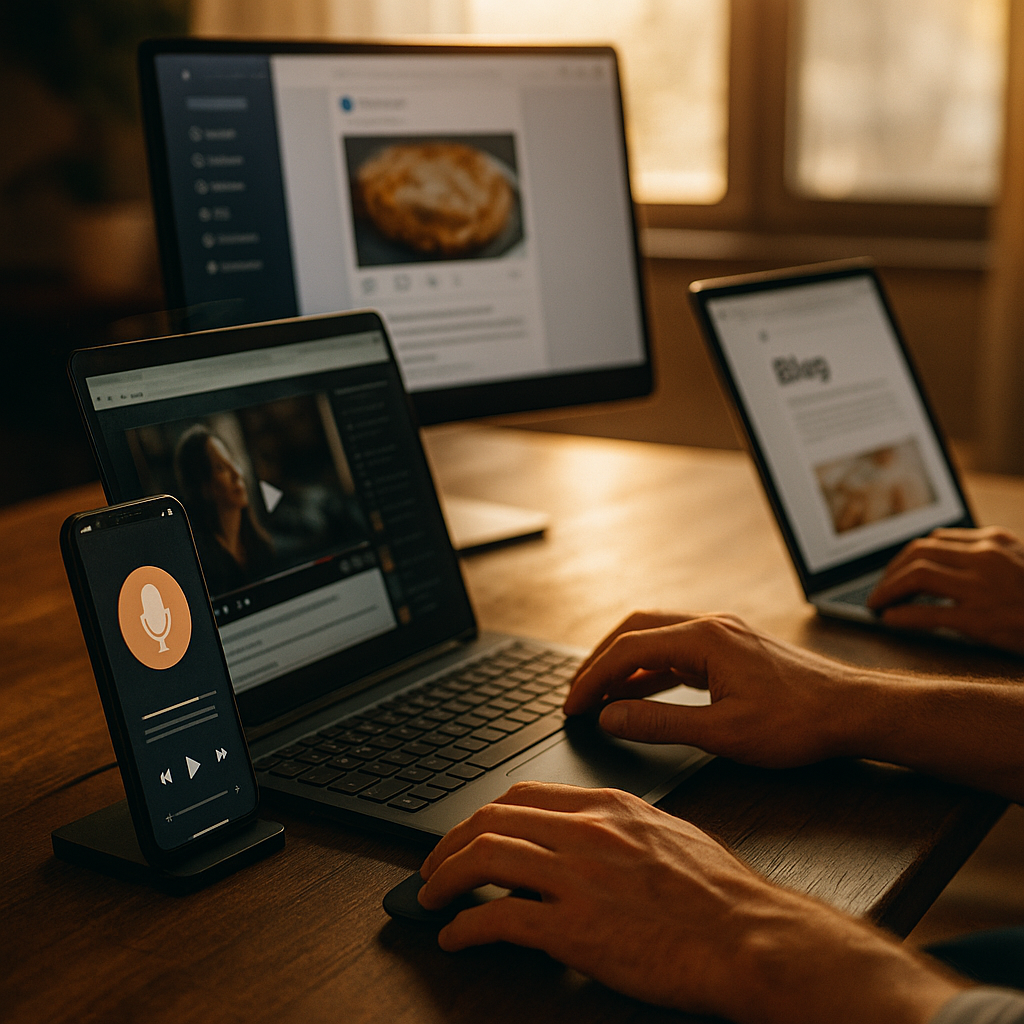
A single TikTok clip now gets summarized by an AI overview, screenshotted into a carousel, and checked out from without ever touching a landing page. If your distribution strategy still treats video, search, and commerce as separate lanes, you’re already behind. Hybrid content formats are collapsing those lanes into one asset, and the brands winning distribution right now are the ones building for the blend, not the channel.
Why the Old Format Playbook Stopped Working
For years, the brief was simple: shoot vertical video for TikTok and Reels, write blog posts for SEO, and bolt on a product feed for social commerce. Three teams, three timelines, three sets of KPIs. That model assumed a stable line between discovery, information, and purchase.
That line is gone. Google’s AI Overviews now answer a huge share of queries before anyone clicks a link, a trend we’ve tracked as zero-click search reshaping how visibility even gets counted. Meanwhile, platforms like TikTok and Instagram are pushing native checkout deeper into the feed. The content that wins now has to do three jobs at once: hook attention in under three seconds, feed an AI-generated snippet clean enough to get quoted, and offer a frictionless path to purchase without forcing a platform exit.
That’s not three assets stitched together. It’s one hybrid format, engineered from the brief stage.
The brands treating video, AI summaries, and commerce as separate workstreams are paying triple for reach they could get from a single well-engineered asset.
What “Hybrid Content” Actually Means in Practice
Strip away the buzzword and hybrid content formats break into three functional layers, usually stacked in the same piece of creative:
- Short-form video as the hook. Fifteen to thirty seconds, native-feeling, built for sound-off viewing. This is still the attention layer — nothing has replaced it.
- AI-legible snippets embedded in the structure. Clear verbal claims, on-screen text, and captions written so a language model can extract a clean, quotable answer. Think of it as SEO for machines that watch video, not just crawl text.
- Interactive commerce baked into the format. Shoppable tags, live-stream checkout, or QR-to-cart moments that convert inside the content rather than after it.
None of these layers is new individually. What’s new is designing all three into a single production pass instead of retrofitting commerce tags onto a video that was never built to sell, or writing a caption after the fact hoping an AI crawler picks it up.
A Quick Example
Picture a skincare brand’s fifteen-second demo. The hook shows before/after texture in the first two seconds. The voiceover states a specific, factual claim (“reduces visible redness in 14 days”) in a clean, standalone sentence — that’s the line an AI summary tool is most likely to lift verbatim. Then a shoppable overlay appears at second eight, timed to the exact moment the product name is spoken. One shoot, three functions, zero handoff friction.
Compare that to the old approach: video team ships the clip, a separate content team writes SEO copy weeks later, and a commerce team adds tags in a third pass. By the time all three land, the trend has moved on.
The AI Snippet Layer Is Now a Distribution Channel, Not an Afterthought
Half of consumers are already letting AI tools do product research on their behalf, according to recent survey data on AI-assisted shopping. That means your content isn’t just competing for a human scroll — it’s competing to be the source an AI model cites, paraphrases, or recommends.
This changes how briefs should be written. Ambiguous, vibes-based captions don’t get picked up cleanly by summarization models. Specific, structured, factual statements do. Marketers who’ve spent a decade optimizing headlines for click-through now need to optimize spoken and on-screen claims for extractability.
It’s worth being blunt here: this isn’t traditional SEO with a video wrapper. It’s a distinct discipline sitting somewhere between SEO and AI answer optimization, and most brands haven’t allocated budget or headcount to it yet. The ones that have are already showing up in AI Overview citations their competitors can’t buy their way into.
Interactive Commerce: Removing the Last Click
Every additional step between “I want this” and “I bought this” costs conversion. Interactive commerce inside hybrid content isn’t a nice-to-have layer — it’s the difference between a video that performs and one that pays for itself.
TikTok Shop, Instagram checkout, and livestream commerce on platforms popular in Southeast Asia and increasingly the US have proven the model at scale. But the tactical lesson for distribution strategy is narrower: commerce triggers need to be timed to the content’s narrative beats, not slapped on as a static product tag in the corner of the screen.
Brands running creator content sessions as repeatable production systems have an advantage here, because they can standardize where and how commerce triggers get embedded across dozens of assets instead of reinventing the placement every time. Consistency in trigger timing also makes performance data comparable across campaigns, which procurement and finance teams will thank you for.
Rebuilding Your Distribution Strategy Around the Blend
If hybrid formats are the creative unit, distribution strategy has to change with them. A few operational shifts matter most:
- Brief for three outcomes simultaneously. Every creative brief should specify the hook, the extractable claim, and the commerce trigger point — not just the concept and CTA.
- Consolidate your production workflow. Separate teams for video, SEO copy, and commerce tagging create lag. A single production pass, even with different specialists collaborating in real time, ships faster and performs better.
- Measure snippet visibility alongside view counts. Track whether your content is showing up in AI-generated answers, not just watch-through rate. This requires new tooling and a new attribution mindset, something we’ve broken down in our attribution and AI visibility framework.
- Pick creators who can perform all three functions. Not every creator can deliver a punchy hook, a clean factual claim, and a natural commerce moment in one take. This is increasingly a casting criterion, not just a talent nice-to-have.
- Repurpose ruthlessly. One hybrid asset should feed short-form, a written recap for AI legibility, and a commerce-ready cutdown. This is the same logic behind content format layering that top creators already use to stack revenue streams — brands should be doing the equivalent for distribution reach.
None of this works if budget stays siloed by channel. Creator spend hit roughly $21 billion recently, and a meaningful chunk of that is still allocated by platform rather than by format function. That’s a planning mismatch. Budget should follow the hybrid asset’s three jobs — hook, snippet, commerce — not the platform it happens to publish on first.
Where This Intersects With Written Content
Counterintuitively, the rise of hybrid video-commerce formats is fueling a parallel written content comeback. Long-form text remains one of the most reliable ways to feed AI models clean, structured, quotable information. Smart teams are pairing every hybrid video asset with a short written companion piece optimized purely for extractability — not for humans to read top-to-bottom, but for models to parse cleanly.
Risk and Compliance Don’t Disappear Just Because Formats Blend
Merging video, AI summaries, and checkout into one asset doesn’t reduce your compliance surface — it multiplies it. A shoppable video with an embedded factual claim now has to satisfy FTC disclosure requirements, platform commerce policies, and increasingly, expectations around AI-generated content transparency. If a snippet gets pulled out of context by a summarization model, you may have limited control over how your claim gets restated.
Build review into the production pass, not after. Legal and compliance teams need visibility into the on-screen claim language before a shoot, not after the asset is already live and being quoted by an AI overview you can’t edit.
Trust is also fragile in this environment. Recent data shows AI ad trust keeps falling even as spend climbs, which means the extractability push has to be balanced against authenticity. An asset engineered too aggressively for snippet-friendliness can read as robotic, undermining the very creator credibility that made short-form video work in the first place.
The Next Step for Distribution Teams
Stop briefing video, SEO, and commerce as separate deliverables. Build one cross-functional brief per hybrid asset, assign a single owner accountable for hook performance, AI snippet visibility, and conversion rate together, and measure all three in the same dashboard before your next planning cycle.
FAQs
What are hybrid content formats in influencer marketing?
Hybrid content formats combine short-form video, AI-legible snippets (clear, quotable claims structured for language models), and interactive commerce elements like shoppable tags into a single piece of creative, rather than treating each function as a separate asset.
How do AI Overviews affect short-form video distribution?
AI Overviews and other generative search features increasingly summarize content before users click through, meaning video captions and spoken claims now function as a discovery channel. Content structured with clear, factual statements is more likely to be quoted or cited by these tools.
Do interactive commerce features actually improve conversion?
Yes, when the commerce trigger is timed to a specific narrative beat in the content rather than added as a generic overlay. Removing steps between interest and checkout consistently improves conversion in livestream and shoppable video formats.
How should brands budget for hybrid content production?
Budget should be allocated by format function (hook, snippet, commerce trigger) rather than by platform, since a single hybrid asset typically serves multiple platforms and objectives simultaneously.
What compliance risks come with blended formats?
Each layer carries its own requirements: FTC disclosure rules for endorsements, platform-specific commerce policies, and the added risk that AI tools may restate or summarize a claim out of its original context. Compliance review should happen at the brief stage, not after publishing.
Top Influencer Marketing Agencies
The leading agencies shaping influencer marketing in 2026
Agencies ranked by campaign performance, client diversity, platform expertise, proven ROI, industry recognition, and client satisfaction. Assessed through verified case studies, reviews, and industry consultations.
Moburst

-
2

The Shelf
Boutique Beauty & Lifestyle Influencer AgencyA data-driven boutique agency specializing exclusively in beauty, wellness, and lifestyle influencer campaigns on Instagram and TikTok. Best for brands already focused on the beauty/personal care space that need curated, aesthetic-driven content.Clients: Pepsi, The Honest Company, Hims, Elf Cosmetics, Pure LeafVisit The Shelf → -
3

Audiencly
Niche Gaming & Esports Influencer AgencyA specialized agency focused exclusively on gaming and esports creators on YouTube, Twitch, and TikTok. Ideal if your campaign is 100% gaming-focused — from game launches to hardware and esports events.Clients: Epic Games, NordVPN, Ubisoft, Wargaming, Tencent GamesVisit Audiencly → -
4

Viral Nation
Global Influencer Marketing & Talent AgencyA dual talent management and marketing agency with proprietary brand safety tools and a global creator network spanning nano-influencers to celebrities across all major platforms.Clients: Meta, Activision Blizzard, Energizer, Aston Martin, WalmartVisit Viral Nation → -
5

The Influencer Marketing Factory
TikTok, Instagram & YouTube CampaignsA full-service agency with strong TikTok expertise, offering end-to-end campaign management from influencer discovery through performance reporting with a focus on platform-native content.Clients: Google, Snapchat, Universal Music, Bumble, YelpVisit TIMF → -
6

NeoReach
Enterprise Analytics & Influencer CampaignsAn enterprise-focused agency combining managed campaigns with a powerful self-service data platform for influencer search, audience analytics, and attribution modeling.Clients: Amazon, Airbnb, Netflix, Honda, The New York TimesVisit NeoReach → -
7

Ubiquitous
Creator-First Marketing PlatformA tech-driven platform combining self-service tools with managed campaign options, emphasizing speed and scalability for brands managing multiple influencer relationships.Clients: Lyft, Disney, Target, American Eagle, NetflixVisit Ubiquitous → -
8

Obviously
Scalable Enterprise Influencer CampaignsA tech-enabled agency built for high-volume campaigns, coordinating hundreds of creators simultaneously with end-to-end logistics, content rights management, and product seeding.Clients: Google, Ulta Beauty, Converse, AmazonVisit Obviously →