


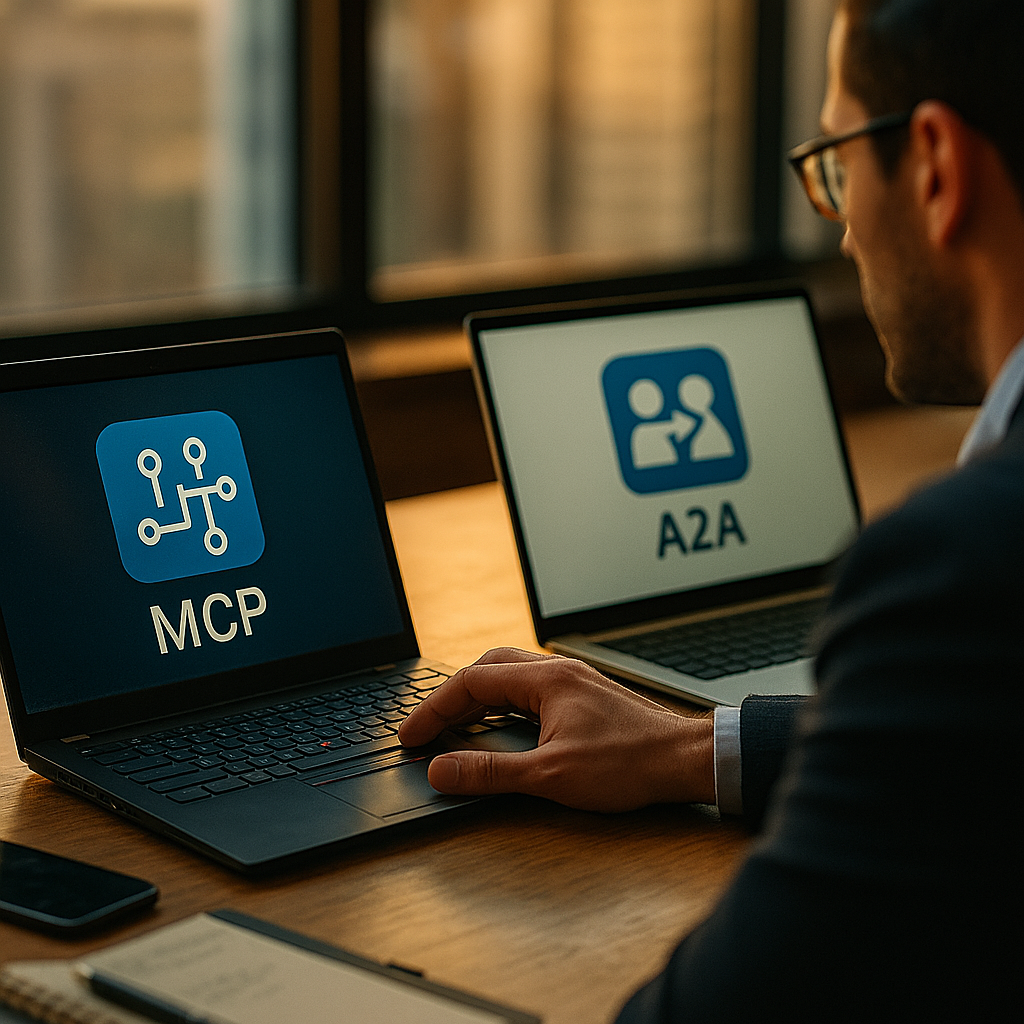
Gartner estimates that by next year, over 40% of agentic AI projects will be scrapped, and a stubborn chunk of those failures will trace back to one root cause: systems that can’t talk to each other. If your marketing stack still treats “integration” as a euphemism for “brittle API and a prayer,” AI model interoperability standards just became the most consequential procurement question you’re not asking.
Two protocols are forcing the issue: Anthropic’s Model Context Protocol (MCP) and Google’s Agent2Agent (A2A). Neither is marketing-specific. Both are about to determine which vendors you can leave and which ones own you.
Why This Matters More Than Your Last Platform Migration
Every CMO has a lock-in scar. Maybe it was a CDP that made data export a six-month professional services engagement. Maybe it was a creator platform that buried attribution data behind a proprietary dashboard with no export function. Vendor lock-in isn’t new. What’s new is the scale of the problem once you plug agentic AI into the stack.
Here’s the shift: agentic marketing tools don’t just store your data, they act on it. An AI agent inside your CDP might trigger a campaign brief, hand it to a creator-matching agent, which hands results to an attribution agent, which reports back to a budget-allocation agent. That’s four vendors, potentially four different AI architectures, and zero guarantee they can pass context between each other without a custom integration team on retainer.
Lock-in used to mean you couldn’t export your data. In an agentic stack, lock-in means your AI agents can’t even talk to each other without a six-figure integration contract.
That’s the practical stake behind MCP and A2A. They’re attempts to standardize how AI agents share context and delegate tasks, the same way HTTP standardized how browsers talk to servers. If they succeed, switching vendors gets cheaper. If they fail, or if vendors implement them selectively, you get lock-in with a compliance-friendly logo slapped on it.
What MCP and A2A Actually Do (No, Really)
Skip the vendor decks for a second. Model Context Protocol, introduced by Anthropic and now backed by OpenAI, Google DeepMind, and Microsoft, standardizes how an AI model pulls in external context: your CRM records, your product catalog, your brand guidelines document. Think of MCP as a universal adapter for feeding data into a model, regardless of which LLM sits underneath.
Agent2Agent, originally a Google initiative now under the Linux Foundation, solves a different problem: how one AI agent hands off a task to another AI agent, potentially built by a different vendor on a different architecture. A2A is less about data access and more about task delegation and negotiation between autonomous systems.
Put them together and you get the theoretical foundation for a marketing stack where your creator CRM’s agent, your CDP’s agent, and your ad platform’s agent can all cooperate without a proprietary middleware layer built by whoever sold you the most expensive contract.
That’s the promise. The reality, as always, is messier.
The Gap Between Protocol Support and Real Interoperability
Every martech vendor with a pulse is now claiming “MCP-compatible” or “A2A-ready” on their homepage. Treat that language the way you’d treat “AI-powered” circa two years ago: as marketing copy until proven otherwise.
Supporting a protocol at the SDK level is not the same as exposing the functionality your team actually needs. A vendor can implement MCP just enough to pull in read-only context while blocking write access, which quietly preserves lock-in on the exact workflows that matter, like campaign execution or budget reallocation.
This is the same pattern we’ve seen with data portability claims before. Our interoperability audit framework exists precisely because vendor claims and vendor behavior diverge often enough that “trust but verify” should be your default procurement posture, not an exception.
Ask vendors these questions before signing anything:
- Which specific functions are exposed via MCP or A2A, and which remain proprietary?
- Can a competing vendor’s agent initiate a task in your system, or only receive data from it?
- What happens to agent-generated workflows and automation rules if we migrate off your platform?
- Is protocol support native, or bolted on through a third-party wrapper that could break on the next update?
If the answers are vague, that’s your answer.
Where Lock-In Actually Hides in an Agentic Stack
Lock-in risk in AI model interoperability standards doesn’t show up where most procurement teams look. It’s rarely in the pricing page. It’s buried in three specific layers.
Context lock-in
If your CDP’s AI agent has spent 18 months learning your customer segments, purchase patterns, and campaign history, that learned context often doesn’t transfer cleanly to a new vendor, even with full data export. The model’s internal representation of your business is proprietary, whether the vendor admits it or not. This is arguably a bigger risk than the old-school “our export format is a mess” problem. Our piece on identity resolution rebuilds for AI shopping agents gets into how disruptive this becomes when the underlying identity graph has to be rebuilt from scratch.
Workflow lock-in
Agentic automations, the multi-step campaigns your team built inside a platform like Klaviyo Composer or Salesforce Agentforce, are logic chains. Even with a standard protocol for agent-to-agent handoffs, the business logic encoded in those workflows is vendor-specific. Our comparison of Klaviyo Composer and Salesforce Agentforce is a useful reference point if you’re weighing exactly this tradeoff for email and SMS orchestration.
Governance lock-in
This is the sleeper risk. If your compliance team has spent a year building approval workflows, brand-safety guardrails, and audit trails around one vendor’s AI governance model, ripping that out is expensive regardless of protocol support. Interoperability standards say nothing about whether your new vendor’s guardrails meet the same regulatory bar, particularly relevant as FTC disclosure requirements and UK ICO guidance tighten around automated decision-making in advertising.
Protocol compatibility solves the plumbing problem. It does not solve the governance, context, or workflow debt you accumulate the longer you stay with a single vendor.
What This Means for CDP and CRM Selection Right Now
If you’re currently evaluating a CDP or agentic CRM, and given how fast this category is moving, you probably are, interoperability standards should be a top-three scoring criterion, not an afterthought buried in the technical appendix.
Look at how Databricks CustomerLake stacks up against Segment and Tealium, or against Salesforce Agentforce, on this exact dimension. Our breakdowns of CustomerLake versus Segment and Tealium and CustomerLake versus Salesforce Agentforce on attribution both flag interoperability gaps that don’t show up until you’re deep into a proof-of-concept.
The same scrutiny applies to CRM selection generally. Our agentic CRM readiness comparison of Salesforce, HubSpot, and Zoho found meaningful variance in how openly each platform exposes agent-to-agent task delegation versus keeping it behind a proprietary orchestration layer.
For mid-market teams without the budget to run a six-month interoperability audit, the calculus is different. Our analysis of vertical ML models versus general CDPs is a useful gut check on when smaller, purpose-built tools are lower lock-in risk simply because their scope is narrower and their data model is less entangled with a vendor’s proprietary AI stack.
Build a Contract, Not Just a Checklist
Protocol support belongs in the SLA, not just the sales pitch. Specific clauses worth pushing for:
- Data and context portability guarantees, with defined timelines and formats, not “reasonable efforts.”
- Protocol version commitments. MCP and A2A are both evolving fast. Lock in what happens if the vendor lags behind a major spec update.
- Audit rights to independently verify claimed interoperability, rather than taking a spec sheet at face value.
- Exit-cost transparency, specifically around rebuilding agentic workflows and governance rules on a new platform.
Procurement teams that treat this like a standard SaaS contract are going to get burned. Enterprise buyers have gotten reasonably sophisticated about data portability clauses over the past decade, largely thanks to GDPR pressure. AI agent portability needs the same rigor, applied fast, because the market isn’t waiting. According to eMarketer, AI-driven marketing automation spend is climbing at a pace that outstrips most organizations’ governance maturity, which is exactly the gap vendors are counting on.
The Realistic Timeline
Don’t expect full interoperability by next quarter. MCP is roughly two years old as a spec; A2A is younger still. Standards bodies move slower than vendor marketing claims, and that gap is where risk lives.
The pragmatic approach: treat any current “interoperability” claim as directional, not guaranteed. Build contracts and architecture decisions that assume partial compliance today, with room to tighten requirements as the protocols mature. Teams building attribution models across creator and CRM data, as covered in our piece on triangulating creator ROI with AI-powered MMM and MTA, are already running into this exact seam between vendors that claim interoperability and vendors that deliver it.
None of this means avoid AI-native platforms. It means negotiate like the lock-in risk is real, because it is, and because the vendors selling you these tools know it better than you do.
Next step: before your next martech renewal or RFP, run a protocol-specific audit, ask each vendor for a live demo of agent-to-agent handoff with a competitor’s tool, not a slide about “planned support.” If they can’t show it, price the lock-in risk into your contract terms now.
Frequently Asked Questions
What is the difference between MCP and A2A?
Model Context Protocol (MCP) standardizes how an AI model accesses external data and context, like CRM records or product catalogs. Agent2Agent (A2A) standardizes how separate AI agents, potentially from different vendors, delegate tasks and communicate with each other. MCP is about feeding a model information; A2A is about agents cooperating on a task.
Does supporting MCP or A2A eliminate vendor lock-in?
No. Protocol support addresses data and task-handoff plumbing, but lock-in also lives in learned context, custom workflow logic, and governance rules built around a specific vendor’s platform. A vendor can technically support a protocol while still making meaningful migration difficult.
How do I verify a vendor’s interoperability claims before signing a contract?
Ask for a live demonstration of agent-to-agent handoff with a third-party or competitor tool, not a roadmap slide. Request documentation on which specific functions are exposed via the protocol versus kept proprietary, and push for audit rights written into the contract.
Which martech categories are most exposed to this lock-in risk?
CDPs, agentic CRMs, and creator/campaign management platforms carry the highest exposure because they accumulate proprietary context and workflow logic over time. The longer an AI agent operates inside one of these systems, the more expensive it becomes to replicate that context elsewhere, regardless of protocol compliance.
Is it worth waiting for these standards to mature before adopting agentic AI tools?
Waiting entirely isn’t practical given competitive pressure, but buyers should treat current interoperability claims as partial and negotiate contracts accordingly, with clear portability guarantees, audit rights, and defined exit costs built in now rather than assumed later.
Top Influencer Marketing Agencies
The leading agencies shaping influencer marketing in 2026
Agencies ranked by campaign performance, client diversity, platform expertise, proven ROI, industry recognition, and client satisfaction. Assessed through verified case studies, reviews, and industry consultations.
Moburst

-
2

The Shelf
Boutique Beauty & Lifestyle Influencer AgencyA data-driven boutique agency specializing exclusively in beauty, wellness, and lifestyle influencer campaigns on Instagram and TikTok. Best for brands already focused on the beauty/personal care space that need curated, aesthetic-driven content.Clients: Pepsi, The Honest Company, Hims, Elf Cosmetics, Pure LeafVisit The Shelf → -
3

Audiencly
Niche Gaming & Esports Influencer AgencyA specialized agency focused exclusively on gaming and esports creators on YouTube, Twitch, and TikTok. Ideal if your campaign is 100% gaming-focused — from game launches to hardware and esports events.Clients: Epic Games, NordVPN, Ubisoft, Wargaming, Tencent GamesVisit Audiencly → -
4

Viral Nation
Global Influencer Marketing & Talent AgencyA dual talent management and marketing agency with proprietary brand safety tools and a global creator network spanning nano-influencers to celebrities across all major platforms.Clients: Meta, Activision Blizzard, Energizer, Aston Martin, WalmartVisit Viral Nation → -
5

The Influencer Marketing Factory
TikTok, Instagram & YouTube CampaignsA full-service agency with strong TikTok expertise, offering end-to-end campaign management from influencer discovery through performance reporting with a focus on platform-native content.Clients: Google, Snapchat, Universal Music, Bumble, YelpVisit TIMF → -
6

NeoReach
Enterprise Analytics & Influencer CampaignsAn enterprise-focused agency combining managed campaigns with a powerful self-service data platform for influencer search, audience analytics, and attribution modeling.Clients: Amazon, Airbnb, Netflix, Honda, The New York TimesVisit NeoReach → -
7

Ubiquitous
Creator-First Marketing PlatformA tech-driven platform combining self-service tools with managed campaign options, emphasizing speed and scalability for brands managing multiple influencer relationships.Clients: Lyft, Disney, Target, American Eagle, NetflixVisit Ubiquitous → -
8

Obviously
Scalable Enterprise Influencer CampaignsA tech-enabled agency built for high-volume campaigns, coordinating hundreds of creators simultaneously with end-to-end logistics, content rights management, and product seeding.Clients: Google, Ulta Beauty, Converse, AmazonVisit Obviously →