


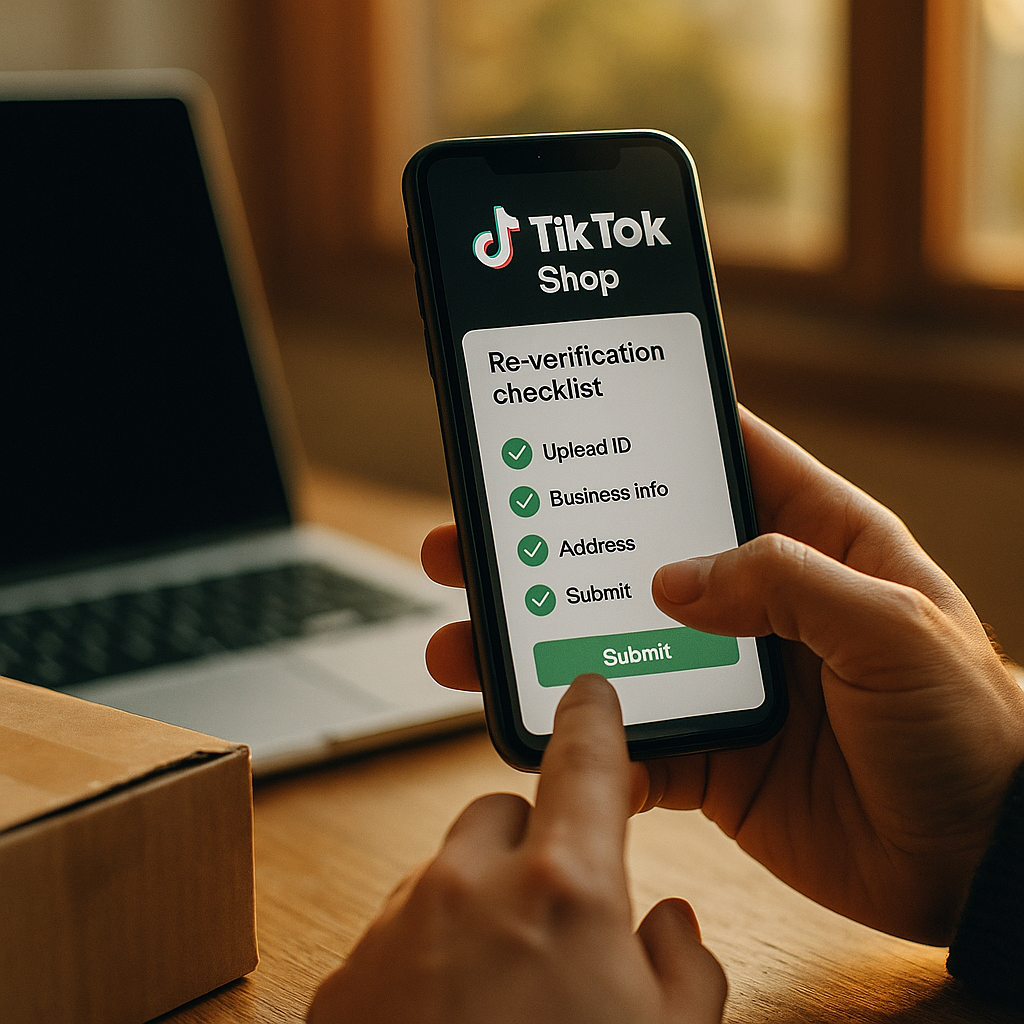
Roughly 18% of merchant re-verification requests get flagged on the first submission, according to internal seller-support data circulating among TikTok Shop agency partners. Most of those flags trace back to one thing: a business entity name that doesn’t match across documents. The TikTok Shop compliance checklist you need for the upcoming Q1 re-verification cycle isn’t complicated, but it is unforgiving. Get the paperwork wrong and your listings go dark before you even get a warning.
Why This Cycle Is Different
TikTok Shop has run verification sweeps before. But the Q1 cycle marks the first full pass under the platform’s tightened seller-identity framework, rolled out after a wave of counterfeit and drop-ship enforcement actions last year. The company has been public about wanting to reduce “identity laundering,” where sellers rotate LLCs to dodge strikes. That means the algorithm checking your paperwork is now cross-referencing entity names against tax IDs, bank account holders, and even historical shop names tied to the same device fingerprint or business license number.
If you run multiple storefronts, or if your brand has been through a rebrand, merger, or holding-company restructure in the last two years, this is not a formality. It’s a real risk to revenue continuity.
A single mismatched suffix — “LLC” versus “Inc.” versus no suffix at all — is enough to trigger a manual review queue that can take TikTok Shop’s trust team two to four weeks to clear.
The Entity Name Trap
Here’s the part that catches even well-run brands off guard: TikTok Shop doesn’t just check that your entity name exists. It checks that it matches, character for character, across every document you upload. Your business license might say “Bright Path Commerce LLC.” Your bank statement might say “Bright Path Commerce.” Your tax filing might abbreviate it as “Bright Path Comm LLC.” To a human, these are obviously the same company. To TikTok’s automated matching layer, they’re three different entities, and that discrepancy alone can trigger a listing freeze.
This is where agencies and in-house teams lose weeks they didn’t budget for. Nobody plans for a freeze caused by a typo in a decade-old filing. But it happens constantly, especially with brands that have gone through DBA changes, franchise structures, or multi-country incorporation.
What Actually Gets Flagged
- Suffix mismatches: LLC, Inc., Ltd., Corp — inconsistent use across documents is the single most common trigger.
- Abbreviated vs. full legal names: “Intl” vs. “International,” “Mfg” vs. “Manufacturing.”
- Address drift: A registered agent address that differs from your operating address without a filed amendment on record.
- Beneficial ownership gaps: Ownership listed on your business license doesn’t match the individual verified via ID upload.
- Stale registrations: Business licenses or certificates older than the renewal window your local jurisdiction requires.
- Bank account holder mismatch: Payout account registered under a parent company name, not the storefront’s legal entity.
Any one of these can be enough. Combine two or three, and you’re not looking at a quick fix — you’re looking at an appeal process that competes for attention with thousands of other Q1 submissions.
The Pre-Submission Checklist
Treat this like an audit, not paperwork. Pull every document into one folder before you touch the re-verification portal.
- Standardize the legal name everywhere. Pick the exact string as it appears on your most recent business registration. Use it verbatim on your bank documents, tax forms, and TikTok Shop seller profile. No abbreviations, no shorthand.
- Confirm business license currency. Renew anything expiring within the next two quarters now, not after a freeze notice lands. Re-verification windows don’t pause for renewal processing times.
- Reconcile bank account ownership. If your payout account is held by a parent company or payment processor subsidiary, get a notarized letter linking that entity to your storefront’s legal name. TikTok Shop’s trust team increasingly asks for this proactively.
- Audit beneficial ownership records. Match the individual named as beneficial owner against the government ID uploaded during onboarding. Ownership changes from funding rounds or buyouts need updated documentation, not just a mental note.
- Screenshot your current shop settings. Before you submit anything, capture your existing verified status, business category, and entity name as currently displayed. If a freeze happens, this is your baseline for the appeal.
- Cross-check multi-storefront consistency. If you operate more than one TikTok Shop under related entities, verify none of them share a tax ID or bank account without proper disclosure. Undisclosed shared ownership is a common flag for “shop farming” suspicion.
This isn’t glamorous work. But it’s the difference between a smooth re-verification and a six-week revenue gap during what’s typically a slower sales quarter anyway — which makes the timing worse, not better, for recovery.
What Happens If You Get Flagged Anyway
Even clean operators get flagged sometimes. TikTok Shop’s matching system isn’t perfect, and false positives happen. If your listings freeze:
- Don’t resubmit identical documents hoping for a different outcome. Fix the specific mismatch first.
- Request the specific rejection reason through seller support rather than assuming. TikTok Shop’s freeze notices are often vague by design; the detailed reason usually requires a direct support ticket.
- Escalate through your TikTok Shop Partner (TSP) agency if you have one — agency-tier accounts often get faster queue placement than direct merchant submissions.
- Keep selling through other channels during the freeze. Don’t let a TikTok Shop pause become a full revenue pause; redirect creator content and affiliate links to your DTC site or Amazon storefront in the interim.
Brands running high-volume TikTok Shop livestream selling programs are especially exposed here, since a freeze mid-campaign doesn’t just pause listings — it can strand paid creator partnerships that were built around a live shopping event.
Documentation Standards, Not Suggestions
TikTok Shop’s help center language uses soft phrasing — “we recommend,” “documents should generally match.” Don’t read that as flexibility. In practice, the review system treats mismatches as binary fail states more often than the language suggests. Treat every “recommend” as a requirement, because the automated layer doing first-pass review doesn’t apply human judgment to near-matches.
This mirrors a pattern seen across UGC and creator marketplace compliance generally: platforms write policy language loosely, then enforce it strictly through automation. The same dynamic shows up in how TikTok’s branded-content disclosure tools work — the toggle looks like compliance, but it isn’t a substitute for actual FTC-level disclosure practice. Merchant verification is the same story: the interface makes it look procedural, but the underlying standard is stricter than it appears.
If your legal team hasn’t reviewed your entity documentation since your last funding round or rebrand, assume it’s out of sync. The cost of checking is an afternoon. The cost of not checking is a Q1 revenue freeze.
Where This Intersects With Broader Compliance Risk
Entity verification doesn’t exist in isolation. Brands juggling multiple creator-marketplace obligations — data processing agreements, disclosure rules, cross-border tax handling — are more likely to have entity-name drift because different teams manage different vendor relationships. If your data processing addendum with a UGC marketplace lists a different legal entity than your TikTok Shop registration, that’s not just a TikTok problem. It’s a signal your corporate documentation hygiene needs a broader audit, possibly touching your creator contract stack too.
For brands operating across multiple markets, the entity-matching problem compounds. A US LLC selling through a UK subsidiary needs separate, internally consistent documentation sets for each storefront, not a single set stretched across jurisdictions. This is the same friction point covered in cross-border disclosure work generally — see the cross-border disclosure matrix for how FTC, ASA, and DSA rules already demand this kind of jurisdiction-specific precision.
Industry data backs up why platforms are tightening here. eMarketer estimates social commerce sales continue climbing double digits year over year, and with volume comes fraud incentive. TikTok isn’t verifying entity names for fun — it’s responding to a real enforcement gap that regulators, not just platform trust teams, have started scrutinizing more closely.
Building a Repeatable Process
One-time fixes don’t solve a recurring problem. TikTok Shop has signaled re-verification cycles will happen more frequently going forward, not less. Build an internal quarterly checklist now:
- Assign one owner (legal ops, not marketing) for entity documentation accuracy.
- Store a single “source of truth” document with the exact legal name, address, and tax ID string to be used across every platform registration.
- Calendar business license renewal dates 90 days ahead, not 30.
- Review beneficial ownership records after every funding event, acquisition, or leadership change.
This kind of documentation discipline pays off beyond TikTok Shop too. Brands managing multiple commerce platform vetting processes or running affiliate programs governed by data minimization policies already know that entity consistency is foundational infrastructure, not busywork.
Need a sanity check on your documentation before submission? Cross-reference guidance from the FTC on business entity disclosure standards, and consult your registered agent for a certified copy of your current filing — it’s the cheapest insurance you’ll buy this quarter.
The Bottom Line
Pull your documents this week, not the week the re-verification notice lands. Standardize your legal entity name across every filing, bank record, and platform profile, and assign a single owner accountable for keeping it that way before Q1 closes out.
FAQs
What triggers a TikTok Shop listing freeze during re-verification?
The most common trigger is a mismatch in your business entity name across documents — business license, bank statement, and tax filing all need to display the exact same legal name, including suffixes like LLC or Inc.
How long does a TikTok Shop verification freeze typically last?
Manual review queues have historically taken two to four weeks to clear, though this varies based on submission volume and whether you escalate through a TikTok Shop Partner agency versus direct merchant support.
Can I keep selling on other channels while my TikTok Shop listings are frozen?
Yes. A TikTok Shop freeze only affects that storefront. Brands should redirect creator content, affiliate links, and paid campaigns to DTC sites or other marketplaces during the freeze to minimize revenue disruption.
Does a business rebrand or LLC restructure automatically trigger re-verification issues?
Not automatically, but it significantly raises the risk. Any change to your legal entity name, ownership structure, or registered address needs to be reflected consistently across all TikTok Shop documentation before the next re-verification cycle.
Who should own entity documentation accuracy inside a brand?
Legal ops or compliance teams should own it, not marketing. Entity name consistency is a corporate records issue, and treating it as a marketing task is why many brands miss mismatches until a freeze notice arrives.
Top Influencer Marketing Agencies
The leading agencies shaping influencer marketing in 2026
Agencies ranked by campaign performance, client diversity, platform expertise, proven ROI, industry recognition, and client satisfaction. Assessed through verified case studies, reviews, and industry consultations.
Moburst

-
2

The Shelf
Boutique Beauty & Lifestyle Influencer AgencyA data-driven boutique agency specializing exclusively in beauty, wellness, and lifestyle influencer campaigns on Instagram and TikTok. Best for brands already focused on the beauty/personal care space that need curated, aesthetic-driven content.Clients: Pepsi, The Honest Company, Hims, Elf Cosmetics, Pure LeafVisit The Shelf → -
3

Audiencly
Niche Gaming & Esports Influencer AgencyA specialized agency focused exclusively on gaming and esports creators on YouTube, Twitch, and TikTok. Ideal if your campaign is 100% gaming-focused — from game launches to hardware and esports events.Clients: Epic Games, NordVPN, Ubisoft, Wargaming, Tencent GamesVisit Audiencly → -
4

Viral Nation
Global Influencer Marketing & Talent AgencyA dual talent management and marketing agency with proprietary brand safety tools and a global creator network spanning nano-influencers to celebrities across all major platforms.Clients: Meta, Activision Blizzard, Energizer, Aston Martin, WalmartVisit Viral Nation → -
5

The Influencer Marketing Factory
TikTok, Instagram & YouTube CampaignsA full-service agency with strong TikTok expertise, offering end-to-end campaign management from influencer discovery through performance reporting with a focus on platform-native content.Clients: Google, Snapchat, Universal Music, Bumble, YelpVisit TIMF → -
6

NeoReach
Enterprise Analytics & Influencer CampaignsAn enterprise-focused agency combining managed campaigns with a powerful self-service data platform for influencer search, audience analytics, and attribution modeling.Clients: Amazon, Airbnb, Netflix, Honda, The New York TimesVisit NeoReach → -
7

Ubiquitous
Creator-First Marketing PlatformA tech-driven platform combining self-service tools with managed campaign options, emphasizing speed and scalability for brands managing multiple influencer relationships.Clients: Lyft, Disney, Target, American Eagle, NetflixVisit Ubiquitous → -
8

Obviously
Scalable Enterprise Influencer CampaignsA tech-enabled agency built for high-volume campaigns, coordinating hundreds of creators simultaneously with end-to-end logistics, content rights management, and product seeding.Clients: Google, Ulta Beauty, Converse, AmazonVisit Obviously →