


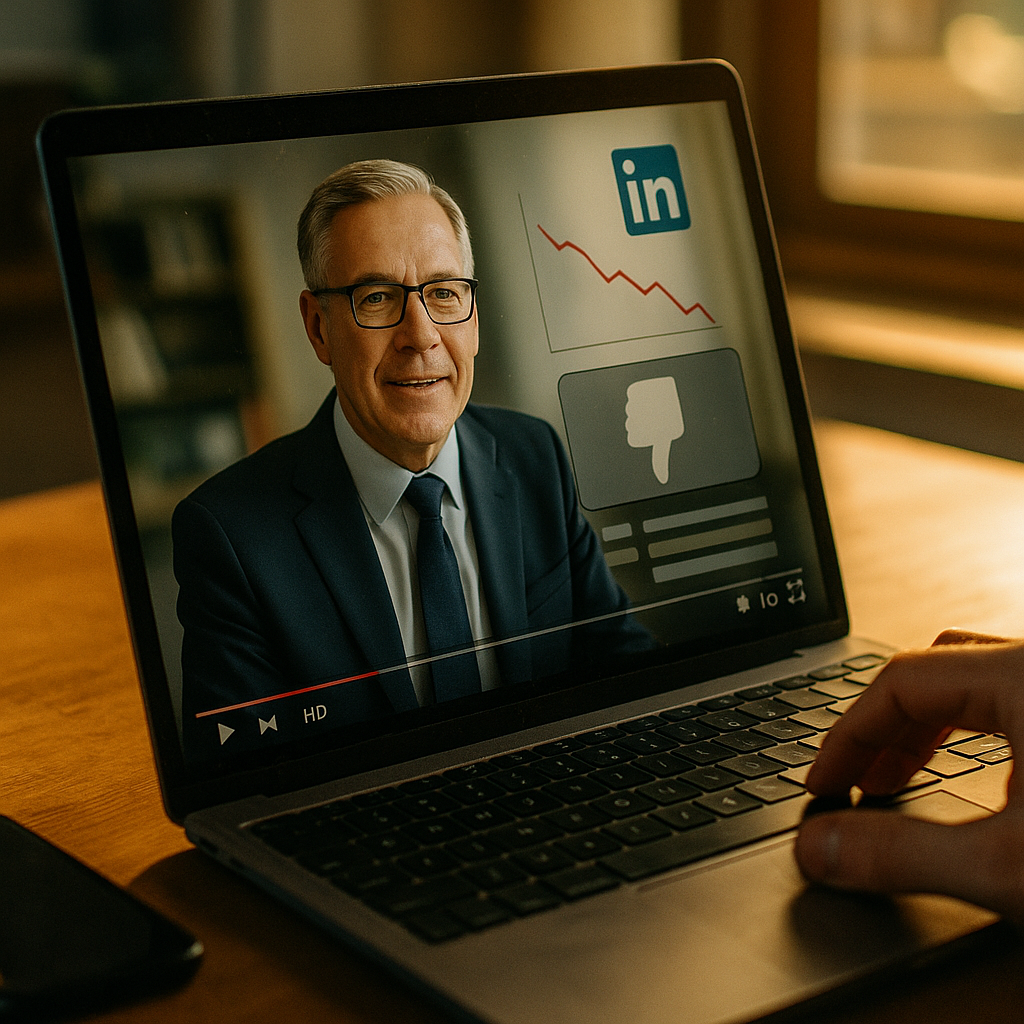
LinkedIn now pushes short-form video to 42% more feed real estate than it did a year ago — and most B2B marketing teams are still uploading glorified webinar clips into a feed that no longer wants them. That’s the primary keyword problem here: LinkedIn’s content-ranking overhaul for short-form video has quietly rewritten the rules for executive talking-head clips, and brands that haven’t adjusted their format are getting buried.
This isn’t a minor tweak. It’s a structural shift in how the platform scores watch time, replay behavior, and “dwell after skip” signals for vertical and square video under 90 seconds. If your executive content still looks like a trimmed keynote, you’re optimizing for a ranking system that stopped existing months ago.
What Actually Changed in the Ranking Model
LinkedIn has been public about leaning harder into video as a feed format, following the same playbook TikTok and Instagram Reels used to train algorithms on completion and re-watch data rather than likes and shares. The difference: LinkedIn’s professional graph means it’s scoring video against a smaller, higher-intent audience pool. That makes early engagement signals disproportionately powerful.
Three things now matter more than they did before:
- Three-second retention — the platform decides within the first few seconds whether to keep feeding your clip to adjacent audiences.
- Completion rate relative to length — a 45-second clip watched to 80% now outperforms a 3-minute clip watched to 30%, even if total watch-time seconds are similar.
- Comment quality, not comment volume — LinkedIn’s spam and engagement-bait detection has gotten stricter, so “great insight!” comment pods do less than they used to.
This mirrors what’s happened on other platforms recently. YouTube’s Shorts algorithm now rewards retention over volume, and TikTok’s watch-time model has forced media buyers to rethink pacing entirely, as covered in our breakdown of the TikTok watch-time algorithm shift. LinkedIn is simply the latest major platform to converge on retention-first scoring — but it’s applying it to a B2B audience that behaves very differently from a consumer scroll.
LinkedIn is not asking “did this get views.” It’s asking “did this hold a professional’s attention long enough to prove relevance,” and it’s doing that math inside the first five seconds.
Why Talking-Head Clips Are the Format Under Pressure
Executive talking-head video is the backbone of most B2B thought-leadership programs. CEOs and CMOs record a hot take, marketing chops it into a 60-90 second clip, and it goes out with a caption pulled from the transcript. That workflow used to be enough. It isn’t anymore.
Here’s the uncomfortable truth: most talking-head clips fail the new ranking model in the first three seconds. An executive sitting behind a desk, mid-sentence, with no visual hook, reads as “meeting recording” to both the algorithm and the human thumb. LinkedIn’s system doesn’t know your CEO is saying something insightful. It only knows whether people stopped scrolling.
The fix isn’t abandoning executive video — it’s restructuring the clip so the first frame, first line, and first five seconds do more work than they used to.
The Hook Has to Arrive Before the Context
Most executive clips open with setup: “So I was talking to a customer last week and they mentioned…” That’s a completion-rate killer. The new playbook demands the claim or tension up front — the thing that makes someone stop — with context filled in afterward. Think of it as writing the headline of the video before you write the article.
A useful structural template for talking-head clips built for this ranking model:
- 0-3 seconds: A contrarian claim, a surprising number, or a direct question aimed at the viewer’s job title.
- 3-15 seconds: One sentence of context — who this affects and why it matters now.
- 15-45 seconds: The core insight, delivered in plain language, ideally with one concrete example or data point.
- 45-60 seconds: A specific, non-generic takeaway or a soft challenge to the viewer’s current approach.
Notice what’s missing: no “hi everyone,” no logo bumper, no slow zoom-in intro. Every second before the hook is a second LinkedIn uses to decide you’re skippable.
On-Screen Text Isn’t Optional Anymore
A huge share of LinkedIn video consumption happens with sound off, particularly during work hours when people are scrolling between meetings. If your executive clip relies entirely on spoken audio with no captions or text overlay, you’re losing a meaningful chunk of the completion-rate math before the message even lands.
Burned-in captions matter, but so does using on-screen text strategically — pulling out the single most quotable line and displaying it as a bold overlay for 2-3 seconds at the exact moment it’s spoken. This does double duty: it reinforces the hook visually and gives screenshot-and-share behavior something to latch onto, which LinkedIn’s algorithm reads as a strong relevance signal.
It’s the same logic driving the redesign of hook pacing across short-form platforms generally. Our piece on redesigning hooks and pacing for accelerated viewing covers similar ground, though LinkedIn’s audience skews toward silent, at-desk consumption rather than mobile-first sound-on scrolling.
Length, Cadence, and the Myth of “Go Longer for Authority”
There’s a persistent belief among B2B marketers that executive video needs to run long to convey authority — three, four, five minutes of unbroken monologue to prove depth. The ranking data doesn’t support that anymore.
LinkedIn’s own guidance to advertisers has increasingly emphasized shorter completion-friendly formats, echoing what LinkedIn’s business platform has published about video engagement benchmarks. Clips in the 30-75 second range are consistently outperforming longer executive monologues on completion rate, which is now the dominant ranking input.
That doesn’t mean long-form has no place. Longer, unscripted formats still build trust in a different way — our analysis of long-form video and livestreams building brand trust makes the case for keeping both in rotation. But if the goal is distribution inside the LinkedIn feed itself, shorter, tighter, hook-first clips are what the current model rewards.
Cadence matters too. Posting one polished executive clip a month gets outcompeted by three rougher, well-structured clips a week. LinkedIn’s ranking system, like most social algorithms, favors accounts that give it a consistent stream of data to learn from. Sparse posting starves the algorithm of signal, and it defaults to caution.
Compliance and Brand Risk in Executive Video
Faster, more frequent executive video also raises the compliance stakes. When an exec is recording multiple short clips a week, off-the-cuff, the odds of an unscripted claim about performance, pricing, or competitors creep up. Legal and comms teams should have a lightweight review checklist — not a full approval chain, which kills the spontaneity that makes these clips work, but a fast pre-post scan for forward-looking statements, comparative claims, or anything that could be read as investment guidance.
This is especially relevant for regulated industries — financial services, healthcare, and public companies near earnings windows. A five-minute compliance pass before publishing is far cheaper than a retraction after a clip gets algorithmic distribution and reaches thousands of unintended viewers. Executives doing public-facing formats like this should take a page from prep protocols used for higher-risk formats; our guide on executive prep for unscripted public forums has transferable lessons even though the platform is different.
Pairing Talking-Heads With Other LinkedIn Formats
Talking-head clips shouldn’t operate in isolation. LinkedIn’s ranking system appears to reward accounts that mix formats — video, document carousels, and live sessions — because it signals a genuinely active presence rather than a single-format bot-like posting pattern.
A short talking-head clip making a bold claim pairs naturally with a follow-up document carousel that breaks the claim into a slide-by-slide argument, or a live roundtable where the executive expands on the topic with peers. This kind of format layering extends the life of a single idea across a week of content, and each format feeds a slightly different part of the algorithm’s engagement scoring.
If your brand also runs product-line or division-specific pages, funneling executive video traffic toward relevant showcase pages gives the algorithm a second signal: that the content is driving meaningful profile and page actions, not just passive views.
Measuring What Actually Matters
Vanity metrics still tempt teams here. Reach and impressions look good in a deck, but they don’t tell you whether the ranking model favors your content going forward. Track these instead:
- Average watch percentage — the single strongest proxy for how the algorithm is scoring your clip.
- Re-watch rate — a strong signal of message clarity and hook strength.
- Comment-to-view ratio, filtered for substantive comments, not emoji reactions.
- Follow-through actions — profile visits, page follows, or showcase-page clicks attributable to the video.
Tools like Sprout Social and native LinkedIn analytics both now surface watch-percentage data at the individual post level, which should be the first metric your team reviews after every executive clip goes live, not the last.
Industry benchmarking from sources like eMarketer continues to show B2B video investment climbing even as consumer platforms get more scrutiny, which makes getting the format right on LinkedIn specifically a competitive differentiator rather than a nice-to-have.
Next step: Pull your last ten executive video posts and check the first three seconds of each against the hook-first structure above. If more than half open with setup instead of a claim, that’s your ranking problem — fix the first three seconds before you touch anything else.
Frequently Asked Questions
What is LinkedIn’s content-ranking overhaul for short-form video?
It’s an update to how LinkedIn’s algorithm scores and distributes video content, prioritizing early retention, completion rate relative to video length, and comment quality over raw view counts or likes. Video posted in the 30-75 second range with strong opening hooks is currently favored for distribution.
How long should executive talking-head clips be on LinkedIn now?
Data suggests 30-75 seconds performs best under the current ranking model, since completion rate carries heavy weight. Longer executive monologues can still work for deeper trust-building, but they’re less likely to win algorithmic distribution in the main feed.
Do captions actually affect LinkedIn video ranking?
Yes, indirectly. Captions and on-screen text increase completion rates among sound-off viewers, which is a primary input into how the algorithm scores and distributes a clip. Skipping captions effectively caps your reach among desk-based, silent scrollers.
How often should a brand post executive video content?
Consistency matters more than polish. Multiple shorter, well-structured clips per week tend to outperform one highly produced clip per month, because the algorithm needs a steady stream of engagement data to keep recommending an account’s content.
What compliance risks come with more frequent executive video?
Increased posting frequency raises the chance of unscripted claims about pricing, performance, or competitors slipping into a clip. A fast pre-publish compliance check, rather than a full approval chain, is the practical middle ground for regulated industries.
Frequently Asked Questions
What is LinkedIn’s content-ranking overhaul for short-form video?
It’s an update to how LinkedIn’s algorithm scores and distributes video content, prioritizing early retention, completion rate relative to video length, and comment quality over raw view counts or likes. Video posted in the 30-75 second range with strong opening hooks is currently favored for distribution.
How long should executive talking-head clips be on LinkedIn now?
Data suggests 30-75 seconds performs best under the current ranking model, since completion rate carries heavy weight. Longer executive monologues can still work for deeper trust-building, but they’re less likely to win algorithmic distribution in the main feed.
Do captions actually affect LinkedIn video ranking?
Yes, indirectly. Captions and on-screen text increase completion rates among sound-off viewers, which is a primary input into how the algorithm scores and distributes a clip. Skipping captions effectively caps your reach among desk-based, silent scrollers.
How often should a brand post executive video content?
Consistency matters more than polish. Multiple shorter, well-structured clips per week tend to outperform one highly produced clip per month, because the algorithm needs a steady stream of engagement data to keep recommending an account’s content.
What compliance risks come with more frequent executive video?
Increased posting frequency raises the chance of unscripted claims about pricing, performance, or competitors slipping into a clip. A fast pre-publish compliance check, rather than a full approval chain, is the practical middle ground for regulated industries.
Top Influencer Marketing Agencies
The leading agencies shaping influencer marketing in 2026
Agencies ranked by campaign performance, client diversity, platform expertise, proven ROI, industry recognition, and client satisfaction. Assessed through verified case studies, reviews, and industry consultations.
Moburst

-
2

The Shelf
Boutique Beauty & Lifestyle Influencer AgencyA data-driven boutique agency specializing exclusively in beauty, wellness, and lifestyle influencer campaigns on Instagram and TikTok. Best for brands already focused on the beauty/personal care space that need curated, aesthetic-driven content.Clients: Pepsi, The Honest Company, Hims, Elf Cosmetics, Pure LeafVisit The Shelf → -
3

Audiencly
Niche Gaming & Esports Influencer AgencyA specialized agency focused exclusively on gaming and esports creators on YouTube, Twitch, and TikTok. Ideal if your campaign is 100% gaming-focused — from game launches to hardware and esports events.Clients: Epic Games, NordVPN, Ubisoft, Wargaming, Tencent GamesVisit Audiencly → -
4

Viral Nation
Global Influencer Marketing & Talent AgencyA dual talent management and marketing agency with proprietary brand safety tools and a global creator network spanning nano-influencers to celebrities across all major platforms.Clients: Meta, Activision Blizzard, Energizer, Aston Martin, WalmartVisit Viral Nation → -
5

The Influencer Marketing Factory
TikTok, Instagram & YouTube CampaignsA full-service agency with strong TikTok expertise, offering end-to-end campaign management from influencer discovery through performance reporting with a focus on platform-native content.Clients: Google, Snapchat, Universal Music, Bumble, YelpVisit TIMF → -
6

NeoReach
Enterprise Analytics & Influencer CampaignsAn enterprise-focused agency combining managed campaigns with a powerful self-service data platform for influencer search, audience analytics, and attribution modeling.Clients: Amazon, Airbnb, Netflix, Honda, The New York TimesVisit NeoReach → -
7

Ubiquitous
Creator-First Marketing PlatformA tech-driven platform combining self-service tools with managed campaign options, emphasizing speed and scalability for brands managing multiple influencer relationships.Clients: Lyft, Disney, Target, American Eagle, NetflixVisit Ubiquitous → -
8

Obviously
Scalable Enterprise Influencer CampaignsA tech-enabled agency built for high-volume campaigns, coordinating hundreds of creators simultaneously with end-to-end logistics, content rights management, and product seeding.Clients: Google, Ulta Beauty, Converse, AmazonVisit Obviously →