


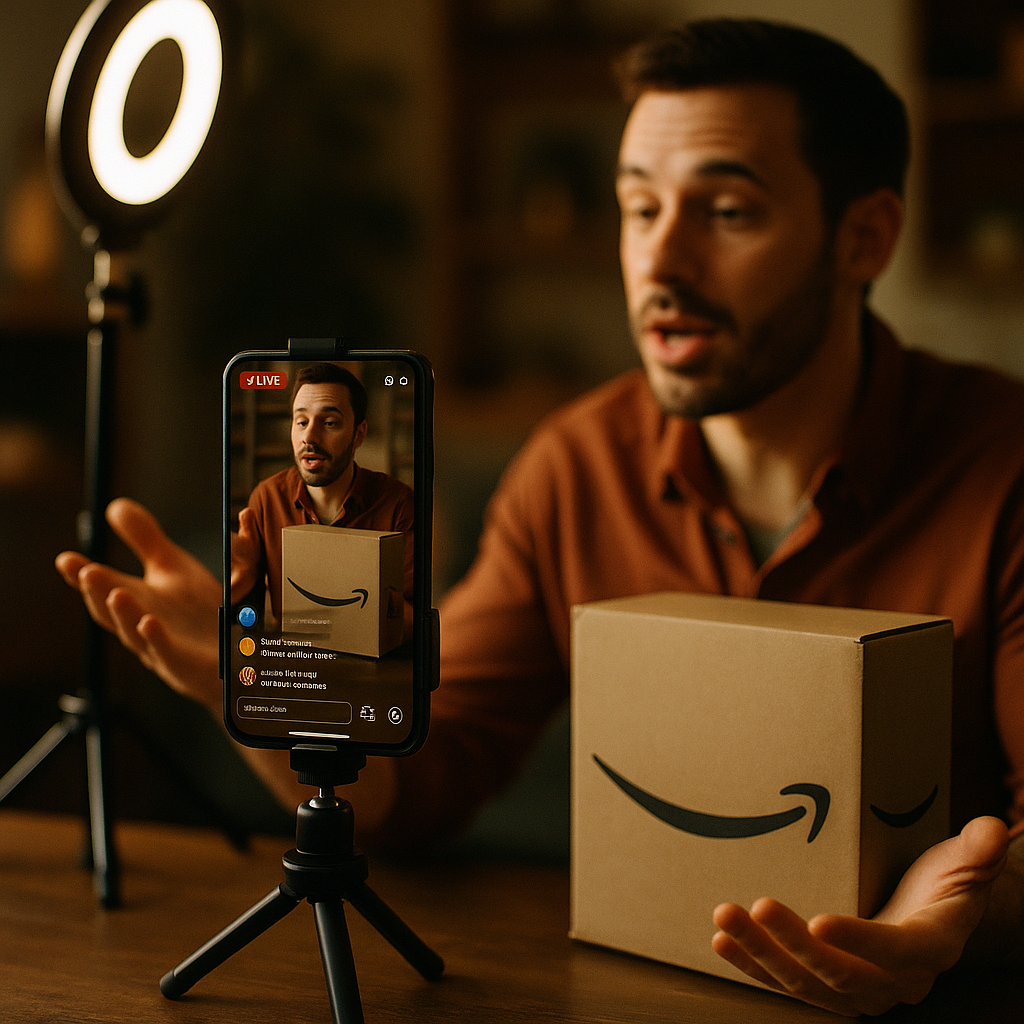
Amazon Live streams now drive checkout sessions in single digit minutes, not days. Brands running Creator Connections segments are seeing add-to-cart rates that outpace static product listings by a wide margin, yet most marketing teams still treat live commerce like an afterthought bolted onto their influencer budget. Amazon Live Creator Connections changes that calculus by putting real-time selling directly inside the marketplace where the purchase already happens. This playbook breaks down how to structure segments, brief creators, and measure results without torching your compliance posture.
What Amazon Live Creator Connections Actually Does
Creator Connections is Amazon’s matchmaking layer between brands and Amazon Live creators. Instead of cold-emailing streamers or hoping an affiliate stumbles onto your ASIN, brands can browse creator profiles, review past stream performance, and invite specific talent to feature products during live segments. The output is a scheduled, trackable broadcast that sits on the product detail page and inside the Amazon Live storefront simultaneously.
Think of it as the marketplace’s answer to TikTok Shop Live, except the audience is already in buy mode. There is no scroll-to-discover step. Shoppers land on a stream because they searched for a product category, and the creator’s job is to close the sale in the window they have.
Why Real-Time Segments Outperform Static Listings
Static PDPs answer questions shoppers already knew to ask. Live segments answer the ones they didn’t think of until they saw the product in use. That’s the entire value proposition of real-time selling: objection handling happens live, on camera, before the shopper bounces to a competitor’s listing.
Brands that run structured, multi-segment Creator Connections campaigns report conversion lifts that traditional sponsored product placements simply cannot match, because live demos compress the consideration phase into minutes instead of days.
According to industry tracking from eMarketer, live shopping continues to grow as a share of total ecommerce spend across major markets, and Amazon’s push into creator-led streaming is a direct response to that trend rather than an experiment. If your competitors haven’t scheduled a segment yet, you have a window. It won’t stay open long.
Segment Structure: The Three-Act Format That Converts
Most high-performing Creator Connections streams follow a loose three-act structure, even when the creator improvises the delivery. Brands that brief against this structure see fewer wasted minutes and higher watch-through rates.
- Hook (first 90 seconds): The creator states the problem the product solves, shows it in use immediately, and flags a limited-time offer or bundle to reward viewers who stay.
- Demonstration and objection handling (middle 8 to 12 minutes): This is where the creator answers live chat questions, compares against alternatives, and shows unboxing or application in real conditions.
- Close (final 2 to 3 minutes): A direct call to action, a recap of the offer, and a reminder that the segment link stays active on the product page after the stream ends.
Brands that skip the close consistently underperform. Viewers who joined mid-stream need the recap, and Amazon’s algorithm rewards streams with strong end-segment engagement when recommending future live content to shoppers.
Briefing Creators Without Killing Authenticity
Here’s the tension every brand faces with live commerce: you want message discipline, but over-scripting kills the spontaneity that makes live streams convert in the first place. The fix isn’t a script. It’s a briefing document that gives creators guardrails, not lines.
A solid Creator Connections brief includes three non-negotiables and leaves the rest to the talent. Cover the required disclosure language, the exact promo code or offer terms, and any claims that legal has flagged as off-limits. Everything else, tone, pacing, personal anecdotes, should stay with the creator. This mirrors the approach brands use in TikTok Shop affiliate programs, where over-controlling creator voice tanks performance even when the product messaging is technically accurate.
If you’re new to Amazon’s live ecosystem generally, it helps to pair this playbook with a deeper look at storefront integration mechanics, since segment success depends heavily on how your storefront is configured before the stream even starts.
Scheduling: When Segments Actually Sell
Timing matters more on Amazon Live than on social platforms, because shoppers are already searching with intent. Evening slots between 7 and 10 p.m. local time consistently outperform daytime streams for household and beauty categories, while weekend afternoon slots do better for hobby and outdoor gear. Test both, but don’t spread your budget too thin across time slots before you have baseline data.
Multi-segment campaigns, three or four shorter streams spread across a week rather than one long broadcast, tend to build cumulative momentum. Amazon’s recommendation engine favors creators with recent, consistent stream activity, so a single one-off segment rarely gets the same discovery boost as a cadence.
Compliance Is Not Optional Here
Live commerce moves fast, which is exactly why compliance teams get nervous about it. Every Creator Connections segment involving paid partnership or free product needs clear, verbal disclosure at the start of the stream, not buried in a chat comment nobody scrolls back to read. The FTC’s endorsement guidelines apply to live video the same way they apply to a static sponsored post, and enforcement has not slowed down.
Build a disclosure checklist into your creator brief and require a screen recording of the opening 60 seconds of every segment for your records. It’s a small operational lift that saves you from a much bigger headache if a segment gets flagged later. Brands managing multiple creator programs across platforms often centralize this kind of documentation the same way they handle it for Shopify Collabs vetting, where paperwork discipline is treated as a program requirement, not a nice-to-have.
Measuring What Actually Matters
Vanity metrics like peak concurrent viewers feel good in a slide deck but tell you almost nothing about revenue impact. Focus your reporting on a shorter list of numbers that connect directly to spend decisions.
- Add-to-cart rate during live window: the clearest early signal a segment is working.
- Post-stream conversion within 24 hours: captures shoppers who watched but purchased later.
- Replay view conversion: Amazon keeps segments live on the PDP after broadcast ends, and replay traffic often converts at a different rate than live traffic.
- Cost per incremental unit: compares segment spend against units sold that wouldn’t have converted from the static listing alone.
Data from Statista on ecommerce conversion benchmarks can give you a rough baseline to compare against, though your own historical PDP conversion rate is always the more honest comparison point. Don’t benchmark against another brand’s public numbers. Benchmark against your own listing’s performance before and after the segment ran.
If you’re running creator programs across multiple platforms simultaneously, reconciling payout and performance data manually becomes a real drag on your team’s time. Brands juggling Amazon Live alongside YouTube or TikTok Shop programs increasingly lean on tools built for cross-platform payout reconciliation just to keep the reporting sane.
Common Mistakes That Quietly Sink Segments
A few patterns show up again and again in underperforming Creator Connections campaigns. First, brands book a creator without checking their recent stream history for category fit, then wonder why a beauty specialist’s audience doesn’t buy kitchen gadgets. Second, teams forget to update inventory buffers before a scheduled segment, and a stream that drives a spike in demand against a thin stock position turns into a customer service problem instead of a win. Third, brands treat the segment as a one-and-done event rather than testing variations in offer structure, hook timing, and creator pairing across multiple attempts.
The brands getting the most out of this format treat live segments the way performance marketers treat ad creative: test, measure, iterate, retire what doesn’t work. Standing platform trends bear this out. According to Sprout Social’s ongoing research into social commerce behavior, shoppers increasingly expect the same real-time responsiveness from brands on shopping platforms that they get on social feeds. Amazon Live is simply where that expectation now shows up inside the marketplace itself.
Frequently Asked Questions
What is Amazon Live Creator Connections?
It’s Amazon’s program that connects brands with Amazon Live creators to run scheduled, live-streamed product demonstrations directly on product detail pages and within the Amazon Live storefront.
How much does it cost to run a Creator Connections segment?
Costs vary by creator reach and negotiated terms, typically structured as a flat fee, a commission on sales driven during the stream, or a hybrid of both. There is no fixed platform rate card published by Amazon.
Do creators need a minimum follower count to join Amazon Live?
No strict minimum exists, though brands typically prioritize creators with demonstrated stream history and category relevance over raw follower counts, since live commerce performance correlates more closely with engagement and past conversion than audience size.
How long should a live selling segment run?
Most effective segments run between 10 and 15 minutes. Shorter streams struggle to build enough objection-handling depth, while longer ones see viewer drop-off that hurts the algorithm’s discovery signals.
What disclosure requirements apply to Amazon Live segments?
Any paid partnership, free product, or affiliate relationship must be disclosed clearly and verbally at the start of the stream, consistent with FTC endorsement guidelines that apply across all commercial video content.
Can brands reuse a live segment after the broadcast ends?
Yes. Amazon keeps completed segments available as replay content on the product detail page, and replay traffic often continues generating conversions well after the original live event.
Next step: pick one SKU with strong PDP traffic but flat conversion, book two creators with different stream histories, and run competing segments over two weeks before committing to a bigger Creator Connections budget.
Frequently Asked Questions
What is Amazon Live Creator Connections?
It’s Amazon’s program that connects brands with Amazon Live creators to run scheduled, live-streamed product demonstrations directly on product detail pages and within the Amazon Live storefront.
How much does it cost to run a Creator Connections segment?
Costs vary by creator reach and negotiated terms, typically structured as a flat fee, a commission on sales driven during the stream, or a hybrid of both. There is no fixed platform rate card published by Amazon.
Do creators need a minimum follower count to join Amazon Live?
No strict minimum exists, though brands typically prioritize creators with demonstrated stream history and category relevance over raw follower counts, since live commerce performance correlates more closely with engagement and past conversion than audience size.
How long should a live selling segment run?
Most effective segments run between 10 and 15 minutes. Shorter streams struggle to build enough objection-handling depth, while longer ones see viewer drop-off that hurts the algorithm’s discovery signals.
What disclosure requirements apply to Amazon Live segments?
Any paid partnership, free product, or affiliate relationship must be disclosed clearly and verbally at the start of the stream, consistent with FTC endorsement guidelines that apply across all commercial video content.
Can brands reuse a live segment after the broadcast ends?
Yes. Amazon keeps completed segments available as replay content on the product detail page, and replay traffic often continues generating conversions well after the original live event.
Top Influencer Marketing Agencies
The leading agencies shaping influencer marketing in 2026
Agencies ranked by campaign performance, client diversity, platform expertise, proven ROI, industry recognition, and client satisfaction. Assessed through verified case studies, reviews, and industry consultations.
Moburst

-
2

The Shelf
Boutique Beauty & Lifestyle Influencer AgencyA data-driven boutique agency specializing exclusively in beauty, wellness, and lifestyle influencer campaigns on Instagram and TikTok. Best for brands already focused on the beauty/personal care space that need curated, aesthetic-driven content.Clients: Pepsi, The Honest Company, Hims, Elf Cosmetics, Pure LeafVisit The Shelf → -
3

Audiencly
Niche Gaming & Esports Influencer AgencyA specialized agency focused exclusively on gaming and esports creators on YouTube, Twitch, and TikTok. Ideal if your campaign is 100% gaming-focused — from game launches to hardware and esports events.Clients: Epic Games, NordVPN, Ubisoft, Wargaming, Tencent GamesVisit Audiencly → -
4

Viral Nation
Global Influencer Marketing & Talent AgencyA dual talent management and marketing agency with proprietary brand safety tools and a global creator network spanning nano-influencers to celebrities across all major platforms.Clients: Meta, Activision Blizzard, Energizer, Aston Martin, WalmartVisit Viral Nation → -
5

The Influencer Marketing Factory
TikTok, Instagram & YouTube CampaignsA full-service agency with strong TikTok expertise, offering end-to-end campaign management from influencer discovery through performance reporting with a focus on platform-native content.Clients: Google, Snapchat, Universal Music, Bumble, YelpVisit TIMF → -
6

NeoReach
Enterprise Analytics & Influencer CampaignsAn enterprise-focused agency combining managed campaigns with a powerful self-service data platform for influencer search, audience analytics, and attribution modeling.Clients: Amazon, Airbnb, Netflix, Honda, The New York TimesVisit NeoReach → -
7

Ubiquitous
Creator-First Marketing PlatformA tech-driven platform combining self-service tools with managed campaign options, emphasizing speed and scalability for brands managing multiple influencer relationships.Clients: Lyft, Disney, Target, American Eagle, NetflixVisit Ubiquitous → -
8

Obviously
Scalable Enterprise Influencer CampaignsA tech-enabled agency built for high-volume campaigns, coordinating hundreds of creators simultaneously with end-to-end logistics, content rights management, and product seeding.Clients: Google, Ulta Beauty, Converse, AmazonVisit Obviously →