


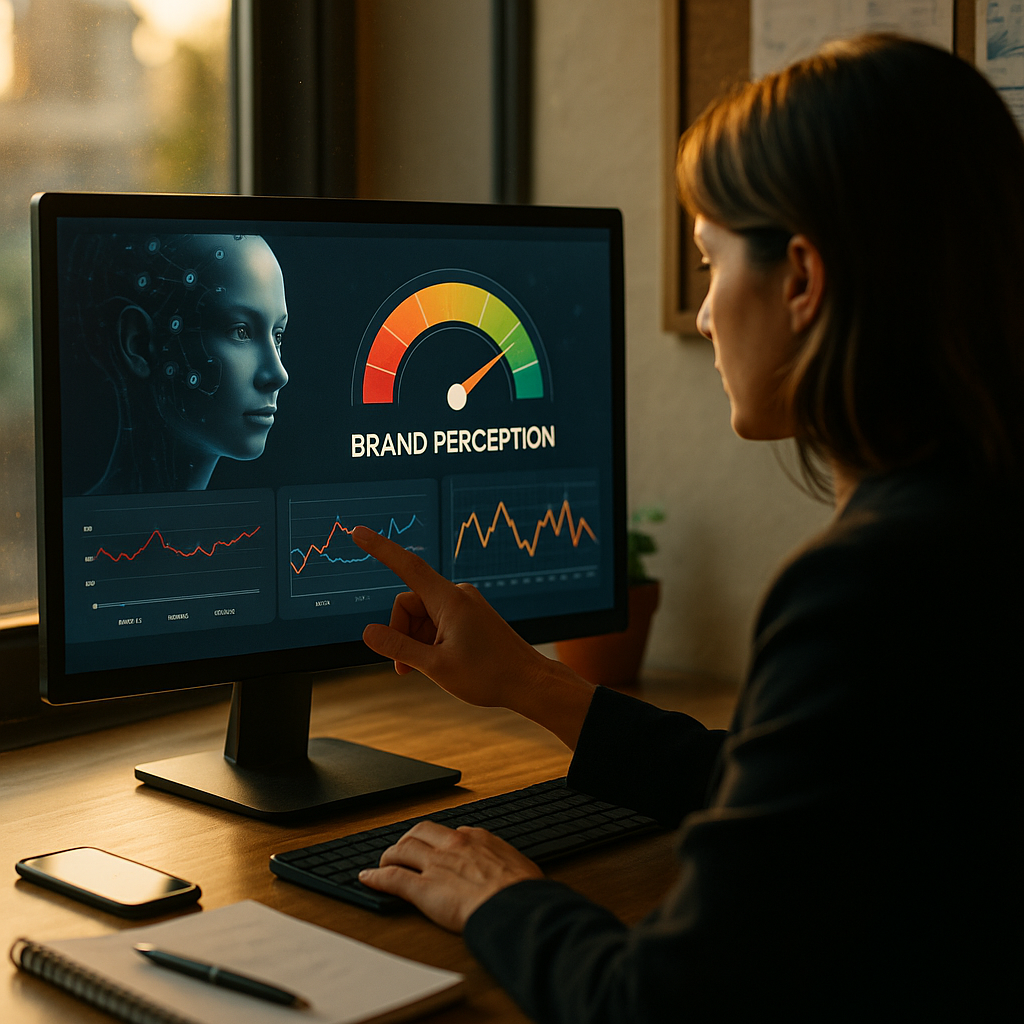
Ask ChatGPT what your brand does, and it might tell your customers something that’s six months out of date, subtly wrong, or borrowed from a competitor’s positioning. AI perception monitoring exists precisely because nobody at your company is watching that conversation happen. Sixty percent of consumers now use AI chatbots to research purchases before they buy. If the model is drifting, your sales pipeline is bleeding quietly.
The Problem Nobody Budgeted For
Marketing teams spent the last decade obsessing over search rankings, social sentiment, and review scores. Those are still relevant. But a new layer sits on top of all of it now: large language models synthesizing your brand identity into a single, confident-sounding paragraph that a prospect reads once and trusts.
The trouble is that LLMs don’t just retrieve facts. They compress, interpolate, and occasionally invent. Ask Claude, Gemini, or ChatGPT to describe your pricing tiers, your return policy, or your flagship product’s key differentiator, and you’ll sometimes get an answer that sounds plausible and is simply wrong. This isn’t a hypothetical edge case — it’s a structural feature of how these systems work, and it’s already reshaping how buyers form first impressions.
Brand drift is what happens when the model’s internal representation of your company diverges from reality, and nobody notices until it shows up in a lost deal or a support ticket referencing a policy that doesn’t exist. Unlike a rogue tweet or a bad review, there’s no notification. No alert. It just sits there, answering thousands of queries a day, quietly misrepresenting you.
If your brand’s LLM answer is wrong today, it will likely still be wrong in three months unless someone actively intervenes — models don’t self-correct on stale training data.
What Brand Drift Actually Looks Like
Drift shows up in a few recognizable patterns. Worth knowing them before you go hunting.
- Feature hallucination: the model invents a product capability you don’t have, based on pattern-matching against competitors.
- Positioning collapse: your carefully differentiated brand gets flattened into “just another CRM” or “similar to X but cheaper.”
- Stale pricing or policy data: the model cites numbers from an old press release long after you’ve updated them.
- Sentiment contamination: a single loud controversy from years back keeps surfacing as the model’s dominant association with your name.
- Attribution errors: the model credits a competitor’s case study, award, or partnership to your brand, or vice versa.
None of these are exotic. They’re the predictable output of models trained on messy, time-lagged web data and fine-tuned toward confident, fluent answers rather than accurate ones. This is the same underlying issue explored in how brands stop AI hallucinations around product claims — except now we’re talking about brand identity itself, not just factual specs.
Why This Is a Sales Problem, Not Just a PR Problem
Here’s the part that should get budget approved faster: buyers are increasingly treating AI answers as a pre-vetting step before they ever talk to sales. B2B research from Gartner and various analyst firms consistently shows self-directed research now dominates the early buying journey. If the model’s summary of your company is inaccurate or unflattering, prospects self-disqualify before your SDR ever gets a chance to correct the record.
You don’t get a rebuttal. You just lose the meeting.
Compare that to the visibility problem that tracking AI citation share addresses — that’s about whether you show up at all. Perception monitoring is the next layer: making sure that when you do show up, what gets said is true and on-brand. Both problems compound each other. Being cited inaccurately can be worse than not being cited.
Building the Internal Protocol
Most companies have zero process for this today. Marketing owns brand voice, IT owns data infrastructure, legal owns compliance risk, and none of them have a mandate to monitor what GPT-5 says about the company on a Tuesday afternoon. That gap is exactly where drift festers.
A workable protocol needs four components, and none of them require a massive team to stand up.
1. Establish a Query Baseline
Pick 20-40 questions a real buyer would plausibly ask an AI assistant about your company: pricing, comparisons to named competitors, product capabilities, refund policy, company reputation, recent controversies. Run them monthly across ChatGPT, Gemini, Claude, and Perplexity. Save the raw outputs. This becomes your drift baseline — the thing you compare future outputs against.
This is tedious manual work at first. Treat it like the early days of rank tracking before tools existed. Somebody has to eyeball the outputs.
2. Score Deviations, Don’t Just Flag Them
Not every inaccuracy matters equally. A wrong founding year is cosmetic. A wrong pricing tier or a fabricated safety claim is a legal and revenue risk. Build a simple severity scale — cosmetic, misleading, materially false — and route each category differently. Materially false claims about pricing or product safety should trigger the same urgency as a factual error in a press release, because functionally, that’s what it is.
The framework echoes what’s already emerging in hallucination rate testing methodology — you’re not just checking if a model is wrong, you’re quantifying how wrong and how often.
3. Trace It to a Source
Drift rarely comes from nowhere. It’s usually traceable to a specific source the model weighted heavily: an outdated Wikipedia edit, a review site with stale info, a competitor’s aggressive SEO content that got scraped into training data, or your own website’s inconsistent messaging across pages. Finding the source matters because it tells you whether you can fix this through content updates, structured data, or whether you’re stuck waiting on the next model refresh cycle.
This is where structured, machine-readable brand facts earn their keep. If your product pages, schema markup, and PR materials all say the same thing in the same language, you reduce the surface area for a model to hallucinate a contradiction. It’s the same logic behind answer engine optimization as brand infrastructure — feeding models clean, consistent, citable facts is cheaper than fighting drift after the fact.
4. Assign Ownership and an Escalation Path
Someone needs to own this the way someone owns social listening or reputation management. In practice, this usually lands with a hybrid team: a marketing ops or brand lead who runs the monitoring cadence, a comms or legal contact for anything materially false, and an SEO/content lead who can push corrective content live fast. Without a named owner, the monthly check either never happens or happens once and gets forgotten.
Treat AI perception monitoring the way you’d treat a security audit: scheduled, documented, and escalated — not an ad hoc Slack thread when someone notices a weird ChatGPT answer.
Tools Are Catching Up, Slowly
A small but growing set of platforms now offer some form of LLM brand visibility tracking — monitoring how often and how accurately a brand appears across AI answer engines. Expect this category to consolidate fast, similar to how rank-tracking tools consolidated in the SEO era. Until the tooling matures, most mid-market and enterprise brands are running semi-manual processes: scheduled prompt batches, spreadsheet logging, and quarterly reviews with legal and comms.
That’s not elegant, but it’s functional, and it beats finding out about a hallucinated product recall from a customer’s screenshot.
Governance frameworks from adjacent AI risk areas are useful templates here too. The rigor described in governance checklists for AI systems touching customer data translates well to perception monitoring: define risk tiers, set review cadences, document who signs off on corrective action.
What This Means for Budget and Headcount
This doesn’t require a new department. It requires reallocating a few hours a month from existing brand, SEO, and comms functions, plus a small tooling budget once dedicated platforms mature. The cost of doing nothing is harder to quantify but almost certainly higher — a single materially false claim repeated across thousands of AI-mediated buyer conversations is a slow, invisible drag on conversion rates that never shows up cleanly in a dashboard.
Marketing leaders should treat this the same way they treat brand tracking studies: not glamorous, not always defensible in a single quarter’s ROI math, but foundational to protecting what you’ve already built.
Industry data on AI adoption in purchase research, tracked by firms like eMarketer and Statista, keeps trending upward every quarter. The FTC’s guidance on deceptive AI-generated claims also signals that regulators are starting to pay attention to who’s accountable when an AI system misrepresents a brand or product — another reason to have a documented protocol before you need one.
Next Step
Start with ten questions. Run them across four major LLMs this week, screenshot the answers, and flag anything that would embarrass you in front of a prospect — that’s your drift baseline, and it costs nothing but an afternoon.
FAQs
What is AI perception monitoring?
It’s the practice of systematically checking how large language models like ChatGPT, Gemini, and Claude describe your brand, products, and policies, then correcting inaccuracies before they influence buyer decisions.
How is brand drift different from a normal SEO or reputation issue?
Reputation and SEO issues are visible and searchable. Brand drift happens inside a model’s synthesized answer, often with no visible source, making it harder to detect and trace than a bad review or a low search ranking.
How often should we run LLM brand checks?
Monthly is a reasonable baseline for most brands, with more frequent checks around major product launches, pricing changes, or PR events that could shift how a model characterizes you.
Can we actually fix inaccurate AI answers about our brand?
Partially. Publishing clear, consistent, structured content and correcting third-party sources the model relies on can reduce drift over time, but model retraining cycles mean fixes aren’t instant.
Who should own this inside a marketing organization?
Most companies assign it to a hybrid group: brand or marketing ops for monitoring cadence, SEO/content for corrective publishing, and legal or comms for anything materially false or reputationally risky.
Visible FAQ Section
See above.
Top Influencer Marketing Agencies
The leading agencies shaping influencer marketing in 2026
Agencies ranked by campaign performance, client diversity, platform expertise, proven ROI, industry recognition, and client satisfaction. Assessed through verified case studies, reviews, and industry consultations.
Moburst

-
2

The Shelf
Boutique Beauty & Lifestyle Influencer AgencyA data-driven boutique agency specializing exclusively in beauty, wellness, and lifestyle influencer campaigns on Instagram and TikTok. Best for brands already focused on the beauty/personal care space that need curated, aesthetic-driven content.Clients: Pepsi, The Honest Company, Hims, Elf Cosmetics, Pure LeafVisit The Shelf → -
3

Audiencly
Niche Gaming & Esports Influencer AgencyA specialized agency focused exclusively on gaming and esports creators on YouTube, Twitch, and TikTok. Ideal if your campaign is 100% gaming-focused — from game launches to hardware and esports events.Clients: Epic Games, NordVPN, Ubisoft, Wargaming, Tencent GamesVisit Audiencly → -
4

Viral Nation
Global Influencer Marketing & Talent AgencyA dual talent management and marketing agency with proprietary brand safety tools and a global creator network spanning nano-influencers to celebrities across all major platforms.Clients: Meta, Activision Blizzard, Energizer, Aston Martin, WalmartVisit Viral Nation → -
5

The Influencer Marketing Factory
TikTok, Instagram & YouTube CampaignsA full-service agency with strong TikTok expertise, offering end-to-end campaign management from influencer discovery through performance reporting with a focus on platform-native content.Clients: Google, Snapchat, Universal Music, Bumble, YelpVisit TIMF → -
6

NeoReach
Enterprise Analytics & Influencer CampaignsAn enterprise-focused agency combining managed campaigns with a powerful self-service data platform for influencer search, audience analytics, and attribution modeling.Clients: Amazon, Airbnb, Netflix, Honda, The New York TimesVisit NeoReach → -
7

Ubiquitous
Creator-First Marketing PlatformA tech-driven platform combining self-service tools with managed campaign options, emphasizing speed and scalability for brands managing multiple influencer relationships.Clients: Lyft, Disney, Target, American Eagle, NetflixVisit Ubiquitous → -
8

Obviously
Scalable Enterprise Influencer CampaignsA tech-enabled agency built for high-volume campaigns, coordinating hundreds of creators simultaneously with end-to-end logistics, content rights management, and product seeding.Clients: Google, Ulta Beauty, Converse, AmazonVisit Obviously →