


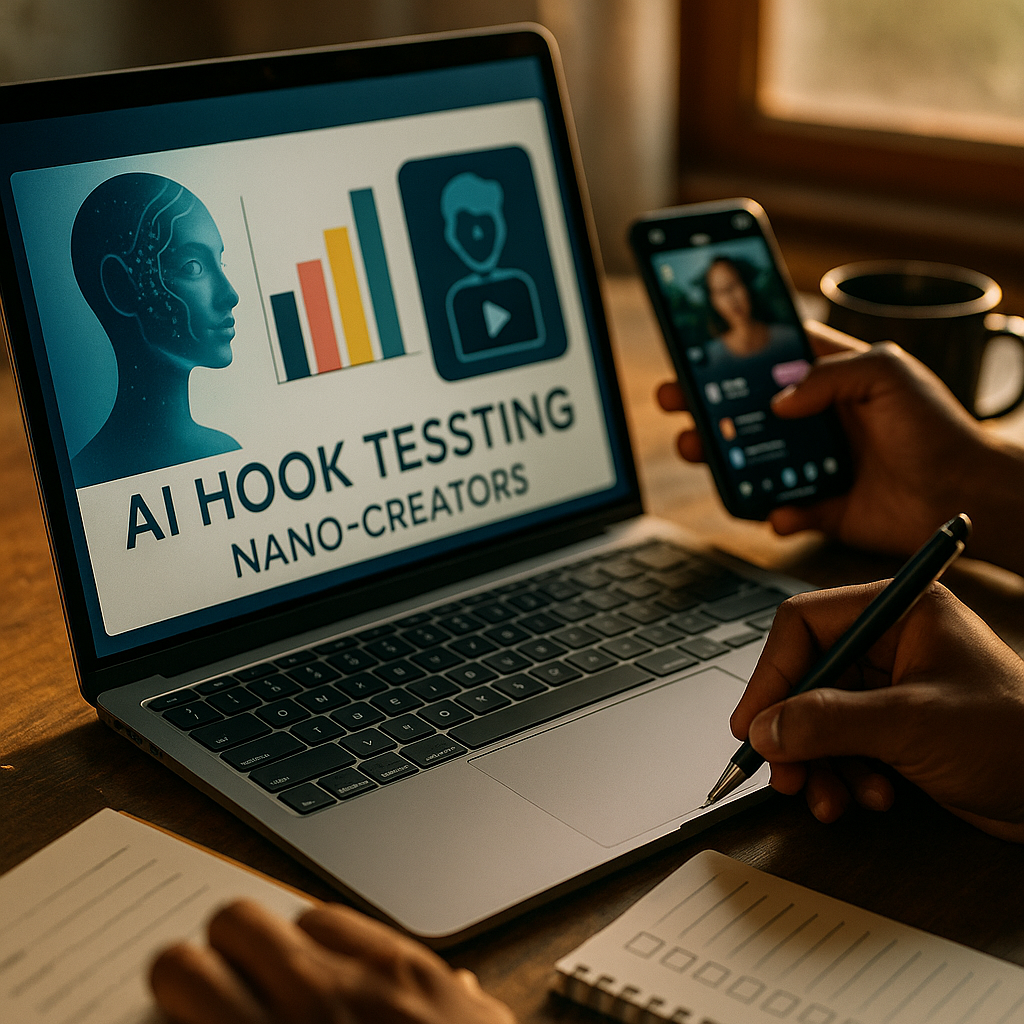
Most brands still pick a hook the way they pick a wine at a restaurant: gut feel, maybe a glance at what worked last quarter. Meanwhile, a single winning hook can lift click-through rate by 30-50% over a mediocre one, according to internal benchmarks shared by several creator marketplaces. A/B testing creator content at scale — across dozens or hundreds of nano-creators simultaneously — is no longer a nice-to-have experiment. It’s becoming table stakes for brands that actually want to know what’s working before they spend real money amplifying it.
Why Nano-Creators Are the Perfect A/B Testing Lab
Nano-creators (typically 1,000 to 20,000 followers) get dismissed as the junior varsity of influencer marketing. That’s a mistake. Their audiences are small enough to be cheap, numerous enough to be statistically useful, and diverse enough to surface real signal about what messaging resonates where.
Run the same hook variant across 200 nano-creators and you’re not testing one creator’s audience — you’re testing a message across 200 micro-segments simultaneously. That’s a sample size most brands could never afford with macro or celebrity talent. A single mid-tier creator partnership can cost more than an entire nano-creator testing cohort, and you’d still only get one data point.
Testing hooks across hundreds of nano-creators isn’t about finding one winner — it’s about building a statistically defensible map of what resonates across audience segments before you scale spend.
What “AI Hook Testing” Actually Means Here
Let’s be precise, because vendors love to blur this. AI-powered hook testing platforms typically do three things: generate or ingest multiple hook variants (the first 1-3 seconds of a video, or the opening line of a caption), distribute those variants across a pool of nano-creators or synthetic/UGC-style content, and then use machine learning to score performance against a defined outcome (watch-through rate, click-through, save rate, conversion).
Some platforms, like those built on top of TikTok’s Creative Center data or Meta’s Advantage+ creative tools, lean on the platform’s own algorithm signals. Others — independent creator marketplaces — run genuinely parallel campaigns with real nano-creators posting real content, then aggregate results. The difference matters enormously for how much you should trust the output.
This isn’t the same conversation as generic AI copy tools. As we’ve noted before, most AI marketing tools are stuck writing copy, not strategy — hook testing platforms need to go further, connecting creative variance to actual audience behavior, not just generating plausible-sounding options.
The Evaluation Framework Brands Actually Need
If you’re vetting one of these platforms for next quarter’s budget, don’t get seduced by dashboards. Ask these questions instead.
- Statistical rigor: Does the platform disclose confidence intervals or is it just reporting raw engagement numbers dressed up as “AI insights”? Ask for the underlying methodology, not just the summary chart.
- Creator pool quality: Are the nano-creators vetted for authentic engagement, or is the platform scraping anyone under 20K followers regardless of audience quality? Bot-inflated nano accounts will poison your test data.
- Speed to signal: How many days does it take to reach statistical significance across the test cohort? Platforms that promise results in 24 hours are usually trading rigor for speed.
- Cross-platform normalization: Does the tool account for the fact that a “hook” performs differently on TikTok versus Instagram Reels versus YouTube Shorts? A platform-agnostic scoring model that ignores these differences will mislead you.
- Data portability: Can you export raw performance data, or are you locked into the vendor’s interpretation layer forever?
This last point connects to a broader martech trend. Buyers increasingly need to verify interoperability before signing contracts — the same logic applies to protocol support that martech buyers must verify across their broader stack, not just creator tools in isolation.
The Emerging-Creator Blind Spot
Here’s an uncomfortable truth: the same AI matching and scoring systems that power hook testing platforms often carry the same bias problems as influencer discovery tools generally. If a platform’s underlying model was trained primarily on historical data from established creators with consistent posting patterns, it may systematically underweight newer, smaller accounts — the very nano-creators you’re trying to test with.
We’ve covered this dynamic before in the context of discovery: AI influencer-matching tools frequently overlook emerging creators because their scoring logic rewards historical engagement volume over current audience quality. The same bias can quietly distort hook testing results if a platform’s “top performer” ranking is really just rewarding creators who’ve been in the system longest.
Ask vendors directly: how does your model handle creators with less than three months of posting history? If they can’t answer clearly, treat every ranked result with suspicion.
Synthetic Content, Real Risk
Some AI hook testing platforms have started generating synthetic or AI-augmented variations of creator content to speed up testing cycles — swapping hooks, voiceovers, or even faces algorithmically rather than commissioning fresh content from every nano-creator in the pool. This is faster and cheaper. It’s also a compliance minefield.
The FTC has been explicit that disclosure obligations apply regardless of whether content is human-made or AI-assisted (see the FTC’s endorsement guidance). If your testing platform is generating synthetic variants without creator consent or proper labeling, you’re exposed — not the vendor. Brands remain liable for what gets published under their campaign, even in a test phase that never reaches paid amplification.
This is where synthetic-media detection tools built for platforms like TikTok and Instagram become relevant even on the buy side — not just for catching bad actors, but for auditing your own testing vendor’s output before it goes anywhere near a live audience.
If your hook-testing vendor can’t tell you exactly which content was human-created versus AI-modified, you don’t have a testing pipeline — you have an undisclosed liability.
How This Changes Budget Allocation
The real ROI case for AI hook testing isn’t the testing itself — it’s what you do with the winner. Brands running structured hook tests before committing spend report meaningfully better performance when they scale the winning variant into paid amplification, compared to brands that scale based on gut instinct or a single creator’s “vibe.”
Think of it as a funnel: test cheap and wide with nano-creators, identify statistically valid winners, then concentrate budget on amplifying those hooks through a smaller number of higher-reach creators or paid social. This mirrors how performance marketers already think about predictive scoring in other channels — the same logic driving predictive models replacing manual scoring in ABM applies here: use data to route spend toward proven signal instead of manual judgment calls.
Practically, that means restructuring how you brief campaigns. Instead of briefing one “hero” creative and hoping it lands, brief 5-8 hook variants per campaign concept, distribute them across your nano-creator testing pool, and hold back your amplification budget until you have a statistically credible winner. It’s a bigger lift upfront. It pays for itself the moment you avoid dumping five figures behind a hook that was never going to convert.
What Good Reporting Looks Like
A platform worth paying for should give you more than a leaderboard. Look for reporting that breaks down performance by audience segment (not just aggregate engagement), shows variance across creator tiers within the nano range, and flags statistical confidence rather than presenting every result as equally reliable. According to eMarketer research on creator marketing measurement, brands citing “lack of standardized metrics” remain among the top barriers to scaling influencer investment — a gap these AI platforms are supposed to close, not widen with another proprietary scoring system nobody can audit.
Also check whether the platform integrates with your existing analytics stack. If hook test results live in a silo, disconnected from your GA4 or attribution setup, you’ll struggle to connect creative testing to downstream revenue. That connective tissue matters more than any single dashboard metric — similar to how attribution rebuilds for AI referral traffic require joining previously siloed data sources to get an honest read on what’s actually driving results.
Common Pitfalls Worth Naming
- Overfitting to platform algorithms: A hook that wins on TikTok’s For You Page logic might flop as a paid Instagram ad. Don’t assume portability without re-testing.
- Sample size theater: 200 creators sounds impressive until you learn 150 of them have fewer than 500 real followers each. Ask for engaged-audience size, not follower count.
- Testing fatigue: Nano-creators asked to post test content repeatedly without fair compensation will produce lower-effort work. Budget for it like a real campaign, not a free trial.
- Ignoring qualitative signal: Comments and DMs often reveal why a hook worked, not just that it worked. Pure quantitative scoring misses context that matters for the next creative cycle.
The bottom line: treat AI hook testing platforms as instruments, not oracles. Vet the data pipeline before you trust the leaderboard, budget for real nano-creator compensation instead of treating tests as freebies, and demand exportable, auditable results before you commit next quarter’s spend to whatever variant tops the chart.
Frequently Asked Questions
What is A/B testing creator content, exactly?
It’s the practice of running multiple creative variants — usually different hooks, opening lines, or thumbnails — across separate audience segments simultaneously, then measuring which variant drives the strongest engagement or conversion before committing full budget to one direction.
How many nano-creators do I need for a statistically valid test?
There’s no universal number, but most practitioners aim for at least 50-100 creators per variant to reach reasonable confidence, depending on engagement rate variance within the pool. Platforms should disclose their confidence threshold rather than leaving you to guess.
Are AI-generated hook variations required to carry FTC disclosure?
Yes. The FTC’s endorsement guidance applies regardless of whether content is fully human-created or AI-assisted. If a hook or visual is synthetically modified, that should be disclosed, and brands remain responsible even if a vendor generated the content.
Can hook testing results from nano-creators predict performance with larger creators?
Directionally, often yes, particularly for messaging and value proposition testing. But format-specific performance (production quality, creator authority) doesn’t always transfer cleanly, so treat nano-creator wins as a strong signal to refine, not a guaranteed blueprint for macro-influencer campaigns.
What’s the biggest mistake brands make when adopting these platforms?
Trusting the leaderboard without auditing the underlying creator pool quality or statistical methodology. A flashy dashboard doesn’t mean the sample was clean or the confidence level was real.
Top Influencer Marketing Agencies
The leading agencies shaping influencer marketing in 2026
Agencies ranked by campaign performance, client diversity, platform expertise, proven ROI, industry recognition, and client satisfaction. Assessed through verified case studies, reviews, and industry consultations.
Moburst

-
2

The Shelf
Boutique Beauty & Lifestyle Influencer AgencyA data-driven boutique agency specializing exclusively in beauty, wellness, and lifestyle influencer campaigns on Instagram and TikTok. Best for brands already focused on the beauty/personal care space that need curated, aesthetic-driven content.Clients: Pepsi, The Honest Company, Hims, Elf Cosmetics, Pure LeafVisit The Shelf → -
3

Audiencly
Niche Gaming & Esports Influencer AgencyA specialized agency focused exclusively on gaming and esports creators on YouTube, Twitch, and TikTok. Ideal if your campaign is 100% gaming-focused — from game launches to hardware and esports events.Clients: Epic Games, NordVPN, Ubisoft, Wargaming, Tencent GamesVisit Audiencly → -
4

Viral Nation
Global Influencer Marketing & Talent AgencyA dual talent management and marketing agency with proprietary brand safety tools and a global creator network spanning nano-influencers to celebrities across all major platforms.Clients: Meta, Activision Blizzard, Energizer, Aston Martin, WalmartVisit Viral Nation → -
5

The Influencer Marketing Factory
TikTok, Instagram & YouTube CampaignsA full-service agency with strong TikTok expertise, offering end-to-end campaign management from influencer discovery through performance reporting with a focus on platform-native content.Clients: Google, Snapchat, Universal Music, Bumble, YelpVisit TIMF → -
6

NeoReach
Enterprise Analytics & Influencer CampaignsAn enterprise-focused agency combining managed campaigns with a powerful self-service data platform for influencer search, audience analytics, and attribution modeling.Clients: Amazon, Airbnb, Netflix, Honda, The New York TimesVisit NeoReach → -
7

Ubiquitous
Creator-First Marketing PlatformA tech-driven platform combining self-service tools with managed campaign options, emphasizing speed and scalability for brands managing multiple influencer relationships.Clients: Lyft, Disney, Target, American Eagle, NetflixVisit Ubiquitous → -
8

Obviously
Scalable Enterprise Influencer CampaignsA tech-enabled agency built for high-volume campaigns, coordinating hundreds of creators simultaneously with end-to-end logistics, content rights management, and product seeding.Clients: Google, Ulta Beauty, Converse, AmazonVisit Obviously →