


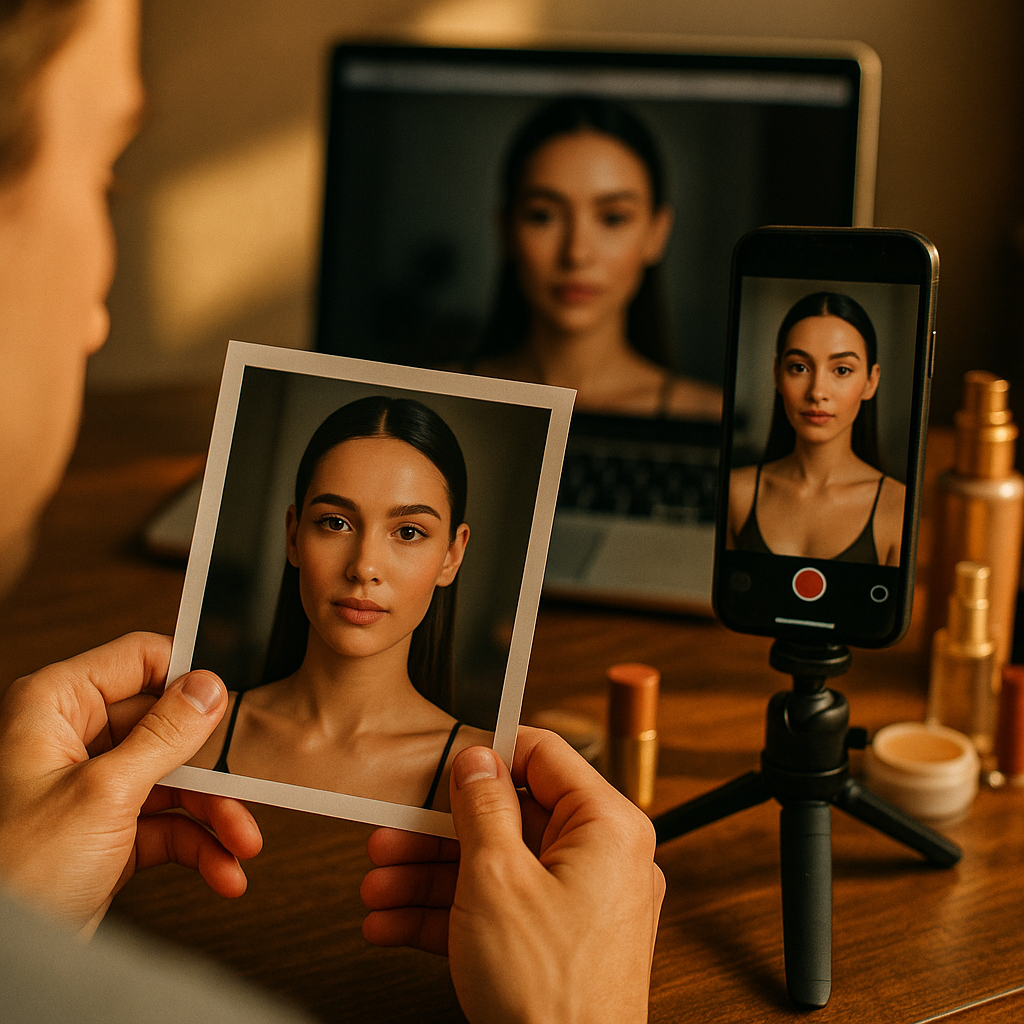
Sixty-seven percent of beauty consumers say they’d stop buying a brand that used an AI influencer without disclosing it, according to recent consumer trust surveys. Yet beauty brands keep launching synthetic creators anyway, betting that efficiency and control outweigh the backlash risk. Who’s right?
The honest answer: it depends entirely on how the program is built. Synthetic creators — fully AI-generated personas, digital twins of real humans, or hybrid avatars — are no longer a novelty in beauty and wellness marketing. They’re a line item in the media plan. But this category carries risk profiles that traditional influencer partnerships simply don’t, and most brand teams are winging it without a real framework.
Why Beauty and Wellness Is Ground Zero
Beauty and wellness brands adopted synthetic creators faster than almost any other vertical, and it’s easy to see why. Product shots need consistency. Campaigns need to scale across dozens of markets and languages. A synthetic spokesperson never ages out of a demographic, never has a scandal, never asks for a rate increase mid-contract. L’Oréal, Ulta, and dozens of DTC skincare brands have all experimented with AI-generated faces for product demos, tutorials, and even “ambassador” roles.
But this is also the category where trust matters most. Consumers are putting these products on their skin, in their bodies, into daily routines tied to health and self-image. Wellness claims already sit under heavy FTC scrutiny. Layer a synthetic persona on top of a supplement claim or a “clinically proven” skincare result, and you’ve compounded two separate compliance risks into one campaign.
The core tension isn’t whether synthetic creators can perform — it’s whether their use quietly erodes the credibility that beauty and wellness marketing depends on to sell in the first place.
What Actually Counts as a Synthetic Creator?
Precision matters here, because “synthetic creator” gets used as a catch-all when it shouldn’t be. For risk-mapping purposes, split them into three buckets:
- Fully synthetic personas: No real human behind the face or voice. Built entirely with generative AI, often marketed as a “virtual ambassador” with a name, backstory, and posting cadence.
- Digital twins: AI recreations of a real, contracted creator or employee, used to scale their likeness across content without requiring their physical presence for every shoot.
- Composited or augmented creators: Real creators whose image, voice, or performance is enhanced, de-aged, or remixed using AI tools, blurring the line between authentic and synthetic.
Each bucket carries a different consent, disclosure, and liability profile. Treating them identically in your contracts or your risk assessment is where most legal teams get exposed. If you’re already grappling with consent frameworks for AI-altered human performers, the groundwork in AI voice cloning consent practices translates directly to digital twin programs.
The Risk Framework: Four Dimensions to Score Before Launch
Rather than treating synthetic creator adoption as a binary yes/no decision, score every proposed campaign against four risk dimensions. This isn’t theoretical — it’s the same rigor legal and compliance teams already apply to influencer contracts, just adapted for a new format.
1. Disclosure Clarity
Does the average consumer scrolling their feed understand, within seconds, that they’re looking at an AI-generated persona? The FTC’s Endorsement Guides don’t yet have a synthetic-creator-specific carve-out, but the existing standard — clear, conspicuous, unavoidable disclosure — still applies. A tiny “AI” badge buried in a bio doesn’t cut it, and platforms are starting to codify this themselves. TikTok and Meta have both rolled out AI-content labeling requirements, and New York’s synthetic performer law adds another layer of state-level obligation that beauty brands operating at scale can’t ignore. For the mechanics of reconciling platform labels with legal disclosure duty, see NY synthetic performer law versus platform AI labels.
2. Claim Substantiation Risk
This is where beauty and wellness gets uniquely dangerous. A synthetic creator “using” a serum for 30 days and reporting visible results is a claim with zero physical basis. There was no skin, no timeline, no clinical reality behind it. If your campaign implies a personal-use testimonial from an entity that never used the product, you’re not just risking an FTC letter — you’re fabricating evidence in an implied clinical narrative. Brands running AI-scripted talking points around health or finance claims should study the parallel guidance in FTC scripting risk, because the same principle applies: who controls the message determines who bears liability.
3. Consumer Trust Erosion
Even fully disclosed synthetic creators can tank trust if the deployment feels manipulative. There’s a difference between a brand transparently using a virtual mascot for product education and a brand quietly swapping a beloved human ambassador for an AI twin without telling anyone why. Wellness audiences, in particular, are primed to detect inauthenticity — it’s a category built on personal transformation stories. A 2024 Edelman trust study found that authenticity remains the top driver of purchase intent in beauty and personal care, ahead of price or ingredient claims. Undermine that, and no amount of production polish saves the campaign.
4. Contractual and IP Exposure
Who owns the synthetic persona’s likeness? What happens if a digital twin is trained on a real creator’s data and that creator’s contract expires? These aren’t hypothetical questions — they’re the exact disputes now surfacing in creator litigation. Any brand deploying digital twins needs airtight training-data consent clauses, ideally modeled on frameworks like the one outlined in AI training-data consent clauses that work. Skipping this step doesn’t just risk a lawsuit — it risks having to pull an entire campaign mid-flight if a creator revokes consent.
Scoring the Program: A Simple Matrix
For each proposed synthetic creator initiative, rate the four dimensions above on a 1-5 scale (1 = low risk, 5 = severe risk). Anything scoring above 12 out of 20 should go through legal review before a single asset is produced, not after.
- Score 4-8: Low risk. Clear disclosure, no personal-use claims, strong consent documentation.
- Score 9-12: Moderate risk. Proceed with legal sign-off on claim language and disclosure placement.
- Score 13-16: High risk. Requires executive and compliance approval, plus a documented escalation path if the campaign draws regulatory or public attention.
- Score 17-20: Do not launch. Rework the concept entirely.
This kind of pre-launch scoring mirrors what mature brands already do with human creator crises. If you don’t have an escalation protocol for when a synthetic campaign goes sideways, the structure used in morality clause escalation protocols is a useful starting template — swap “creator misconduct” for “synthetic disclosure failure” and most of the workflow still holds.
Where Brands Are Getting Burned
A handful of recurring mistakes show up across beauty and wellness synthetic creator launches:
- Treating disclosure as a design afterthought. Marketing teams design the campaign first, then ask legal how to label it. It should be the reverse.
- Letting AI tools generate claim language unsupervised. Generative scripts can accidentally produce “clinically tested” or “dermatologist recommended” phrasing with no substantiation behind it. Every synthetic script needs the same claims review a human-written ad would get.
- Assuming Gen Z tolerance equals blanket acceptance. Younger audiences are more comfortable with AI content in general, but beauty and wellness purchases are emotionally loaded. Comfort with AI aesthetics doesn’t mean comfort with AI health advice.
- No kill switch. If a synthetic campaign draws backlash or a regulatory inquiry, brands need a pre-agreed process to pull assets fast, across every platform and every market simultaneously.
Cross-border deployment adds another wrinkle entirely. A synthetic creator campaign running in the EU, UK, and US simultaneously has to satisfy three different disclosure and consumer protection regimes at once, not unlike the compliance layering seen in EU compliance requirements for commerce-linked content. Legal teams should map jurisdiction-specific disclosure rules before greenlighting any global rollout, not after the first regulator asks questions.
Building Trust Into the Business Case
None of this means synthetic creators are a bad bet for beauty and wellness. Used well, they solve real operational problems: consistent global campaigns, faster content turnaround, controllable brand voice. The mistake is treating trust as a marketing nice-to-have rather than a hard business constraint that shapes the entire program design.
Brands that get this right build disclosure and claims review into the creative brief from day one, not as a legal checkpoint bolted on at the end. They also test synthetic content with real consumer panels before scaling, specifically probing for the “gut check” moment when someone realizes a face isn’t real. If that moment produces distrust rather than curiosity, the campaign needs rework, regardless of how good the visuals look.
Industry benchmarking data from sources like eMarketer and Statista shows synthetic media spend climbing steadily across CPG categories, but adoption curves and trust curves aren’t moving at the same rate. That gap is exactly where brand risk lives.
FAQs
Common questions marketing and compliance teams ask before greenlighting synthetic creator programs in beauty and wellness.
Frequently Asked Questions
Do synthetic creators need to disclose that they’re AI-generated?
Yes. The FTC’s Endorsement Guides require clear and conspicuous disclosure of material connections and misleading impersonation, and this standard extends to AI-generated personas presenting opinions or endorsements. Platform-level labeling requirements from TikTok and Meta add further obligations on top of legal disclosure duties.
Can a synthetic creator make product performance claims, like skincare results?
Only if the claim is substantiated by real clinical or user data, not implied personal experience. Since a synthetic creator has no physical existence, any testimonial-style claim about visible results is inherently fabricated and carries high FTC risk unless framed clearly as a dramatization backed by actual study data.
What’s the difference between a digital twin and a fully synthetic creator?
A digital twin is an AI recreation of a real, consenting person, typically a contracted creator or employee, used to scale their content output. A fully synthetic creator has no real human counterpart at all. Digital twins require explicit likeness and training-data consent from the real individual; fully synthetic personas do not, but face stricter disclosure scrutiny since there’s no real person behind the endorsement.
How should brands handle synthetic creator campaigns across multiple countries?
Map disclosure and consumer protection requirements jurisdiction by jurisdiction before launch. The US, UK, and EU each have different standards for AI-content labeling and endorsement disclosure, and a single global asset rarely satisfies all of them without market-specific adjustments.
What happens if a synthetic creator campaign triggers a consumer trust backlash?
Brands need a pre-built escalation protocol that allows for immediate asset removal across platforms, a public communication plan, and a legal review of any claims made in the campaign. Treating this like a standard creator crisis response, with clear ownership and timelines, prevents a slow, reactive scramble.
Next step: Before your next synthetic creator brief goes into production, run it through the four-dimension risk matrix above and require a documented score in the campaign approval file. If legal can’t sign off on disclosure and claims language before shooting starts, the launch date moves, not the standard.
Frequently Asked Questions
Do synthetic creators need to disclose that they’re AI-generated?
Yes. The FTC’s Endorsement Guides require clear and conspicuous disclosure of material connections and misleading impersonation, and this standard extends to AI-generated personas presenting opinions or endorsements. Platform-level labeling requirements from TikTok and Meta add further obligations on top of legal disclosure duties.
Can a synthetic creator make product performance claims, like skincare results?
Only if the claim is substantiated by real clinical or user data, not implied personal experience. Since a synthetic creator has no physical existence, any testimonial-style claim about visible results is inherently fabricated and carries high FTC risk unless framed clearly as a dramatization backed by actual study data.
What’s the difference between a digital twin and a fully synthetic creator?
A digital twin is an AI recreation of a real, consenting person, typically a contracted creator or employee, used to scale their content output. A fully synthetic creator has no real human counterpart at all. Digital twins require explicit likeness and training-data consent from the real individual; fully synthetic personas do not, but face stricter disclosure scrutiny since there’s no real person behind the endorsement.
How should brands handle synthetic creator campaigns across multiple countries?
Map disclosure and consumer protection requirements jurisdiction by jurisdiction before launch. The US, UK, and EU each have different standards for AI-content labeling and endorsement disclosure, and a single global asset rarely satisfies all of them without market-specific adjustments.
What happens if a synthetic creator campaign triggers a consumer trust backlash?
Brands need a pre-built escalation protocol that allows for immediate asset removal across platforms, a public communication plan, and a legal review of any claims made in the campaign. Treating this like a standard creator crisis response, with clear ownership and timelines, prevents a slow, reactive scramble.
Top Influencer Marketing Agencies
The leading agencies shaping influencer marketing in 2026
Agencies ranked by campaign performance, client diversity, platform expertise, proven ROI, industry recognition, and client satisfaction. Assessed through verified case studies, reviews, and industry consultations.
Moburst

-
2

The Shelf
Boutique Beauty & Lifestyle Influencer AgencyA data-driven boutique agency specializing exclusively in beauty, wellness, and lifestyle influencer campaigns on Instagram and TikTok. Best for brands already focused on the beauty/personal care space that need curated, aesthetic-driven content.Clients: Pepsi, The Honest Company, Hims, Elf Cosmetics, Pure LeafVisit The Shelf → -
3

Audiencly
Niche Gaming & Esports Influencer AgencyA specialized agency focused exclusively on gaming and esports creators on YouTube, Twitch, and TikTok. Ideal if your campaign is 100% gaming-focused — from game launches to hardware and esports events.Clients: Epic Games, NordVPN, Ubisoft, Wargaming, Tencent GamesVisit Audiencly → -
4

Viral Nation
Global Influencer Marketing & Talent AgencyA dual talent management and marketing agency with proprietary brand safety tools and a global creator network spanning nano-influencers to celebrities across all major platforms.Clients: Meta, Activision Blizzard, Energizer, Aston Martin, WalmartVisit Viral Nation → -
5

The Influencer Marketing Factory
TikTok, Instagram & YouTube CampaignsA full-service agency with strong TikTok expertise, offering end-to-end campaign management from influencer discovery through performance reporting with a focus on platform-native content.Clients: Google, Snapchat, Universal Music, Bumble, YelpVisit TIMF → -
6

NeoReach
Enterprise Analytics & Influencer CampaignsAn enterprise-focused agency combining managed campaigns with a powerful self-service data platform for influencer search, audience analytics, and attribution modeling.Clients: Amazon, Airbnb, Netflix, Honda, The New York TimesVisit NeoReach → -
7

Ubiquitous
Creator-First Marketing PlatformA tech-driven platform combining self-service tools with managed campaign options, emphasizing speed and scalability for brands managing multiple influencer relationships.Clients: Lyft, Disney, Target, American Eagle, NetflixVisit Ubiquitous → -
8

Obviously
Scalable Enterprise Influencer CampaignsA tech-enabled agency built for high-volume campaigns, coordinating hundreds of creators simultaneously with end-to-end logistics, content rights management, and product seeding.Clients: Google, Ulta Beauty, Converse, AmazonVisit Obviously →