


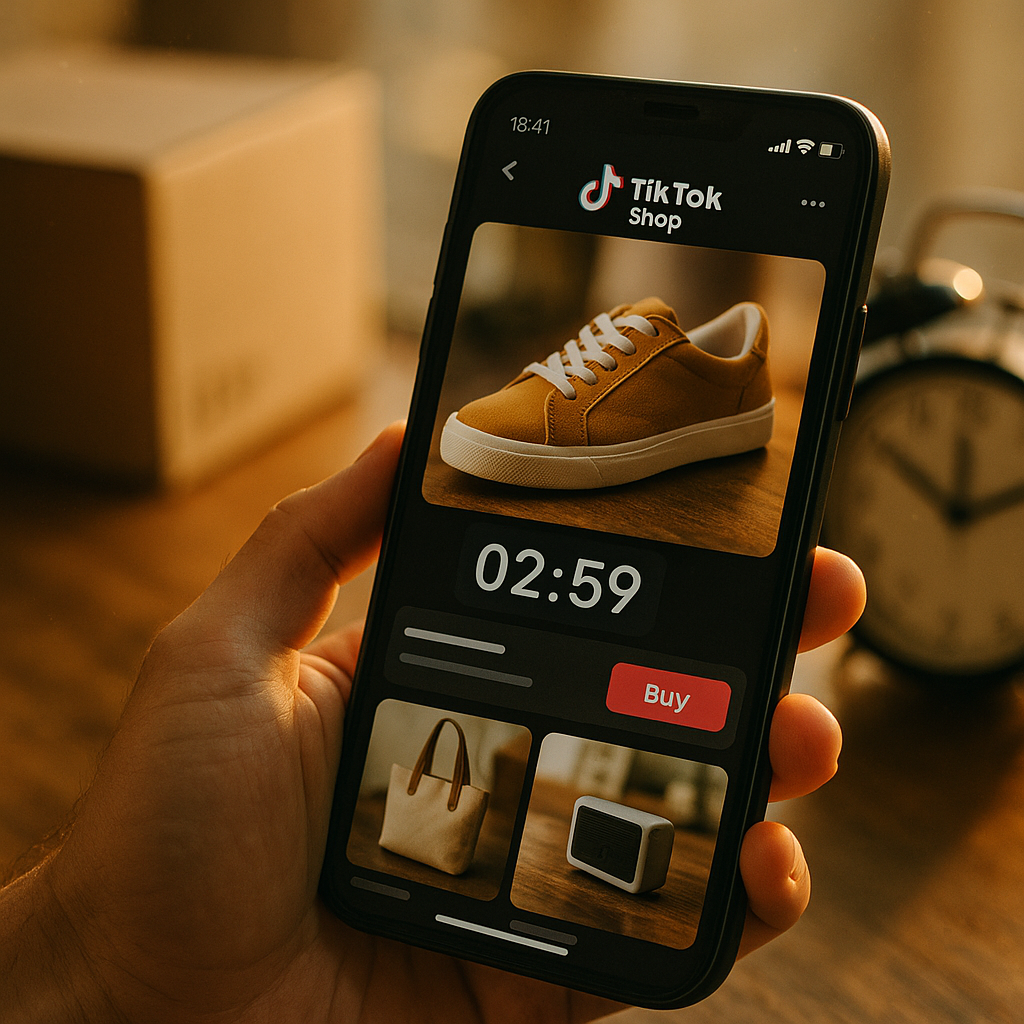
Forty-three state attorneys general have active deceptive-scarcity enforcement priorities heading into the holiday quarter. Meanwhile, TikTok Shop’s livestream countdown timers reset, loop, and reappear across sessions with almost no guardrails. If your brand is running holiday livestreams with a ticking clock and a “only 3 left” banner, you’re sitting on a compliance gap that state regulators are actively hunting.
This isn’t a theoretical FTC issue anymore. It’s a state-law issue, and the two frameworks don’t line up as neatly as most brand teams assume.
The Core Problem: One Timer, Fifty Rulebooks
TikTok Shop’s livestream engine was built for engagement, not legal nuance. Countdown timers create urgency. Urgency drives conversion. TikTok’s own merchant data has repeatedly shown livestream sessions with visible timers converting at multiples of static listing pages. That’s exactly why the feature exists — and exactly why it’s dangerous.
The FTC’s guidance on scarcity claims is relatively well understood at this point: don’t fabricate urgency, don’t recycle a “sale ends tonight” timer across multiple nights, don’t claim limited stock when the warehouse is full. Brands have had a year or more to internalize that framework, and we’ve covered the federal exposure in detail in our piece on countdown timers and FTC scarcity risk.
But state deceptive-scarcity statutes are a different animal. California’s Unfair Competition Law, New York’s General Business Law Section 349, Texas’s Deceptive Trade Practices Act, and similar statutes in two dozen other states don’t just mirror the FTC Act. Many have their own standard for what counts as “capable of being misleading,” which is a lower bar than the FTC’s “likely to mislead a reasonable consumer” test. Some states allow private rights of action. That means a single livestream can generate exposure not just from a state AG, but from a class of consumers who bought during a countdown that turned out to be cosmetic.
A countdown timer that would survive FTC scrutiny can still violate a state statute with a lower deception threshold — and several states let consumers sue directly, without waiting for a regulator to act.
Why Holiday Selling Makes This Worse
Q4 livestream volume doesn’t just increase risk proportionally. It compounds it. Consider what changes during the holiday selling window:
- Frequency spikes. Brands running one livestream a week in Q3 often run daily or twice-daily sessions in November and December. More sessions mean more chances for a timer to reset in a way that contradicts the on-screen claim.
- Inventory claims get sloppier. “Only 12 left” banners are frequently tied to a warehouse feed that isn’t holiday-stress-tested. If the feed lags or the SKU is actually being replenished hourly, the claim becomes false in a way that’s easy to document after the fact.
- Multiple creators, one SKU. Holiday campaigns often spread the same discounted product across five or ten affiliated creators. If each one runs an independent countdown claiming the same “limited quantity,” a plaintiff’s attorney has an easy math problem to present to a jury.
- Bundle and gift-set complexity. Gift bundles assembled just for the holiday season make “limited edition” claims more common — and more scrutinized, since regulators know bundles are often just repackaged existing stock.
None of this is hypothetical. State AG offices coordinate informally on consumer protection sweeps, and livestream commerce has been on their radar since TikTok Shop’s earlier expansion. Add the seasonal spike in consumer complaints that every AG office sees between November and January, and you have the ingredients for an enforcement action that picks off two or three brands as examples for the rest of the industry.
Where TikTok’s Native Tools Fall Short
TikTok Shop gives sellers a countdown widget, a “sold” ticker, and stock-level displays. What it doesn’t give you is a compliance layer that checks whether those numbers are true at the moment they’re displayed. The platform’s terms of service push responsibility for claim accuracy onto the merchant, full stop. Platform policy documents from TikTok for Business make this allocation explicit, and it mirrors the approach taken by TikTok’s advertising policies more broadly: creative accuracy is the advertiser’s job, not the platform’s.
That allocation matters because it means your legal exposure doesn’t get diluted just because TikTok built the feature. A state AG isn’t going to sue TikTok for your inventory claim. They’re going to sue you, or the merchant of record, or both.
What “Deceptive Scarcity” Actually Looks Like on a Livestream
It helps to get concrete. Based on the patterns state regulators have flagged in e-commerce broadly, here’s what tends to draw scrutiny:
- Timers that reset without disclosure. A countdown hits zero, the stream continues, and a new countdown begins with no acknowledgment that the “deal” didn’t actually end.
- Static low-stock numbers. “Only 5 left” displayed identically across three separate livestream sessions over a week, with no inventory system actually driving the number.
- Price-anchoring paired with fake urgency. A “was $80, now $40, ends in 10 minutes” claim where $80 was never a real selling price. This stacks a scarcity violation on top of a separate false reference-pricing issue — something we broke down in our guide to auditing livestream price claims.
- Creator-driven urgency without brand oversight. An affiliate creator verbally claims “this always sells out, get it now” without any data to support that, and the brand doesn’t correct it in real time or in the replay.
Every one of these is fixable. None of them require abandoning countdown mechanics altogether. But they do require a monitoring process that most brands haven’t built yet, especially smaller teams leaning on affiliate creators to carry holiday volume.
Building a State-Law-Aware Livestream Playbook
Reconciling the mechanics with the law doesn’t mean turning off timers for Q4. It means tightening the operational discipline around them. A few things that actually move the needle:
Tie every displayed number to a live feed. If your stock counter says “8 left,” that number needs to come from your actual inventory management system in near real time, not a manually typed estimate from a creator’s phone. This is table stakes, but it’s the single most common gap we see in brand audits.
Standardize timer language across your creator roster. If you’re running holiday campaigns across multiple affiliated creators, give them a script for urgency claims and a hard rule against ad-libbing scarcity language. Our contract audit framework for script control is built for exactly this kind of multi-creator consistency problem, and it applies just as cleanly to state-law risk as it does to federal.
Archive every livestream and its associated claims. State investigations move slowly, sometimes months after a complaint. If you can’t produce the actual on-screen countdown and stock claims from a specific date, you’re litigating from a defensive crouch. Screen-record every session, timestamp it, and retain it for at least the length of your state’s statute of limitations for consumer protection claims (often three to four years).
Run a pre-holiday compliance sweep. Don’t wait until December 20th to discover your countdown widget has been looping the same fake urgency message since Black Friday. We laid out a practical version of this in our Q4 countdown timer compliance audit, and pairing it with the broader countdown timer disclosure rules gives most legal teams a complete checklist.
Loop in state-specific counsel, not just federal. If your brand sells nationally, you need someone who can flag which states have private rights of action for deceptive scarcity and which rely solely on AG enforcement. That distinction changes your risk calculus significantly, since private suits tend to arrive faster and target smaller-dollar transactions than AG actions typically bother with.
A Note on Merchant-of-Record Structure
Brands using third-party sellers or dropship arrangements on TikTok Shop should also revisit who is legally the merchant of record for a given SKU. State consumer protection claims typically follow the seller relationship, not just the brand name displayed on the livestream. If you’ve restructured your TikTok Shop entity for tax or verification reasons, it’s worth cross-checking that structure against your scarcity-claim liability, similar to the diligence we recommend in our piece on merchant verification requirements.
Industry data backs up why this matters right now. eMarketer’s retail forecasts have consistently shown livestream commerce as one of the fastest-growing slices of holiday social spend, and platforms like Sprout Social have tracked rising consumer skepticism toward “limited time” claims specifically. Regulators read the same data you do. They know livestream urgency tactics are scaling faster than the compliance infrastructure around them, and that gap is precisely where enforcement priorities tend to form.
FAQs
Do state deceptive-scarcity laws apply even if a brand follows FTC guidance?
Yes. Many state statutes, including consumer protection laws in California, New York, and Texas, use a lower or differently worded deception standard than the FTC Act. Compliance with FTC guidance reduces risk but doesn’t guarantee a claim is safe under every applicable state law.
Can consumers sue directly over a fake countdown timer?
In states with a private right of action under their consumer protection statute, yes. This differs from the FTC framework, where enforcement generally comes only from the agency itself, not individual consumers.
Is it illegal to reuse the same countdown timer across multiple livestream sessions?
Reusing a timer isn’t automatically illegal, but it becomes a problem when the on-screen claim implies a one-time, expiring deal that actually repeats identically session after session. Regulators and plaintiffs’ attorneys look for that inconsistency between the claim and the reality.
Who is liable if an affiliate creator makes a false urgency claim during a livestream?
Liability can extend to both the creator and the brand, especially if the brand supplied the product, approved the promotion, or failed to correct a false claim it knew about. Clear contractual scripting requirements help limit, though not eliminate, brand exposure.
How long should brands retain livestream recordings for compliance purposes?
A common practice is to retain recordings for the length of the relevant state’s statute of limitations for consumer protection claims, often three to four years, though brands selling nationally should check the longest applicable window across their sales states.
FAQs
Frequently Asked Questions
Do state deceptive-scarcity laws apply even if a brand follows FTC guidance?
Yes. Many state statutes, including consumer protection laws in California, New York, and Texas, use a lower or differently worded deception standard than the FTC Act. Compliance with FTC guidance reduces risk but doesn’t guarantee a claim is safe under every applicable state law.
Can consumers sue directly over a fake countdown timer?
In states with a private right of action under their consumer protection statute, yes. This differs from the FTC framework, where enforcement generally comes only from the agency itself, not individual consumers.
Is it illegal to reuse the same countdown timer across multiple livestream sessions?
Reusing a timer isn’t automatically illegal, but it becomes a problem when the on-screen claim implies a one-time, expiring deal that actually repeats identically session after session. Regulators and plaintiffs’ attorneys look for that inconsistency between the claim and the reality.
Who is liable if an affiliate creator makes a false urgency claim during a livestream?
Liability can extend to both the creator and the brand, especially if the brand supplied the product, approved the promotion, or failed to correct a false claim it knew about. Clear contractual scripting requirements help limit, though not eliminate, brand exposure.
How long should brands retain livestream recordings for compliance purposes?
A common practice is to retain recordings for the length of the relevant state’s statute of limitations for consumer protection claims, often three to four years, though brands selling nationally should check the longest applicable window across their sales states.
Don’t wait for a state AG letter to find out your countdown widget has been lying to customers. Run the pre-holiday audit, tie your stock claims to real data, and lock down creator scripting before your next livestream goes live.
Top Influencer Marketing Agencies
The leading agencies shaping influencer marketing in 2026
Agencies ranked by campaign performance, client diversity, platform expertise, proven ROI, industry recognition, and client satisfaction. Assessed through verified case studies, reviews, and industry consultations.
Moburst

-
2

The Shelf
Boutique Beauty & Lifestyle Influencer AgencyA data-driven boutique agency specializing exclusively in beauty, wellness, and lifestyle influencer campaigns on Instagram and TikTok. Best for brands already focused on the beauty/personal care space that need curated, aesthetic-driven content.Clients: Pepsi, The Honest Company, Hims, Elf Cosmetics, Pure LeafVisit The Shelf → -
3

Audiencly
Niche Gaming & Esports Influencer AgencyA specialized agency focused exclusively on gaming and esports creators on YouTube, Twitch, and TikTok. Ideal if your campaign is 100% gaming-focused — from game launches to hardware and esports events.Clients: Epic Games, NordVPN, Ubisoft, Wargaming, Tencent GamesVisit Audiencly → -
4

Viral Nation
Global Influencer Marketing & Talent AgencyA dual talent management and marketing agency with proprietary brand safety tools and a global creator network spanning nano-influencers to celebrities across all major platforms.Clients: Meta, Activision Blizzard, Energizer, Aston Martin, WalmartVisit Viral Nation → -
5

The Influencer Marketing Factory
TikTok, Instagram & YouTube CampaignsA full-service agency with strong TikTok expertise, offering end-to-end campaign management from influencer discovery through performance reporting with a focus on platform-native content.Clients: Google, Snapchat, Universal Music, Bumble, YelpVisit TIMF → -
6

NeoReach
Enterprise Analytics & Influencer CampaignsAn enterprise-focused agency combining managed campaigns with a powerful self-service data platform for influencer search, audience analytics, and attribution modeling.Clients: Amazon, Airbnb, Netflix, Honda, The New York TimesVisit NeoReach → -
7

Ubiquitous
Creator-First Marketing PlatformA tech-driven platform combining self-service tools with managed campaign options, emphasizing speed and scalability for brands managing multiple influencer relationships.Clients: Lyft, Disney, Target, American Eagle, NetflixVisit Ubiquitous → -
8

Obviously
Scalable Enterprise Influencer CampaignsA tech-enabled agency built for high-volume campaigns, coordinating hundreds of creators simultaneously with end-to-end logistics, content rights management, and product seeding.Clients: Google, Ulta Beauty, Converse, AmazonVisit Obviously →