


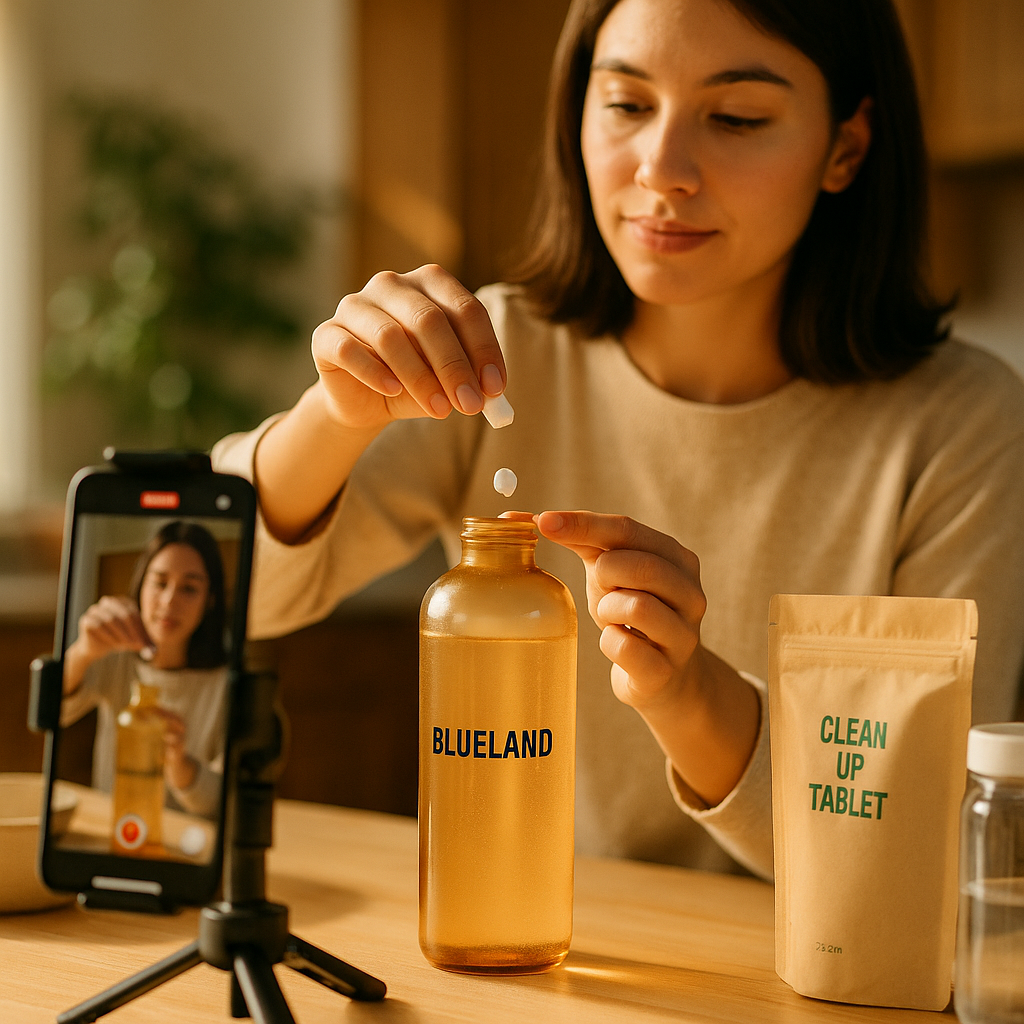
Refill culture used to live in granola-crunchy corners of the internet. Then Blueland turned it into a full-blown creator sustainability category, one nano-creator home tour at a time. The brand didn’t just sell tablets that dissolve in water. It built a content system that made empty-bottle guilt go viral.
Here’s the number that should stop every sustainability marketer mid-scroll: nano-creators with under 10,000 followers drive engagement rates roughly three to four times higher than macro-influencers, according to data compiled by Sprout Social. Blueland bet its entire content strategy on that gap, and it worked.
The Problem With Selling Sustainability
Sustainable products have a marketing problem nobody talks about enough: they’re boring to demo. A refillable soap dispenser doesn’t explode with flavor like a snack brand’s TikTok Shop drop. There’s no unboxing thrill. There’s no “wait for it” moment.
So how do you make refill tablets feel exciting? You don’t sell the product. You sell the transformation of a space.
Blueland’s answer was simple and, in hindsight, obvious: home tours. Not aspirational, magazine-perfect home tours, but the kind where a creator opens their actual cabinet, shows the actual clutter of plastic spray bottles, and then reveals the swap. The narrative arc practically writes itself. Chaos, then clarity. Waste, then order.
Nano-creators didn’t just review Blueland’s products — they turned refill routines into a recognizable content format that other creators started replicating without being paid to do it.
That’s the real unlock. Blueland didn’t pay for reach. It paid for a format that was easy enough to copy that it spread organically, the same way founder-led TikTok content turned Scrub Daddy into a category-defining name.
Why Nano-Creators, Not Sustainability Influencers
You’d expect a green cleaning brand to chase eco-influencers with six-figure followings and “zero waste” in their bio. Blueland went the other direction.
Instead, the brand recruited hundreds of nano-creators, people with 2,000 to 15,000 followers who weren’t sustainability specialists at all. Moms. Renters. College students moving into their first apartment. People whose feeds were mostly grocery hauls and Target runs, not composting tutorials.
Why does this matter? Because credibility in the cleaning category doesn’t come from expertise. It comes from relatability. A viewer trusts a stranger’s messy kitchen counter more than a polished influencer’s staged pantry. Nano-creators sell believability, not authority.
This mirrors a pattern that’s shown up repeatedly across categories. Chamberlain Coffee used nano-creators to win physical shelf space by proving demand existed among ordinary shoppers, not just superfans. Blueland applied the same logic to sustainability: prove that regular people, not eco-activists, were making the swap.
The Home Tour Format, Deconstructed
Strip away the aesthetic and Blueland’s nano-creator briefs followed a consistent, almost formulaic structure:
- The reveal shot: Under-sink cabinet or laundry closet, packed with mismatched plastic bottles.
- The confession: A quick, casual admission about how much plastic waste the creator generates monthly.
- The swap: Refillable Blueland bottles replacing the clutter, usually in under 15 seconds of footage.
- The math: A quick calculation, often on-screen text, showing bottles saved per year.
- The tone: Never preachy. Almost always self-deprecating (“I’ve been part of the problem for years”).
That last point matters more than people give it credit for. Sustainability marketing fails when it moralizes. Blueland’s briefs explicitly avoided guilt-tripping the viewer. The creator was the one confessing, not lecturing. That subtle shift, confession instead of instruction, is what made the format shareable rather than skippable.
It’s a similar principle to what makes Duolingo’s chaos-driven content work: the brand isn’t explaining why you should learn a language, it’s just being unhinged and letting the trend-jacking system do the persuading. Blueland swapped chaos for confession, but the mechanism, low-friction relatability, is the same.
Building a Category, Not Just a Campaign
Here’s where Blueland’s play gets genuinely interesting from a strategy standpoint. Most brands treat influencer content as a sales lever. Blueland treated it as category infrastructure.
By flooding TikTok and Instagram with hundreds of near-identical home tour formats, Blueland effectively trained the algorithm, and the audience, to associate “refill tablet home tour” with its brand first. Competitors entering the space later had to either copy Blueland’s exact format (reinforcing Blueland’s association) or invent a new one from scratch (losing the discovery advantage of an established content pattern).
This is category ownership through content repetition, not product patents. It’s a defensible moat that’s much harder to copy than a formula or a bottle shape.
When hundreds of nano-creators use the same content structure to sell the same behavior change, the format itself becomes the brand asset — copyable in mechanics, but not in market position.
Compare this to how Ridge Wallet built a nine-figure brand on repetitive demo content without ever discounting. Repetition, done right, isn’t laziness. It’s how you build pattern recognition into a category before anyone else claims it.
The Compliance Angle Brands Keep Missing
Sustainability claims sit in a regulatory minefield that most marketing teams underestimate. The FTC’s Green Guides specifically police environmental marketing claims, and “eco-friendly,” “sustainable,” and “zero waste” are exactly the kind of language that draws scrutiny when creators use it loosely.
Blueland’s nano-creator program built compliance into the brief itself, not as an afterthought. Creators were instructed to talk about specific, provable outcomes (bottles avoided, refill counts, plastic weight saved) rather than vague environmental virtue claims. That’s a meaningfully different risk posture than letting creators freestyle sustainability language.
It’s the same operational discipline seen in Chubbies’ approach to FTC compliance in nano-creator drops, or how Ollie built credential-based vetting to reduce claims risk in a regulated category. Sustainability marketing and pet health marketing have more in common than you’d think: both invite regulatory attention when creators overstate benefits.
For brand and legal teams building creator programs, the takeaway is straightforward. Specificity is your compliance shield. Vague virtue is your liability.
What the Numbers Actually Showed
Blueland doesn’t publish granular creator-attribution data publicly, but the pattern across the brand’s public reporting and industry commentary tracks with broader nano-creator economics. Programs built on high-volume, low-cost creator relationships typically see cost-per-acquisition drop by 40-60% compared to macro-influencer campaigns, according to benchmarks tracked by eMarketer. Engagement-to-conversion ratios on home-and-lifestyle content, the exact format Blueland leaned into, also tend to outperform product-only demo content because viewers project themselves into the scenario rather than just watching a feature list.
The strategic bet wasn’t about a single quarter’s performance. It was about owning search and social discovery for an entire behavior: refilling instead of rebuying. Search “refillable cleaning products” today and the content ecosystem Blueland helped build still shapes what shows up.
What Other Brands Can Steal From This
You don’t need to sell soap tablets to apply this playbook. The structural lessons transfer across categories:
- Pick a behavior, not just a product. Blueland sold “refilling,” not “cleaner.” Behaviors are stickier content hooks than features.
- Recruit for relatability, not reach. Nano-creators with ordinary lives outperform experts when the goal is trust, not authority.
- Standardize the format, not the script. Give creators a repeatable structure (reveal, confession, swap, math) and let personality fill the gaps.
- Build compliance into the brief. Specific, provable claims protect the brand better than aspirational language ever will.
- Measure category share of voice, not just conversions. If your content format gets copied by competitors, that’s a sign you’ve built real market position.
None of this requires a huge budget. It requires discipline in briefing and a willingness to let hundreds of small creators do what one celebrity spokesperson never could: make sustainability feel normal.
The Takeaway
Blueland’s win wasn’t a viral moment. It was a repeatable content format that turned an unsexy behavior change into a recognizable category asset. Brands chasing “sustainability marketing” in the next budget cycle should stop looking for a bigger influencer and start looking for a better format worth repeating a thousand times over.
FAQs
Why did Blueland use nano-creators instead of established sustainability influencers?
Nano-creators offered higher relatability and trust with everyday audiences. Sustainability specialists often read as preachy or niche, while ordinary creators showing their real homes made the refill behavior feel achievable and normal rather than aspirational.
What made the home tour content format effective for a cleaning brand?
The format turned an unglamorous product category into a visual before-and-after narrative. Showing cluttered cabinets transformed into refillable systems gave viewers a clear, low-effort way to imagine making the same swap themselves.
How did Blueland manage FTC compliance risk in creator sustainability claims?
Briefs focused creators on specific, provable claims like bottles saved or refill counts rather than broad environmental language. This reduced exposure to scrutiny under the FTC’s Green Guides, which regulate vague or unsubstantiated sustainability marketing claims.
Can smaller brands replicate this nano-creator sustainability strategy?
Yes. The model relies on format consistency and creator volume rather than large budgets. Brands need a clear behavior to promote, a repeatable content structure, and a compliance-conscious briefing process rather than expensive celebrity partnerships.
How is this approach different from typical influencer marketing campaigns?
Most campaigns optimize for a single launch moment. Blueland’s strategy optimized for long-term category ownership, using repeated content patterns across hundreds of creators to make its brand synonymous with an entire consumer behavior.
FAQs
Why did Blueland use nano-creators instead of established sustainability influencers?
Nano-creators offered higher relatability and trust with everyday audiences. Sustainability specialists often read as preachy or niche, while ordinary creators showing their real homes made the refill behavior feel achievable and normal rather than aspirational.
What made the home tour content format effective for a cleaning brand?
The format turned an unglamorous product category into a visual before-and-after narrative. Showing cluttered cabinets transformed into refillable systems gave viewers a clear, low-effort way to imagine making the same swap themselves.
How did Blueland manage FTC compliance risk in creator sustainability claims?
Briefs focused creators on specific, provable claims like bottles saved or refill counts rather than broad environmental language. This reduced exposure to scrutiny under the FTC’s Green Guides, which regulate vague or unsubstantiated sustainability marketing claims.
Can smaller brands replicate this nano-creator sustainability strategy?
Yes. The model relies on format consistency and creator volume rather than large budgets. Brands need a clear behavior to promote, a repeatable content structure, and a compliance-conscious briefing process rather than expensive celebrity partnerships.
How is this approach different from typical influencer marketing campaigns?
Most campaigns optimize for a single launch moment. Blueland’s strategy optimized for long-term category ownership, using repeated content patterns across hundreds of creators to make its brand synonymous with an entire consumer behavior.
Top Influencer Marketing Agencies
The leading agencies shaping influencer marketing in 2026
Agencies ranked by campaign performance, client diversity, platform expertise, proven ROI, industry recognition, and client satisfaction. Assessed through verified case studies, reviews, and industry consultations.
Moburst

-
2

The Shelf
Boutique Beauty & Lifestyle Influencer AgencyA data-driven boutique agency specializing exclusively in beauty, wellness, and lifestyle influencer campaigns on Instagram and TikTok. Best for brands already focused on the beauty/personal care space that need curated, aesthetic-driven content.Clients: Pepsi, The Honest Company, Hims, Elf Cosmetics, Pure LeafVisit The Shelf → -
3

Audiencly
Niche Gaming & Esports Influencer AgencyA specialized agency focused exclusively on gaming and esports creators on YouTube, Twitch, and TikTok. Ideal if your campaign is 100% gaming-focused — from game launches to hardware and esports events.Clients: Epic Games, NordVPN, Ubisoft, Wargaming, Tencent GamesVisit Audiencly → -
4

Viral Nation
Global Influencer Marketing & Talent AgencyA dual talent management and marketing agency with proprietary brand safety tools and a global creator network spanning nano-influencers to celebrities across all major platforms.Clients: Meta, Activision Blizzard, Energizer, Aston Martin, WalmartVisit Viral Nation → -
5

The Influencer Marketing Factory
TikTok, Instagram & YouTube CampaignsA full-service agency with strong TikTok expertise, offering end-to-end campaign management from influencer discovery through performance reporting with a focus on platform-native content.Clients: Google, Snapchat, Universal Music, Bumble, YelpVisit TIMF → -
6

NeoReach
Enterprise Analytics & Influencer CampaignsAn enterprise-focused agency combining managed campaigns with a powerful self-service data platform for influencer search, audience analytics, and attribution modeling.Clients: Amazon, Airbnb, Netflix, Honda, The New York TimesVisit NeoReach → -
7

Ubiquitous
Creator-First Marketing PlatformA tech-driven platform combining self-service tools with managed campaign options, emphasizing speed and scalability for brands managing multiple influencer relationships.Clients: Lyft, Disney, Target, American Eagle, NetflixVisit Ubiquitous → -
8

Obviously
Scalable Enterprise Influencer CampaignsA tech-enabled agency built for high-volume campaigns, coordinating hundreds of creators simultaneously with end-to-end logistics, content rights management, and product seeding.Clients: Google, Ulta Beauty, Converse, AmazonVisit Obviously →