


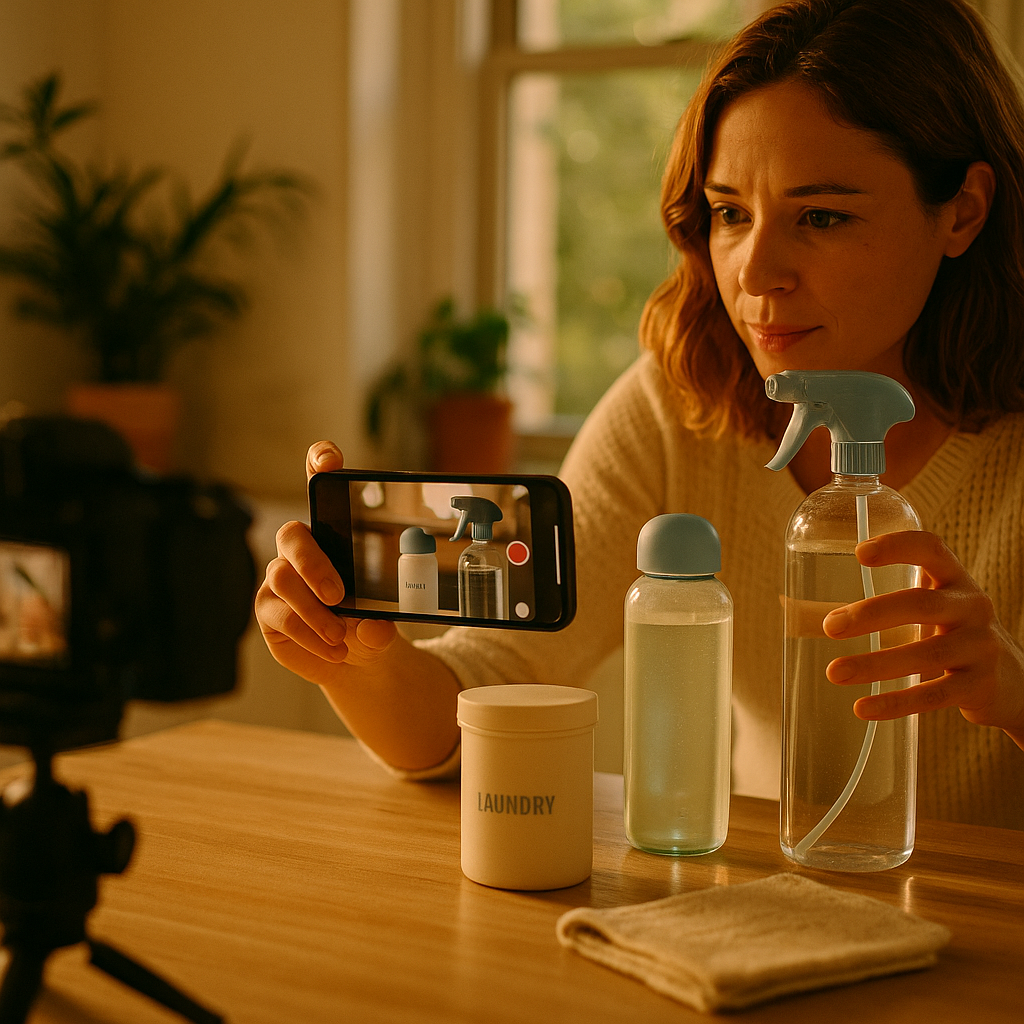
Would you trust a sustainability claim more from a celebrity spokesperson or from a stranger’s messy bathroom cabinet? Blueland bet on the cabinet. The refillable cleaning brand built an entire creator sustainability category — not a campaign, a category — by paying nano-creators to film unscripted home tours. No studio lighting. No brand-approved talking points. Just tablets dropping into water bottles on someone’s actual kitchen counter.
The Problem With Selling “Sustainable” to a Skeptical Buyer
Sustainability marketing has a credibility problem. Consumers have been burned by greenwashing so many times that the word “eco-friendly” now triggers suspicion rather than trust. A 2023 NielsenIQ analysis found that products marketed as sustainable grew faster than conventional counterparts, yet most shoppers still say they can’t tell which claims are real. That gap between demand and belief is exactly where Blueland found its opening.
Traditional advertising couldn’t close that gap. A polished commercial showing a spotless kitchen and a voiceover about “reducing plastic waste” reads as marketing, not proof. Blueland needed something that looked like evidence, not persuasion. That’s a fundamentally different creative brief than most CPG brands write.
Sustainability claims don’t get believed in commercials. They get believed in someone’s actual kitchen, filmed on a phone, with the tablet fizzing in real tap water.
Why Nano-Creators, Not Sustainability Influencers
Blueland could have chased the eco-influencer tier — the accounts with 200,000 followers, a linktree full of affiliate codes, and a well-rehearsed climate monologue. Instead, the brand leaned into creators with 1,000 to 15,000 followers who had never positioned themselves as sustainability experts at all. Home organizers. New parents. People who just liked tidy shelves.
This wasn’t a budget-saving shortcut, though it certainly helped margins. It was a trust strategy. Nano-creators post home content because it’s their actual home. When one of them shows a Blueland refill station tucked under the sink next to a stack of Tupperware, the context does the selling. There’s no “sponsored aesthetic” to see through.
The format is almost boringly simple: a room tour, a cleaning routine, or an “unboxing my new apartment” video where the Blueland tablets and reusable bottles appear as one detail among many. No dramatic reveal. No “let me tell you why I switched.” Just presence. And presence, repeated across hundreds of creators, becomes category ownership.
The Mechanics: How the Program Actually Runs
Blueland’s approach mirrors a pattern other DTC brands have used to scale nano-creator programs without drowning in manual outreach. The building blocks look like this:
- Volume over exclusivity: Instead of five high-follower partnerships, Blueland activates hundreds of small creators simultaneously, each contributing a single authentic data point rather than a hero campaign.
- Product-as-payment, plus flat fees: Many nano-creators receive starter kits and modest flat payments rather than commission-only deals, which keeps the incentive structure simple and avoids the “hard sell” tone that commission pressure often produces.
- Loose creative briefs: Creators get talking points about refill mechanics and plastic reduction stats, not scripts. The brand trades control for believability.
- Home-context placement: The brief explicitly encourages filming in real rooms, not staged flat-lays. Clutter is a feature, not a flaw.
This mirrors the structure Influencers Time covered in the earlier breakdown of Blueland’s nano-creator sustainability strategy, where the brand first proved that small-scale, high-trust content could outperform bigger, glossier partnerships on conversion.
Home Tours as the Unlock
Why home tours specifically, and not unboxings or product reviews? Because home tours solve the “does this actually fit my life” objection that kills a lot of sustainability purchases at the cart stage. Refillable cleaning products ask something conventional cleaning products don’t: change your habits, keep a bottle, remember to reorder tablets. That’s friction.
A home tour answers the objection before it’s asked. Viewers see the refill station already integrated into someone’s routine — under the sink, on a shelf, wherever it lives day to day. The product looks lived-with, not just purchased. That single visual cue does more persuasive work than a paragraph of copy about ocean plastic ever could.
It also solves a distribution problem specific to sustainability products. Category education is expensive when you’re buying media. It’s nearly free when hundreds of creators are quietly doing it inside content people already want to watch. Someone scrolling a “small apartment organization” video isn’t looking for a sustainability lecture, but they’ll absorb one anyway if it’s three seconds inside a video they chose to watch for other reasons.
The Numbers Behind the Category Play
Blueland doesn’t publish a full breakdown of its creator spend, but the pattern is visible in output. The brand has worked with thousands of small creators cumulatively, generating a long tail of UGC that functions as always-on social proof rather than a campaign with a start and end date. That’s a meaningfully different asset than a quarterly influencer push.
Compare that to typical influencer marketing benchmarks. According to eMarketer, brands increasingly favor smaller creator tiers for exactly this reason: nano and micro creators tend to post more frequently, cost less per post, and generate engagement rates that outperform mega-influencers on a per-dollar basis. Sprout Social’s research on creator marketing echoes the same trend — audiences increasingly rate relatability above production value when judging trust.
A single celebrity endorsement fades after the campaign ends. Hundreds of nano-creator home tours keep surfacing in search and recommendation feeds for years, functioning as evergreen inventory rather than a media buy.
What This Means for Category Creation, Not Just Sales
Here’s the part other brands often miss: Blueland wasn’t just selling cleaning tablets. It was defining what “refillable cleaning” looks like in someone’s actual home, before competitors could define it for them. That’s category ownership, and it’s much harder to buy with a media budget than to earn with volume and repetition.
Once enough creators show the same behavior — tablet, water, reusable bottle, done — that behavior becomes the default mental model for the category. Competitors entering later have to either match that visual language or fight against it. Either way, Blueland set the terms.
Risk Management: What Could Go Wrong (And Didn’t)
Sustainability claims sit in a particularly hot zone for regulators. The FTC’s Green Guides specifically govern environmental marketing claims, and “reduces plastic waste” is exactly the kind of statement that invites scrutiny if a creator overstates it. Brands running sustainability-adjacent creator programs need disclosure hygiene that’s tighter than average, not looser.
Blueland’s nano-creator model actually reduces this risk rather than increasing it, provided the brand manages disclosures properly. Because creators aren’t making dramatic environmental claims — they’re just showing product usage in context — there’s less room for a creator to accidentally promise something the product can’t back up. That’s a subtler version of the vetting discipline covered in how vetted nano-creators reduce compliance risk, where credentialing and clear briefs kept claims defensible at scale.
The brand still has to enforce #ad and #sponsored tagging consistently across hundreds of creators, which is an operational challenge, not a strategic one. Compliance tooling and clear onboarding briefs solve most of it. Brands that skip this step and scale nano-creator volume without disclosure guardrails are the ones that end up in FTC crosshairs, not brands doing it deliberately.
What Other Brands Should Steal (and What They Shouldn’t)
Not every product category benefits from the home-tour format. Blueland’s approach works because the product lives somewhere visible and habitual — under a sink, on a counter, in a laundry room. A B2B SaaS tool or a supplement pill bottle doesn’t get the same visual payoff from a room tour.
What transfers across categories is the underlying principle: pick the content format where your product’s context does more convincing than your copy does. For cleaning products, that’s the home. For other categories, it might be a car, a gym bag, or a desk setup. The Chamberlain Coffee nano-creator playbook applied a similar logic to retail shelf presence, using small creators to normalize a product’s place in everyday routines rather than treating it as a hero product in isolation.
Brands should also resist the urge to over-produce these placements once the strategy starts working. The temptation is always to “professionalize” a winning nano-creator format with better lighting, tighter scripts, bigger creators. That’s usually the moment it stops working. The rawness is the mechanism, not a limitation to fix.
Measurement: What to Track Instead of Vanity Metrics
Standard influencer KPIs — reach, likes, follower growth — undersell what home-tour content actually does. Blueland-style programs are better measured on:
- Share of voice within a defined category (how often your product appears as the default example when creators discuss “sustainable swaps”)
- Repeat purchase rate among customers acquired through nano-creator content, since habit-forming products like refills live or die on reorders
- Content half-life, tracking how long individual videos continue driving traffic or search impressions months after posting
- Cost per authentic placement
Brands using platforms like those referenced by Meta Business or TikTok Ads Manager for attribution should pair those dashboards with organic search tracking. A lot of the category-defining value here shows up in branded search lift, not last-click attribution.
Next step: If your brand sells something that lives in a visible, habitual space — a kitchen, a bathroom, a desk — stop briefing nano-creators for reviews and start briefing them for context. Ask them to show where the product lives, not why they love it. That’s the shift that turned Blueland from a product into a category.
FAQs
What made Blueland’s nano-creator strategy different from typical influencer marketing?
Blueland prioritized volume and authenticity over reach, paying hundreds of small creators to show products in real home settings rather than partnering with a handful of large influencers for polished campaigns.
Why do home tours work better than product reviews for sustainability products?
Home tours show a product already integrated into someone’s daily routine, which answers the “does this fit my life” objection that stops many sustainability purchases before checkout.
Is a nano-creator strategy cheaper than working with larger influencers?
Generally yes. Nano-creators typically charge lower flat fees or accept product-based compensation, and brands can activate far more creators for the same budget as a single mid-tier influencer deal.
What compliance risks come with sustainability-focused creator campaigns?
The FTC’s Green Guides govern environmental marketing claims closely, so brands must ensure creators avoid overstating impact and consistently use proper sponsorship disclosures across every partnership.
Can this strategy work outside the cleaning or home category?
Yes, if the product has a visible, habitual context, such as a gym bag, car, or desk setup. The core principle, letting environment do the persuading instead of scripted claims, transfers across categories.
FAQs
What made Blueland’s nano-creator strategy different from typical influencer marketing?
Blueland prioritized volume and authenticity over reach, paying hundreds of small creators to show products in real home settings rather than partnering with a handful of large influencers for polished campaigns.
Why do home tours work better than product reviews for sustainability products?
Home tours show a product already integrated into someone’s daily routine, which answers the “does this fit my life” objection that stops many sustainability purchases before checkout.
Is a nano-creator strategy cheaper than working with larger influencers?
Generally yes. Nano-creators typically charge lower flat fees or accept product-based compensation, and brands can activate far more creators for the same budget as a single mid-tier influencer deal.
What compliance risks come with sustainability-focused creator campaigns?
The FTC’s Green Guides govern environmental marketing claims closely, so brands must ensure creators avoid overstating impact and consistently use proper sponsorship disclosures across every partnership.
Can this strategy work outside the cleaning or home category?
Yes, if the product has a visible, habitual context, such as a gym bag, car, or desk setup. The core principle, letting environment do the persuading instead of scripted claims, transfers across categories.
Top Influencer Marketing Agencies
The leading agencies shaping influencer marketing in 2026
Agencies ranked by campaign performance, client diversity, platform expertise, proven ROI, industry recognition, and client satisfaction. Assessed through verified case studies, reviews, and industry consultations.
Moburst

-
2

The Shelf
Boutique Beauty & Lifestyle Influencer AgencyA data-driven boutique agency specializing exclusively in beauty, wellness, and lifestyle influencer campaigns on Instagram and TikTok. Best for brands already focused on the beauty/personal care space that need curated, aesthetic-driven content.Clients: Pepsi, The Honest Company, Hims, Elf Cosmetics, Pure LeafVisit The Shelf → -
3

Audiencly
Niche Gaming & Esports Influencer AgencyA specialized agency focused exclusively on gaming and esports creators on YouTube, Twitch, and TikTok. Ideal if your campaign is 100% gaming-focused — from game launches to hardware and esports events.Clients: Epic Games, NordVPN, Ubisoft, Wargaming, Tencent GamesVisit Audiencly → -
4

Viral Nation
Global Influencer Marketing & Talent AgencyA dual talent management and marketing agency with proprietary brand safety tools and a global creator network spanning nano-influencers to celebrities across all major platforms.Clients: Meta, Activision Blizzard, Energizer, Aston Martin, WalmartVisit Viral Nation → -
5

The Influencer Marketing Factory
TikTok, Instagram & YouTube CampaignsA full-service agency with strong TikTok expertise, offering end-to-end campaign management from influencer discovery through performance reporting with a focus on platform-native content.Clients: Google, Snapchat, Universal Music, Bumble, YelpVisit TIMF → -
6

NeoReach
Enterprise Analytics & Influencer CampaignsAn enterprise-focused agency combining managed campaigns with a powerful self-service data platform for influencer search, audience analytics, and attribution modeling.Clients: Amazon, Airbnb, Netflix, Honda, The New York TimesVisit NeoReach → -
7

Ubiquitous
Creator-First Marketing PlatformA tech-driven platform combining self-service tools with managed campaign options, emphasizing speed and scalability for brands managing multiple influencer relationships.Clients: Lyft, Disney, Target, American Eagle, NetflixVisit Ubiquitous → -
8

Obviously
Scalable Enterprise Influencer CampaignsA tech-enabled agency built for high-volume campaigns, coordinating hundreds of creators simultaneously with end-to-end logistics, content rights management, and product seeding.Clients: Google, Ulta Beauty, Converse, AmazonVisit Obviously →