


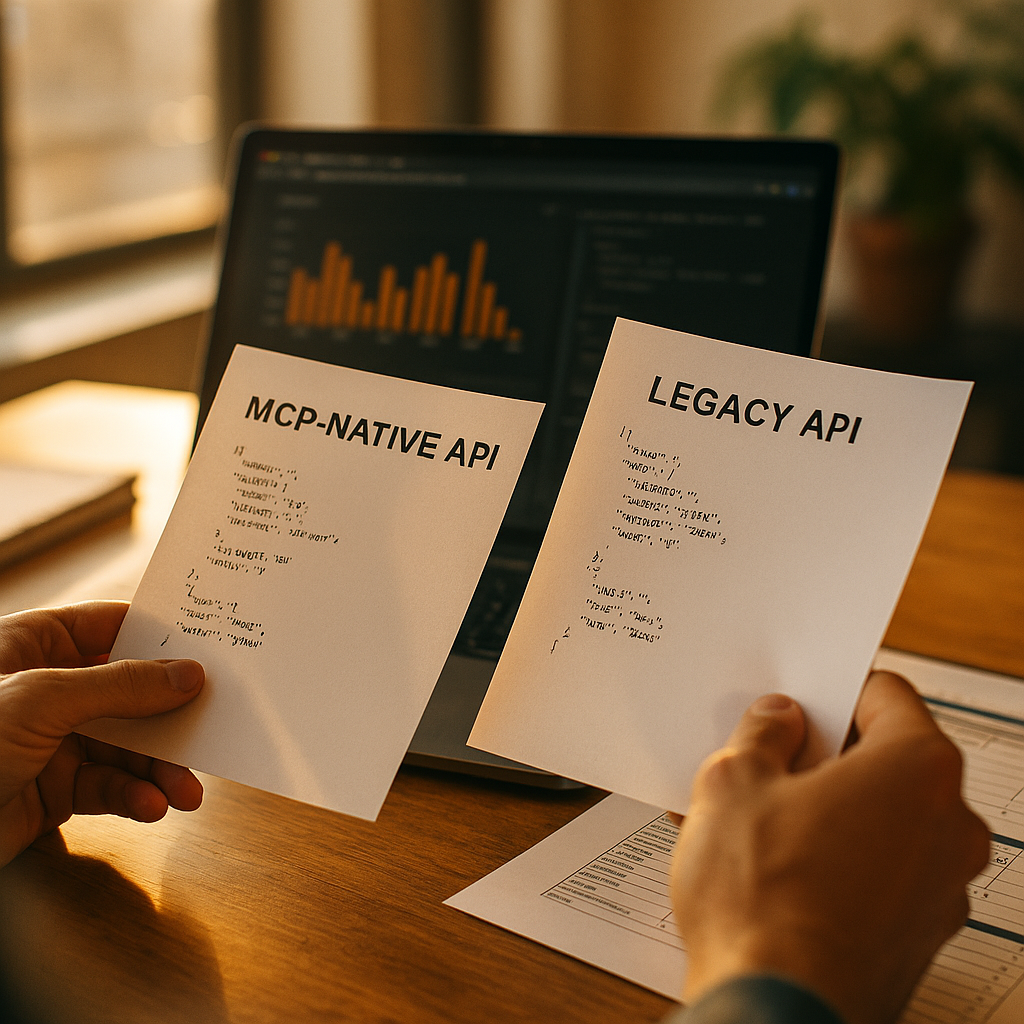
Gartner predicts that by 2028, 33% of enterprise software will embed agentic AI capable of autonomous decision-making, up from less than 1% now. So here’s the uncomfortable question every CMO should be asking before signing another twelve-month contract: will your current martech stack actually talk to the agents you’re about to deploy, or will it just pretend to? The MCP-native vs legacy API divide is about to decide which vendors survive renewal season.
Why This Comparison Suddenly Matters
Two years ago, nobody in marketing ops cared how a platform handled protocol architecture. You cared about dashboards, reporting cadence, and whether support answered emails in under 48 hours. That calculus has changed.
AI agents now negotiate media buys, pull creator analytics, adjust budgets mid-flight, and write directly into CRM records. For any of that to work reliably across tools, the systems need a shared language for context-sharing, not just data transfer. That’s what Model Context Protocol (MCP) was built for: a standardized way for AI models to discover, request, and act on context from external tools without custom-coded bridges for every single integration.
Legacy REST APIs weren’t designed with this in mind. They move data. They don’t carry intent, permissions, or session context the way agentic workflows require. That gap is exactly where renewal-season risk hides.
If your vendor’s roadmap mentions “AI agent support” but their integration docs still describe static REST endpoints, you’re looking at a bridge, not a native capability — and bridges break under agentic load.
MCP-Native vs Legacy API: The Core Technical Differences
Let’s get specific, because “AI-ready” has become the most abused phrase in vendor decks.
- Context persistence: MCP maintains session context across multiple tool calls. A legacy API treats every request as stateless and isolated, forcing agents to re-authenticate and re-explain intent constantly.
- Discovery vs hardcoding: MCP servers expose available tools and capabilities dynamically. Legacy integrations require engineers to hardcode every endpoint, meaning every new agent capability needs a dev sprint.
- Bidirectional reasoning: MCP allows an agent to ask a tool what it can do before acting. Legacy APIs assume the caller already knows the schema, which breaks the moment an agent needs to improvise.
- Governance hooks: Native MCP implementations typically ship with permission scoping built into the protocol layer. Bolt-on API wrappers usually push governance to a separate middleware layer, which is exactly where security gaps tend to form.
None of this is theoretical anymore. Platforms like Lucrative AI’s MCP engine already demonstrate what native context-linking looks like in production, connecting creator CRM data directly to warehouse systems without a patchwork of custom connectors. That’s the benchmark competing vendors need to hit, not just claim.
The Renewal Trap: What “AI-Ready” Actually Means in Vendor Contracts
Vendors know renewal season is coming. Expect a wave of “agentic AI enabled” messaging in Q1 pitch decks. Most of it will be marketing language layered over the same REST infrastructure from three years ago.
Here’s the tell: ask the vendor for their MCP server specification or documentation link. A real MCP-native platform can produce it in minutes. A legacy platform doing damage control will pivot to talking about their “AI roadmap” instead.
This distinction isn’t academic. It determines whether your team spends next year building custom middleware to patch interoperability gaps, or actually deploying the agentic workflows your budget was approved for. Teams that got burned by this already know the pattern; it’s the same due-diligence failure covered in our vendor claims audit framework for agentic media buying.
A 2024 Salesforce survey found 61% of IT leaders say integration complexity is a top barrier to AI adoption. Legacy API sprawl is the primary cause, and MCP was built specifically to remove it.
A Practical Evaluation Framework for Marketing Teams
You don’t need a computer science degree to run this evaluation. You need the right five questions, asked directly to procurement contacts and technical account managers, before ink hits paper.
- Does the platform expose an MCP server, or only a REST API with an AI wrapper? Ask for architecture documentation, not sales copy.
- Can an external agent discover available actions dynamically? If every new capability requires custom code from your dev team, you’re paying legacy-integration tax indefinitely.
- What’s the permission model for agent write-access? This matters enormously for CRM and budget systems. Review it the way you’d review any CRM write-access governance checklist.
- Does the vendor support Agent2Agent (A2A) protocol alongside MCP? Interoperability between agents from different vendors is the next compliance frontier, and our MCP and A2A protocol guide breaks down what to verify contractually.
- What’s the kill-switch mechanism if an agent misbehaves? Native protocols typically bake in interrupt controls; legacy wrappers often don’t. This is a dealbreaker item covered in our kill-switch certification piece.
Run these five questions across every vendor up for renewal. You’ll be surprised how quickly the “AI-native” claims separate from the real ones.
What Happens If You Get This Wrong
Picture this: your team signs a three-year renewal with a platform that markets itself as “agent-ready.” Six months later, you try to connect an autonomous budget-shifting agent, something like the workflows described in our mid-flight budget shift framework, and discover the integration requires a six-week custom build because the vendor’s “API” is really just a data export tool with a chatbot slapped on top.
Now you’re stuck. Locked into a contract, paying for infrastructure that can’t do the one thing you renewed it for.
This isn’t a rare scenario. It’s becoming the default outcome for teams who evaluate vendors on feature lists instead of protocol architecture.
The financial exposure compounds too. eMarketer estimates AI-driven marketing spend will keep climbing through the decade, and every dollar routed through a brittle integration is a dollar at operational risk. Fraud detection, attribution, and compliance workflows all depend on clean, real-time context-sharing. Legacy APIs choke under that load precisely when you need them most, whether that’s catching bot fraud or tracing spend back to revenue in real time.
Where the Market Is Actually Headed
MCP adoption isn’t a niche technical trend anymore. Anthropic open-sourced the protocol, and major platforms including OpenAI’s tooling ecosystem and Google’s Gemini agent framework have adopted or announced support for it. When competing AI labs converge on the same interoperability standard, that’s not hype, that’s infrastructure consolidation happening in real time.
For marketing teams, this means the vendors slow to adopt MCP natively won’t just lag on features. They’ll become integration liabilities, the tool everyone routes around instead of through.
Smart teams are already treating protocol support as a procurement checkbox equal to security certifications or data residency requirements. Not a nice-to-have. A baseline. If you want a broader diagnostic before renewal conversations even start, our agentic AI readiness framework walks through scoring vendors across governance, data infrastructure, and protocol compatibility.
Next Step
Before any renewal conversation, request each vendor’s MCP server documentation in writing, not a roadmap promise. If they can’t produce it, budget for a legacy-integration replacement cycle now, not after the contract locks you in for another year.
FAQs
What is MCP in the context of marketing technology?
Model Context Protocol is an open standard that lets AI agents discover and use external tools and data sources dynamically, without custom-coded integrations for each connection. In marketing platforms, it enables agents to pull creator data, campaign metrics, or CRM records with shared context rather than isolated API calls.
How is MCP different from a standard REST API?
REST APIs are stateless and require developers to hardcode every endpoint an application might call. MCP maintains context across multiple interactions and lets agents discover available capabilities on the fly, which is essential for autonomous, multi-step agentic workflows.
Why does this matter for vendor renewals specifically?
Many vendors are rebranding legacy APIs as “AI-ready” without actual protocol-level changes. Signing a multi-year renewal with one of these platforms locks marketing teams into brittle integrations right as agentic AI adoption accelerates, creating costly mid-contract technical debt.
What questions should marketing teams ask vendors before renewal?
Ask whether the platform exposes a native MCP server, whether agents can discover actions dynamically, how permission scoping works for write-access, whether A2A protocol is supported, and what kill-switch controls exist for misbehaving agents.
Is MCP adoption actually widespread, or still experimental?
Adoption is accelerating quickly. Multiple major AI labs and platform providers have adopted or announced support for the protocol, signaling it’s becoming an industry standard rather than a niche experiment.
FAQs
What is MCP in the context of marketing technology?
Model Context Protocol is an open standard that lets AI agents discover and use external tools and data sources dynamically, without custom-coded integrations for each connection. In marketing platforms, it enables agents to pull creator data, campaign metrics, or CRM records with shared context rather than isolated API calls.
How is MCP different from a standard REST API?
REST APIs are stateless and require developers to hardcode every endpoint an application might call. MCP maintains context across multiple interactions and lets agents discover available capabilities on the fly, which is essential for autonomous, multi-step agentic workflows.
Why does this matter for vendor renewals specifically?
Many vendors are rebranding legacy APIs as “AI-ready” without actual protocol-level changes. Signing a multi-year renewal with one of these platforms locks marketing teams into brittle integrations right as agentic AI adoption accelerates, creating costly mid-contract technical debt.
What questions should marketing teams ask vendors before renewal?
Ask whether the platform exposes a native MCP server, whether agents can discover actions dynamically, how permission scoping works for write-access, whether A2A protocol is supported, and what kill-switch controls exist for misbehaving agents.
Is MCP adoption actually widespread, or still experimental?
Adoption is accelerating quickly. Multiple major AI labs and platform providers have adopted or announced support for the protocol, signaling it’s becoming an industry standard rather than a niche experiment.
Top Influencer Marketing Agencies
The leading agencies shaping influencer marketing in 2026
Agencies ranked by campaign performance, client diversity, platform expertise, proven ROI, industry recognition, and client satisfaction. Assessed through verified case studies, reviews, and industry consultations.
Moburst

-
2

The Shelf
Boutique Beauty & Lifestyle Influencer AgencyA data-driven boutique agency specializing exclusively in beauty, wellness, and lifestyle influencer campaigns on Instagram and TikTok. Best for brands already focused on the beauty/personal care space that need curated, aesthetic-driven content.Clients: Pepsi, The Honest Company, Hims, Elf Cosmetics, Pure LeafVisit The Shelf → -
3

Audiencly
Niche Gaming & Esports Influencer AgencyA specialized agency focused exclusively on gaming and esports creators on YouTube, Twitch, and TikTok. Ideal if your campaign is 100% gaming-focused — from game launches to hardware and esports events.Clients: Epic Games, NordVPN, Ubisoft, Wargaming, Tencent GamesVisit Audiencly → -
4

Viral Nation
Global Influencer Marketing & Talent AgencyA dual talent management and marketing agency with proprietary brand safety tools and a global creator network spanning nano-influencers to celebrities across all major platforms.Clients: Meta, Activision Blizzard, Energizer, Aston Martin, WalmartVisit Viral Nation → -
5

The Influencer Marketing Factory
TikTok, Instagram & YouTube CampaignsA full-service agency with strong TikTok expertise, offering end-to-end campaign management from influencer discovery through performance reporting with a focus on platform-native content.Clients: Google, Snapchat, Universal Music, Bumble, YelpVisit TIMF → -
6

NeoReach
Enterprise Analytics & Influencer CampaignsAn enterprise-focused agency combining managed campaigns with a powerful self-service data platform for influencer search, audience analytics, and attribution modeling.Clients: Amazon, Airbnb, Netflix, Honda, The New York TimesVisit NeoReach → -
7

Ubiquitous
Creator-First Marketing PlatformA tech-driven platform combining self-service tools with managed campaign options, emphasizing speed and scalability for brands managing multiple influencer relationships.Clients: Lyft, Disney, Target, American Eagle, NetflixVisit Ubiquitous → -
8

Obviously
Scalable Enterprise Influencer CampaignsA tech-enabled agency built for high-volume campaigns, coordinating hundreds of creators simultaneously with end-to-end logistics, content rights management, and product seeding.Clients: Google, Ulta Beauty, Converse, AmazonVisit Obviously →