


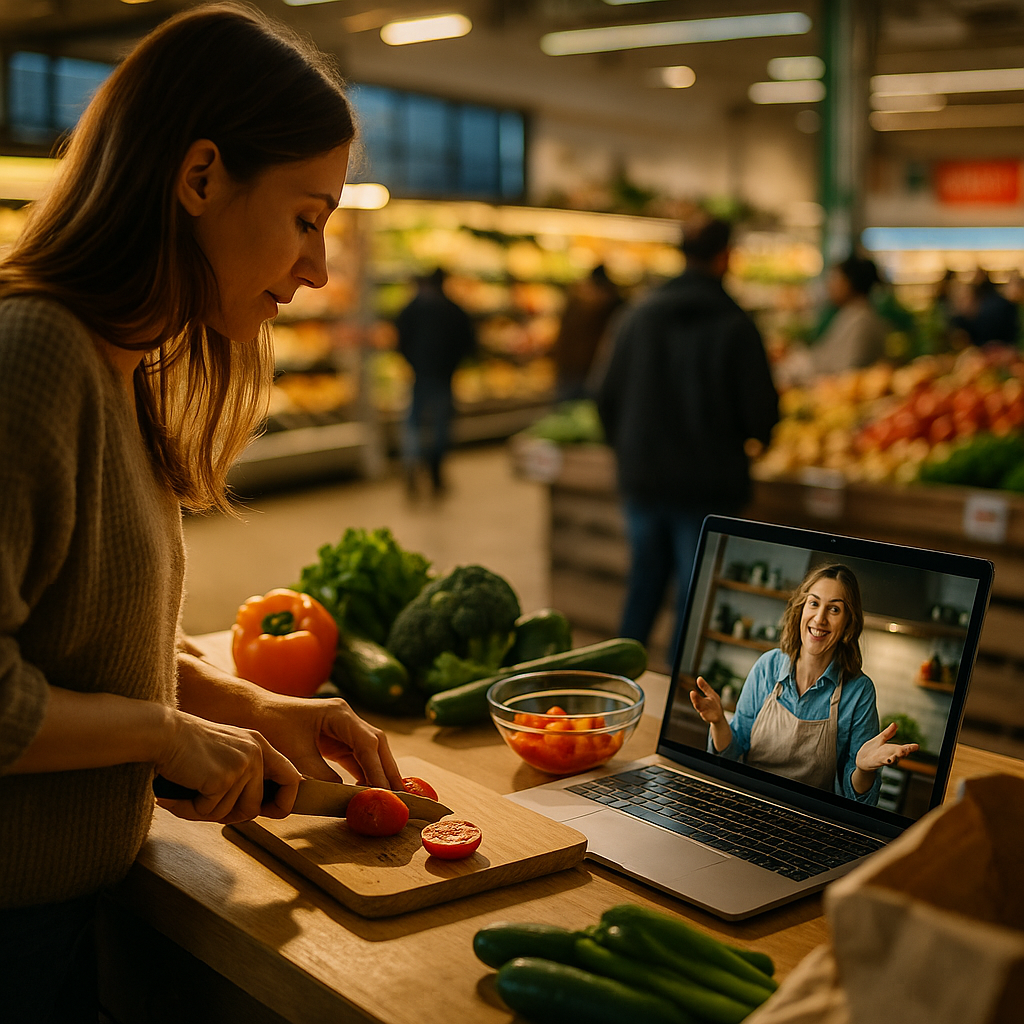
Foot traffic to grocery stores has been flat or declining for years, even as ad budgets climb. So when a regional chain posted an 11% same-store traffic lift on cook-along weeks versus control weeks, procurement teams and CMOs took notice. This is the case study behind that number, and why in-store traffic lift is becoming the metric grocery marketers actually trust.
The Problem: Digital Engagement Wasn’t Moving Carts
The chain, a 42-store operator in the Mid-Atlantic region, had a familiar problem. Its social accounts were healthy. Engagement rates hovered above category benchmarks. But the marketing director couldn’t draw a line from likes to register receipts. Sound familiar?
Leadership had already tried the standard playbook: sponsored posts from national food influencers, seasonal giveaways, a TikTok account that mostly reposted supplier content. None of it moved the needle on the metric that mattered to store operations — weekly transaction counts by location.
The chain’s insight, arrived at after a few painful budget review meetings, was simple: influencer content that lives entirely on a phone screen doesn’t create a reason to drive to a specific store on a specific day. It needed content that functioned like an event, not an ad.
The Fix: Weekly Cook-Alongs Tied to Store Circulars
The solution was a recurring format, not a campaign. Every week, a rotating roster of six regional food creators — mostly nano and micro-tier, 8K to 60K followers — hosted a live or near-live cook-along built entirely around that week’s circular ingredients. Think a $4.99 rotisserie chicken transformed into three dinners, filmed in the creator’s own kitchen, streamed on Instagram and TikTok, then cut into short-form recap clips.
The mechanics mattered more than the concept. Each cook-along included:
- A recipe card with a QR code linking to the store’s weekly digital circular, pre-filtered to the relevant department
- A named “featured store” for that week’s in-person demo, rotated across the 42 locations on a quarterly cycle
- An in-store sampling station staffed the same day, timed to coincide with the livestream’s peak viewership window
- A unique discount code tied to the creator, redeemable only in-store, not online
This wasn’t influencer marketing bolted onto retail operations. It was retail operations designed around a content calendar. That distinction is the whole case study, honestly.
The chain didn’t measure success by views or engagement. It measured success by whether transaction counts at the featured store spiked on cook-along day compared to the same day the prior month.
Why Nano and Micro-Creators, Not Regional Food Celebrities?
The team tested both. A well-known regional food TV personality generated more impressions per post. But nano-creators with hyper-local followings — often literally people who shopped at the featured store — drove higher redemption rates on the in-store codes. Their audiences trusted them as neighbors, not as talent. That trust translated into action, not just attention.
This mirrors what’s worked for other grocery-adjacent brands leaning on smaller creators over big names. Chamberlain Coffee’s approach to nano-creators and shelf space follows the same logic: proximity and authenticity beat reach when the goal is a physical store visit, not just brand awareness.
The Numbers Behind the Traffic Lift
Over a 20-week pilot, the chain tracked five metrics across featured stores versus a matched control group of stores not participating that week:
- Transaction count lift: 11% average increase on cook-along day at featured stores
- Basket size: up 6%, driven largely by ingredient bundle purchases tied to the recipe
- Code redemption rate: 14% of livestream viewers who visited the store used the creator’s unique code
- Repeat visit rate: 22% of code-redeemers returned to the same store within two weeks
- Cost per incremental visit: roughly $2.10, well under the chain’s typical paid media cost per store visit of $6-8
That cost-per-visit gap is the number that got this past finance. Grocery margins are thin, often under 3% net according to Statista’s retail industry data, so any traffic-driving tactic has to prove efficiency, not just reach.
It’s also worth noting the repeat visit rate. Nearly a quarter of people who redeemed a code came back within two weeks without a new incentive. That’s a signal the cook-alongs weren’t just harvesting existing intent, they were building habit.
Operational Lessons: What Made This Repeatable
Plenty of grocery chains have tried one-off influencer activations. Few have made them weekly and sustained the model past a quarter. A few operational choices explain why this one stuck.
The content calendar synced with merchandising, not marketing. Recipes were locked six weeks out, tied directly to the circular planning cycle already run by category managers. Creators weren’t given creative freedom to pick ingredients; they were given a shopping list and asked to make it look good. This constraint, ironically, made the content faster to produce and easier to approve legally.
Compliance was baked in from week one. Every creator agreement specified disclosure language meeting FTC endorsement guidelines, and the legal team pre-approved a disclosure template rather than reviewing each post individually. That single decision cut approval turnaround from five days to same-day.
Store staff were read into the calendar, not surprised by it. Store managers received a one-page brief every Monday: which creator, which recipe, which sampling station setup. Understaffing the sampling table on demo day was the single biggest execution failure in the first six weeks, and it directly correlated with lower traffic lift.
What Didn’t Work
Not everything succeeded. Attempts to run cook-alongs simultaneously across all 42 stores diluted the “event” feeling and made the featured-store mechanic meaningless. The chain also found that creators who cooked from studio kitchens rather than home kitchens performed worse on trust signals in post-campaign surveys, even with identical recipes. Authenticity of setting mattered as much as authenticity of message, a theme that shows up repeatedly in founder-led and creator-led demo content across categories.
Livestream shopping formats, increasingly common in beauty and CPG per Chobani’s TikTok Shop livestream playbook, offer a useful parallel: the format only works when the incentive to act is immediate and location-specific, not just a general brand impression.
How Brands Can Adapt This Without a National Budget
The chain’s total weekly production cost per cook-along ran under $3,000, including creator fees, sampling ingredients, and staff overtime. That’s a figure most regional retailers, restaurant groups, or even single-location businesses could scale up or down. The real barrier isn’t budget. It’s coordination between marketing, merchandising, and store operations, three departments that rarely share a planning calendar.
For brands considering this model, a few starting questions matter more than the creative concept:
- Can your merchandising calendar be locked far enough in advance to brief creators properly?
- Do you have store-level staff capacity to execute a same-day activation without disrupting normal operations?
- Can you build a redemption mechanism (a code, a coupon, a QR-triggered offer) that’s trackable at the point of sale, not just at the point of click?
- Is your legal team set up to pre-approve disclosure templates rather than review content case by case?
If the answer to any of these is no, the format will still generate content. It just won’t generate measurable traffic lift, which is the entire point of doing this over standard influencer marketing.
Where This Fits in a Broader Creator Strategy
Cook-alongs aren’t a replacement for always-on creator partnerships or paid social. They’re a specific tool for a specific job: converting digital attention into a physical store visit on a predictable schedule. Retailers running loyalty programs might connect the redemption codes directly to loyalty account data, giving a much richer view of lifetime value beyond the initial visit, something HubSpot’s retail marketing resources and Sprout Social’s benchmark reports both point to as the next frontier for attribution in retail social strategy.
The broader lesson for grocery and retail marketers: influencer content earns attention, but only operational integration earns foot traffic. Formats that ignore the store floor rarely survive past the pilot budget.
Cost per incremental visit came in at $2.10, roughly a third of the chain’s typical paid media cost per store visit. That’s the number that turned a marketing experiment into a permanent line item.
The takeaway for any regional retailer watching this: don’t chase reach, chase a redeemable action tied to a specific store and date, then measure transactions, not impressions. Start with one store, one weekly format, and a redemption code your POS system can actually track.
FAQs
What is a creator cook-along in a retail marketing context?
A creator cook-along is a live or recorded cooking demonstration hosted by an influencer, built around ingredients from a retailer’s current promotional circular, designed to drive a specific in-store action like a redemption code or featured sampling event.
How do you measure in-store traffic lift from an influencer campaign?
The most reliable method compares transaction counts at a featured store against a matched control store not running the activation, on the same day of week, ideally over multiple cycles to control for seasonal variance.
Why did nano-creators outperform larger regional influencers in this case?
Nano-creators had smaller but geographically concentrated, high-trust audiences. Their followers were more likely to live near the featured store and act on a code, resulting in higher redemption rates despite lower overall reach.
What’s the typical cost of running a weekly cook-along program?
In this case study, the chain spent under $3,000 per week including creator fees, sampling ingredients, and staff overtime, well below the cost of comparable paid media driving equivalent store visits.
Does this model work for single-location businesses, not just chains?
Yes, though the “featured store” rotation mechanic that created urgency and exclusivity would need to be replaced with a different incentive, such as limited-time redemption windows or first-100-customers offers.
FAQs
What is a creator cook-along in a retail marketing context?
A creator cook-along is a live or recorded cooking demonstration hosted by an influencer, built around ingredients from a retailer’s current promotional circular, designed to drive a specific in-store action like a redemption code or featured sampling event.
How do you measure in-store traffic lift from an influencer campaign?
The most reliable method compares transaction counts at a featured store against a matched control store not running the activation, on the same day of week, ideally over multiple cycles to control for seasonal variance.
Why did nano-creators outperform larger regional influencers in this case?
Nano-creators had smaller but geographically concentrated, high-trust audiences. Their followers were more likely to live near the featured store and act on a code, resulting in higher redemption rates despite lower overall reach.
What’s the typical cost of running a weekly cook-along program?
In this case study, the chain spent under $3,000 per week including creator fees, sampling ingredients, and staff overtime, well below the cost of comparable paid media driving equivalent store visits.
Does this model work for single-location businesses, not just chains?
Yes, though the “featured store” rotation mechanic that created urgency and exclusivity would need to be replaced with a different incentive, such as limited-time redemption windows or first-100-customers offers.
Top Influencer Marketing Agencies
The leading agencies shaping influencer marketing in 2026
Agencies ranked by campaign performance, client diversity, platform expertise, proven ROI, industry recognition, and client satisfaction. Assessed through verified case studies, reviews, and industry consultations.
Moburst

-
2

The Shelf
Boutique Beauty & Lifestyle Influencer AgencyA data-driven boutique agency specializing exclusively in beauty, wellness, and lifestyle influencer campaigns on Instagram and TikTok. Best for brands already focused on the beauty/personal care space that need curated, aesthetic-driven content.Clients: Pepsi, The Honest Company, Hims, Elf Cosmetics, Pure LeafVisit The Shelf → -
3

Audiencly
Niche Gaming & Esports Influencer AgencyA specialized agency focused exclusively on gaming and esports creators on YouTube, Twitch, and TikTok. Ideal if your campaign is 100% gaming-focused — from game launches to hardware and esports events.Clients: Epic Games, NordVPN, Ubisoft, Wargaming, Tencent GamesVisit Audiencly → -
4

Viral Nation
Global Influencer Marketing & Talent AgencyA dual talent management and marketing agency with proprietary brand safety tools and a global creator network spanning nano-influencers to celebrities across all major platforms.Clients: Meta, Activision Blizzard, Energizer, Aston Martin, WalmartVisit Viral Nation → -
5

The Influencer Marketing Factory
TikTok, Instagram & YouTube CampaignsA full-service agency with strong TikTok expertise, offering end-to-end campaign management from influencer discovery through performance reporting with a focus on platform-native content.Clients: Google, Snapchat, Universal Music, Bumble, YelpVisit TIMF → -
6

NeoReach
Enterprise Analytics & Influencer CampaignsAn enterprise-focused agency combining managed campaigns with a powerful self-service data platform for influencer search, audience analytics, and attribution modeling.Clients: Amazon, Airbnb, Netflix, Honda, The New York TimesVisit NeoReach → -
7

Ubiquitous
Creator-First Marketing PlatformA tech-driven platform combining self-service tools with managed campaign options, emphasizing speed and scalability for brands managing multiple influencer relationships.Clients: Lyft, Disney, Target, American Eagle, NetflixVisit Ubiquitous → -
8

Obviously
Scalable Enterprise Influencer CampaignsA tech-enabled agency built for high-volume campaigns, coordinating hundreds of creators simultaneously with end-to-end logistics, content rights management, and product seeding.Clients: Google, Ulta Beauty, Converse, AmazonVisit Obviously →