


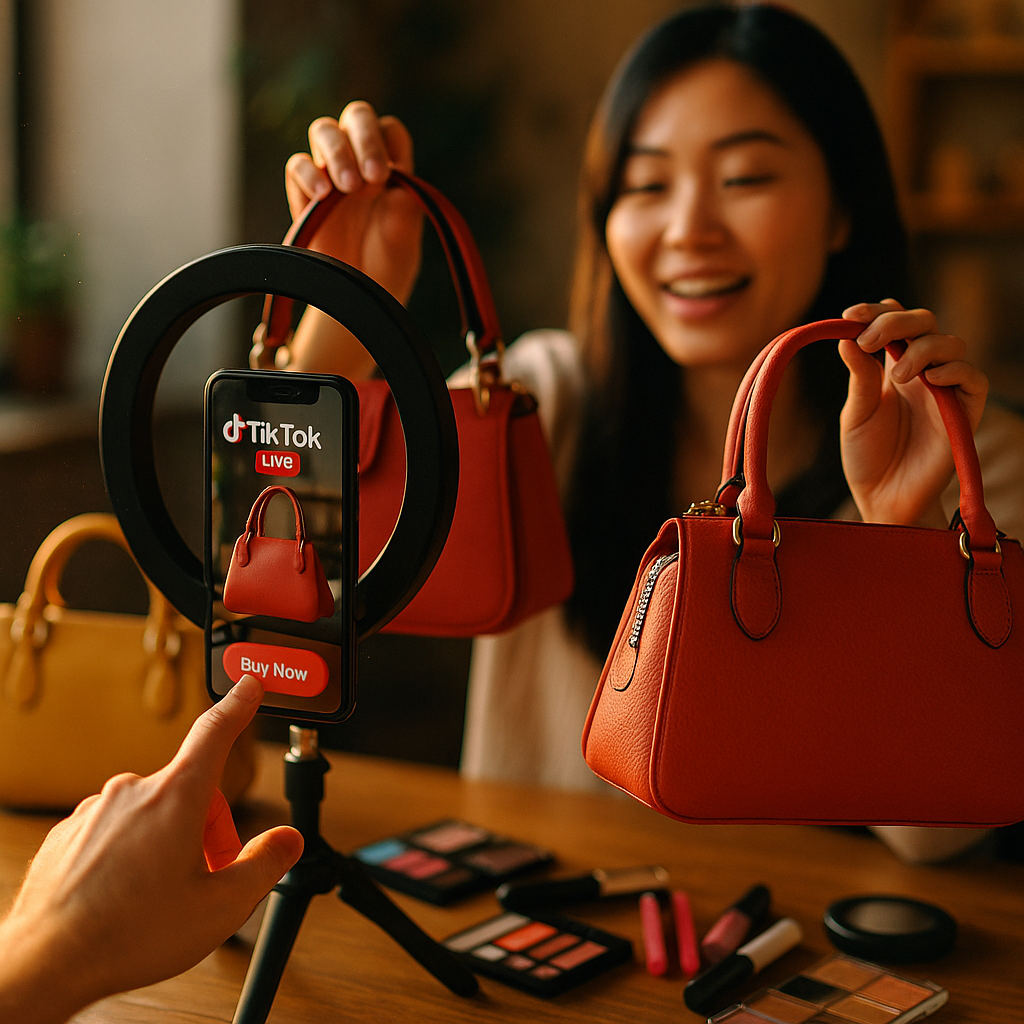
Forty-two percent of TikTok Shop purchases happen on impulse. No research phase, no cart abandonment, no next-day reconsideration — just a tap, a checkout, and a shipping confirmation. If your livestream script wasn’t built around that number, you’re leaving revenue on the table every single broadcast.
That stat comes from TikTok’s internal shopping behavior data, echoed by third-party commerce researchers tracking the platform’s checkout flow. It should reframe how brands think about livestream structure entirely. Most teams still plan streams like QVC reruns: product intro, features, price, repeat. That format ignores the actual psychology driving TikTok Shop sales — and it wastes the narrow window when a viewer is most likely to buy without thinking twice.
Why Impulse, Not Consideration, Drives TikTok Shop Revenue
TikTok Shop isn’t a search-driven marketplace. Nobody opens the app looking for a specific SKU. They’re scrolling, half-watching, half-distracted — and then something interrupts that pattern hard enough to trigger a purchase before rational evaluation kicks in. That’s the mechanism. It’s closer to grocery store checkout-lane psychology than Amazon-style comparison shopping.
This matters for budget allocation, not just creative. If nearly half your buyers are impulse-driven, your livestream pacing, host scripting, and even camera framing need to optimize for split-second decision triggers rather than long-form persuasion. Brands still building 20-minute feature walkthroughs are optimizing for the wrong 58%.
When 42% of buyers convert on impulse, the first 90 seconds of a livestream segment matter more than the next 20 minutes combined.
The Anatomy of a Spontaneous-Buy Segment
Impulse doesn’t mean chaotic. The highest-converting TikTok Shop hosts follow a repeatable rhythm, even if it looks improvised. Break down any top-performing livestream and you’ll find the same four beats, compressed into roughly 90 to 150 seconds per product:
- Interrupt (0–10 seconds): A visual or verbal pattern break — dropping a product, a before/after reveal, a shocked reaction — that stops the scroll-thumb reflex.
- Proof (10–40 seconds): Fast, tactile demonstration. Not a spec sheet. Show the product doing the thing it claims to do, live, unedited.
- Scarcity (40–70 seconds): Stock counter, time-limited bundle, or price drop tied to the live moment specifically — not a generic “limited time” claim.
- Close (70–150 seconds): Direct, repeated call to tap the yellow basket, paired with a reason to act now rather than bookmark for later.
Notice what’s missing: a long ingredients list, a brand history recap, a competitor comparison. Those belong in your product detail page, not your impulse window. Save the education for pinned comments or the shop tab description.
Segment Length Is a Retention Lever, Not Just a Content Choice
Livestream viewers churn fast. TikTok’s own engagement data (and pattern consistent with what we’ve seen across short-form retention research on other platforms) suggests attention drops sharply after the two-minute mark on any single product segment. Structuring content around 90-150 second windows isn’t arbitrary — it matches how long you actually have before a viewer’s thumb starts twitching toward the next stream.
Hosts who ignore this and linger on a product for five-plus minutes usually see a mid-segment viewer drop, then a weaker close than if they’d wrapped at 100 seconds and moved to the next SKU.
Building the Playbook: Pre-Stream Structuring
The best-performing streams aren’t improvised — they’re storyboarded down to the second, then delivered with enough natural energy that it doesn’t feel scripted. Here’s the operational structure worth adopting:
- Sequence products by impulse-friendliness. Lead with your lowest-consideration, highest-visual-payoff item. Save complex or high-ticket products for after you’ve built stream momentum and viewer trust.
- Script the interrupt moment explicitly. Don’t leave the pattern-break to chance. Write the exact line or action that opens each segment.
- Pre-load scarcity mechanics. Real stock counters, genuine time-boxed bundles. Fabricated urgency is both an FTC risk and, increasingly, something viewers can smell from a mile away.
- Build a rapid re-engagement loop. Every 3-4 segments, insert a giveaway, poll, or comment shoutout to reset attention before fatigue sets in.
- End every segment with a single, unambiguous CTA. One action, said twice, not three competing asks.
This structure lines up closely with what we outlined in how to structure TikTok Shop videos that convert — the difference is livestream demands the pacing be even tighter, since you’re competing with an infinite scroll rather than a single video’s runtime.
What About Compliance? Urgency Without the FTC Headache
Here’s where a lot of brands get nervous, and rightly so. Scarcity and urgency are the exact mechanics that trigger regulatory scrutiny. The FTC has been explicit that manufactured countdown timers, fake stock-outs, and misleading “sold out” claims are deceptive practices — full stop, no gray area.
The fix isn’t to abandon urgency. It’s to make it real and disclosed. If you’re running countdown-timer mechanics, review the scripting approach in our countdown timer scripts that avoid FTC risk breakdown before your next stream. The same discipline applies to restock messaging — we covered the compliant version of that specifically for beauty categories in beauty restock livestream compliance, and the framework generalizes well beyond beauty.
If you’re in a regulated vertical like supplements, the risk multiplier is even higher — health claims stacked on urgency claims is a compliance minefield, which is why we built a dedicated guide on running supplement livestreams without FTC exposure.
Real urgency converts. Fabricated urgency converts too — until it triggers an FTC inquiry that costs more than the campaign ever earned.
Product Tagging Isn’t an Afterthought
None of this segment structuring matters if the shopping cart isn’t surfaced at the right second. TikTok’s discovery algorithm weights product tags heavily in how it distributes livestream content to non-followers, and timing your tag pop-ups to coincide with your scarcity beat (not your interrupt beat) measurably improves click-through. We go deeper on the mechanics in how product tags boost reach — worth a read if your tech team is still treating tagging as a set-it-and-forget-it task.
Get the tag timing wrong and even a perfectly scripted segment underperforms, because the friction between “I want this” and “I can buy this” widens by a few crucial seconds.
Host Selection Matters More Than Script Polish
A tight script delivered by a stiff, over-rehearsed host underperforms a looser script delivered by someone who reads as genuinely excited. TikTok Shop audiences have developed a sharp radar for inauthenticity — something we’ve tracked across the platform more broadly, including in how the algorithm now favors casual content over polished production. The same bias shows up in live commerce. Brands hiring hosts purely for follower count, without testing their live improvisation skill, routinely underperform smaller creators who know how to riff naturally inside a structured segment.
If you’re rebuilding trust with TikTok Shop after a pause or a past compliance stumble, pair your host-selection criteria with the broader guidance in our re-entry playbook for advertiser confidence.
Measuring What Actually Matters
Total watch time is a vanity metric if it’s not paired with segment-level conversion data. The metrics worth tracking per segment:
- Tap-to-cart rate within the scarcity/close window specifically, not the segment average.
- Viewer retention curve across the 90-150 second segment — where exactly does drop-off spike?
- Comment sentiment velocity during the interrupt beat, as an early signal of whether the hook landed.
- Repeat-viewer rate across streams, which correlates strongly with long-term impulse-buy reliability versus one-off spikes.
Platforms like Sprout Social and category benchmarking from eMarketer can help contextualize whether your segment-level numbers are competitive or lagging, especially if you’re running livestream commerce across multiple categories and need an external benchmark rather than just internal trend lines.
Run this measurement discipline for two or three streams and you’ll start to see which product categories in your catalog actually lend themselves to the impulse mechanic. Not everything does — high-consideration purchases (think: skincare devices, appliances) may need a hybrid structure that blends a shorter impulse segment with a longer, separately-tagged educational VOD clip for viewers who want more before buying.
Next Step
Audit your last three livestreams against the 90-150 second segment structure above — if your top-performing segment already falls in that window, you’ve found your template; if it doesn’t, that’s your next test.
FAQs
What does the 42% impulse-buy stat actually measure?
It refers to the share of TikTok Shop purchases made without prior research or consideration — viewers who buy within the same session they first see the product, typically during a livestream or short-form video.
How long should a TikTok Shop livestream product segment be?
Most high-converting segments run 90 to 150 seconds, structured around an interrupt, a proof moment, a scarcity trigger, and a direct close. Longer segments tend to see mid-point viewer drop-off.
Is scarcity messaging on TikTok Shop risky from a compliance standpoint?
Yes, if it’s fabricated. Fake countdowns or false stock claims violate FTC guidance on deceptive practices. Real, disclosed scarcity (genuine limited stock, time-boxed bundles) is compliant and still effective.
Does host familiarity affect impulse-buy conversion?
Substantially. Repeat viewers who trust a host convert faster and with less persuasion needed per segment, which is why consistent hosting (versus rotating talent) tends to outperform over multiple streams.
Should every product in a catalog use the impulse-segment structure?
No. High-consideration items often need a hybrid approach: a short impulse-style hook paired with supplementary educational content in the shop tab or pinned comments for viewers who want more detail before purchasing.
FAQs
What does the 42% impulse-buy stat actually measure?
It refers to the share of TikTok Shop purchases made without prior research or consideration — viewers who buy within the same session they first see the product, typically during a livestream or short-form video.
How long should a TikTok Shop livestream product segment be?
Most high-converting segments run 90 to 150 seconds, structured around an interrupt, a proof moment, a scarcity trigger, and a direct close. Longer segments tend to see mid-point viewer drop-off.
Is scarcity messaging on TikTok Shop risky from a compliance standpoint?
Yes, if it’s fabricated. Fake countdowns or false stock claims violate FTC guidance on deceptive practices. Real, disclosed scarcity (genuine limited stock, time-boxed bundles) is compliant and still effective.
Does host familiarity affect impulse-buy conversion?
Substantially. Repeat viewers who trust a host convert faster and with less persuasion needed per segment, which is why consistent hosting (versus rotating talent) tends to outperform over multiple streams.
Should every product in a catalog use the impulse-segment structure?
No. High-consideration items often need a hybrid approach: a short impulse-style hook paired with supplementary educational content in the shop tab or pinned comments for viewers who want more detail before purchasing.
Top Influencer Marketing Agencies
The leading agencies shaping influencer marketing in 2026
Agencies ranked by campaign performance, client diversity, platform expertise, proven ROI, industry recognition, and client satisfaction. Assessed through verified case studies, reviews, and industry consultations.
Moburst

-
2

The Shelf
Boutique Beauty & Lifestyle Influencer AgencyA data-driven boutique agency specializing exclusively in beauty, wellness, and lifestyle influencer campaigns on Instagram and TikTok. Best for brands already focused on the beauty/personal care space that need curated, aesthetic-driven content.Clients: Pepsi, The Honest Company, Hims, Elf Cosmetics, Pure LeafVisit The Shelf → -
3

Audiencly
Niche Gaming & Esports Influencer AgencyA specialized agency focused exclusively on gaming and esports creators on YouTube, Twitch, and TikTok. Ideal if your campaign is 100% gaming-focused — from game launches to hardware and esports events.Clients: Epic Games, NordVPN, Ubisoft, Wargaming, Tencent GamesVisit Audiencly → -
4

Viral Nation
Global Influencer Marketing & Talent AgencyA dual talent management and marketing agency with proprietary brand safety tools and a global creator network spanning nano-influencers to celebrities across all major platforms.Clients: Meta, Activision Blizzard, Energizer, Aston Martin, WalmartVisit Viral Nation → -
5

The Influencer Marketing Factory
TikTok, Instagram & YouTube CampaignsA full-service agency with strong TikTok expertise, offering end-to-end campaign management from influencer discovery through performance reporting with a focus on platform-native content.Clients: Google, Snapchat, Universal Music, Bumble, YelpVisit TIMF → -
6

NeoReach
Enterprise Analytics & Influencer CampaignsAn enterprise-focused agency combining managed campaigns with a powerful self-service data platform for influencer search, audience analytics, and attribution modeling.Clients: Amazon, Airbnb, Netflix, Honda, The New York TimesVisit NeoReach → -
7

Ubiquitous
Creator-First Marketing PlatformA tech-driven platform combining self-service tools with managed campaign options, emphasizing speed and scalability for brands managing multiple influencer relationships.Clients: Lyft, Disney, Target, American Eagle, NetflixVisit Ubiquitous → -
8

Obviously
Scalable Enterprise Influencer CampaignsA tech-enabled agency built for high-volume campaigns, coordinating hundreds of creators simultaneously with end-to-end logistics, content rights management, and product seeding.Clients: Google, Ulta Beauty, Converse, AmazonVisit Obviously →