


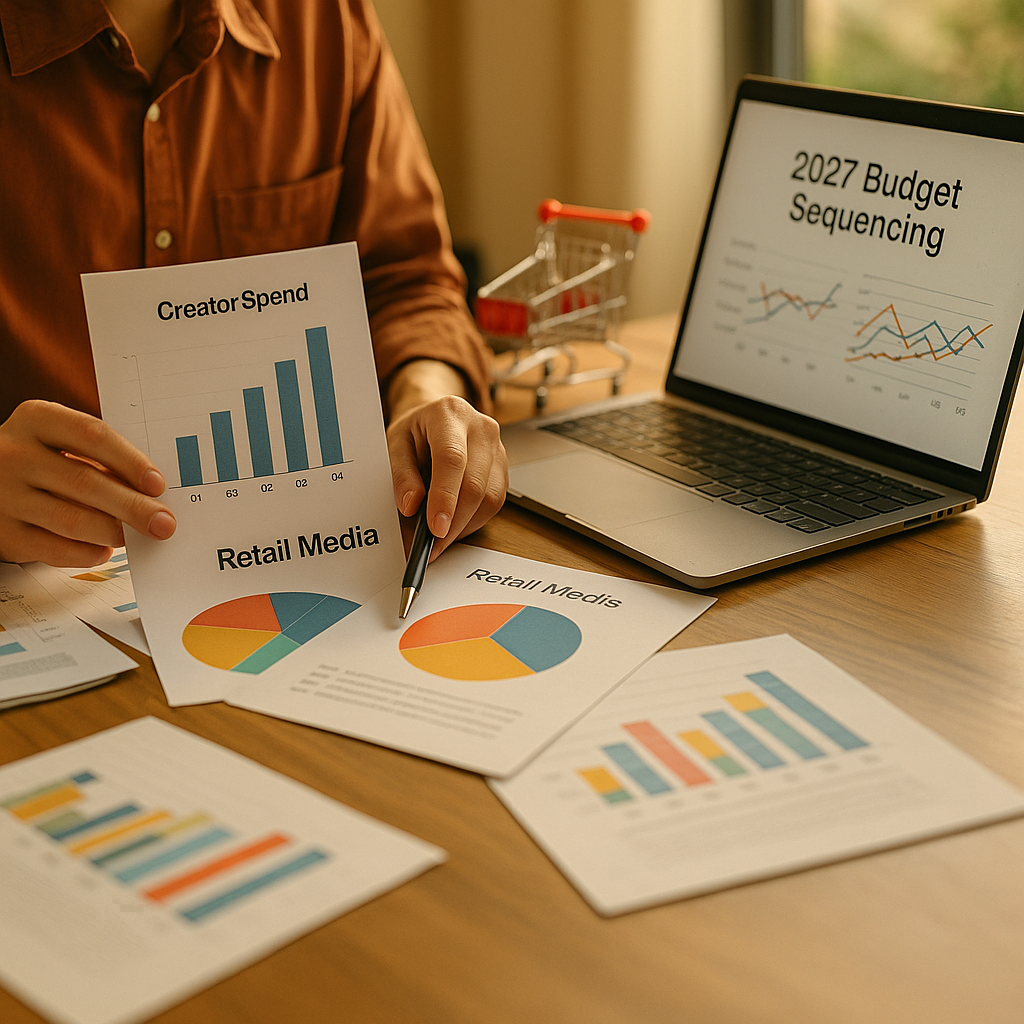
Goldman Sachs says the creator economy hits $480 billion by decade’s end. Retail media, meanwhile, is eating linear ad budgets whole. So why are most brands still planning creator spend and retail media in separate meetings, run by separate teams, on separate timelines? That disconnect is about to get expensive.
If you’re building next year’s marketing budget right now, the sequencing question isn’t “how much for creators” versus “how much for retail media.” It’s how those two lines converge, and which one you fund first to make the other work harder.
The $480 Billion Number Isn’t the Point — the Timing Is
Goldman’s forecast has been quoted so often it’s starting to lose meaning. Everyone cites the topline. Few brands actually build a spend calendar around it. The number matters less than the growth curve behind it: creator economy spend is compounding faster than traditional media, and retail media networks (Amazon, Walmart Connect, Target Roundel, Instacart) are absorbing an increasing share of brand budgets that used to sit in linear TV or generic social.
Here’s the uncomfortable part for finance teams: these two trends are colliding at the SKU level. A creator post now frequently drives a retail media search spike within 48 hours. Brands that treat these as separate budget lines are measuring half the funnel and none of the interaction effect.
Retail media and creator content aren’t two channels anymore — they’re one funnel with two entry points, and budgeting them separately is how brands lose attribution and money simultaneously.
What Convergence Actually Looks Like on a P&L
Walk into most CFO budget reviews and you’ll still see “influencer marketing” and “retail media” as distinct cost centers, often owned by different VPs. That’s an org chart problem masquerading as a budget problem. The brands getting this right in category leaders like beauty and CPG are doing something different: they’re funding creator content as the top-of-funnel driver that feeds retail media’s bottom-of-funnel conversion engine, and they’re sequencing dollars accordingly.
Practically, this means creator briefs now specify retail placement outcomes, not just impressions. A TikTok Shop creator video isn’t judged on views alone. It’s judged on whether it lifted Amazon search share for the SKU that week. For deeper modeling on this handoff, see our breakdown of merging retail lift and influencer reach inside a unified media mix model.
How Should You Sequence 2027 Budget Planning?
Sequencing, not sizing, is the real 2027 budget planning challenge. Get the order wrong and you’ll overfund awareness before you have retail infrastructure to capture the demand, or you’ll overfund retail media bids without enough creator content in market to drive organic search lift. Here’s a sequencing logic that’s holding up across CPG, beauty, and DTC brands running this playbook now.
- Lock retail media baseline spend first. This is largely non-negotiable defensive spend — if you don’t bid on your own branded search terms on Amazon, a competitor will. Treat this as fixed cost, not discretionary.
- Fund creator content as a demand-generation input, sequenced 4-6 weeks ahead of retail media pushes. Content needs runway to seed organic search and social proof before paid retail media dollars try to capture that demand.
- Reserve a flexible tranche (15-20%) for reactive creator spend tied to real-time retail signals: trending SKUs, competitor stockouts, seasonal spikes.
- Zero-base the legacy line items — sponsorships, aggregator platforms, awareness-only influencer deals that don’t tie to a retail or commerce outcome.
This isn’t theoretical. It mirrors the quarterly cadence outlined in our quarterly budget sequencing framework for the creator economy, which breaks the $480B forecast into actionable quarterly gates rather than one annual lump-sum decision.
Zero-Based Budgeting Is the Only Honest Starting Point
Most brands don’t need more creator budget. They need to stop funding creator spend that was locked in during a different market. A macro-influencer sponsorship signed two years ago, priced on reach assumptions that algorithm changes have since gutted, is not automatically worth renewing just because it’s in the budget template.
Zero-based budgeting forces the question: would you fund this line item today, from scratch, given what you now know about retail-media convergence? Our guide on zero-based budgeting from macro sponsorships to micro-influencers walks through exactly this reallocation exercise, and it pairs well with the CFO-specific model in zero-based budgeting for the creator spend crossover.
One pattern shows up repeatedly: brands cutting 20-30% from legacy aggregator platforms and macro sponsorships, then redeploying that capital into a nano-to-micro creator ladder that’s cheaper per unit of engagement and easier to tie directly to retail conversion data.
Where the Fraud and Attribution Risk Hides
Convergence creates new attribution complexity, and complexity is where fraud hides. When a creator’s content is supposed to drive both social engagement and retail search lift, you need clean measurement on both sides — and vendors know that’s hard to audit.
Before you commit 2027 dollars to any creator platform or agency claiming they can “prove” retail lift from creator content, run their methodology through a real vetting process. Our fraud-detection vendor vetting checklist is a useful starting point, especially since inflated engagement metrics get laundered more easily when they’re wrapped in a retail-lift narrative that’s harder for finance teams to independently verify.
This is also where a 12-month creator vetting cadence matters more than a one-time audit. Platforms and creator rosters shift constantly; a vendor that passed vetting in Q1 may not deserve the same trust by Q4. The fraud-adjusted creator discovery playbook lays out a repeatable cycle rather than a one-off checkbox.
The riskiest budget line in 2027 won’t be the one that’s too small — it’ll be the one nobody re-audits after the initial vetting pass.
Measurement: Retail Lift Plus Reach, Not Either/Or
CFOs are increasingly (and rightly) skeptical of reach-based creator reporting. “12 million impressions” doesn’t answer whether the campaign moved product. Retail media convergence actually gives marketing teams a gift here: real, SKU-level sales data that can validate or kill a creator strategy far faster than brand-lift surveys ever could.
The brands winning budget approval in 2027 planning cycles are the ones walking into finance reviews with media mix models that explicitly connect creator spend to retail ROAS, not vague directional claims. Two resources worth building into your planning deck: media mix modeling for CFOs comparing creator spend and retail ROAS, and the sales-lift-first reporting approach in a CFO framework for proving sales lift.
Boards don’t fund reach. They fund revenue they can trace. If your 2027 deck still leads with impressions, you’re pitching the wrong audience the wrong metric.
A Quick Gut-Check for Your Planning Meeting
- Does your creator budget have an explicit retail media handoff point, or are the two teams still planning in silos?
- Have you zero-based any line item older than 18 months?
- Can your vendor show fraud-detection methodology beyond a single onboarding audit?
- Is at least 15% of creator spend flexible enough to react to real-time retail signals?
- Does your reporting deck lead with sales lift, or still lead with reach?
If you answered “no” to more than two of these, your 2027 plan is still built for a market that no longer exists. According to eMarketer, retail media ad spend continues to outpace overall digital ad growth, and Statista‘s creator economy tracking shows a similar acceleration curve. Neither is slowing down long enough for brands to plan them separately much longer.
For teams that want a longer runway view rather than a single-year fix, the 3-year capital allocation plan for creator spend sequencing is worth reviewing alongside your annual budget — 2027 planning shouldn’t happen in isolation from 2028 and beyond, especially given how fast retail media inventory and pricing are shifting. You can also benchmark your organizational readiness against the model in our creator economy center of excellence org chart, since convergence budgeting only works if the teams behind it are structured to collaborate, not compete for headcount.
Next Step
Don’t wait for a full annual planning cycle to test this. Pick one SKU or product line, fund a small creator-to-retail-media sequence this quarter, measure the search and sales lift directly, then use that data — not the $480 billion headline — to justify your 2027 allocation to finance.
Frequently Asked Questions
What is the Goldman Sachs $480 billion creator economy forecast based on?
The forecast projects the global creator economy’s growth trajectory through the end of the decade, factoring in platform monetization tools, brand deal volume, and creator-driven commerce. It’s a directional signal for budget planners more than a precise annual figure.
How should brands sequence creator and retail media budgets for next year?
Lock defensive retail media spend first, fund creator content 4-6 weeks ahead of retail pushes to seed demand, reserve a flexible tranche for reactive spend, and zero-base any legacy line items that no longer tie to a measurable retail or commerce outcome.
Why is retail-media convergence changing how creator ROI gets measured?
Retail media networks provide SKU-level sales data that can directly validate whether creator content drove purchases, replacing vague reach and impression metrics with actual revenue attribution that finance teams trust.
What’s the biggest budgeting mistake brands make with creator spend?
Treating creator budgets and retail media budgets as separate line items owned by separate teams, which breaks attribution and duplicates measurement effort instead of capturing the interaction effect between the two channels.
How much of a creator budget should stay flexible for 2027 planning?
Most brands running this model reserve 15-20% of creator spend as a reactive tranche, allowing teams to respond to real-time retail signals like trending SKUs or competitor stockouts rather than locking every dollar into a fixed annual plan.
Top Influencer Marketing Agencies
The leading agencies shaping influencer marketing in 2026
Agencies ranked by campaign performance, client diversity, platform expertise, proven ROI, industry recognition, and client satisfaction. Assessed through verified case studies, reviews, and industry consultations.
Moburst

-
2

The Shelf
Boutique Beauty & Lifestyle Influencer AgencyA data-driven boutique agency specializing exclusively in beauty, wellness, and lifestyle influencer campaigns on Instagram and TikTok. Best for brands already focused on the beauty/personal care space that need curated, aesthetic-driven content.Clients: Pepsi, The Honest Company, Hims, Elf Cosmetics, Pure LeafVisit The Shelf → -
3

Audiencly
Niche Gaming & Esports Influencer AgencyA specialized agency focused exclusively on gaming and esports creators on YouTube, Twitch, and TikTok. Ideal if your campaign is 100% gaming-focused — from game launches to hardware and esports events.Clients: Epic Games, NordVPN, Ubisoft, Wargaming, Tencent GamesVisit Audiencly → -
4

Viral Nation
Global Influencer Marketing & Talent AgencyA dual talent management and marketing agency with proprietary brand safety tools and a global creator network spanning nano-influencers to celebrities across all major platforms.Clients: Meta, Activision Blizzard, Energizer, Aston Martin, WalmartVisit Viral Nation → -
5

The Influencer Marketing Factory
TikTok, Instagram & YouTube CampaignsA full-service agency with strong TikTok expertise, offering end-to-end campaign management from influencer discovery through performance reporting with a focus on platform-native content.Clients: Google, Snapchat, Universal Music, Bumble, YelpVisit TIMF → -
6

NeoReach
Enterprise Analytics & Influencer CampaignsAn enterprise-focused agency combining managed campaigns with a powerful self-service data platform for influencer search, audience analytics, and attribution modeling.Clients: Amazon, Airbnb, Netflix, Honda, The New York TimesVisit NeoReach → -
7

Ubiquitous
Creator-First Marketing PlatformA tech-driven platform combining self-service tools with managed campaign options, emphasizing speed and scalability for brands managing multiple influencer relationships.Clients: Lyft, Disney, Target, American Eagle, NetflixVisit Ubiquitous → -
8

Obviously
Scalable Enterprise Influencer CampaignsA tech-enabled agency built for high-volume campaigns, coordinating hundreds of creators simultaneously with end-to-end logistics, content rights management, and product seeding.Clients: Google, Ulta Beauty, Converse, AmazonVisit Obviously →