


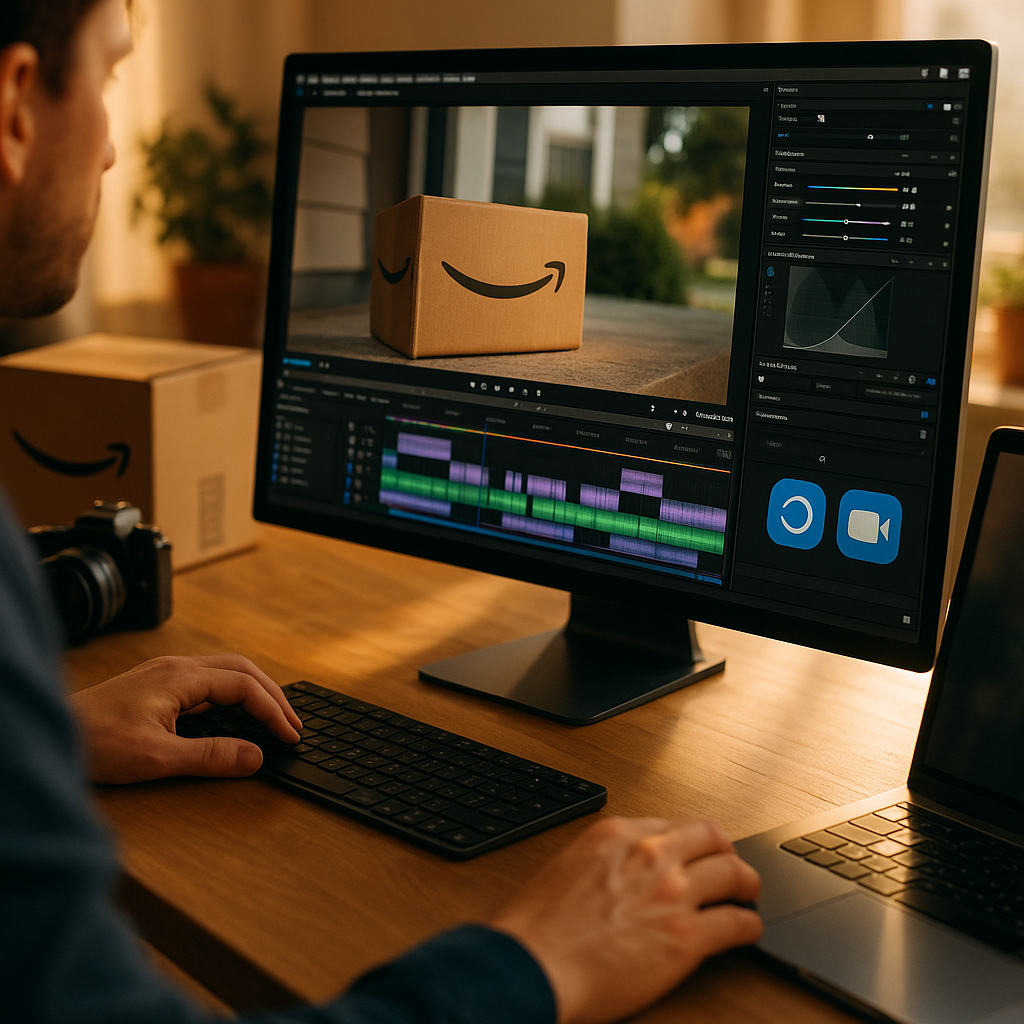
Three weeks. That’s the average lead time brand teams have budgeted for producing a single video ad variant, from brief to final cut. Amazon’s new agentic audio and video ad generation tools just made that timeline look absurd. Inside Amazon Ads, generative agents can now storyboard, voice, and render a 15-second video spot in the time it takes to grab coffee. For media buyers still staffing production around weekly agency check-ins, that’s not a minor efficiency gain. It’s a structural threat to how creative budgets get planned.
What Amazon Actually Shipped
Amazon Ads has spent the past two years quietly expanding its generative creative suite, and the latest agentic layer moves it from “helpful tool” to something closer to an autonomous production unit. The system takes a product listing, brand guidelines, and a handful of prompts, then outputs multiple video and audio ad variants: different voiceovers, different pacing, different calls to action, all tuned for placement across Amazon’s owned inventory and increasingly its off-platform partners.
The “agentic” part matters. This isn’t a single-shot generator spitting out one draft for a human to fix. It’s a chain of specialized agents, one handling script logic, another handling voice synthesis, another handling visual composition, that iterate against each other before a human ever sees the output. Amazon has positioned this as an extension of its existing self-service ad tools, but the practical effect for brand teams is closer to replacing a junior creative team than replacing a single tool.
What used to require a creative brief, two rounds of agency revisions, and a legal review cycle can now produce a first-pass deliverable in under an hour, shifting the real bottleneck from production to approval.
The Timeline Math Has Changed, Not Just the Tools
Here’s the part media buyers need to internalize: this isn’t primarily a cost story. It’s a calendar story. Traditional video ad production for a mid-size brand campaign typically runs four to six weeks when you count concepting, shoot scheduling, editing, and revisions. Audio-only ads compress that somewhat but still involve voice talent booking and studio time.
Agentic generation collapses most of that into same-day turnaround. Brands running Amazon DSP campaigns can now test creative concepts against live performance data and regenerate variants within the same planning cycle, rather than locking in creative weeks before a campaign goes live. That changes how you should be budgeting flight dates, and it changes what “creative testing” even means when iteration cost drops close to zero.
It also puts pressure on adjacent workflows. If Amazon can generate ten video variants overnight, your approval process becomes the slowest part of the chain by a wide margin. Brands that haven’t already streamlined creative sign-off are going to feel that gap acutely. Teams that have modernized their creator content approval workflows are better positioned to actually capture the speed advantage instead of just watching drafts pile up in a review queue.
Why Media Buyers Are Cautiously Excited, Not Fully Sold
Ask a media buyer running seven-figure Amazon budgets what worries them about agentic creative tools, and cost isn’t the first answer. Control is. When an AI agent chains together script, voice, and visual decisions autonomously, the audit trail for “why does this ad say what it says” gets murkier. That matters enormously in regulated categories: supplements, financial products, anything touching health claims.
There’s also a brand-safety dimension. Generated voiceovers can drift in tone. Generated scripts can accidentally imply claims your legal team never approved. The speed is real, but so is the risk of shipping something off-brand at scale before anyone catches it. This is exactly the tension explored in the agentic media buying trust gap, where nearly half of surveyed marketers still require human sign-off before agentic systems can execute, even when the tooling is technically capable of running unsupervised.
None of this means the tools aren’t worth adopting. It means the operational question has shifted from “can AI generate decent ad creative” (yes, clearly) to “how fast can our governance keep up with generation speed.” Those are very different problems, and most brand teams are still solving the wrong one.
Where This Fits in the Bigger Retail Media Shift
Amazon isn’t alone here, but it has a structural advantage: first-party purchase data feeding directly into creative generation. Google and Meta have their own generative ad tools, but Amazon’s version can theoretically tune creative variants against actual conversion signals from its retail ecosystem in near real time. That’s a different value proposition than generic AI video generation.
eMarketer and other analysts have tracked retail media’s growing share of total ad spend for several years now, and tools like this are part of why that growth keeps compounding. When the platform holding the purchase data also controls creative production, the incentive to consolidate spend there gets stronger. Brand teams evaluating budget allocation should treat this as a genuine strategic input, not just a nice-to-have production feature. For more on how retail media performance claims are being validated (or not), see retail media sales-lift attribution coverage on vendor trust gaps.
It’s worth comparing this to what’s happening with product video generation more broadly. Tools that turn catalog images into shoppable video are solving a similar production bottleneck from a different angle, converting static assets into dynamic creative without a shoot. Amazon’s agentic system is the retail-media-native version of that same trend, and buyers should expect these categories to converge over the next several planning cycles.
Operational Changes Media Buyers Should Make Now
Speed without process is just chaos with better production values. If your team is adopting Amazon’s agentic tools, or evaluating whether to, a few operational shifts are non-negotiable:
- Rebuild your approval SLAs around hours, not weeks. If legal and brand review still operate on a five-business-day cycle, you’ve just created a new bottleneck that erases most of the speed gain.
- Establish claim-checking as a pre-flight step, not a post-hoc catch. Generated scripts need automated scanning for regulatory language before human review even starts. This is the same logic behind AI pre-flight checks that catch problems before spend goes live.
- Audit brand compliance at the variant level, not the campaign level. When one prompt generates ten variants, checking one and assuming the rest match isn’t good enough. Look at frameworks for vetting brand compliance at scale if you haven’t already built this muscle.
- Renegotiate agency retainers. If Amazon’s tooling is producing first-pass creative in-house, your agency relationship should shift toward strategy, refinement, and channels where human craft still matters, not commodity production.
- Track model versioning in vendor contracts. Agentic tools get updated constantly, and a model swap can change output quality or tone overnight. This is precisely why model substitution clauses deserve a contract review before you scale usage.
None of these are exotic asks. They’re the same discipline brands have applied to programmatic media buying for a decade, just pointed at a new part of the funnel.
Will This Replace Human Creative Teams?
Short answer: not the good ones. What it replaces is the high-volume, low-differentiation work, the fifth version of a product ad that just swaps the CTA. That work was never where creative directors added the most value anyway.
What it does threaten is the mid-tier production shop whose entire pitch was “we can turn creative around fast.” Speed just stopped being a differentiator. Judgment, brand voice, and cultural fluency are what’s left to compete on, and those are harder to automate than a voiceover script.
Brands should also watch how this interacts with influencer and creator content pipelines. If agentic tools can generate branded video at near-zero marginal cost, the comparative value of creator-made content shifts toward authenticity and trust signals that synthetic content can’t replicate. That’s consistent with the broader push toward engineering creator content for algorithmic amplification, where the human element remains the differentiator even as production tooling gets automated underneath it.
For a useful industry benchmark on how fast AI-generated advertising is scaling overall, eMarketer’s ad spend research and Statista’s advertising data are both tracking this shift closely, and the trajectory points toward generative tools becoming baseline infrastructure rather than a novelty within the next few planning cycles. Amazon’s own marketing operations benchmarks from platforms like HubSpot echo a similar pattern across other channels: production speed is no longer the constraint, governance is.
The Real Bottleneck Isn’t Creative Anymore
Here’s the uncomfortable truth for a lot of brand teams: your creative production timeline was never really about creative production. It was about how many humans had to sign off before something could ship. Amazon’s agentic tools just removed the production excuse. What’s left exposed is whatever’s slow in your approval chain, your legal review, your brand governance.
Fixing that isn’t glamorous work. But it’s the actual unlock. Brands that treat this moment as “buy faster tools” will get modest gains. Brands that treat it as “redesign the approval pipeline around machine-speed production” will get the real advantage.
Next Step
Before scaling Amazon’s agentic ad tools across your next campaign, run a 30-day pilot limited to one product line, map every hour lost to approval delays, and fix that pipeline first. The generation speed is already there. Your governance just needs to catch up.
FAQs
What are Amazon’s agentic audio and video ad generation tools?
They’re AI systems within Amazon Ads that use chained, specialized agents to autonomously produce audio and video ad variants, handling scripting, voice synthesis, and visual composition with minimal human input before a first draft reaches a reviewer.
How much faster is agentic creative production compared to traditional methods?
Traditional video ad production typically takes four to six weeks from brief to final cut. Amazon’s agentic tools can generate first-pass video and audio variants in under an hour, though brand review and legal approval still add time on top of that.
Does faster ad generation increase brand safety risk?
It can, if approval workflows aren’t updated to match. Generated scripts may drift from approved messaging or unintentionally imply claims that weren’t vetted, which is why pre-flight compliance checks and variant-level review matter more with agentic tools than with traditional production.
Will agentic AI tools replace creative agencies?
They’re more likely to replace low-differentiation, high-volume production work than strategic creative direction. Agencies that shift toward brand strategy, cultural insight, and creative judgment remain valuable; agencies competing purely on turnaround speed will feel the most pressure.
What should media buyers change first when adopting these tools?
Approval workflows. If legal and brand review still operate on a multi-day cycle, the production speed gain gets erased. Buyers should also revisit vendor contracts for model versioning language, since agentic tools update frequently and can shift output quality without notice.
Top Influencer Marketing Agencies
The leading agencies shaping influencer marketing in 2026
Agencies ranked by campaign performance, client diversity, platform expertise, proven ROI, industry recognition, and client satisfaction. Assessed through verified case studies, reviews, and industry consultations.
Moburst

-
2

The Shelf
Boutique Beauty & Lifestyle Influencer AgencyA data-driven boutique agency specializing exclusively in beauty, wellness, and lifestyle influencer campaigns on Instagram and TikTok. Best for brands already focused on the beauty/personal care space that need curated, aesthetic-driven content.Clients: Pepsi, The Honest Company, Hims, Elf Cosmetics, Pure LeafVisit The Shelf → -
3

Audiencly
Niche Gaming & Esports Influencer AgencyA specialized agency focused exclusively on gaming and esports creators on YouTube, Twitch, and TikTok. Ideal if your campaign is 100% gaming-focused — from game launches to hardware and esports events.Clients: Epic Games, NordVPN, Ubisoft, Wargaming, Tencent GamesVisit Audiencly → -
4

Viral Nation
Global Influencer Marketing & Talent AgencyA dual talent management and marketing agency with proprietary brand safety tools and a global creator network spanning nano-influencers to celebrities across all major platforms.Clients: Meta, Activision Blizzard, Energizer, Aston Martin, WalmartVisit Viral Nation → -
5

The Influencer Marketing Factory
TikTok, Instagram & YouTube CampaignsA full-service agency with strong TikTok expertise, offering end-to-end campaign management from influencer discovery through performance reporting with a focus on platform-native content.Clients: Google, Snapchat, Universal Music, Bumble, YelpVisit TIMF → -
6

NeoReach
Enterprise Analytics & Influencer CampaignsAn enterprise-focused agency combining managed campaigns with a powerful self-service data platform for influencer search, audience analytics, and attribution modeling.Clients: Amazon, Airbnb, Netflix, Honda, The New York TimesVisit NeoReach → -
7

Ubiquitous
Creator-First Marketing PlatformA tech-driven platform combining self-service tools with managed campaign options, emphasizing speed and scalability for brands managing multiple influencer relationships.Clients: Lyft, Disney, Target, American Eagle, NetflixVisit Ubiquitous → -
8

Obviously
Scalable Enterprise Influencer CampaignsA tech-enabled agency built for high-volume campaigns, coordinating hundreds of creators simultaneously with end-to-end logistics, content rights management, and product seeding.Clients: Google, Ulta Beauty, Converse, AmazonVisit Obviously →