


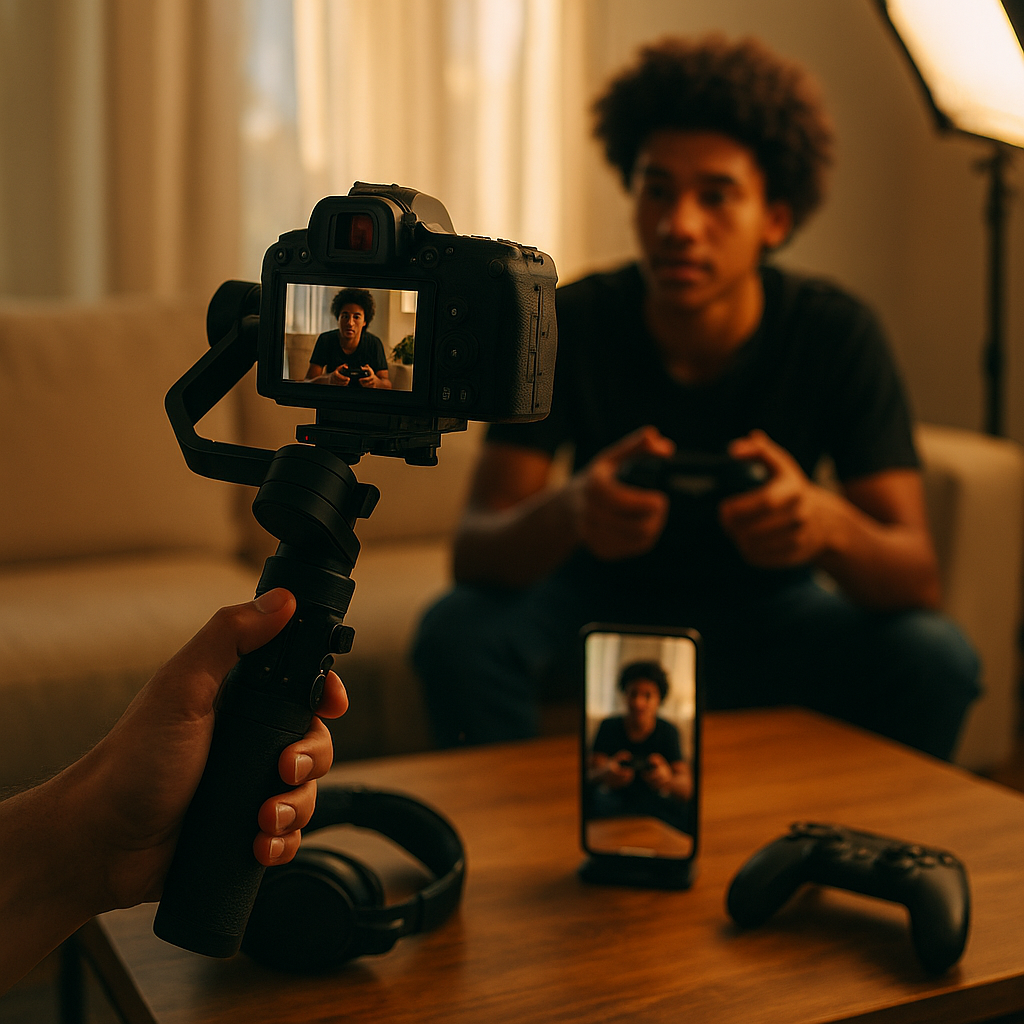
One gaming app spent $40,000 on a single “hero” TikTok ad. It flopped in three days. The winning creative that quarter? A $600 variant shot on the same day, from the same b-roll, with a different hook and a shakier zoom. This is the uncomfortable truth about the rapid-iteration ad creative format: volume beats polish, and most gaming marketers are still shooting like it’s 2019.
If you’re running user acquisition for a mobile game, you already know TikTok’s ad auction punishes stale creative. Fatigue sets in fast, sometimes within 48 hours of a variant going live. The fix isn’t shooting more campaigns. It’s shooting smarter, once, and slicing that footage into dozens of testable angles before your competitor finishes their storyboard review.
Why One Shoot Should Never Produce One Ad
Gaming apps have a structural advantage most brands don’t: gameplay footage is inherently modular. A single session can yield boss fights, near-misses, loot drops, UI moments, and reaction shots. Treating that footage as raw material for one polished ad is like buying a pallet of lumber and building a single chair.
The smarter model, and the one performance teams at UA-heavy studios have quietly standardized on, is to plan the shoot around fragmentation from day one. That means briefing your creator or capture team not for “a great ad” but for “forty great pieces.”
A single 90-minute gameplay capture session, cut correctly, can realistically produce 20-40 distinct TikTok variants without reshooting a single frame.
This isn’t a novel idea in performance marketing generally. It’s just underused in gaming, where creative teams still default to trailer-style production values borrowed from console marketing. TikTok doesn’t reward trailers. It rewards specificity, speed, and volume, which is exactly why the format below exists.
What the Rapid-Iteration Format Actually Requires
Before you book the capture session, get four things locked in the brief. Skip any of these and your editors will burn hours reverse-engineering intent from raw footage.
- A hook inventory, not a hook. List 10-15 opening lines or visual hooks before the shoot: “This game got banned in three countries,” “POV: you’re addicted to this in 4 minutes,” “I found the most satisfying loop on TikTok.” Each one becomes a separate variant’s first three seconds.
- Modular capture, not narrative capture. Shoot gameplay in distinct, nameable chunks: tutorial confusion, mid-game tension, victory screen, failure screen, UI close-ups, in-app purchase prompts. Label these during capture, not during editing.
- A reaction layer, separate from gameplay. Capture face-cam reactions independently. This lets editors mix and match reaction clips against different gameplay chunks, effectively doubling your variant count without new footage.
- A caption and CTA matrix. Pre-write 8-10 caption angles and 5-6 CTA variations. Pair these against your hooks and gameplay chunks in a spreadsheet before editing starts, so the edit team is assembling, not deciding.
This is the same modular thinking behind building one hero asset that scales across formats, just compressed into a single shoot day instead of a single campaign concept.
The Math That Justifies the Extra Prep Time
Here’s the ROI case, plainly. If a standard gaming app shoot costs $3,000-$8,000 and produces one ad, your cost per variant is the full shoot cost. If that same shoot, with proper modular briefing, produces 30 variants, your cost per variant drops to roughly $100-$270. Editing time increases, sure. But editing is cheaper than reshooting, and infinitely cheaper than running a media budget against fatigued creative.
eMarketer has repeatedly flagged creative fatigue as one of the top reasons UA costs spike on TikTok, particularly in gaming verticals where CPI competition is brutal. Refer to eMarketer’s advertising research for category-level fatigue benchmarks. The practical implication: your creative refresh rate needs to outpace your competitors’ testing velocity, not just your own last quarter.
Building the Variant Matrix
Once footage is captured, the real leverage comes from a variant matrix, essentially a grid crossing hooks against gameplay chunks against CTAs. A simple 5x4x3 matrix (5 hooks, 4 gameplay chunks, 3 CTAs) yields 60 theoretical combinations. You won’t cut all 60. But having the matrix means your editors are pulling from a menu, not improvising.
Structure it like this:
- Rank hooks by predicted strength (based on past performance data or category benchmarks).
- Pair top hooks with your strongest gameplay moment first. This is your control set, roughly 5-8 variants.
- Cross remaining hooks against secondary gameplay chunks for your test set, another 15-20 variants.
- Reserve 5-10 slots for wildcard pairings, unexpected combinations your data hasn’t validated yet.
This mirrors the logic in watch-time-first briefing for TikTok’s algorithm: the platform rewards early retention signals, so your matrix should prioritize hook-and-chunk pairings most likely to hold viewers in the first three to five seconds, before optimizing for anything downstream.
Don’t Skip the Compliance Pass
Gaming apps, especially those with loot boxes, gacha mechanics, or real-money elements, sit in a scrutinized category. Running 30+ variants means 30+ opportunities for a compliance slip: an implied win-rate claim, an unlabeled paid partnership, an unsubstantiated “best game of the year” claim.
Build a single compliance checklist that every variant gets run through before upload, not after a platform flag. Check for FTC-relevant disclosure language if creators are involved, verify no misleading gameplay footage (a notorious issue in mobile gaming ads, where shown gameplay doesn’t match the actual app), and confirm age-gating claims match your app store rating. The FTC’s endorsement guidance is the baseline reference here, and it applies even when the “creator” is an in-house employee doing a reaction cam.
This connects directly to broader originality standards worth building into any high-volume brief; see how anti-repost creative standards protect platform reach, since TikTok’s algorithm can suppress distribution on content it flags as duplicative or recycled, a real risk when you’re pumping out dozens of similar-looking variants from one shoot.
Editing Workflow: Where Most Teams Bottleneck
The shoot is rarely the constraint. Editing throughput is. If one editor is manually cutting all 30 variants from scratch, you’ve just recreated the bottleneck you were trying to avoid.
Three fixes that actually work in production:
- Template-based editing. Build 3-4 base templates in CapCut or Premiere with placeholder zones for hook text, gameplay clip, and CTA. Editors swap assets into templates rather than building from a blank timeline each time.
- Batch captioning. Write all captions and on-screen text in a single spreadsheet pass before any editor touches the timeline. Context-switching between writing and cutting is the single biggest time-killer in high-volume production.
- Parallel review, not sequential. Review variants in batches of 5-10, not one at a time as they’re finished. Sequential review creates approval bottlenecks that erase the speed advantage of the whole exercise.
Tools matter less than discipline here, but TikTok’s own TikTok Ads Manager supports Smart Creative and automated variant testing that can absorb a lot of this volume once assets are uploaded, letting the platform’s algorithm do some of the combinatorial work for you rather than manually testing every pairing.
Testing Cadence: How Fast Is Too Fast?
Once variants are live, the temptation is to kill underperformers within hours. Resist it. TikTok’s delivery algorithm needs a minimum learning window, generally 48-72 hours or a few thousand impressions, before performance signals are reliable. Pulling creative too early just resets the auction’s understanding of your account.
A sane cadence for gaming UA teams: launch 8-10 variants per batch, let them run a full learning cycle, then rotate in fresh cuts from your matrix while archiving (not deleting) underperformers. Archived losers often get revived later against different audiences or after a game update changes the gameplay footage’s relevance.
This staged approach also plays well with broader short-form strategy; the same pacing logic shows up in short-form briefs built for algorithm distribution, where batch testing consistently outperforms one-off launches.
What “Dozens of Variants” Actually Looks Like in Practice
A mid-size puzzle game UA team I’ve seen operate this way runs a monthly shoot day: two hours of gameplay capture, one hour of reaction cam, and a pre-built matrix ready before the camera even turns on. That single day feeds their entire testing calendar for three to four weeks, roughly 35-45 variants, with only minor caption tweaks added mid-cycle. Compare that to teams still commissioning individual ads per concept, who might produce six to eight pieces in the same window at triple the cost.
Sprout Social’s research on short-form video consistently points to volume and frequency as key drivers of algorithmic reach, not production value; see Sprout Social’s platform insights for category benchmarks on posting cadence and engagement.
Where This Format Breaks Down
It’s not a fit for every gaming title. Narrative-heavy games with limited replayable “moments” struggle to generate enough modular footage. Highly polished premium titles where brand perception matters more than raw CPI can find rapid-iteration content looks cheap in a way that damages positioning. And teams without a real analyst reviewing variant data will drown in dashboards without ever learning anything.
If your game genuinely only has three or four distinct visual moments worth showing, don’t force 30 variants out of them. Force quality instead, and look at frameworks like the spontaneous-purchase brief for winning the first three seconds, which prioritizes hook craft over sheer volume.
Take the next shoot you have booked and rebuild the brief around fragmentation before a single frame is captured. Write your hook list, chunk your gameplay moments, and build the variant matrix first. The shoot day doesn’t change much. What you get out of it does.
FAQs
How many TikTok variants should a single gaming app shoot realistically produce?
With proper modular briefing, a well-planned shoot can yield 20-40 distinct variants. The range depends on how many gameplay chunks, hooks, and CTAs you build into the pre-shoot matrix, and how much your editing team can template versus build from scratch.
Does TikTok’s algorithm penalize near-duplicate ad variants?
TikTok’s system doesn’t penalize variants outright, but it can suppress reach on content it flags as low-effort duplication. Varying the hook, pacing, and visual framing of each cut, not just the caption, keeps variants from reading as recycled to the algorithm.
How long should each variant run before judging performance?
Give each batch a minimum of 48-72 hours or a few thousand impressions before making kill decisions. Pulling creative too early disrupts the ad account’s learning phase and skews future auction performance.
What’s the biggest bottleneck in rapid-iteration production?
Editing throughput, not shooting. Teams that don’t pre-build templates, caption batches, and a variant matrix before the shoot end up with an editor manually building every cut from scratch, which erases the speed advantage entirely.
Is this format appropriate for all gaming app categories?
No. Narrative-driven or premium titles with limited replayable visual moments, or brands where perceived polish matters more than raw performance, tend to struggle with the format. It works best for games with high moment-to-moment visual variety, like puzzle, casual, and mid-core action titles.
Top Influencer Marketing Agencies
The leading agencies shaping influencer marketing in 2026
Agencies ranked by campaign performance, client diversity, platform expertise, proven ROI, industry recognition, and client satisfaction. Assessed through verified case studies, reviews, and industry consultations.
Moburst

-
2

The Shelf
Boutique Beauty & Lifestyle Influencer AgencyA data-driven boutique agency specializing exclusively in beauty, wellness, and lifestyle influencer campaigns on Instagram and TikTok. Best for brands already focused on the beauty/personal care space that need curated, aesthetic-driven content.Clients: Pepsi, The Honest Company, Hims, Elf Cosmetics, Pure LeafVisit The Shelf → -
3

Audiencly
Niche Gaming & Esports Influencer AgencyA specialized agency focused exclusively on gaming and esports creators on YouTube, Twitch, and TikTok. Ideal if your campaign is 100% gaming-focused — from game launches to hardware and esports events.Clients: Epic Games, NordVPN, Ubisoft, Wargaming, Tencent GamesVisit Audiencly → -
4

Viral Nation
Global Influencer Marketing & Talent AgencyA dual talent management and marketing agency with proprietary brand safety tools and a global creator network spanning nano-influencers to celebrities across all major platforms.Clients: Meta, Activision Blizzard, Energizer, Aston Martin, WalmartVisit Viral Nation → -
5

The Influencer Marketing Factory
TikTok, Instagram & YouTube CampaignsA full-service agency with strong TikTok expertise, offering end-to-end campaign management from influencer discovery through performance reporting with a focus on platform-native content.Clients: Google, Snapchat, Universal Music, Bumble, YelpVisit TIMF → -
6

NeoReach
Enterprise Analytics & Influencer CampaignsAn enterprise-focused agency combining managed campaigns with a powerful self-service data platform for influencer search, audience analytics, and attribution modeling.Clients: Amazon, Airbnb, Netflix, Honda, The New York TimesVisit NeoReach → -
7

Ubiquitous
Creator-First Marketing PlatformA tech-driven platform combining self-service tools with managed campaign options, emphasizing speed and scalability for brands managing multiple influencer relationships.Clients: Lyft, Disney, Target, American Eagle, NetflixVisit Ubiquitous → -
8

Obviously
Scalable Enterprise Influencer CampaignsA tech-enabled agency built for high-volume campaigns, coordinating hundreds of creators simultaneously with end-to-end logistics, content rights management, and product seeding.Clients: Google, Ulta Beauty, Converse, AmazonVisit Obviously →