


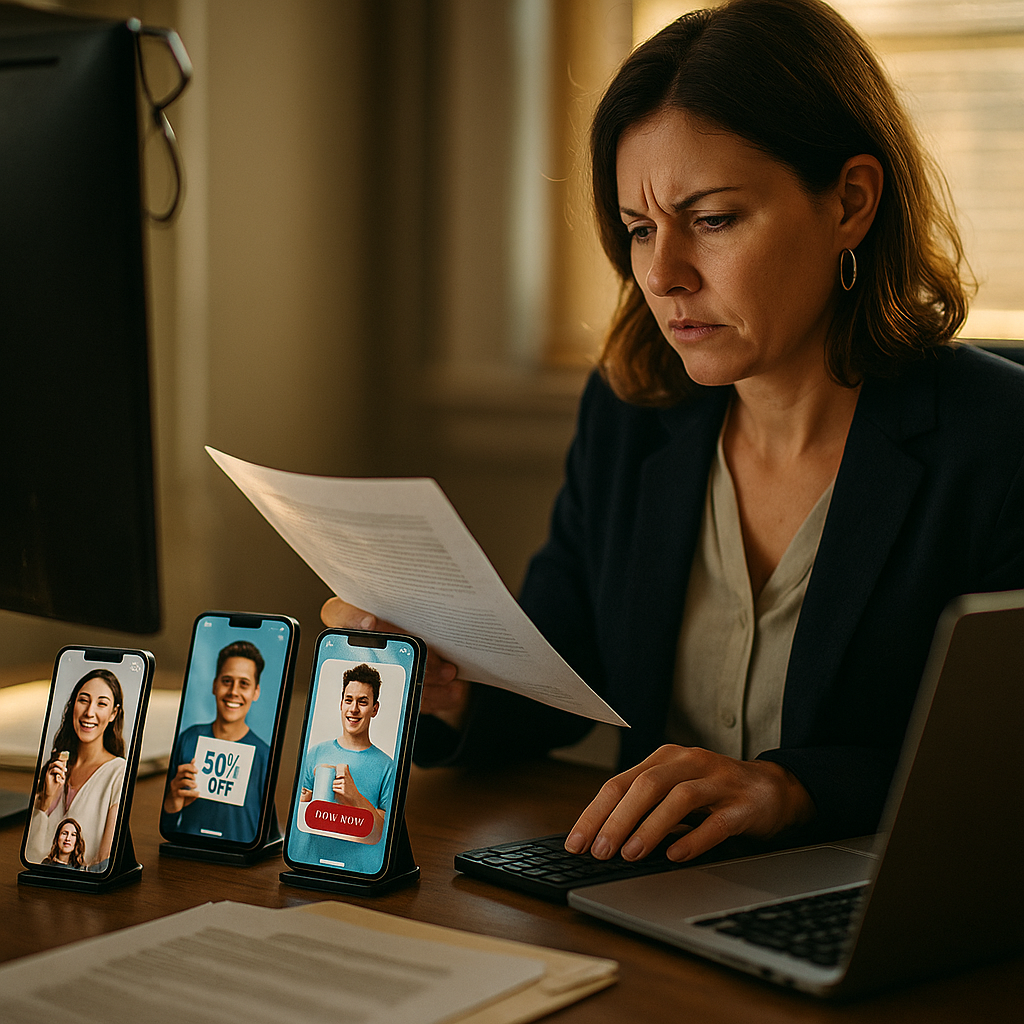
The FTC has settled testimonial cases worth millions since updating its Endorsement Guides, and your AI ad-generation tool doesn’t know or care. If you’re spinning up thousands of creator ad variations with automation, one missing typical-results disclaimer can trigger a violation the moment the ad goes live — not eventually, immediately. FTC testimonial rules haven’t caught up to generative ad tech, which means brands are the ones left holding the liability.
Why This Suddenly Matters More
Two years ago, a brand might run a dozen testimonial-based ads per quarter, each reviewed by legal before launch. Now marketing teams use AI to generate hundreds of ad variations from a single creator video — swapping hooks, captions, thumbnails, even voiceover phrasing — and push them live through automated ad platforms within hours. Meta’s Advantage+ creative and TikTok’s Smart Creative tools were built for speed, not compliance review.
That speed is the problem. The FTC’s Endorsement Guides require that when a testimonial highlights an atypical result (a creator saying “I lost 30 pounds in a month” or “I made $10K in my first week”), the ad must either disclose what results consumers can generally expect, or make unmistakably clear that the results shown aren’t typical. This isn’t a suggestion. It’s been enforceable text since the FTC’s revised guides took effect, and enforcement has only gotten sharper.
If an AI tool generates 200 variations of one testimonial ad and only 40 carry the required disclaimer, you don’t have 160 harmless drafts — you have 160 potential violations, each one a separate exposure point if the campaign runs.
What Counts as a “Typical Results” Claim, Exactly?
This is where most compliance teams get tripped up. The rule doesn’t apply to every testimonial — it applies specifically to testimonials that reference results, especially results that are impressive, quantified, or emotionally compelling enough that a viewer would reasonably expect similar outcomes for themselves.
- Triggers disclosure: “This serum cleared my skin in 10 days,” “I doubled my followers using this app,” “My energy levels tripled.”
- Generally doesn’t trigger disclosure: “I love how this feels,” “This is my new go-to product,” subjective opinion with no measurable outcome claimed.
- Gray zone (get legal involved): Before/after visuals without spoken claims, implied results through editing, comparison shots that suggest transformation.
Here’s the part AI tools miss entirely: context matters as much as the words. A creator saying “this changed my skin” over a dramatic before/after cut is a results claim, even without a number attached. Automated caption generators and script rewriters don’t understand visual subtext. They optimize for engagement language, not regulatory nuance.
The Automation Blind Spot
Ask any brand running AI-driven creative testing at scale, and they’ll tell you the appeal is obvious: faster iteration, better performance data, lower production cost per variant. The tools pull from a base creator asset, then generate dozens of permutations testing hook length, CTA phrasing, on-screen text, even AI-voiced dubs for different regions.
What none of these tools do natively is track which variations still carry a legally required disclaimer after edits. A human editor might drop the results claim’s caption disclaimer while trimming a video for a 15-second cut. An AI system doing the same trim at scale doesn’t know the disclaimer was load-bearing. It just sees text that doesn’t fit the new runtime and removes it.
This mirrors a pattern Influencers Time has covered before in the disclosure space — automation strips out compliance elements because it optimizes for format, not legal function. We saw the same failure mode with sponsorship tags in AI-generated creator scripts, where brands assumed script automation preserved FTC-required disclosures by default. It doesn’t, unless you build it to.
Where Liability Actually Lands
Brands routinely assume the creator or the ad platform absorbs testimonial risk. Neither is true. The FTC has been explicit: both the endorser and the brand can be held liable for misleading endorsements, and the brand’s liability doesn’t shrink because a machine generated the final ad copy. If anything, using AI to generate volume without a compliance layer looks worse under scrutiny — it signals the brand prioritized scale over review.
Agencies aren’t shielded either. If your agency’s automated workflow is producing the variations, your indemnification clauses need to explicitly address AI-generated compliance failures, not just standard creative disputes. Check your current creator contracts. Most were written before AI ad variation tools existed, and the language hasn’t caught up.
Building a Compliance Layer Into Automated Workflows
You don’t have to slow down variant testing to stay compliant. You need a system that flags disclosure requirements before variations go live, not after a complaint arrives. Here’s what that looks like operationally:
- Tag source assets at ingestion. When a creator video enters your ad automation pipeline, tag it immediately if it contains a results-based claim. That tag should travel with every derivative variation the AI generates.
- Lock disclaimer placement as a non-editable element. Most AI creative tools let you designate certain text or overlays as fixed. Use that feature for typical-results disclaimers so automated trims can’t silently remove them.
- Run a pre-launch compliance audit on variant batches. Before a batch of 50 or 200 variations goes to ad spend, sample-check a meaningful percentage for disclosure integrity — not just brand voice or CTA performance.
- Build a rejection rule into your ad platform integration. If a variation strips the required disclaimer during automated formatting (say, for a 6-second bumper cut), the system should flag it for human review instead of auto-publishing.
- Document your review process. If the FTC ever asks how you handle disclosure compliance at scale, “we have a documented audit trail” is a materially better answer than “the AI tool handles it.”
This isn’t dramatically different from how brands have had to rebuild processes around other automated compliance gaps. The governance charter approach for agentic AI campaigns applies the same logic: define what the AI can decide autonomously, and what always requires a human checkpoint. Disclosure integrity should sit firmly in the “always human-reviewed” column.
Platform Rules Add Another Layer
FTC compliance is the floor, not the ceiling. TikTok and Meta both have their own disclosure enforcement mechanisms layered on top of federal rules, and those platform-level systems increasingly use AI detection themselves to flag missing disclosures. TikTok has been especially aggressive here, tying monetization eligibility directly to disclosure compliance, a shift covered in depth in our piece on TikTok’s monetization-disclosure link.
The overlap between platform rules and FTC testimonial requirements isn’t always clean. A video might satisfy TikTok’s sponsorship disclosure toggle while still lacking the specific typical-results language the FTC requires. Brands running cross-platform variant campaigns need a compliance matrix, not a single checklist, because the same base asset might need different disclaimer treatment depending on destination platform. Our comparison of TikTok and Instagram disclosure rules breaks down exactly where those gaps tend to appear.
Passing a platform’s automated disclosure check doesn’t mean you’ve satisfied the FTC. Treat them as separate compliance layers, because regulators certainly do.
What About Synthetic and AI-Voiced Testimonials?
A newer wrinkle: brands using AI-generated voiceovers or synthetic avatars to re-record creator testimonials in different languages or tones for ad variation testing. If the underlying claim is a results claim, the disclosure requirement doesn’t disappear because the voice is synthetic. In fact, regulators are watching this space closely given rising concern about synthetic endorsers misrepresenting authentic experience. Our coverage of synthetic performer disclosure rules is worth a read if your variant pipeline includes any AI dubbing or avatar-based reformatting.
According to FTC guidance, the standard for disclosure is whether a reasonable consumer would be misled about typical outcomes, regardless of how the endorsement is delivered. Voice, format, and platform are irrelevant to that test. The claim is what matters.
Practical Checklist Before You Scale Any Testimonial Campaign
- Does the source testimonial contain any quantified or implied result?
- Is the typical-results disclaimer locked as a non-editable overlay in your AI creative tool?
- Has a sample of AI-generated variations been human-reviewed for disclaimer presence before launch?
- Do your creator and agency contracts address liability for AI-generated variant compliance?
- Are you tracking disclosure compliance separately per platform, not just once at the campaign level?
- Is there a documented audit trail your legal team can produce if asked?
Marketing teams often treat FTC compliance as a launch-gate checkbox: verify once, move on. That model breaks completely once AI is generating dozens of variants per week from a rotating set of creator assets. Compliance now needs to be continuous, embedded in the pipeline, not a one-time review step. Brands that treat it as infrastructure, similar to how they’ve had to rebuild processes around data minimization for AI-driven content systems, are the ones avoiding costly rework later.
Industry data on creator marketing spend keeps climbing — eMarketer estimates continued double-digit growth in influencer ad budgets — and AI-driven creative testing is a major driver of that efficiency. But efficiency without a compliance layer is just risk moving faster.
The Bottom Line
Don’t wait for an FTC letter to find out your automation stripped a disclaimer. Audit your current AI ad-variation pipeline this quarter, lock disclosure language as a protected element, and get your legal team reviewing a sample of variants before every major campaign push — not after it’s already spending budget.
FAQs
Do AI-generated ad variations need their own individual FTC review?
Not every single variation needs manual legal sign-off, but every variation containing a results-based testimonial claim needs to retain the required disclaimer. A sample-based audit process combined with locked, non-editable disclaimer elements is the practical way to manage this at scale.
Who is liable if an AI tool removes a required disclaimer during automated editing?
The brand remains liable, along with the creator in most cases. The FTC doesn’t treat automation as a shield from responsibility. Brands should also review agency and platform contracts to ensure liability for AI-generated compliance failures is explicitly addressed.
What qualifies as a “typical results” claim under FTC testimonial rules?
Any testimonial referencing a specific, measurable, or impressive outcome — like weight loss, income, or product performance — that a reasonable consumer might expect to replicate. Vague opinion statements without a claimed result generally don’t trigger the disclosure requirement.
Does satisfying TikTok or Meta’s disclosure tools mean I’m FTC compliant?
No. Platform disclosure tools (like sponsorship toggles) address platform policy, not necessarily FTC typical-results requirements. These are separate compliance layers that need separate verification.
Do AI-voiced or synthetic testimonials still require typical-results disclaimers?
Yes. The disclosure requirement is tied to the claim being made, not the format or voice delivering it. Synthetic dubs, avatars, or AI-generated voiceovers carrying a results claim still require the same disclosure treatment as the original creator content.
FAQs
Do AI-generated ad variations need their own individual FTC review?
Not every single variation needs manual legal sign-off, but every variation containing a results-based testimonial claim needs to retain the required disclaimer. A sample-based audit process combined with locked, non-editable disclaimer elements is the practical way to manage this at scale.
Who is liable if an AI tool removes a required disclaimer during automated editing?
The brand remains liable, along with the creator in most cases. The FTC doesn’t treat automation as a shield from responsibility. Brands should also review agency and platform contracts to ensure liability for AI-generated compliance failures is explicitly addressed.
What qualifies as a “typical results” claim under FTC testimonial rules?
Any testimonial referencing a specific, measurable, or impressive outcome — like weight loss, income, or product performance — that a reasonable consumer might expect to replicate. Vague opinion statements without a claimed result generally don’t trigger the disclosure requirement.
Does satisfying TikTok or Meta’s disclosure tools mean I’m FTC compliant?
No. Platform disclosure tools (like sponsorship toggles) address platform policy, not necessarily FTC typical-results requirements. These are separate compliance layers that need separate verification.
Do AI-voiced or synthetic testimonials still require typical-results disclaimers?
Yes. The disclosure requirement is tied to the claim being made, not the format or voice delivering it. Synthetic dubs, avatars, or AI-generated voiceovers carrying a results claim still require the same disclosure treatment as the original creator content.
Top Influencer Marketing Agencies
The leading agencies shaping influencer marketing in 2026
Agencies ranked by campaign performance, client diversity, platform expertise, proven ROI, industry recognition, and client satisfaction. Assessed through verified case studies, reviews, and industry consultations.
Moburst

-
2

The Shelf
Boutique Beauty & Lifestyle Influencer AgencyA data-driven boutique agency specializing exclusively in beauty, wellness, and lifestyle influencer campaigns on Instagram and TikTok. Best for brands already focused on the beauty/personal care space that need curated, aesthetic-driven content.Clients: Pepsi, The Honest Company, Hims, Elf Cosmetics, Pure LeafVisit The Shelf → -
3

Audiencly
Niche Gaming & Esports Influencer AgencyA specialized agency focused exclusively on gaming and esports creators on YouTube, Twitch, and TikTok. Ideal if your campaign is 100% gaming-focused — from game launches to hardware and esports events.Clients: Epic Games, NordVPN, Ubisoft, Wargaming, Tencent GamesVisit Audiencly → -
4

Viral Nation
Global Influencer Marketing & Talent AgencyA dual talent management and marketing agency with proprietary brand safety tools and a global creator network spanning nano-influencers to celebrities across all major platforms.Clients: Meta, Activision Blizzard, Energizer, Aston Martin, WalmartVisit Viral Nation → -
5

The Influencer Marketing Factory
TikTok, Instagram & YouTube CampaignsA full-service agency with strong TikTok expertise, offering end-to-end campaign management from influencer discovery through performance reporting with a focus on platform-native content.Clients: Google, Snapchat, Universal Music, Bumble, YelpVisit TIMF → -
6

NeoReach
Enterprise Analytics & Influencer CampaignsAn enterprise-focused agency combining managed campaigns with a powerful self-service data platform for influencer search, audience analytics, and attribution modeling.Clients: Amazon, Airbnb, Netflix, Honda, The New York TimesVisit NeoReach → -
7

Ubiquitous
Creator-First Marketing PlatformA tech-driven platform combining self-service tools with managed campaign options, emphasizing speed and scalability for brands managing multiple influencer relationships.Clients: Lyft, Disney, Target, American Eagle, NetflixVisit Ubiquitous → -
8

Obviously
Scalable Enterprise Influencer CampaignsA tech-enabled agency built for high-volume campaigns, coordinating hundreds of creators simultaneously with end-to-end logistics, content rights management, and product seeding.Clients: Google, Ulta Beauty, Converse, AmazonVisit Obviously →