


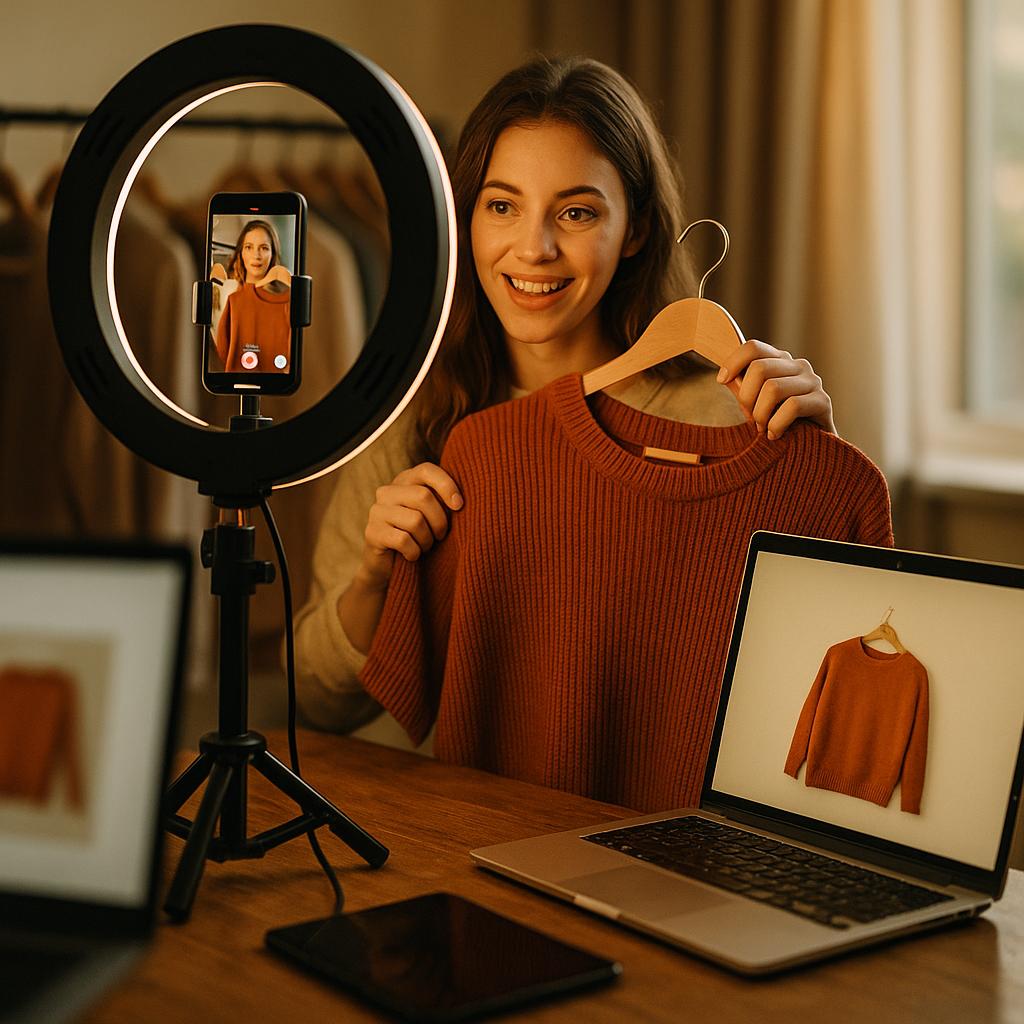
Static product ads convert at roughly 2-3%. Livestream shopping sessions on platforms like TikTok Shop and Whatnot are hitting 30% conversion rates on featured drops. If your media plan hasn’t moved money toward livestream shopping yet, you’re funding a channel that’s ten times less efficient than the alternative sitting right in front of you.
That gap isn’t a rounding error. It’s a signal that the entire logic of static e-commerce advertising — build the perfect image, run it against a cold audience, hope for a click — is losing to a format that compresses discovery, trust-building, and checkout into a single 45-minute window.
The Math That Should Scare Your Media Planner
Let’s be blunt about what a 2-3% conversion rate actually means. You’re paying to reach 100 people, and 97 or 98 of them do nothing. Static display and social commerce ads have hovered in that range for years, and eMarketer’s benchmarks on paid social conversion haven’t budged much despite billions in platform investment on creative optimization and AI-driven targeting.
Livestream shopping flips that ratio. Sessions hosted by trained live sellers on TikTok Shop, and increasingly on Whatnot and Amazon Live, are converting viewers into buyers at rates north of 20%, with top-performing drops crossing 30%. That’s not influencer hype. It’s a structural difference in how the format works.
A static ad asks a stranger to trust a headline. A livestream asks them to trust a person they’ve watched answer questions in real time — for twenty minutes, not two seconds.
Static ads sell a single frozen moment. Livestreams sell a relationship, compressed. The host demos the product, answers objections live, shows it on different body types or in different lighting, and creates urgency through visible stock counters and time-limited bundles. Every one of those elements attacks a different reason people abandon a static ad funnel.
Why Static Ads Are Losing Efficiency, Not Just Losing Attention
It’s tempting to write this off as “video beats image,” but that undersells what’s happening. The real issue is that static ads front-load all their persuasion into the creative itself, and creative fatigue is brutal. A high-performing static ad might hold its CTR for two to three weeks before performance decays. Teams that have built weekly creative testing calendars know this cycle intimately — it’s an arms race against your own audience’s boredom.
Livestream doesn’t have the same decay curve. Each session is live, slightly different, and responsive to the chat. The host can pivot mid-stream if a product angle isn’t landing. Try doing that with a static carousel ad mid-flight. You can’t. You wait for reporting, pull the creative, brief a new one, and wait again for approval — a cycle that weekly video ad pipelines were built to shorten, but still can’t match real-time adaptation.
There’s also an inventory-signaling effect static ads simply can’t replicate. When a livestream host says “only 40 left in this bundle,” and viewers watch the counter tick down live, that’s a scarcity mechanic operating in real time on an audience that’s already emotionally warmed up. Static ads can claim scarcity in copy. Livestream proves it.
What This Means for Budget Allocation, Concretely
Reshaping budget away from static ads doesn’t mean abandoning them. It means re-ranking where dollars go first. A useful framework:
- Reserve static/display for top-of-funnel awareness, where reach and frequency still matter more than immediate conversion.
- Shift mid-to-bottom funnel dollars toward livestream shopping, where the format’s conversion advantage is largest.
- Fund livestream production and host training the way you’d fund a creative studio — this is not a “set it and forget it” influencer gifting arrangement.
- Repurpose livestream clips as static-style ad creative, closing the loop instead of running two disconnected content pipelines.
That last point matters more than most brands realize. The best-performing livestream moments — the objection handled well, the unboxing reaction, the price-drop reveal — make excellent short-form ad creative. Brands that have built hero content strategies turning one asset into fifteen-plus formats are already positioned to do this. Livestream shopping just gives them a much richer well to pull from than a single studio shoot.
If you’re trying to get finance to sign off on this reallocation, don’t lead with vibes. Lead with the same rigor you’d use to win CFO approval using CTR data — except now your baseline comparison is conversion rate, and the delta is far more dramatic than any CTR lift you’ve pitched before.
The Host Is the New Creative Asset
Here’s the part legacy media planners struggle with: in livestream shopping, the creative budget line and the talent budget line are the same line. You’re not paying for a 30-second video asset that runs for months. You’re paying for a person’s ability to sell live, repeatedly, adapting to a chat window in real time.
That changes how you should think about creator compensation. A flat fee for a single livestream session undervalues a host who can reliably pull 25%+ conversion. Structuring flat fees versus commission splits becomes far more important in livestream than in static content deals, because the commission upside is directly tied to a metric you can watch tick up in real time on screen.
Brands running multiple product verticals should also look at incentive tiers that scale across categories, since a host who converts at 30% on beauty products may perform very differently on electronics or home goods. Treating all livestream talent with one flat rate card ignores category-specific performance data you’re already collecting every session.
Risk and Compliance Don’t Disappear Just Because Conversion Is High
A 30% conversion rate is seductive enough to make teams sloppy. Don’t let it. Livestream shopping still carries the same disclosure obligations as any other sponsored content under FTC endorsement guidelines, and live formats make compliance harder to police because there’s no pre-approval step before something goes out live to thousands of viewers.
Brands scaling livestream programs internationally should be doing this inside a real governance structure, not an ad hoc one. A 90-day governance audit before expanding into new verticals or markets catches disclosure gaps, pricing claim risks, and platform policy violations before they become a PR problem instead of a line-item fix.
This is especially true if you’re running livestream programs across regions with different advertising and consumer protection laws. What passes review in one market — a price comparison claim, a health-adjacent beauty claim — may violate rules elsewhere. Teams managing overseas KOL operations at scale already know that live formats multiply this risk because there’s no edit button once a claim is spoken on air.
How Fast Should You Actually Move Budget?
Don’t blow up your static ad budget overnight. Run a controlled reallocation:
- Pull 10-15% of static/display budget for a 60-day livestream pilot on your highest-margin SKUs.
- Track conversion rate, average order value, and return rate against your static benchmark — return rate matters because live-sold impulse buys can behave differently than considered purchases.
- If conversion holds above 15-20%, scale the reallocation to 30-40% of the previously static-allocated budget.
- Reinvest a portion of the efficiency gain into host training and production quality, not just more sessions.
Platforms make this easier to test than it used to be. TikTok Shop’s livestream tools and Amazon Live’s integration with existing catalog listings mean you don’t need a standalone tech stack to run the pilot. Check TikTok’s advertising resources for current livestream shopping ad formats before committing budget, since features and eligibility change quickly.
One more thing worth tracking: engagement platforms like Sprout Social and native platform analytics can help you correlate chat engagement volume with conversion spikes mid-stream. That data is gold for briefing future hosts on what actually moves buyers versus what just generates comments.
What to Do Monday Morning
Pull your last quarter’s static e-commerce ad conversion data, put it next to any livestream pilot numbers you already have (or run a two-week test if you don’t), and bring both to your next budget review. Let the 10x conversion gap make the argument for you — it’s stronger than any pitch deck.
FAQs
What conversion rate should brands expect from livestream shopping?
Top-performing livestream shopping sessions on platforms like TikTok Shop are converting at 20-30%, compared to roughly 2-3% for static e-commerce ads. Actual results vary by category, host quality, and audience warmth, so brands should benchmark their own pilot data rather than assume industry averages will apply directly.
Does livestream shopping replace static ads entirely?
No. Static ads still play a role in top-of-funnel awareness and retargeting. The shift should move mid-to-bottom funnel conversion budget toward livestream, while keeping static creative for reach and brand recall.
How should brands compensate livestream hosts differently than static content creators?
Because livestream performance is measurable in real time, commission-based or hybrid flat-fee-plus-commission structures tend to align incentives better than flat fees alone, especially for hosts driving high-conversion categories.
What compliance risks are unique to livestream shopping?
Live formats lack a pre-approval step, so disclosure lapses or unsubstantiated claims can go out to viewers before anyone can catch them. Brands need real-time monitoring and clear host briefings on FTC disclosure requirements and category-specific claim restrictions.
How long should a livestream shopping budget pilot run before scaling?
A 60-day pilot on a subset of high-margin SKUs, tracking conversion rate, average order value, and return rate against static ad benchmarks, gives enough data to decide whether to scale the reallocation.
Frequently Asked Questions
What conversion rate should brands expect from livestream shopping?
Top-performing livestream shopping sessions on platforms like TikTok Shop are converting at 20-30%, compared to roughly 2-3% for static e-commerce ads. Actual results vary by category, host quality, and audience warmth, so brands should benchmark their own pilot data rather than assume industry averages will apply directly.
Does livestream shopping replace static ads entirely?
No. Static ads still play a role in top-of-funnel awareness and retargeting. The shift should move mid-to-bottom funnel conversion budget toward livestream, while keeping static creative for reach and brand recall.
How should brands compensate livestream hosts differently than static content creators?
Because livestream performance is measurable in real time, commission-based or hybrid flat-fee-plus-commission structures tend to align incentives better than flat fees alone, especially for hosts driving high-conversion categories.
What compliance risks are unique to livestream shopping?
Live formats lack a pre-approval step, so disclosure lapses or unsubstantiated claims can go out to viewers before anyone can catch them. Brands need real-time monitoring and clear host briefings on FTC disclosure requirements and category-specific claim restrictions.
How long should a livestream shopping budget pilot run before scaling?
A 60-day pilot on a subset of high-margin SKUs, tracking conversion rate, average order value, and return rate against static ad benchmarks, gives enough data to decide whether to scale the reallocation.
Top Influencer Marketing Agencies
The leading agencies shaping influencer marketing in 2026
Agencies ranked by campaign performance, client diversity, platform expertise, proven ROI, industry recognition, and client satisfaction. Assessed through verified case studies, reviews, and industry consultations.
Moburst

-
2

The Shelf
Boutique Beauty & Lifestyle Influencer AgencyA data-driven boutique agency specializing exclusively in beauty, wellness, and lifestyle influencer campaigns on Instagram and TikTok. Best for brands already focused on the beauty/personal care space that need curated, aesthetic-driven content.Clients: Pepsi, The Honest Company, Hims, Elf Cosmetics, Pure LeafVisit The Shelf → -
3

Audiencly
Niche Gaming & Esports Influencer AgencyA specialized agency focused exclusively on gaming and esports creators on YouTube, Twitch, and TikTok. Ideal if your campaign is 100% gaming-focused — from game launches to hardware and esports events.Clients: Epic Games, NordVPN, Ubisoft, Wargaming, Tencent GamesVisit Audiencly → -
4

Viral Nation
Global Influencer Marketing & Talent AgencyA dual talent management and marketing agency with proprietary brand safety tools and a global creator network spanning nano-influencers to celebrities across all major platforms.Clients: Meta, Activision Blizzard, Energizer, Aston Martin, WalmartVisit Viral Nation → -
5

The Influencer Marketing Factory
TikTok, Instagram & YouTube CampaignsA full-service agency with strong TikTok expertise, offering end-to-end campaign management from influencer discovery through performance reporting with a focus on platform-native content.Clients: Google, Snapchat, Universal Music, Bumble, YelpVisit TIMF → -
6

NeoReach
Enterprise Analytics & Influencer CampaignsAn enterprise-focused agency combining managed campaigns with a powerful self-service data platform for influencer search, audience analytics, and attribution modeling.Clients: Amazon, Airbnb, Netflix, Honda, The New York TimesVisit NeoReach → -
7

Ubiquitous
Creator-First Marketing PlatformA tech-driven platform combining self-service tools with managed campaign options, emphasizing speed and scalability for brands managing multiple influencer relationships.Clients: Lyft, Disney, Target, American Eagle, NetflixVisit Ubiquitous → -
8

Obviously
Scalable Enterprise Influencer CampaignsA tech-enabled agency built for high-volume campaigns, coordinating hundreds of creators simultaneously with end-to-end logistics, content rights management, and product seeding.Clients: Google, Ulta Beauty, Converse, AmazonVisit Obviously →