


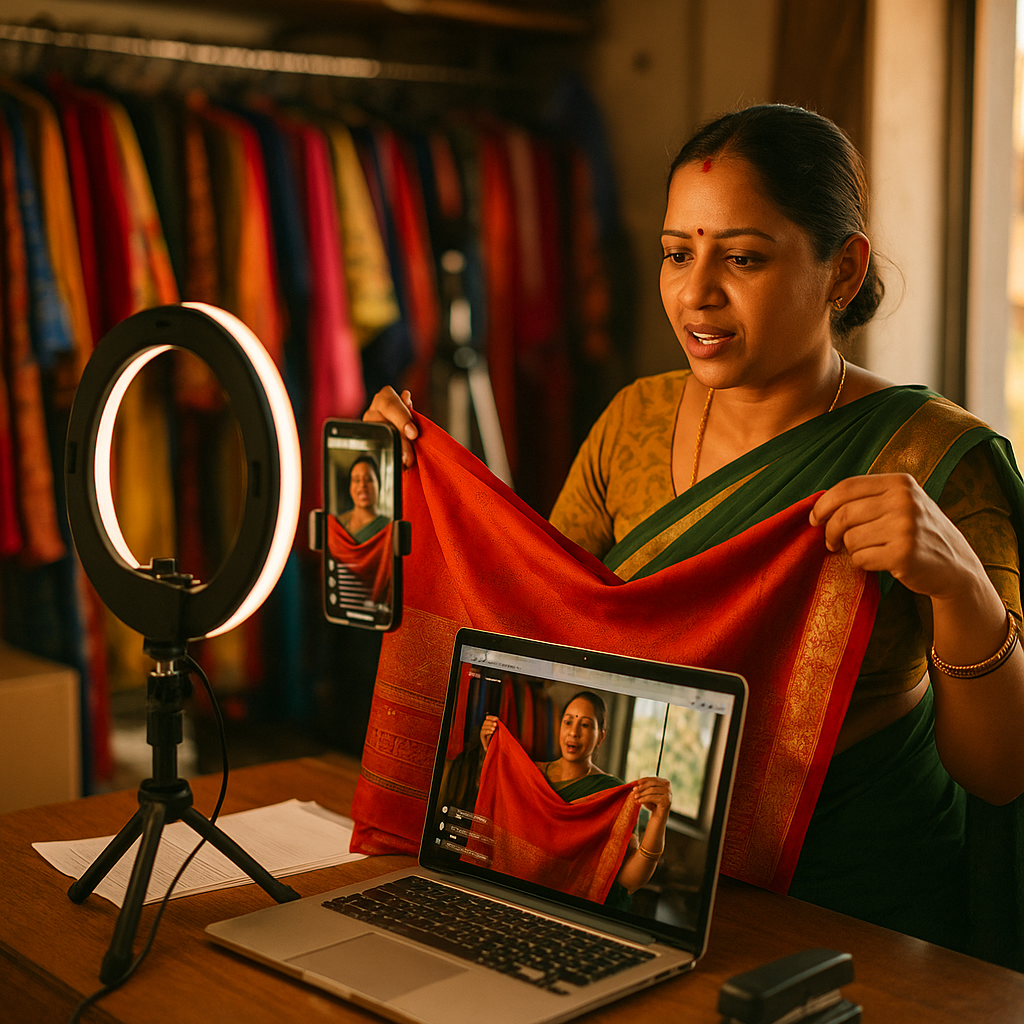
India’s live commerce market is projected to hit $20 billion by 2030, but here’s the uncomfortable truth: most brands running livestream shopping in India are one Consumer Protection Authority complaint away from a shutdown notice. India social commerce compliance isn’t optional anymore, and platform rules alone won’t save you.
The gap between what TikTok Shop-style platforms enforce and what Indian law actually requires is wider than most marketing teams realize. Bridging it takes more than a checklist — it takes a structural understanding of two regulatory systems that were never designed to talk to each other.
Why India Is a Different Animal
Let’s get one thing straight: India banned TikTok in 2020. So “TikTok Shop-style” here means the clones and adaptations — Meesho’s livestream features, Flipkart’s video commerce push, Amazon’s Inspire livestreams, and homegrown apps like Bulbul and Simsim (now folded into Meesho). Each has built its own version of the buy-now-during-the-stream mechanic. None of them were built with India’s Consumer Protection (E-Commerce) Rules in mind first.
That matters because India’s e-commerce rulebook is unusually prescriptive compared to the US or UK. The Consumer Protection Act, 2019, and its e-commerce rules impose obligations that platform terms of service simply don’t cover: mandatory grievance officers, country-of-origin labeling, a ban on “flash sales” that manipulate pricing, and strict liability for “fall-back liability” when marketplaces fail to verify sellers.
A livestream selling flow optimized for conversion — countdown timers, “only 3 left” banners, one-tap checkout — is precisely the kind of dark-pattern architecture Indian regulators have flagged as a compliance target, not a growth hack.
The Consumer Protection Act’s Livestream Blind Spots
India’s Central Consumer Protection Authority (CCPA) issued guidelines specifically targeting dark patterns in late 2023, and enforcement has only tightened since. Thirteen dark patterns are named explicitly, including false urgency, basket sneaking, and confirm-shaming. Livestream commerce is basically a delivery mechanism for several of these at once.
Consider the standard livestream format: a host counts down inventory in real time, flashes a discount timer, and pushes viewers toward instant checkout before they’ve had time to read a return policy. That’s not a hypothetical — it’s the default template most brands import wholesale from Southeast Asian or US playbooks. If you’re already auditing scarcity messaging for FTC purposes, the same review needs to happen for CCPA rules — the mechanics are similar but the enforcement body and penalty structure are different. Our livestream countdown timer audit framework is a useful starting point, but it needs India-specific thresholds layered on top, since CCPA fines can reach ₹50 lakh per contravention with repeat-offense escalation.
Grievance redressal is the other landmine. Indian rules require a named grievance officer with published contact details and a defined resolution timeline — 48 hours for acknowledgment, one month for resolution. Most livestream platforms route complaints through a generic in-app ticket system that doesn’t meet this bar. If your brand is selling through a marketplace’s livestream feature, you need contractual confirmation that the marketplace’s grievance mechanism actually satisfies Rule 4 of the E-Commerce Rules — not just an assumption that it does.
Country-of-Origin and Import Disclosure Are Non-Negotiable
This one trips up global brands constantly. Every product listing — and by extension, every livestream product card — must disclose country of origin, and platforms are required to allow filtering by it. For brands manufacturing overseas and livestream-selling into India through a marketplace, that disclosure has to appear on-screen during the stream, not buried three taps deep in a product page nobody visits mid-checkout.
Skip this and you’re not just risking a CCPA fine. You’re risking a Bureau of Indian Standards referral if the product category (electronics, toys, packaged goods) falls under mandatory labeling rules. Cross-border creator campaigns already carry disclosure complexity; our cross-border creator disclosure matrix is a good reference model for building an India-specific overlay.
Platform Rules Aren’t a Compliance Substitute
Here’s where a lot of brand teams get complacent. They assume that because Meesho or Flipkart has “compliance guidelines” baked into their seller dashboards, the legal risk is handled. It isn’t. Platform policy is a private contract; the Consumer Protection Act is public law enforced by a statutory authority with investigative and penalty powers. A platform can suspend your seller account for a policy violation. The CCPA can fine you, order corrective advertising, and — in serious cases — refer matters for criminal prosecution under the Act’s misleading advertisement provisions.
Brands that treat platform onboarding checklists as their full compliance program are making the same mistake we’ve seen play out in the US with shipping subsidy disclosures. Our shipping subsidy fraud framework covers a parallel situation: platform incentive structures that look compliant on the surface but create liability the moment a regulator looks past the marketing copy.
Platform terms of service are the floor, not the ceiling. Indian consumer law sits above them, and it doesn’t care whose livestream infrastructure you used.
The practical fix is a dual-track compliance matrix: one column for platform-specific seller policies, one column for CCPA/Consumer Protection Act obligations, mapped against every stage of the livestream funnel — pre-stream promotion, in-stream claims, checkout flow, post-purchase grievance handling. If a requirement only appears in one column, that’s your exposure gap.
Influencer Hosts Carry Their Own Liability Layer
India’s Ministry of Consumer Affairs has separately issued endorsement guidelines requiring influencers to disclose material connections — “#ad,” “#sponsored,” or equivalent — in a way that’s “difficult to miss.” For livestream hosts, that means verbal disclosure at stream start isn’t enough if it isn’t reinforced visually and repeatedly throughout a session that might run 60-90 minutes with viewers dropping in mid-stream.
This mirrors a problem we’ve flagged before with fast-moving formats: disclosure placement breaks down when the content format itself is optimized against attention retention. Just as watch-time algorithm changes have broken FTC disclosure placement on YouTube, India’s livestream formats create the same structural tension — hosts want continuous, low-friction selling; regulators want persistent, unmissable disclosure. Brands need contract language that puts the burden of solving this tension on the host and the platform, not just on hope.
Livestream host contracts should also account for what happens when a host makes an unscripted product claim during a live session — a health benefit, a performance guarantee, a comparison to a competitor. Once it’s live, it’s published, and Indian misleading-advertisement rules apply retroactively regardless of intent. Brief documents need explicit script boundaries. We’ve covered this exact liability structure in livestream host hiring risk and in when brand talking points become script liability — the same contractual logic applies here, with CCPA substituted for FTC as the enforcement body.
Data, Payments, and the Compliance Stack Nobody Budgets For
Livestream commerce generates a torrent of behavioral data — watch duration, click-through moments, cart abandonment triggers, chat sentiment. India’s Digital Personal Data Protection Act, 2023 (DPDPA) is now the governing framework for how that data gets collected, processed, and retained, and its consent requirements are stricter than what most global brands have built for US operations.
If your livestream platform integration pulls viewer data into a CRM or retargeting pipeline, you need a data processing addendum that reflects DPDPA consent granularity — not a boilerplate GDPR-style DPA repurposed for a different jurisdiction. Our guide on DPAs for platform APIs is a useful structural template, but India requires its own consent-manager framework under DPDPA rules that finished rollout this year.
Payment flows are the other underbuilt piece. In-stream checkout that routes through UPI, embedded wallets, or buy-now-pay-later options triggers RBI payment aggregator rules on top of consumer protection obligations. If a brand’s livestream integration allows peer-style tipping or gifting features layered onto commerce — increasingly common on hybrid social-commerce apps — that’s an entirely separate compliance surface. We’ve mapped the equivalent US exposure in our peer-to-peer payment compliance checklist, and the underlying principle — know exactly which entity is the regulated payment intermediary — holds true in India too, just under RBI rather than state money-transmitter law.
Brands also need breach-notification readiness. DPDPA imposes notification obligations to India’s Data Protection Board that don’t map cleanly onto the multi-state US framework brands are more used to navigating. If you already have a breach notification timeline for other markets, India needs its own lane in that same playbook, not a footnote.
Building the Actual Compliance Framework
Practically, here’s what a defensible India livestream commerce program needs:
- A named, published grievance officer meeting Rule 4 response timelines, independent of the platform’s own support system.
- Dark-pattern audit of every livestream UI element — countdown timers, stock counters, one-click upsells — checked against the CCPA’s thirteen named patterns.
- Country-of-origin and BIS labeling verification built into the pre-stream product QA, not left to the platform’s catalog defaults.
- Host contracts with explicit disclosure placement requirements and script boundaries around claims, refreshed for every campaign, not templated once and reused.
- DPDPA-compliant consent capture for any viewer data flowing into retargeting or CRM systems, with a documented lawful basis for each use.
- RBI-aligned payment intermediary mapping for any in-stream checkout, tipping, or wallet feature.
None of this is exotic. It’s the same discipline brands already apply to US FTC exposure and EU GDPR exposure. The difference is that India’s enforcement infrastructure — the CCPA, the Data Protection Board, RBI — is newer, less predictable in its early rulings, and more willing to make an example of a recognizable brand name. According to eMarketer, India’s retail e-commerce growth continues to outpace most G20 markets, which means regulatory attention is only going to intensify as the category matures. Data from Statista similarly shows India’s social commerce segment scaling faster than mature markets like the US and UK — exactly the kind of rapid growth that draws regulatory scrutiny before industry norms have settled.
If you want a broader operational reference for reconciling platform-specific rules with statutory law, our TikTok Shop legal checklist is built around the same reconciliation logic, even though it’s written for a different regulator. The method transfers even when the law doesn’t.
Next step: audit one live campaign end-to-end against the six-point framework above before your next livestream event goes live, not after a complaint lands on the grievance officer’s desk you may not yet have appointed.
Frequently Asked Questions
What is the main law governing livestream commerce in India?
The Consumer Protection Act, 2019, along with its Consumer Protection (E-Commerce) Rules and the CCPA’s dark pattern guidelines, forms the core framework. The Digital Personal Data Protection Act, 2023 governs data collected through livestream interactions.
Are countdown timers and “limited stock” banners illegal in Indian livestream commerce?
Not automatically, but they’re heavily scrutinized. If the urgency claim is false or manipulated to pressure purchases, it falls under the CCPA’s named dark patterns and can trigger fines and corrective-advertising orders.
Do global platforms like Amazon or Meesho handle India compliance automatically?
No. Platform terms of service are a private contract layer, not a substitute for statutory compliance. Brands remain independently liable under the Consumer Protection Act regardless of what a platform’s seller dashboard claims to cover.
What disclosure rules apply to influencer livestream hosts in India?
The Ministry of Consumer Affairs requires clear, prominent, and repeated disclosure of any material connection between the influencer and the brand, in a way that’s “difficult to miss” — a single verbal mention at stream start is generally not sufficient.
How does India’s data law affect livestream shopping data?
The DPDPA requires granular, purpose-specific consent for collecting viewer behavioral data during livestreams, along with defined retention limits and breach-notification obligations to India’s Data Protection Board.
What penalties can brands face for livestream commerce violations in India?
Penalties under the Consumer Protection Act can reach ₹50 lakh per contravention, with repeat violations facing escalated fines and potential referral for misleading-advertisement prosecution.
Frequently Asked Questions
What is the main law governing livestream commerce in India?
The Consumer Protection Act, 2019, along with its Consumer Protection (E-Commerce) Rules and the CCPA’s dark pattern guidelines, forms the core framework. The Digital Personal Data Protection Act, 2023 governs data collected through livestream interactions.
Are countdown timers and “limited stock” banners illegal in Indian livestream commerce?
Not automatically, but they’re heavily scrutinized. If the urgency claim is false or manipulated to pressure purchases, it falls under the CCPA’s named dark patterns and can trigger fines and corrective-advertising orders.
Do global platforms like Amazon or Meesho handle India compliance automatically?
No. Platform terms of service are a private contract layer, not a substitute for statutory compliance. Brands remain independently liable under the Consumer Protection Act regardless of what a platform’s seller dashboard claims to cover.
What disclosure rules apply to influencer livestream hosts in India?
The Ministry of Consumer Affairs requires clear, prominent, and repeated disclosure of any material connection between the influencer and the brand, in a way that’s “difficult to miss” — a single verbal mention at stream start is generally not sufficient.
How does India’s data law affect livestream shopping data?
The DPDPA requires granular, purpose-specific consent for collecting viewer behavioral data during livestreams, along with defined retention limits and breach-notification obligations to India’s Data Protection Board.
What penalties can brands face for livestream commerce violations in India?
Penalties under the Consumer Protection Act can reach ₹50 lakh per contravention, with repeat violations facing escalated fines and potential referral for misleading-advertisement prosecution.
Top Influencer Marketing Agencies
The leading agencies shaping influencer marketing in 2026
Agencies ranked by campaign performance, client diversity, platform expertise, proven ROI, industry recognition, and client satisfaction. Assessed through verified case studies, reviews, and industry consultations.
Moburst

-
2

The Shelf
Boutique Beauty & Lifestyle Influencer AgencyA data-driven boutique agency specializing exclusively in beauty, wellness, and lifestyle influencer campaigns on Instagram and TikTok. Best for brands already focused on the beauty/personal care space that need curated, aesthetic-driven content.Clients: Pepsi, The Honest Company, Hims, Elf Cosmetics, Pure LeafVisit The Shelf → -
3

Audiencly
Niche Gaming & Esports Influencer AgencyA specialized agency focused exclusively on gaming and esports creators on YouTube, Twitch, and TikTok. Ideal if your campaign is 100% gaming-focused — from game launches to hardware and esports events.Clients: Epic Games, NordVPN, Ubisoft, Wargaming, Tencent GamesVisit Audiencly → -
4

Viral Nation
Global Influencer Marketing & Talent AgencyA dual talent management and marketing agency with proprietary brand safety tools and a global creator network spanning nano-influencers to celebrities across all major platforms.Clients: Meta, Activision Blizzard, Energizer, Aston Martin, WalmartVisit Viral Nation → -
5

The Influencer Marketing Factory
TikTok, Instagram & YouTube CampaignsA full-service agency with strong TikTok expertise, offering end-to-end campaign management from influencer discovery through performance reporting with a focus on platform-native content.Clients: Google, Snapchat, Universal Music, Bumble, YelpVisit TIMF → -
6

NeoReach
Enterprise Analytics & Influencer CampaignsAn enterprise-focused agency combining managed campaigns with a powerful self-service data platform for influencer search, audience analytics, and attribution modeling.Clients: Amazon, Airbnb, Netflix, Honda, The New York TimesVisit NeoReach → -
7

Ubiquitous
Creator-First Marketing PlatformA tech-driven platform combining self-service tools with managed campaign options, emphasizing speed and scalability for brands managing multiple influencer relationships.Clients: Lyft, Disney, Target, American Eagle, NetflixVisit Ubiquitous → -
8

Obviously
Scalable Enterprise Influencer CampaignsA tech-enabled agency built for high-volume campaigns, coordinating hundreds of creators simultaneously with end-to-end logistics, content rights management, and product seeding.Clients: Google, Ulta Beauty, Converse, AmazonVisit Obviously →